A construction contractor with a 0.85
The EMR isn't a fixed number. Contractors who manage it actively pay less than those who treat insurance as a passive cost. Safety…

A construction contractor with a 0.85 EMR pays 15% less for workers compensation than one with a 1.0 EMR - and 29% less than one with a 1.20 EMR. On a $120,000 annual workers comp premium, that gap between 0.85 and 1.20 is $41,400 per year. Over five years, the difference in premium cost exceeds $200,000 - enough to fund a full-time safety manager, replace every piece of worn PPE in the company, and still have money left over.
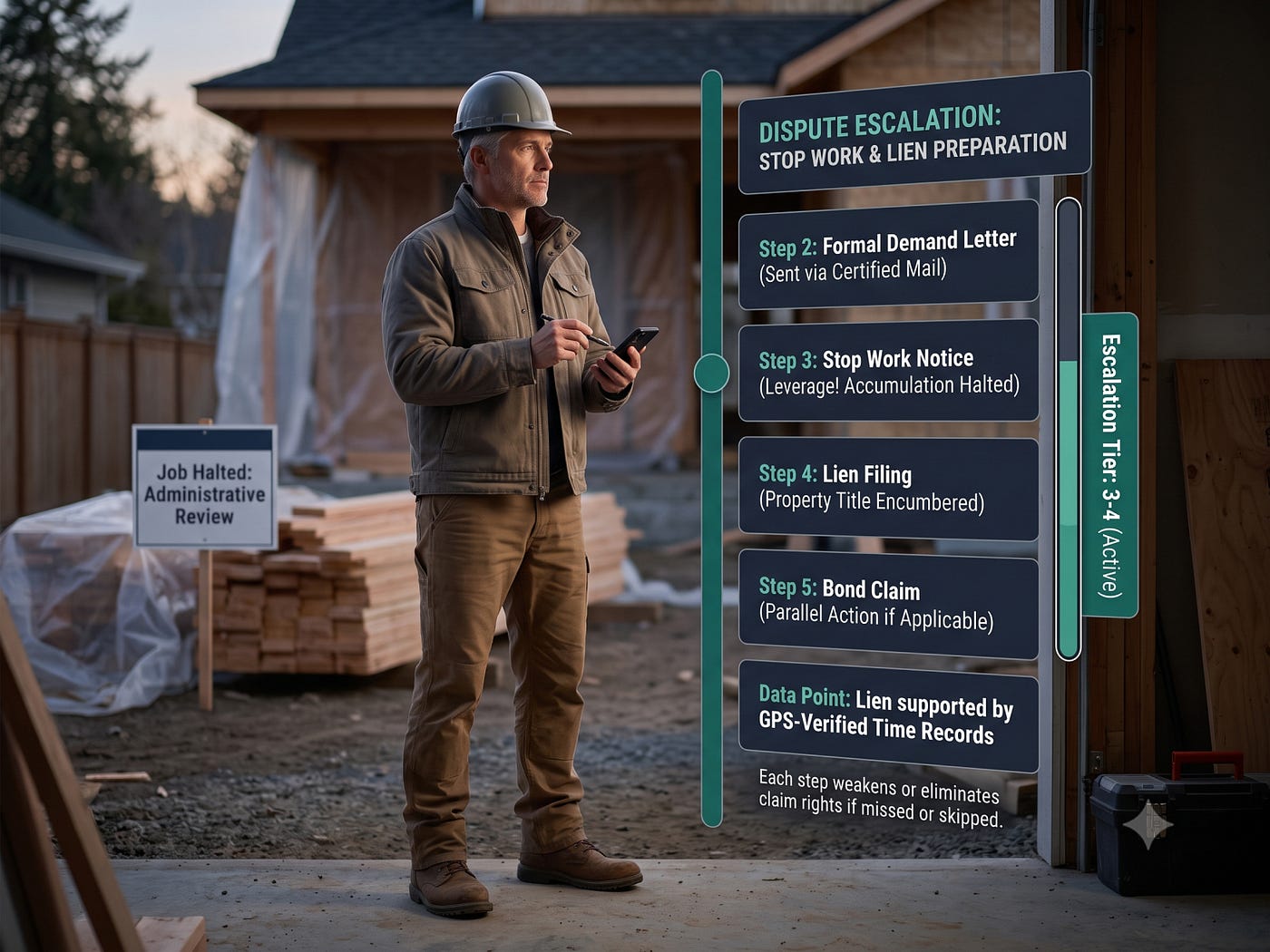
The EMR isn't a fixed number. Contractors who manage it actively pay less than those who treat insurance as a passive cost. Safety programs, return-to-work policies, early claims reporting, accurate payroll classification, and - critically - the ability to challenge fraudulent or inflated claims with documented evidence all move the number. The documentation foundation for that last point is construction time tracking software with GPS verification. A GPS clock-in record showing a worker wasn't on site when they claim to have been injured is worth more than any verbal defense.the documentation foundation starts with GPS timesheets for contractors.
This guide covers how the EMR is calculated, what drives it up, and the specific tactics contractors use to push it down.
What the EMR Is and Why It Matters
The Experience Modification Rate (EMR) is a multiplier applied to workers compensation premiums based on a contractor's actual claims history compared to the expected claims for a company of the same size and trade classification.
EMR affects more than premium cost:
Bonding capacity: Most surety underwriters use 1.0 EMR as a threshold. Contractors above 1.0 face higher bond premiums or reduced capacity. Above 1.25, many sureties decline to bond at all - effectively barring the contractor from bonded public work. See Construction Bonds Guide.
Public bidding prequalification: Federal, state, and large municipal procurement often require EMR below 1.0 or 1.10. A contractor with EMR 1.35 is disqualified from an entire category of public work - regardless of low bid price.
Private owner prequalification: Many institutional and commercial owners use EMR thresholds in their contractor prequalification. EMR above 1.0 can disqualify a contractor from being invited to bid before pricing is ever discussed.
Subcontractor qualification: Large GCs regularly require subs to have EMR below a threshold (commonly 1.0 or 1.10). A sub with a high EMR loses access to the best GC relationships.
If you are bidding bonded work, review this construction bonding guide to understand how safety performance, documentation, and financial controls affect bonding capacity.
For general contractors, EMR can also affect whether subcontractors and owners view the company as a reliable partner. That is why safety management should be treated as part of the company's operating system, not just an HR or insurance issue.
Contractors managing multiple crews should also consider using project management software for general contractors to keep jobsite documentation, assignments, photos, and time records organized in one place.
How the EMR Is Calculated
The EMR is calculated by NCCI (National Council on Compensation Insurance) in most states, or by state rating bureaus in monopolistic and independent states. The calculation uses 3 years of claims data, excluding the most recent policy year.
For a 2026 EMR: Claims from policy years 2022, 2023, and 2024 are used. Policy year 2025 (most recent) is excluded - too fresh to be fully developed.
Primary vs. Excess Losses
The EMR formula separates each claim into two components:
Primary losses: The first $18,500 of each claim (split point - varies by state and year). Primary losses are fully included in the EMR calculation. Small, frequent claims hurt more proportionally than large rare claims.
Excess losses: The amount above the split point per claim. Excess losses are discounted (typically 10-30% of actual cost) in the EMR formula. A single $500,000 catastrophic claim damages your EMR less than 30 small claims totaling the same amount.
Implication: Frequency is punished more than severity. A contractor with 20 small claims averaging $8,000 each ($160,000 total) has a worse EMR impact than a contractor with one $200,000 claim - because all 20 small claims are entirely in the primary layer, while the large claim has most of its cost in the discounted excess layer.
This drives the strategy: eliminate small claims above all else. Return-to-work programs, modified duty assignments, and early intervention are most valuable for preventing small lost-time claims from accumulating.
EMR Calculation Example (Simplified)
EMR = (Primary actual + Excess actual × discount factor) ÷ Expected losses
EMR = ($74,000 + $23,000 × 0.25) ÷ $183,000 = ($74,000 + $5,750) ÷ $183,000 = 0.436
(This is simplified - the actual formula includes ballast and weighting factors, but the principle holds: actual losses vs. expected losses drives the number.)
Get your EMR worksheet from NCCI or your state rating bureau. The worksheet shows exactly which claims are in the calculation, the split between primary and excess, and what the EMR would be if specific claims were removed. Understanding the worksheet shows you which claims are hurting you most and where intervention has the highest return.
Tactic 1: Prevent Small Claims Through Active Safety
The EMR calculation punishes frequency. The highest-ROI investment is preventing the small, frequent claims that drive up the primary loss count.
Using construction photo documentation software can help contractors create a visual record of jobsite conditions, safety practices, and completed work.
For roofing companies, documentation is especially important because fall protection, weather conditions, steep slopes, ladders, and material handling all create claim exposure. Roofing contractors can organize crew activity, site photos, and field updates with roofing contractor project management software.
OSHA Compliance as a Floor, Not a Ceiling
OSHA compliance eliminates the most common violation citations but isn't sufficient for a low EMR. OSHA standards set minimums - a company meeting minimums will have average or above-average claims frequency. Below-average claims frequency requires going beyond the minimum.
High-impact safety practices:
- Weekly jobsite safety inspections with written documentation
- Trade-specific toolbox talks - 10 minutes before starting hazardous scopes
- Fall protection plans for every elevated work scope
- Pre-task planning for high-risk activities (excavation, concrete, steel erection)
- Substance abuse testing program - pre-employment, post-accident, random
- New employee orientation with documented acknowledgment
Document everything. A safety program that happens but isn't documented provides no legal protection and no insurance credit. Safety records that show consistent, documented activity demonstrate to the surety underwriter and insurance carrier that the company takes safety seriously.
Near-Miss Reporting
Most injuries are preceded by near-misses that didn't result in injury. A near-miss reporting culture catches hazards before they become claims. Workers who can report near-misses without penalty - and see them addressed - are engaged in the safety program rather than avoiding paperwork.
Track near-misses alongside OSHA recordable incidents. A high near-miss rate on a specific task type predicts future claims on that task - and allows targeted intervention before the injury occurs.
Tactic 2: Return-to-Work Programs
Lost-time claims are the most expensive category in the EMR calculation - both in direct medical and indemnity cost and in the signal they send to the rating bureau about your risk profile. A return-to-work (RTW) program minimizes lost-time claims by finding modified duty assignments for injured workers rather than having them sit at home.
How Return-to-Work Works
An injured worker who can't perform their normal duties is offered modified duty - lighter work within their medical restrictions:
- Flagging, cleanup, material handling (light)
- Office or administrative work
- Training or orientation duties
- Inspection and documentation tasks
The worker earns wages (reducing or eliminating indemnity payments), stays connected to the workplace (improving recovery), and the claim moves from lost-time to medical-only. Medical-only claims cost approximately 80% less than lost-time claims in EMR impact because they have lower total cost and shorter duration.
Implementing RTW
- Identify a list of modified duty positions before injuries occur - not scrambling after
- Brief supervisors on RTW policy: any injured employee returning to work at any capacity is a priority
- Work with the treating physician on restrictions - request a restrictions letter with every medical visit
- Document all modified duty offers and worker responses
- If a worker declines reasonable modified duty, document it - may affect indemnity benefit continuation
A construction time keeping app that tracks hours by cost code makes modified duty tracking easy. An injured worker doing light admin duties clocks into an "RTW" or "light duty" cost code - creating a record of modified duty participation that supports the claims file.
A construction time tracking software system can make modified-duty tracking easier by letting injured workers clock into a light-duty or return-to-work cost code.
Tactic 3: Early Claims Reporting
Claims reported within 24 hours of injury cost significantly less than claims reported days or weeks later. NCCI data consistently shows that delayed reporting correlates with higher claim costs, more litigation, and longer duration.
Why early reporting reduces cost:
- Faster medical treatment reduces injury severity
- Early contact with the injured worker before an attorney gets involved
- Earlier opportunity to investigate the circumstances
- Earlier opportunity to offer modified duty
- Insurer's claims adjuster controls the claim before costs escalate
Establish a mandatory same-day reporting policy: Any injury, however minor, is reported to the supervisor the same day, and the supervisor reports to the office the same day. The office notifies the insurance carrier within 24 hours.
Supervisors who delay reporting to "see if the injury gets better" are the most common cause of reporting failures. Train supervisors that delayed reporting costs the company money and their job. Never penalize a worker for reporting an injury - that suppresses early reporting and creates OSHA retaliation exposure.
Tactic 4: Using Time Tracking Records to Contest Claims
Fraudulent and inflated workers comp claims are a real problem in construction - and GPS-verified time records are one of the most effective defenses.
What Time Records Can Prove
Worker wasn't on site when alleged injury occurred: A worker files a claim alleging injury on Tuesday at 10am at Job Site A. Your contractor time tracking app shows they clocked out of Job Site A at 8:45am Tuesday and didn't clock back in. GPS stamps confirm the clock-out location. The claim collapses against this evidence.
메타데이터
- post_id
- 8900d89c4a5d
- slug
- a-construction-contractor-with-a-0-85-8900d89c4a5d
- url
- https://medium.com/@tasktagapp/a-construction-contractor-with-a-0-85-8900d89c4a5d
- canonical_url
- https://medium.com/@tasktagapp/a-construction-contractor-with-a-0-85-8900d89c4a5d
- author_url
- https://medium.com/@tasktagapp
- status
- ok
- fetched_at
- 2026-08-18 23:24:02