The Martyr Whom the Sea Could Not Drown: The Brutal Torture and Last Letter of Masterda Surya Sen
Smashed bones, pulled nails, and a body caged in the deep ocean — how the British tried to erase India’s fiercest revolutionary, and why…
The Martyr Whom the Sea Could Not Drown: The Brutal Torture and Last Letter of Masterda Surya Sen
Smashed bones, pulled nails, and a body caged in the deep ocean — how the British tried to erase India’s fiercest revolutionary, and why his golden dream lives on.
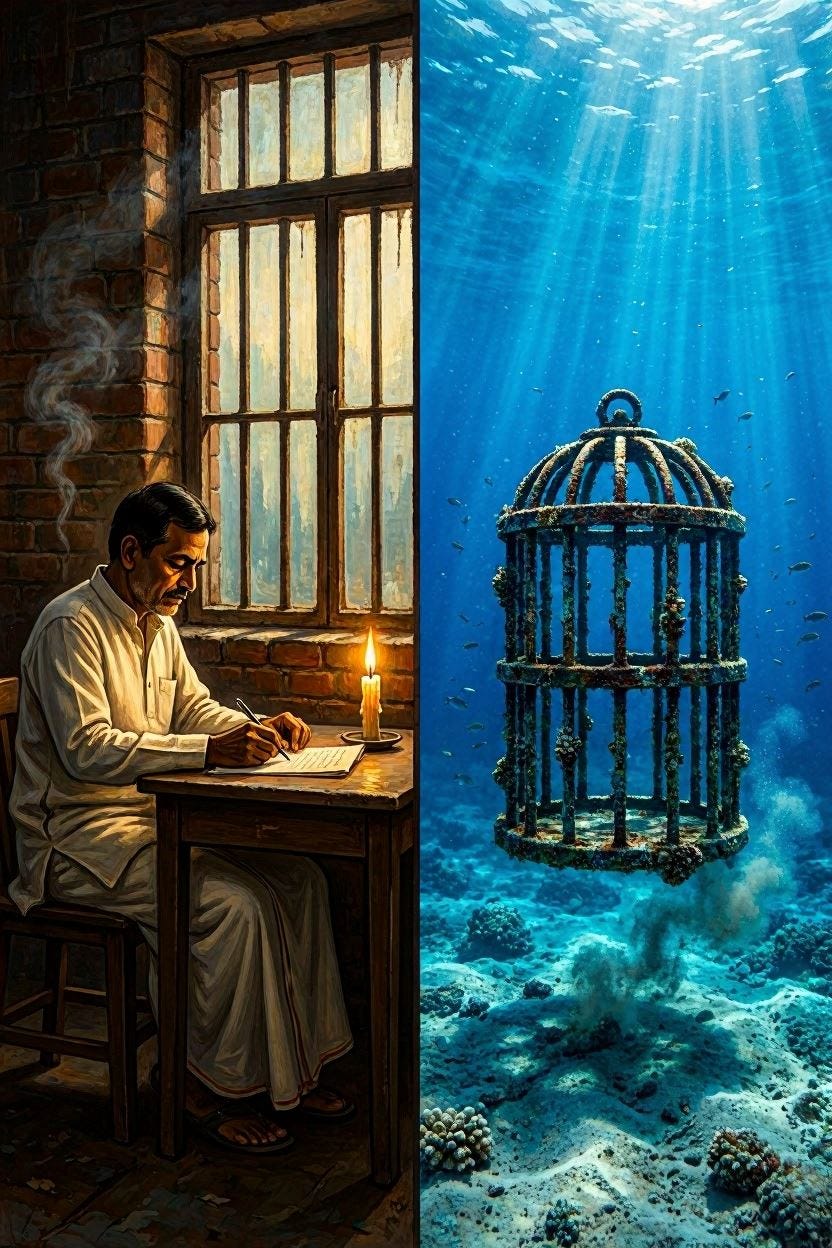
An emotional digital artwork of revolutionary leader Masterda Surya Sen writing his last letter in a dark jail cell, side-by-side with a metaphoric image of an iron cage sinking into the deep blue ocean of the Bay of Bengal.” ( Image Created using AI)
On the cold midnight of January 12, 1934, the stone walls of Chittagong Jail witnessed an act of brutality so grotesque that it remains one of the darkest, most whispered chapters of the Indian freedom struggle.
Masterda Surya Sen — the schoolteacher-turned-revolutionary who shook the foundations of the British Empire with the historic 1930 Chittagong Armoury Raid — was to be hanged. But the empire was not content with just taking his life; they feared his very ghost.
Before he was dragged to the gallows, British officers broke his teeth with hammers, shattered his limbs so he could not stand, and pulled out his fingernails with pliers. When they finally slipped the noose around his neck, he was already unconscious, his body a mutilated shadow of the man who had dared to dream of a free India.
Fearing that his grave would become a shrine of revolution, the British locked his lifeless body in a metal cage, weighed it down with heavy stones, and dumped it into the pitch-black depths of the Bay of Bengal from the warship HMS Renown.
But they forgot one thing: You cannot drown a dream.
Hours before his brutal execution, on January 11, 1934, at 7:00 PM, Masterda penned his final, immortal letter to his comrades and countrymen. Below is a painful, evocative poetic tribute to his sacrifice, followed by the translation of his legendary last words.
The Cage in the Deep Blue: A Poem for Masterda
The midnight was cold, the shadows were deep,
While the rest of the world was fast asleep.
A whisper of gold, a traitor’s foul greed,
Sold the king of the rebels, the revolutionary seed.
They brought down the hammers on joints and on bone,
But from those shattered lips, there escaped not a groan.
They tore off the nails, they shattered his teeth,
To bury his pride in the dirt underneath.
They feared how he stood, they feared how he spoke,
So they broke his fragile body before the dawn broke.
To the gallows they dragged him, half-lifeless and pale,
A silent protagonist in a horrific tale.
No final goodbyes, no prayers were read,
As the rope took the breath of the hero they dread.
But death was a coward, and so was the crown,
They feared even the ashes of the man they brought down.
In a heavy iron cage, beneath the dark wave,
The Bay of Bengal became his unsung grave.
Deep in the ocean, where the wild currents sweep,
The heart of the revolution lies buried asleep.
Yet, the wind on the water still echoes his name,
And the waves carry forward his unquenched flame.
For they drowned his pale bones in the deep, salty blue,
But the dream of his freedom, they could never subdue.
The Golden Dream: Masterda’s Last Letter to India
(Written from Chittagong Jail on January 11, 1934, at 7:00 PM)
“My last word to you is Unity and Idealism.
The noose hangs above my head. Death is knocking at my door. My mind is flying away towards the infinite… This is the time for Sadhana (devotion). This is the time to embrace death as a friend. How sweet are the memories of you all!
My dear brothers and sisters, break the monotony of my colorless life with your enthusiasm. At this joyous, sacred, and crucial moment, what am I leaving behind for you? Only one thing — my dream. A golden dream, the dream of a free India.
What a beautiful moment it was when I first saw this dream! I have chased it like a madman all my life. I do not know how far I have succeeded. Today, I must stop.
If death touches you before you reach the goal, hand over the torch of this ideal to your followers — just as I hand it over to you today. Never retreat. The days of bondage are ending. Behold, the morning sun of freedom is rising!
Never lose hope. Never forget the Chittagong Rebellion of April 18, 1930. Keep the memories of Jalalabad, Julkha, Chandannagar, and Dhalghat alive in your hearts. Write the names of those patriots who died on the altar of freedom in letters of blood upon the temple of your hearts.
Let there be no division in our organization. This is my earnest prayer. To all those inside and outside the prisons, I send my blessings and my love.
Farewell to you all. Long Live Revolution! Bande Mataram.”
Masterda Surya Sen’s sacrifice is not just a page in a history textbook. It is a reminder of the colossal price paid for the air we breathe today. His body lies somewhere at the bottom of the ocean, but his spirit remains woven into the very fabric of our freedom.
This story is published under “Writer’s Circle.” A space for raw thoughts, everyday fictional and non-fictional stories, and voices that feel real and relatable. Would you like to contribute? Follow our publication. Have a story to tell? Share it with us here.
메타데이터
- post_id
- 890a24b03898
- slug
- masterda-surya-sen-torture-hanging-last-letter-poem-890a24b03898
- url
- https://medium.com/writers-chaupal/masterda-surya-sen-torture-hanging-last-letter-poem-890a24b03898
- canonical_url
- https://medium.com/writers-chaupal/masterda-surya-sen-torture-hanging-last-letter-poem-890a24b03898
- author_url
- https://medium.com/@kousiknavy80
- status
- ok
- fetched_at
- 2026-06-28 10:39:35