Hempcrete Market: Building the Future of Sustainable Construction
Global Hempcrete Market Analysis
Hempcrete Market: Building the Future of Sustainable Construction
Global Hempcrete Market
Global Hempcrete Market Analysis
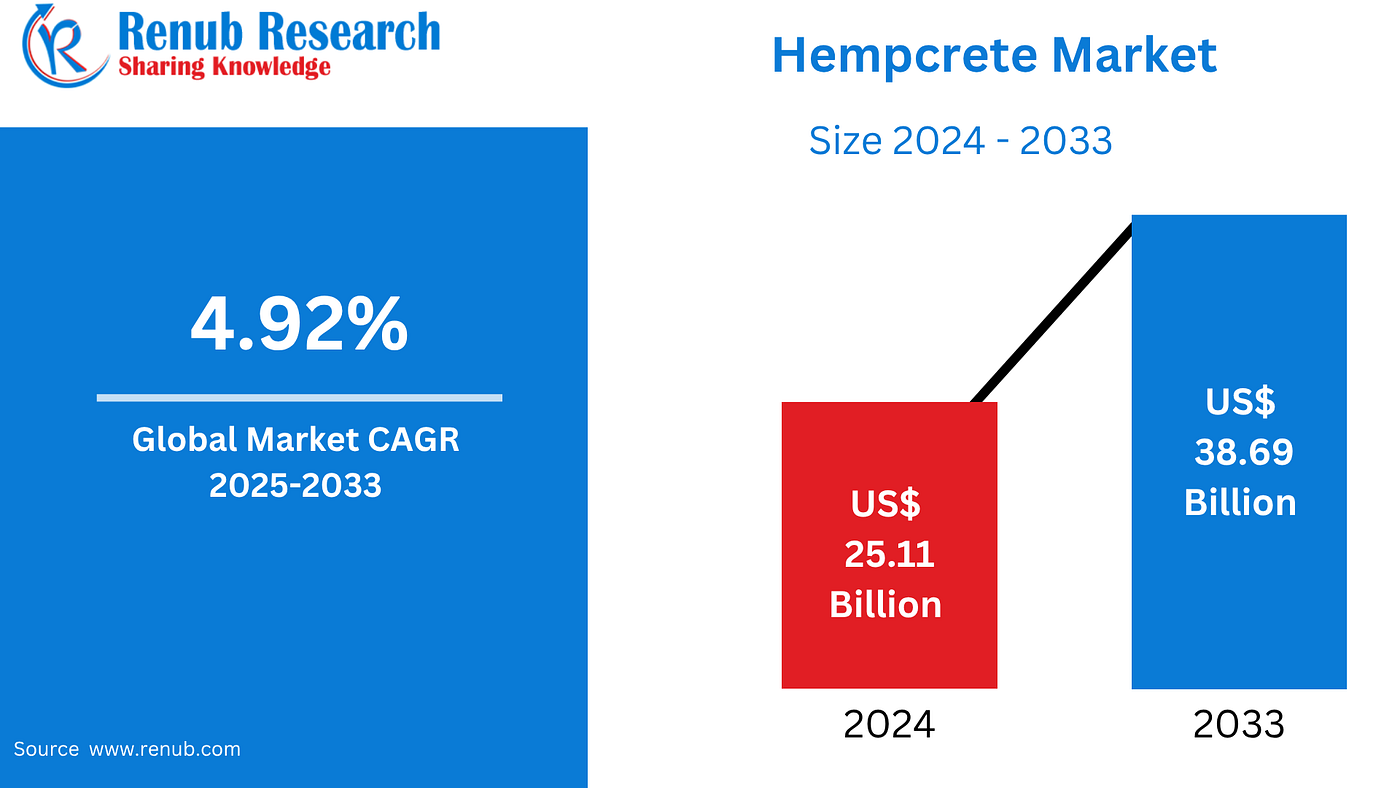
According To Renub Research global hempcrete market is steadily expanding as sustainability becomes a central pillar of the global construction industry. Valued at US$ 25.11 billion in 2024, the market is projected to reach approximately US$ 38.69 billion by 2033, growing at a compound annual growth rate (CAGR) of 4.92% between 2025 and 2033. This growth is largely driven by increasing demand for eco-friendly, low-carbon, and energy-efficient building materials across residential and non-residential construction.
Hempcrete is gaining recognition as a viable alternative to conventional construction materials due to its carbon-negative lifecycle, excellent insulation properties, and compatibility with green building standards. As governments, developers, and consumers prioritize climate-resilient construction, hempcrete is transitioning from a niche material to a mainstream solution in sustainable architecture.
Global Hempcrete Market Outlook
Hempcrete is a bio-composite construction material made from hemp hurd (the woody core of the hemp plant), a lime-based binder, and water. Unlike traditional concrete, hempcrete is lightweight, non-structural, and primarily used for insulation and infill applications rather than load-bearing purposes. Its most notable advantage lies in its environmental performance, as it absorbs more carbon dioxide during hemp cultivation and curing than it emits during production.
The material is widely valued for its thermal insulation, vapor permeability, sound absorption, fire resistance, and resistance to mold and pests. Hempcrete creates breathable building envelopes that regulate humidity and indoor temperature naturally, contributing to healthier indoor environments and lower energy consumption.
Globally, hempcrete adoption is strongest in regions with established green building cultures such as Europe and North America. Countries including France, the United Kingdom, and Canada have developed mature hemp supply chains and supportive regulatory frameworks. As sustainability becomes integral to real estate development and urban planning, hempcrete is increasingly viewed as a long-term solution for reducing the construction sector’s environmental footprint.
Download Free Sample Report:https://www.renub.com/request-sample-page.php?gturl=global-hempcrete-market-p.php
Growth Drivers of the Global Hempcrete Market
Growing Demand for Green and Sustainable Building Materials
The global construction industry is under increasing pressure to reduce carbon emissions and environmental impact. Hempcrete aligns strongly with sustainability goals due to its renewable nature, biodegradability, and carbon sequestration capability. Unlike conventional concrete and bricks, which are energy-intensive to produce, hempcrete significantly lowers embodied carbon in buildings.
Green building certifications and environmentally conscious developers are accelerating adoption as hempcrete supports compliance with sustainability benchmarks. The shift toward low-impact construction materials is one of the most influential drivers behind the growing global hempcrete market.
Superior Thermal Insulation and Energy Efficiency
Hempcrete offers excellent thermal insulation and natural humidity regulation, reducing reliance on mechanical heating and cooling systems. Buildings constructed with hempcrete maintain stable indoor temperatures, resulting in lower energy consumption and operational costs over time.
As global energy prices rise and building regulations tighten around energy efficiency, materials that improve thermal performance are increasingly prioritized. Hempcrete’s ability to enhance comfort while lowering long-term energy expenses makes it particularly attractive for both residential and commercial developments.
Government Support and Policy Initiatives
Government initiatives supporting industrial hemp cultivation and sustainable construction are accelerating hempcrete adoption. Several countries have introduced subsidies, tax incentives, and regulatory reforms to encourage hemp farming and its industrial applications.
Additionally, sustainable construction frameworks and certification systems favor materials like hempcrete for their low environmental impact. These policy measures are strengthening hempcrete supply chains, improving raw material availability, and enabling broader commercial adoption across global markets.
Challenges of the Global Hempcrete Market
Lack of Structural Strength Constrains Application
One of the primary limitations of hempcrete is its non-structural nature. It cannot replace concrete or steel in load-bearing applications, which restricts its use to insulation, infill, and partitioning. Builders must combine hempcrete with timber or steel frames, increasing design complexity and construction costs.
This limitation reduces hempcrete’s suitability for high-rise buildings and large-scale infrastructure projects. For developers unfamiliar with alternative construction methods, the need for hybrid structural systems can act as a barrier to adoption.
Limited Availability and Awareness of Raw Materials
Despite its benefits, hempcrete adoption is constrained by limited awareness among architects, contractors, and consumers. In many regions, industrial hemp cultivation is still subject to regulatory uncertainty, restricting raw material supply.
Underdeveloped processing infrastructure and fragmented supply chains also contribute to higher material costs. These challenges slow market scalability and prevent hempcrete from achieving price competitiveness with traditional building materials in some regions.
Global Wall Hempcrete Market
Wall applications represent the largest segment of the hempcrete market. Hempcrete is widely used as wall infill in timber-framed buildings, providing superior insulation, breathability, and moisture regulation. This application is particularly popular in low-rise residential and eco-friendly commercial buildings.
As demand for sustainable housing grows, wall-based hempcrete solutions are experiencing strong uptake, especially in Europe and North America where green construction standards are well established.
Global Roof Hempcrete Market
Hempcrete is increasingly used in roof insulation systems due to its lightweight structure, thermal efficiency, and fire-resistant properties. Roof applications benefit from hempcrete’s ability to reduce heat loss and regulate indoor temperatures, making it suitable for passive houses and energy-efficient designs.
Its use is expanding in both new constructions and renovation projects, particularly in sustainable housing and green retrofitting initiatives.
Global Residential Hempcrete Market
Residential construction is a major driver of hempcrete demand worldwide. Homeowners are increasingly seeking healthier, low-energy, and environmentally responsible housing solutions. Hempcrete is used in walls, floors, and roofs of single-family homes, eco-villages, and off-grid dwellings.
Its non-toxic and breathable characteristics make it especially appealing for indoor living environments. Growing environmental awareness and demand for sustainable homes continue to support strong growth in residential hempcrete applications.
Global Non-Residential Hempcrete Market
Non-residential buildings such as schools, offices, hospitality facilities, and public infrastructure are increasingly adopting hempcrete to achieve sustainability certifications and energy efficiency targets. While structural limitations restrict full-scale use, hempcrete is commonly applied for insulation, acoustic control, and interior partitions.
Government-led green building programs and environmentally conscious corporate strategies are driving demand in this segment, positioning hempcrete as a preferred material in sustainable commercial construction.
United States Hempcrete Market
The United States hempcrete market is expanding following regulatory support for industrial hemp cultivation. Growing interest in sustainable construction, coupled with green building incentives, is encouraging adoption in residential and small commercial projects.
Although still a niche market, awareness is increasing, particularly in states with strong sustainability initiatives. Domestic startups and innovation in hemp-based construction systems are strengthening market momentum and long-term growth potential.
France Hempcrete Market
France is the global leader in hempcrete adoption, supported by a mature hemp supply chain and widespread industry expertise. The country’s strong industrial hemp production and government backing for low-carbon construction have positioned France at the forefront of hempcrete usage.
Hempcrete is widely used in rural, suburban, and retrofit housing projects, making France a benchmark market for global hempcrete development.
India Hempcrete Market
India’s hempcrete market is emerging, driven by growing interest in green architecture, eco-tourism, and sustainable housing. Regulatory progress in select states is encouraging hemp cultivation and alternative building practices.
While challenges such as limited infrastructure and awareness remain, India’s climate conditions and rising environmental consciousness present significant long-term opportunities for hempcrete adoption.
Brazil Hempcrete Market
Brazil’s hempcrete market is in early stages but shows growing potential as sustainability gains prominence in construction. Regulatory uncertainty around hemp cultivation remains a key challenge, but discussions around legalization and green architecture are paving the way for future growth.
Hempcrete’s breathability and humidity-regulating properties make it well suited to Brazil’s climate, supporting long-term adoption prospects.
UAE Hempcrete Market
The UAE is exploring hempcrete as part of its broader sustainability and carbon-neutrality goals. Although the market is nascent, interest is growing in luxury villas, eco-resorts, and energy-efficient developments.
Hempcrete’s insulation performance is particularly valuable in the region’s extreme climate. Government-led sustainability initiatives and eco-tourism development are expected to support gradual market expansion.
Global Hempcrete Market Segmentation Overview
The global hempcrete market is segmented by application into wall, floor, and roof systems. By end use, it is divided into residential and non-residential construction. Regionally, adoption spans North America, Europe, Asia-Pacific, Latin America, and the Middle East & Africa, with varying growth dynamics based on regulatory support, climate conditions, and sustainability priorities.
Competitive Landscape and Key Players Analysis
The global hempcrete market is moderately fragmented, with specialized manufacturers and green building material providers driving innovation and supply chain development. Key players include IsoHemp, Hempitecture Inc., Americhanvre Cast Hemp, Hemp Block USA, and Dun Agro Hemp Group.
These companies focus on expanding production capacity, improving material performance, and educating the construction industry. Strategic partnerships, certifications, and product standardization are central to gaining wider market acceptance.
Future Outlook of the Global Hempcrete Market
The global hempcrete market is poised for consistent growth through 2033 as sustainability becomes a defining factor in construction decisions. Rising environmental regulations, energy efficiency requirements, and consumer demand for healthier buildings will continue to drive adoption.
While challenges related to structural limitations, cost, and supply chains remain, ongoing innovation and supportive policies are expected to improve scalability and affordability. As the construction industry transitions toward low-carbon materials, hempcrete is set to play an increasingly important role in shaping the future of sustainable building worldwide.
메타데이터
- post_id
- 892c64abc3f4
- slug
- hempcrete-market-building-the-future-of-sustainable-construction-892c64abc3f4
- url
- https://medium.com/@amanrenub/hempcrete-market-building-the-future-of-sustainable-construction-892c64abc3f4
- canonical_url
- https://medium.com/@amanrenub/hempcrete-market-building-the-future-of-sustainable-construction-892c64abc3f4
- author_url
- https://medium.com/@amanrenub
- status
- ok
- fetched_at
- 2026-08-11 05:10:16




