Zero Trust Architecture: The Future of Enterprise Security
For years, enterprises relied on firewalls, perimeter security, VPNs, and internal trust models to protect their systems.
Zero Trust Architecture: The Future of Enterprise Security
For years, enterprises relied on firewalls, perimeter security, VPNs, and internal trust models to protect their systems.
But the modern digital world has changed everything.
Now enterprises operate across:
- Remote work environments
- Cloud infrastructure
- Mobile devices
- Third-party applications
- Hybrid networks
- AI-powered systems
The network perimeter no longer exists in the way it once did.
And that’s exactly why Zero Trust Architecture is becoming the future of enterprise security.
What Is Zero Trust Architecture?
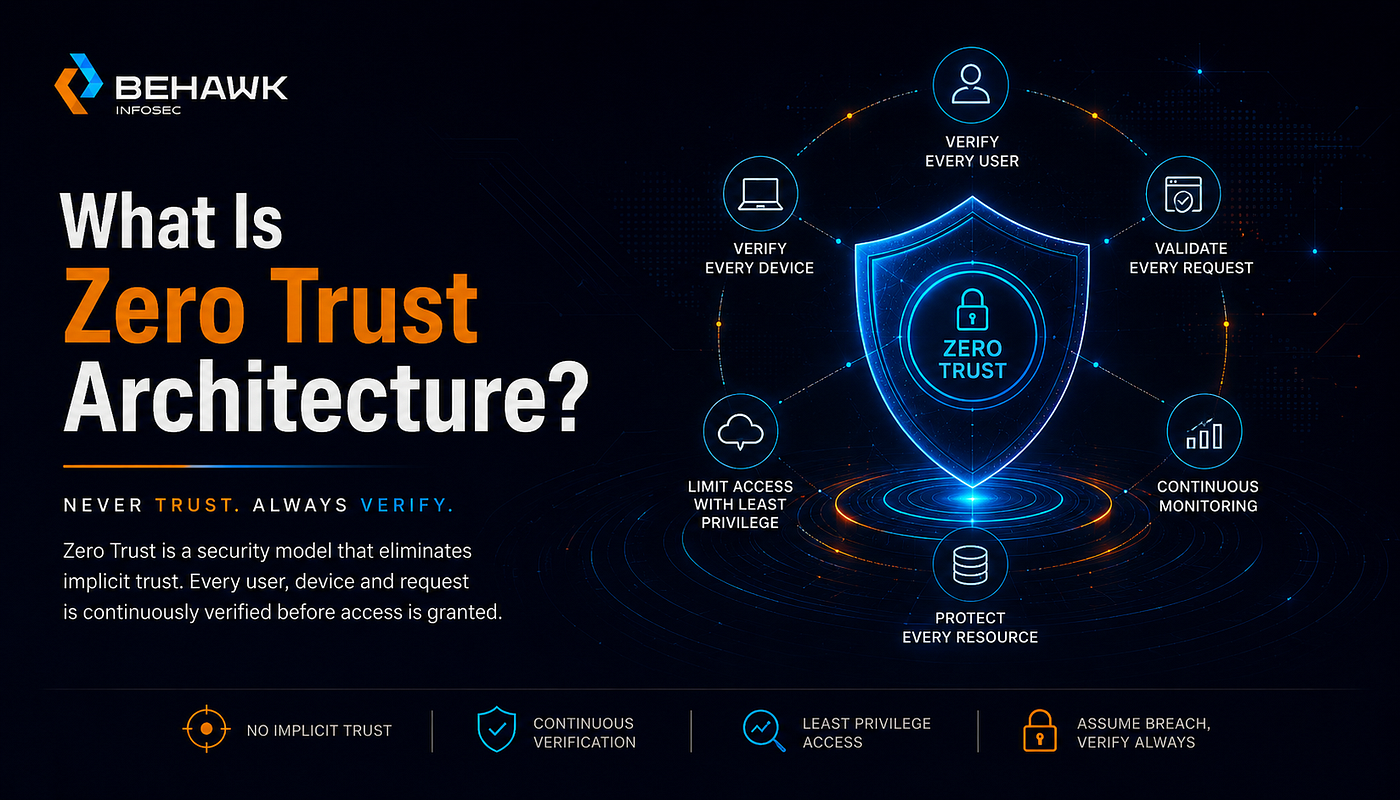
Zero Trust is a cybersecurity framework based on one simple principle:
“Never trust. Always verify.”
Instead of automatically trusting users or devices inside a network, Zero Trust continuously validates:
- Identity
- Access permissions
- Device health
- User behavior
- Application activity
Every request is treated as potentially risky until verified.
This approach significantly reduces the chances of unauthorized access, insider threats, and lateral movement within enterprise systems.
Why Traditional Security Models Are Failing
Traditional security was designed for centralized office environments.
But modern enterprises are now decentralized.
Employees work remotely. Applications live in the cloud. Data moves across multiple platforms and devices.
Cybercriminals are also becoming more advanced:
- Phishing attacks
- Credential theft
- Ransomware
- Supply chain attacks
- AI-powered cyber threats
Once attackers gain access in traditional systems, they can often move freely within the network.
That’s the biggest weakness.
Zero Trust changes this completely.
Core Principles of Zero Trust Architecture
1. Continuous Verification
Verification is not a one-time login event.
Zero Trust continuously checks:
- Who the user is
- What device they are using
- Their location
- Their behavior patterns
- Access context
Even authenticated users are continuously monitored.
2. Least Privilege Access
Users only receive access to the exact resources they need.
Nothing more.
This minimizes damage if an account becomes compromised.
For example:
- A finance employee should not automatically access engineering systems.
- A contractor should not have full administrative privileges.
Limiting access reduces enterprise risk significantly.
3. Micro-Segmentation
Zero Trust divides networks into smaller protected segments.
Instead of one large open environment, systems become isolated and controlled.
If an attacker gains access to one segment, they cannot easily move across the entire infrastructure.
This helps contain security breaches quickly.
4. Device Security Validation
Not every device should be trusted automatically.
Zero Trust checks:
- Device health
- Operating system updates
- Security compliance
- Endpoint protection status
Unsecured or suspicious devices can be restricted immediately.
5. Real-Time Monitoring and Analytics
Modern Zero Trust systems rely heavily on:
- Behavioral analytics
- AI-driven monitoring
- Threat intelligence
- Security automation
The goal is early detection and rapid response.
Enterprises no longer wait for damage to happen before acting.
Why Enterprises Are Adopting Zero Trust
Remote Work Has Changed Security
Remote and hybrid work environments expanded enterprise attack surfaces dramatically.
Employees now connect from:
- Home networks
- Public Wi-Fi
- Personal devices
- Multiple locations
Traditional perimeter-based security cannot handle this complexity effectively.
Zero Trust was built for this modern reality.
Cloud Adoption Requires New Security Models
As businesses migrate to:
- AWS
- Azure
- Google Cloud
- SaaS applications
…the old “inside vs outside network” concept becomes outdated.
Zero Trust protects users, applications, and data regardless of location.
Cyberattacks Are More Sophisticated
Attackers are targeting:
- Human behavior
- Identity systems
- Third-party vendors
- Weak authentication methods
Zero Trust reduces the impact of compromised credentials by continuously validating every interaction.
Key Benefits of Zero Trust Architecture
Stronger Security
Continuous verification significantly reduces unauthorized access risks.
Reduced Lateral Movement
Attackers cannot move freely across systems due to segmentation and restricted access controls.
Better Compliance
Zero Trust supports security standards and compliance requirements across industries like:
- Healthcare
- Finance
- Government
- Enterprise IT
Improved Visibility
Organizations gain better insight into:
- User activity
- Device behavior
- Access patterns
- Potential threats
Faster Threat Detection
AI-driven monitoring helps identify unusual behavior earlier before major damage occurs.
Challenges of Implementing Zero Trust
While Zero Trust offers major advantages, implementation can be complex.
Common challenges include:
- Legacy systems
- Integration difficulties
- User friction
- Cost of modernization
- Organizational resistance
Zero Trust is not a single product.
It is a long-term security strategy requiring:
- Planning
- Technology alignment
- Policy changes
- Continuous improvement
The Role of AI in Zero Trust Security
AI is becoming increasingly important in modern enterprise security.
AI-powered Zero Trust systems can:
- Detect anomalies faster
- Analyze massive security datasets
- Automate threat response
- Predict suspicious behavior patterns
As cyber threats evolve, AI and Zero Trust will likely become deeply interconnected.
The Future of Enterprise Security
The future of cybersecurity is no longer about protecting a single network perimeter.
It is about protecting:
- Identities
- Devices
- Applications
- Data
- Cloud environments
- User behavior
Zero Trust Architecture represents a major shift from reactive security to proactive security.
Instead of assuming trust, enterprises now operate with continuous validation and intelligent access control.
In a world where cyber threats are constantly evolving, Zero Trust is quickly becoming not just an option — but a necessity.
Final Thoughts
Enterprise security is entering a new era.
The companies that adapt early to Zero Trust principles will be better prepared for:
- Remote work security
- Cloud infrastructure protection
- AI-driven cyber threats
- Modern compliance requirements
Zero Trust is not about creating fear.
It’s about building resilience. Because in modern cybersecurity, trust must always be earned — never assumed.
메타데이터
- post_id
- 893a459cd166
- slug
- zero-trust-architecture-the-future-of-enterprise-security-893a459cd166
- url
- https://medium.com/@socialbehawk/zero-trust-architecture-the-future-of-enterprise-security-893a459cd166
- canonical_url
- https://medium.com/@socialbehawk/zero-trust-architecture-the-future-of-enterprise-security-893a459cd166
- author_url
- https://medium.com/@socialbehawk
- status
- ok
- fetched_at
- 2026-08-09 23:39:41