How Zomato’s 650 Weather Stations Help Retain Its Customer Base
Zomato is building 650 weather stations.
How Zomato’s 650 Weather Stations Help Retain Its Customer Base
Zomato is building 650 weather stations.
This is happening once after the data is arrived.
That’s the actually interesting part.
A weather API tells you: “Chennai is 39℃”
Zomato’s system tells you: “It’s 40℃ in Pallavaram, at 11:45 AM, with 3 active deliveries within 2km, and the rider has been on road for 45 minutes”
Same data source, completely different intelligence.
Here’s how they stack it:
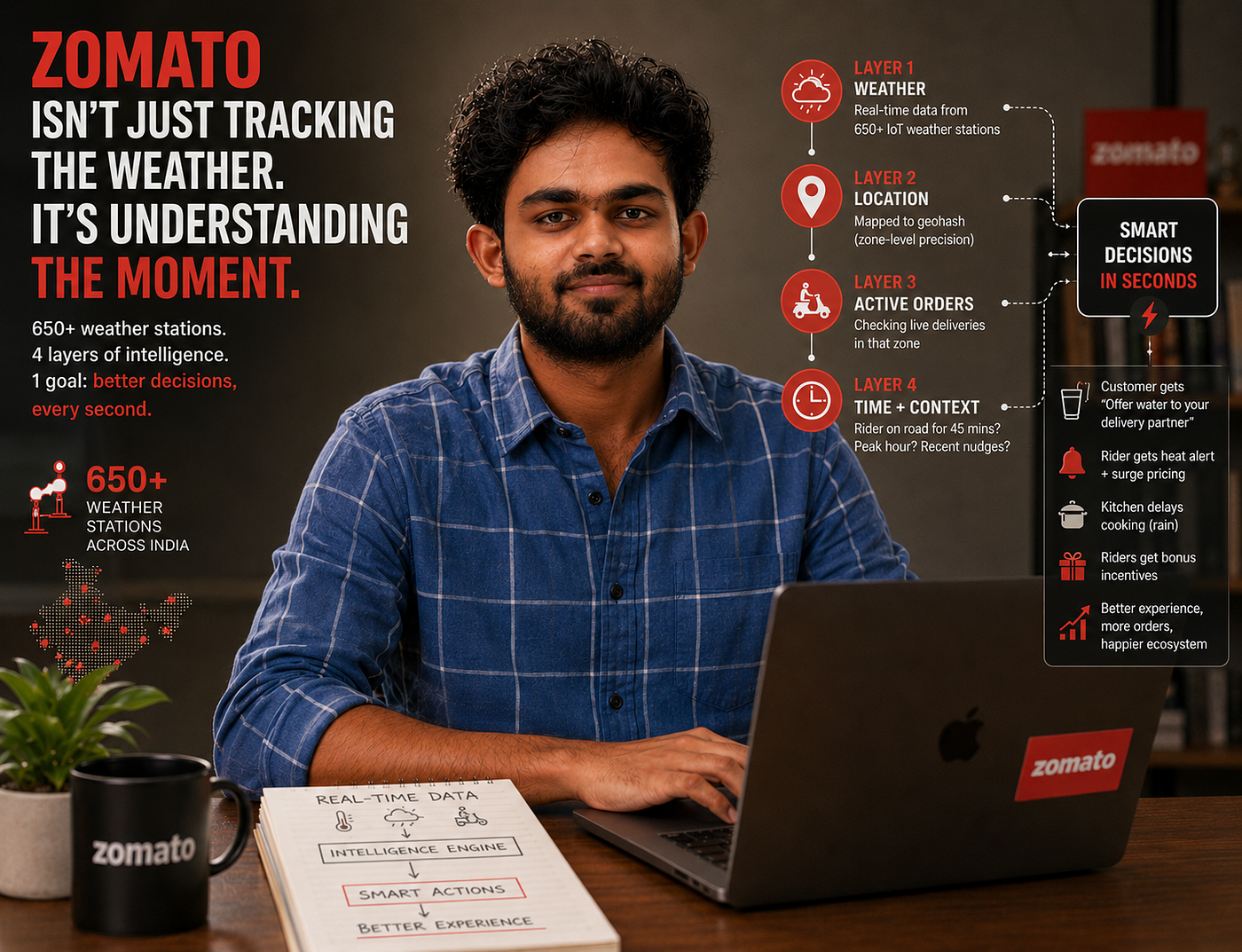
Layer 1 — Weather: 650+ IoT sensors push real time readings every few minutes. Temperature, humidity, wind, rainfall. Not city level instead, zone-level, street-level.
Layer 2 — Location: Every readings gets mapped to a geohash — a tiny grid cell of the city. So “40℃” doesn’t float in the air. It belongs to a specific zone. Precisely.
Layer 3 — Active orders: The system checks: “are there live deliveries happening inside this zone right now?”
A heatwave with zero active orders = irrelevant. A heatwave with 12 rides on road = acts immediately.
Layer 4 — Time + Context: How long has the rider been out? Did this customer already get a nudge recently? Is this a peak hour or slow noon?
Only when all 4 layers align — the decision fires.
That’s not just a weather notification.
That’s a beautiful context engine.
One sensor reading fans out into 5 simultaneous decisions:
- Customer gets “offer water to your delivery partner”.
- Rider gets a heat safety alert, surge pricing activates for that zone.
- Kitchen is told to delay cooking (in case of rain, the riders might be slow so the food cooked at normal time would arrive cold).
- Riders get bonus incentives pushed proactively (bad weather drives people to order more but fewer riders comes out, so Zomato fills the supply gap before the shortage even hits.
All from one simple temperature reading. All in parallel. All in seconds.
What got me is how simple each layer is individually.
- IoT sensor: Just provides a numerical data.
- Geohash: Just a grid cell lookup.
- Active order: Just a database query.
But stack all layers together and you get something that feels almost human.
That’s what good system design does. Simple pieces. Stacked with intention.
메타데이터
- post_id
- 8954ced09eca
- slug
- how-zomatos-650-weather-stations-help-retain-its-customer-base-8954ced09eca
- url
- https://medium.com/@shrinivas.personal/how-zomatos-650-weather-stations-help-retain-its-customer-base-8954ced09eca
- canonical_url
- https://medium.com/@shrinivas.personal/how-zomatos-650-weather-stations-help-retain-its-customer-base-8954ced09eca
- author_url
- https://medium.com/@shrinivas.personal
- status
- ok
- fetched_at
- 2026-07-10 19:34:48