Tottenham Hotspur: A club who’ve lost sight of their identity
How Spurs lost their identity and what they must do to get back on track
Tottenham Hotspur: A club who’ve lost sight of their identity
How Spurs lost their identity and what they must do to get back on track
Oh Spurs. It seems barely a week can go by without Tottenham Hotspur football club doing something bizarre or frustrating. Last week it involved seemingly not realising that a club can only have eight players out on international loans at the same time, during a deadline day exodus.
After loaning Djed Spence to Rennes and Bryan Gil back to Sevilla (who Spurs had previously paid £25m and Erik Lamela to secure the services of), Tottenham were in the process of loaning Matt Doherty to Atletico Madrid when it became apparent that FIFA rules would not let them do this.
So instead, in a move similar to this time last year with Serge Aurier, they agreed to mutually terminate Doherty’s contract, allowing him to join Atletico on a free transfer.
Given Spurs had spent the whole January transfer window haggling over what was believed to be £5–10m for Sporting right back Pedro Porro, it was an incredible oversight to be caught out by these loan rules and, in doing so, likely lose several of the million they’d spent 31 days attempting to save.
But errors such as this have become commonplace at the North London club over the years. Arguably it began during the January transfer window of 2012. After 20 games, as the season entered the January period, Tottenham sat in 3rd place, only separated from Manchester United by goal difference and three points off the leaders Manchester City. For the first time in the Premier League era, Spurs were title contenders.
Or so they should have been. The January window provided the perfect opportunity to take a financial risk (by ENIC’s standards) and back manager Harry Redknapp who had Tottenham playing their most exciting and impressive football in decades. This was likely to be Luka Modric’s last season before moving on to the elite level (which he shortly did, transferring to Real Madrid) and Gareth Bale was beginning to hit his peak. By adding one or two players who could genuinely improve the first team, Spurs would surely at the very least challenge the Manchester clubs the rest of the way.

Harry Redknapp (right) during his time at Spurs with Gareth Bale (left)
Redknapp mentioned on Talksport recently that he wanted Luis Suarez. Instead, he ended up with 33-year-old Louis Saha and 34-year-old Ryan Nelson on free transfers. Both good players in their prime (particularly Saha), but both way past this and nowhere near good enough to challenge the first team players for their spots. ENIC had seen a team performing far above its expectations and decided this meant there was no need for investment. In actuality, this was the time that needed it the most.
Tottenham would go on to finish the season in 4th place, missing out on Champions League football as Chelsea finished below them, but won the Champions League. An unfortunate rule that would be changed to prevent the team with the better league finish being punished. But only after the summer of 2012. ‘Spursy’, one might say.
Redknapp was sacked and AVB brought in, who was instantly backed with the likes of Mousa Dembele, Hugo Lloris, Jan Vertonghen, Gylfi Sigurdsson and Clint Dempsey being brought in. Oh, how ‘Arry could’ve used a few of these during January.
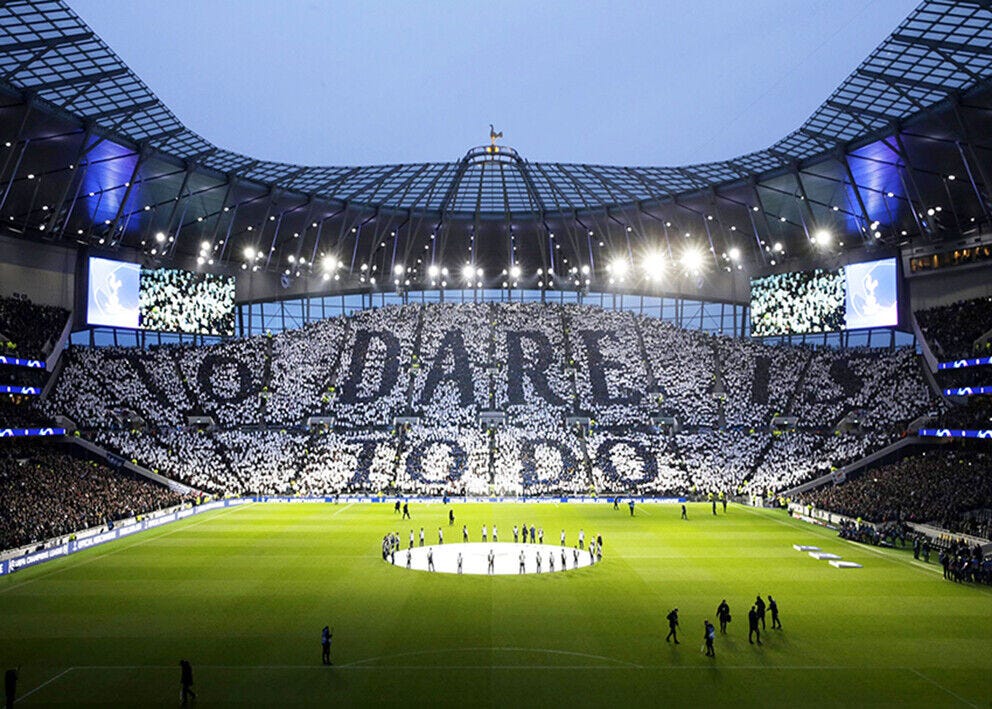
Fast forward to the 2018 summer window and Tottenham were in a far different position. Mauricio Pochettino had established them as genuine contenders on all fronts, having secured Champions League football for the third year running playing the sort of football Spurs fans have always maintained is at the heart of their identity. ‘To Dare is to do’ — Poch’s Spurs certainly embodied this club motto, starting games on the front foot and relentlessly pressing their opponents all over the pitch, swarming forwards as a pack to win the ball back and then attack, attack, attack. A front four of Harry Kane, Heung-Min Son, Dele Alli and Christian Eriksen were amongst the most feared attack in the world. All that was needed, in the eyes of many, was some silverware. And Spurs were surely on the verge.

Mauricio Pochettino as Tottenham Head Coach
Poch had even managed to maintain this while playing a full season ‘away from home’ as the construction of their £1bn state-of-the-art stadium was completed. With a capacity of over 20,000 more than White Hart Lane and a view to hosting additional events such as NFL, boxing and music concerts, the new stadium would surely secure Tottenham as the ‘big club’ they so desired to be.
Yet, football is and will always be judged by on field results. And in a league in which spending power increases year-on-year (except for during the height of the COVID pandemic) and more teams outside of the traditional ‘big six’ have the funds to heavily invest in their playing squads, even having one bad window can be hugely detrimental to results.
Spurs went further than that. In the summer of 2018, they became the first club in the Premier League era not to sign a single player. It would seem the thinking went, keep a hold of our star players and this would be the equivalent of making several signings. This is a blinkered view of how transfer business works. Pochettino had seen the problem with this. He spoke of the need to refresh the squad and later in the 18/19 season would use his famous ‘furniture’ analogy, explaining how you can build a lovely house (the stadium and top tier training facilities), but then you need to fill it with nice furniture. Spurs had almost finished building their beautiful house, but had brought the same furniture from their previous home, which was now beginning to fall apart.

Tottenham Hotspur chairman, Daniel Levy
The best teams and managers have always known when to move on players. Often, this can be met with scepticism, as it may seem the player in question still has much to offer. But teams become complacent and stale without consistent refreshment. New faces are needed to shake up the status quo and put pressure on those who have perhaps become assured of their places over the years. And sometimes a player needs to move on to relight their competitive fire with a new challenge. This is as true in life and work as it is in Premier League football.
But Spurs stagnated. They moved no one on and brought no one in.
Some will point to their incredible run to the Champions league final and their 4th place finish that season as evidence they were not hurt by their lack of transfer dealings. But, just as positive changes slowly accumulate until they have their full effect potentially years down the line (look at Arteta’s Arsenal currently for evidence of this), so to do negative decisions and a lack of action have a delayed adverse effect.

Pochettino (left) and Levy (right) celebrate Spurs beating Ajax to reach the Champions League final
Arguably, Tottenham are still feeling the impact from their 18 months without signing a player. There has been a slow decline since the peak of that first Champions League final. Next season, Pochettino was proved right, as the team struggled to get going and no longer pressed at the intensity his philosophy demanded. The Spurs hierarchy should’ve realised their mistake and kept faith in him, giving him time to rebuild the team in his image over the next 12–18 months. But instead, Levy went for the easy option. Blame the manager, not the ‘furniture’ and hope a new voice can reinvigorate the same group. If it worked, then there would be no need for Poch’s ‘painful rebuild’ he had spoken of.
This is where Spurs lost their identity. Yes, Levy certainly had his faults. The lack of investment at key moments had prevented Spurs from potentially taking the final step to winning trophies. But his investment in the facilities of the club had set Tottenham up to become a truly elite level club. It would require more time and patience than for those clubs backed by oligarchs and states, but it was sustainable and well-planned. It was frustrating for fans at times, but it was necessary and sensible. And it was at least supported by one thing. Identity.
Tottenham have historically played attractive football. The fans have seen the likes of Hoddle, Ardilles and Greaves grace the hallowed turf of N17 and demand their team takes the game to the opposition. Under Levy’s stewardship, despite a lack of silverware, Spurs’ DNA has mostly been upheld. Jol, Redknapp and Pochettino have provided exciting, attacking sides. Supporters have been treated to the likes of Modric, Bale and Van der Vaart. To Eriksen, Alli, Son and Kane. Maintaining their penchant for beautiful football has at least been a constant at White Hart Lane.
But the sacking of Pochettino and subsequent appointment of ‘proven winner’ Jose Mourinho changed this. Levy deviated from Tottenham’s established identity. In Mourinho, he appointed a manager known for prioritising a winning at-all-costs mentality. How his sides win is of no relevance to Jose, only that they succeed.
Was Levy affected by the media narrative around Tottenham needing to win a trophy? Or was he simply drawn to a box-office name manager who only knew success? Either way, it was (and would prove to be) a truly awful appointment.
Yes, Mourinho had won trophies at every club he’d managed. But, he’d always been given vast resources to do so. At Spurs he would not get this, yet would be tasked with similar objectives of winning silverware. Furthermore, other than at Manchester United, which after a brief period of success ended abruptly in ugly fashion, he had not managed a club which demanded attractive football as a non-negotiable. There was talk among fans of this being less relevant for a while as long as trophies were won, but as soon as things begun to go sour and instant success was not achieved, the discussion turned to the style of football.

Jose Mourinho struggled during his time at Spurs
Mourinho was gone within 18 months. Spurs were regressing on the pitch, playing dour football and on track to miss out on Champions League football for the second time in as many seasons. The ‘proven winner’ experiment had failed. Yet, after a summer debacle which saw Spurs go through around 7 potential managers, another coach who had seen criticism for his dull style of play was appointed. Except this time the man in question, Nuno Espirto Santo, wasn’t even a ‘proven winner.’ He was sacked after 4 months with Spurs 18th for goals scored and 19th for shots and chances created in the Premier League.
At this point, Tottenham’s sharp decline was evident. Yet, rather than accept the situation and understand that to rebuild would take time and patience, along with a realisation that the style of football mattered, Levy again went for the ‘quick fix’. Out went Nuno and in came ‘proven winner’ Antonio Conte.

Antonio Conte
This was a popular appointment with most fans, but I had my doubts from the start. Like with Jose, Tottenham were appointing a manager who prioritised winning above all else. Once again, the style of play did not matter, only the result. And once again, Spurs had chosen a coach who, yes, had achieved great success in his career, but had always been provided with vast resources to do so. Supposedly, Conte almost ‘guaranteed trophies’, but at Spurs he would have to achieve this while spending significantly less than he was accustomed to.
And so, we are having a similar discussion around 15 months into Conte’s reign. Things started well and he did superbly to secure Champions League football last season. The style of football was also surprisingly good. It may not have been front foot attacking football, but some of the counter attacks Spurs executed during the run-in were easy on the eye and there was no shortage of goals.
However, this season the style has regressed and Tottenham have continually failed to impress. Almost every game this season has seen Spurs look second-best, even when they have come out on top. They were knocked out the League cup at the first hurdle, were out of the title race by the World Cup break and, although they have done well to progress to a winnable last-16 tie against AC Milan, realistically have no chance of winning the Champions League.
The FA Cup stands as Tottenham’s one real chance of silverware this season. And it’s a good one, with Liverpool, Arsenal, Chelsea and Newcastle all having already been knocked out. If they were to go all the way and win a first trophy since 2008, Conte will undoubtedly have been a success. He will have done what he was brought in to do. Win a trophy.
But if Tottenham falter and end the season trophy-less once again. If they do this while playing an unattractive style of football and with a star striker who, after breaking the club’s all time top scorer record this weekend, may look to move on still in search of his first trophy, then they will fall even further behind the other big clubs.
There is a way to solve this. Tottenham Hotspur must rediscover their identity. ‘To dare is to do.’ Style matters. With Conte likely to move on this summer according to reports, Levy has a chance to reset and go back to what previously worked. He can do this with Spurs now in a position to provide additional funds to strengthen the squad due to the added revenue the new stadium is bringing in. They are still far off the wealth of Manchester City, Chelsea and Newcastle, but they can certainly provide a Pochettino, Redknapp and Jol style manager with more resources than these three had during their tenures.
Spurs need to go back to prioritising playing stylish, front-foot football. They should focus on developing youth and scouting players with great potential, as they did with Modric, Bale and Dele Alli. Yes, trophies will be no easier to come by. But if you put the infrastructure in place and aim for consistency then, when you encounter a season like this current one where the teams usually competing for the title falter, you can ponce.
Arsenal have done this. Who knows if they will follow through and win the league, but the systems they have put in place have set them up for success. They backed their manager through a tough period, unlike Spurs with Pochettino, and focussed on developing youth and playing an attractive style of football in-line with their club ethos. They have been rewarded for this.
Whether it’s bringing Pochettino back or looking for a coach on-the-up like De Zerbi, Tottenham simply must get this next appointment right. They must appoint a manager in-line with their identity and provide him with the necessary time to get the club back on track.
They must focus on style and a long-term vision over short-term success. If Spurs do this, they will at least be back on the path which so almost led them to success in the Pochettino years while playing the best football in the league.
메타데이터
- post_id
- 8963cfa3caa9
- slug
- tottenham-hotspur-a-club-whove-lost-sight-of-their-identity-8963cfa3caa9
- url
- https://medium.com/@jasper23/tottenham-hotspur-a-club-whove-lost-sight-of-their-identity-8963cfa3caa9
- canonical_url
- https://medium.com/@jasper23/tottenham-hotspur-a-club-whove-lost-sight-of-their-identity-8963cfa3caa9
- author_url
- https://medium.com/@jasper23
- status
- ok
- fetched_at
- 2026-06-29 02:33:43