The Brain’s Broken Windows: Why the Blood-Brain Barrier Intentionally Leaves Some Doors Unlocked
How Circumventricular Organs serve as the brain’s “open windows” to the body, and their hidden link to chronic inflammation and mood.
The Brain’s Broken Windows: Why the Blood-Brain Barrier Intentionally Leaves Some Doors Unlocked
How Circumventricular Organs serve as the brain’s “open windows” to the body, and their hidden link to chronic inflammation and mood.
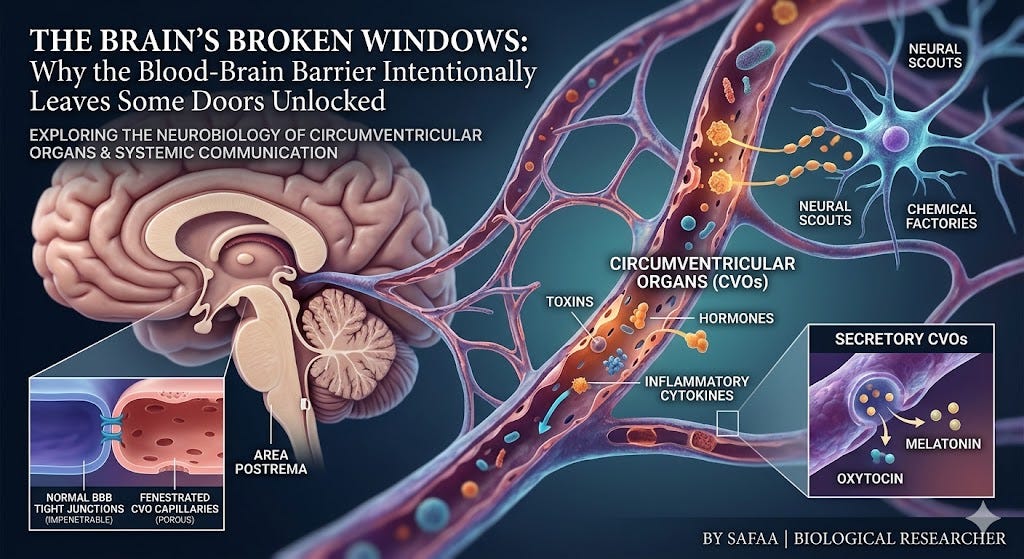
An anatomical illustration highlighting the Circumventricular Organs (CVOs) and fenestrated capillaries allowing the passage of toxins, cytokines, and hormones between systemic circulation and neural pathways. Created by Safaa | Biological Researcher (AI-generated illustration)
When we think of the Blood-Brain Barrier (BBB), we tend to visualize a biological fortress. It is a highly selective, microscopic wall of endothelial cells that guards our neural territory, fiercely filtering out circulating toxins, pathogens, and chaotic hormonal fluctuations while letting only vital nutrients pass. For decades, neuroscience taught us that this cellular security system was absolute — an unbroken seal protecting our psychological and biological sovereignty.
But what if I told you that this fortress has intentional holes?
What if certain, critical regions of the brain are completely naked to the bloodstream?
This isn’t a structural flaw or an evolutionary oversight. It is a masterful piece of biological engineering. In response to a fascinating discussion with one of my avid readers, John, we are diving deep into the neuro-architecture of the brain’s “open windows” — and correcting a common misconception about where they actually sit.
The Illusion of the Exposed Brain Stem
In popular neuropsychiatry literature, such as Dr. William Walsh’s pioneering work The Essence of Bipolar Disorder, there is frequent mention of brain regions escaping the strict surveillance of the BBB. This often leads to the assumption that the entire brain stem is left unprotected.
Biologically, however, an exposed brain stem would be an evolutionary death sentence.
The brain stem is our primal control center; it regulates autonomic, non-negotiable life functions such as respiration, blood pressure, and cardiac rhythm. Allowing systemic toxins or inflammatory cytokines to have unfettered, direct access to the entire brainstem would trigger neural chaos at the slightest infection.
The truth is far more precise. The brain stem is heavily guarded by **highly specialized tight junctions. However, sitting right on its dorsal border, tucked away in the medulla oblongata, lies a tiny, highly specialized structure that is completely devoid of a BBB: the Area Postrema**. This precise misunderstanding is likely the origin of the “exposed brain stem” myth.
And its purpose is nothing short of brilliant.
Enter the Circumventricular Organs (CVOs)
The Area Postrema belongs to an exclusive elite club of brain structures known as the Circumventricular Organs (CVOs). These are distinct midline structures lining the brain’s ventricular system that have intentionally traded their blood-brain barrier for a state of high vascularity and fenestrated (porous) capillaries.
Why would the brain leave these doors unlocked?
Because the brain cannot rule a body it cannot sense. If the neural fortress were completely sealed, the central nervous system would be biologically blind to what is happening in the systemic circulation. According to foundational research on **CVO neuro-anatomy** these zones serve as the brain’s sensory scouts and neuroendocrine chemical factories — windows through which the brain “tastes” and samples the blood in real-time.
Neuroscientists divide these open windows into two functional categories:
1. The Sensory Windows (The Inbound Scouts)
These organs sample the chemical composition of the blood and send immediate neural signals to the rest of the brain.
- The Area Postrema: Known as the “chemical trigger zone.” If you ingest something toxic, this naked patch of neural tissue detects the poison in the blood before it can damage the rest of the body, instantly triggering the emetic (vomiting) reflex to expel the threat.
- The Organum Vasculosum of the Lamina Terminalis (OVLT) & Subfornical Organ (SFO): These zones monitor systemic osmolarity (salt-to-water balance) and angiotensins. Detailed studies on **SFO fluid regulation** explain how these cells instantly trigger the cognitive sensation of thirst and signal the brain to conserve water when the blood becomes too concentrated.
2. The Secretory Windows (The Outbound Factories)
These organs lack a barrier because they need to release large macromolecules, such as hormones, directly into the bloodstream without encountering a cellular wall.
- The Posterior Pituitary Gland & Median Eminence: This is where master regulators such as oxytocin (the bonding hormone) and vasopressin are synthesized and released directly into the systemic circulation to modulate peripheral organs.
- The Pineal Gland: The cradle of your circadian rhythms. As highlighted in literature regarding **the pineal gland and melatonin pathways** it must release melatonin directly into the blood at night to synchronize your biological timetable without being blocked by a tight barrier.
The Double-Edged Sword: Vulnerability and Mental Health
While these open windows are fundamental to our homeostatic survival, they represent a profound neurobiological vulnerability.
Because the CVOs lack a tight barrier, they are the first brain regions to experience systemic inflammation. When your gut health is compromised or you are battling chronic metabolic stress, circulating pro-inflammatory cytokines cross through these unlocked windows.
Once inside the CVOs, these inflammatory signals can leak into adjacent protected brain regions — such as the hypothalamus and the limbic system. Landmark psychiatric insights into the **neuro-immune pathway of systemic inflammation** show how this influx can micro-dose the brain with stress signals, disrupt neurotransmitter synthesis (like dopamine and serotonin), and alter mood topography. This biomechanical pathway helps explain the organic roots behind severe mood fluctuations, anxiety, and conditions like bipolar disorder.
Guarding the Unlocked Doors
The brain’s architecture reminds us that true sovereignty isn’t about complete isolation; it is about controlled vulnerability. The brain leaves its windows open because communication with the body is worth the risk.
Our job, through targeted metabolic choices, anti-inflammatory habits, and intentional living, is to ensure that the blood flowing through those open windows is as clean, nourished, and calm as possible.
What are your thoughts on the brain’s open windows? If you’ve read Dr. Walsh’s work or have experienced how systemic stress alters your mental clarity, let’s continue the discussion in the comments below!
References
- Gould, D. J., & Sirelkhatim, A. (2023). Neuroanatomy, Blood Brain Barrier. StatPearls Publishing.
- Sisó, S., Jeffrey, M., & González, L. (2016). Sensory circumventricular organs in health and disease. Frontiers in Neuroanatomy, 10, 30.
- Hiyama, T. Y., & Noda, M. (2019). Sodium imaging of the subfornical organ and fluid regulation. PubMed Central (PMC), PMC6544435.
- Aulinas, A. (2020). Physiology of the Pineal Gland and Melatonin. Endotext [Internet]. MDText.com, Inc.
- Dantzer, R. (2018). Neuroimmune pathways of systemic inflammation: Relevance to psychiatry. World Psychiatry, 17(1), 15–16.
Support My Research & Stay Connected
If you found this biological deep dive valuable, I invite you to join my growing community of science-driven readers. My work is dedicated to exploring the intersection of neurobiology, psychoanalysis, and physical health to help you reclaim your Biological Sovereignty.
Subscribe to My Substack: Join the “Biological Sovereignty” newsletter for exclusive research updates, in-depth biological protocols, and nuanced insights delivered directly to your inbox. 👉 [Join the Community on Substack](https://safaalabib.substack.com/)
Support My Work on Patreon: If you’d like to support my independent research and help me create more high-quality, evidence-based content, consider becoming a patron. You can choose the tier that fits your level of curiosity. 👉[ Support My Research on Patreon](https://www.patreon.com/c/SafaaLabibBiology?vanity=user)
Explore More: You can find a collection of my published work and curated stories here: 👉[ Safaa Labib on Digitalmehmet](https://digitalmehmet.com/author/labibsafaa641/)
Thank you for being part of this journey toward mastering your internal ecosystem.
메타데이터
- post_id
- 89ab5f59d656
- slug
- the-brains-broken-windows-why-the-blood-brain-barrier-intentionally-leaves-some-doors-unlocked-89ab5f59d656
- url
- https://medium.com/health-science/the-brains-broken-windows-why-the-blood-brain-barrier-intentionally-leaves-some-doors-unlocked-89ab5f59d656
- canonical_url
- https://medium.com/health-science/the-brains-broken-windows-why-the-blood-brain-barrier-intentionally-leaves-some-doors-unlocked-89ab5f59d656
- author_url
- https://medium.com/@labibsafaa641
- status
- ok
- fetched_at
- 2026-06-09 15:37:30