The Trust Problem: Why Verification Badges on Escort Platforms Mean Almost Nothing (And What…
That little checkmark next to a profile doesn’t mean what you think it means.
The Trust Problem: Why Verification Badges on Escort Platforms Mean Almost Nothing (And What Actually Works)
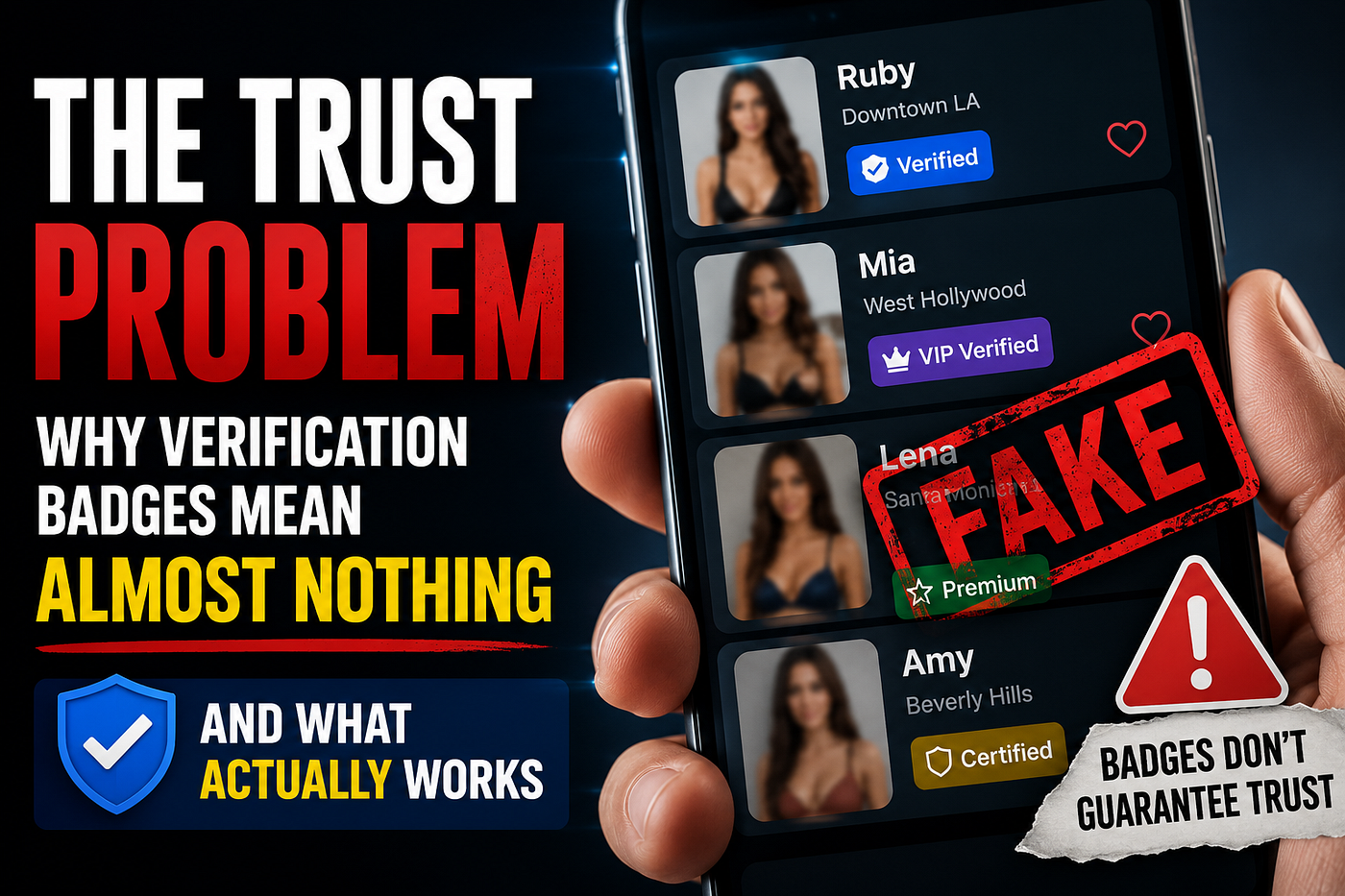
That little checkmark next to a profile doesn’t mean what you think it means.
I realized something troubling while comparing escort platforms last month: nearly every profile I clicked had some kind of verification badge. “Verified.” “VIP.” “Certified.” “Trusted Member.” Little icons promising legitimacy, plastered across hundreds of listings.
Here’s the problem: When I dug deeper — reverse image searching photos, cross-referencing information, checking review authenticity — I found zero correlation between verification badges and actual profile legitimacy.
Verified profiles used stolen photos. VIP accounts had obvious red flags. Certified members disappeared after collecting deposits.
The verification systems that were supposed to build trust had become decoration.
This isn’t just disappointing — it’s actively dangerous. Users make decisions based on trust signals they believe mean something. When platforms award badges indiscriminately, they create false security while genuine verification becomes impossible to identify.
So what’s actually happening with verification on escort platforms? And more importantly — what actually works when you’re trying to determine if a profile is legitimate?
What Verification Was Supposed to Mean
In the early days of escort platforms, verification served a clear purpose: confirming that the person in the photos is the person who will show up.
The promise was simple:
- Photos match the actual provider
- Identity has been confirmed (privately)
- The account represents a real person
- Some platform accountability exists
This mattered because escort browsing involves inherent information asymmetry. Providers meet clients in person. Clients make decisions based on photos, descriptions, and limited information. Trust signals help bridge that gap.
When verification worked, it meant:
A platform employee or automated system had:
- Confirmed photo authenticity (matching selfie with timestamp)
- Verified account ownership (email, phone, or ID confirmation)
- Checked that photos weren’t stolen from other sources
- Monitored account activity for suspicious patterns
The verification badge became shorthand for: “This platform vouches that this profile is legitimate.”
That was the theory.
How Platforms Degraded Verification Into Meaninglessness
What happened between “verification means something” and “verification is everywhere but meaningless”?
The Monetization Trap
Many platforms discovered verification badges could be monetized.
The evolution went like this:
Phase 1: Free verification based on actual standards
- Photo matching required
- Manual review process
- Limited badges awarded
- Correlation with legitimacy high
Phase 2: Freemium verification
- Basic verification free (weak standards)
- Premium verification paid (slightly better)
- More badges awarded
- Correlation weakening
Phase 3: Pay-to-play verification
- Verification tied to listing fees
- Anyone paying gets badge
- Automated approval
- Standards effectively eliminated
- Badges everywhere
- Correlation with legitimacy: zero
Platforms realized they could charge for verification badges without actually verifying anything. The badge became a revenue stream, not a trust signal.
Users still trusted the checkmark. Platforms knew it meant nothing.
The Competitive Pressure Problem
When one platform started handing out verification badges freely, others faced pressure to match.
If Platform A shows 80% verified profiles and Platform B shows 20%, users perceive Platform A as “safer” — even if Platform A’s verification is meaningless and Platform B’s is rigorous.
This created a race to the bottom:
- Platforms lowered standards to increase verification percentages
- Marketing emphasized “X% verified providers!”
- Actual verification quality plummeted
- Users couldn’t distinguish real from fake verification
The platforms optimizing for appearance of safety won users from platforms maintaining actual standards.
The Automation Excuse
Some platforms claim automated verification systems maintain standards while scaling.
In practice, automated verification often means:
- Upload any photo → Approved
- Email verification → Badge awarded
- Phone number confirmation → Verified status
- Pay listing fee → VIP badge
None of these actually verify that photos match the person, prevent stolen images, or confirm profile legitimacy.
Real verification requires:
- Timestamped photo matching (selfie with specific pose/text)
- Reverse image searching to catch stolen photos
- Behavioral monitoring for suspicious patterns
- Manual review of questionable accounts
Automation can assist these processes but can’t replace human judgment entirely — especially when scammers deliberately work to game automated systems.
The Multiple Badge Confusion
Many platforms now offer tiered verification:
- “Verified”
- “VIP Verified”
- “Premium”
- “Elite”
- “Certified”
- “Background Checked”
- “Photo Verified”
This creates several problems:
-
Users don’t know what each badge means Does “VIP” mean better verification or just a paid upgrade? Does “Premium” indicate screening or listing placement?
-
Platforms rarely explain badge criteria clearly Check the help sections — most are vague or nonexistent about what verification actually entails.
-
Multiple badges create false hierarchy Users assume higher tiers mean stronger verification. Often they just mean higher fees.
-
The badges become visual noise When every profile has 3–5 badges, they stop meaning anything.
The complexity provides cover for platforms to monetize trust signals without delivering actual verification.
Platform-by-Platform Verification Reality Check
Let me walk through what verification actually means (or doesn’t) on major platforms.
Eros: Verification Theater
What the badges claim:
- “VIP” status
- “Verified” profiles
- “Featured” listings
What they actually indicate:
VIP Status: Payment tier. You paid more for listing prominence. Zero verification involved. A scammer with $200 can get VIP status as easily as a legitimate provider.
Verified Badge: Extremely low bar. Usually just means:
- Email confirmed
- Payment processed
- Photos uploaded
I’ve seen verified Eros profiles using:
- Celebrity photos
- Stolen Instagram images
- Obvious stock photography
- Photos recycled across multiple fake accounts
The verification correlation: Near zero. The badges indicate payment status, not legitimacy.
Why it persists: Eros makes significant revenue from VIP upgrades and featured placements. Maintaining the illusion that these badges mean something drives sales.
What users should know: Ignore Eros badges completely. Verify profiles independently regardless of verification status.
Tryst: Actually Meaningful Verification
What makes Tryst different:
Manual Application Review: Tryst manually reviews provider applications before approval. This creates a baseline filter that auto-approval platforms lack.
What they check:
- Profile completeness
- Photo quality and consistency
- Information legitimacy
- Red flag patterns
Verification tiers that mean something:
- Basic approval (manual review passed)
- Photo verification (submitted matching selfie)
- Background verification (additional screening)
The verification correlation: Much higher than platforms with pay-to-play systems. When you see Tryst verification, it indicates actual platform review occurred.
Limitations:
- Not perfect — scammers still slip through
- Verification doesn’t guarantee service quality
- Manual review has subjective elements
What users should know: Tryst verification actually correlates with legitimacy, but still verify independently for high-stakes decisions. The manual screening eliminates obvious scams better than automated systems.
Slixa: Premium Positioning Isn’t Verification
What Slixa offers:
Premium Listing Model: Higher fees ($300–500/month typical) create natural filtering. Scammers running volume operations avoid platforms with high costs.
Profile Quality Standards: Slixa monitors photo quality and presentation. Profiles must meet aesthetic standards.
What this actually verifies:
- Provider willing/able to pay premium fees
- Photos meet quality benchmarks
- Profile formatting acceptable
What this doesn’t verify:
- Photo authenticity (professional photos can still be stolen)
- Identity confirmation
- Service legitimacy
- Review authenticity
The verification correlation: Medium. Premium pricing filters low-effort scams but doesn’t prevent sophisticated ones. Professional scammers invest in good photos and pay platform fees.
What users should know: Slixa’s model reduces certain scam types through cost barriers, but this is economic filtering, not verification. High-quality presentation doesn’t equal legitimacy.
Escortstime: Photo Verification Model
What Escortstime implements:
Photo Verification System: Requires current selfie matching profile photos. Not just “upload any photo” but specific matching to demonstrate the person in profile photos controls the account.
How it works:
- Provider submits timestamped selfie
- Platform compares to profile photos
- Verification badge awarded if match confirmed
- Monitored for suspicious activity patterns
What this verifies:
- Person in photos controls this account
- Photos represent current appearance
- Account holder willing to confirm identity to platform
What this doesn’t guarantee:
- Service quality
- Personality match
- Review authenticity (still developing review integration)
The verification correlation: Higher than pay-to-play systems. The photo verification requirement filters accounts using stolen photos or misrepresenting appearance.
Limitations:
- Smaller platform means less review data
- Newer verification system still building trust history
- Photo matching has edge cases (makeup, angles, etc.)
What users should know: The verification badge on Escortstime actually indicates specific verification steps occurred — photo matching, not just payment processing. This makes the badge meaningful for the narrow question: “Do these photos represent the account holder?”
Bedpage: Zero Verification
What Bedpage offers:
Essentially nothing.
Verification system: None. Open posting with minimal review.
Barriers to entry: Near zero. Anyone can post anything.
What this means:
- Highest volume of fake profiles
- Most stolen photos
- Maximum scam prevalence
- Users verify everything independently
Why some users still browse:
- Free for providers (attracts some legitimate budget-conscious providers)
- Familiar Backpage-style interface
- Sometimes finds options missing from curated platforms
What users should know: Assume every Bedpage listing is fake until proven otherwise. The lack of verification isn’t a bug — it’s the business model. Approach with extreme skepticism.
Verification Comparison Table

What Actually Indicates Profile Legitimacy (Since Badges Don’t)
If platform verification is unreliable, what actually works for vetting profiles?
1. Reverse Image Search
Most effective single verification method.
How to do it:
- Right-click profile photos
- “Search Google for image” (or use TinEye.com)
- Check if photos appear elsewhere
What you’re looking for:
- Photos stolen from Instagram/OnlyFans
- Images used on multiple escort accounts
- Stock photography or model portfolios
- Catfish profiles
Red flags:
- Photos appear on social media with different name
- Same photos across multiple escort accounts
- Professional model shots (unless clearly stated)
- Photos appearing in different cities/countries
Green flags:
- Photos appear only on this one account
- Consistent posting history
- Natural, non-professional photos mixed with professional ones
- Verifiable social media presence (if provided)
Tools:
- Google Image Search
- TinEye (more comprehensive)
- Yandex (catches images Google misses)
Time investment: 2–3 minutes Accuracy: 70–80% for catching stolen photos
2. Cross-Platform Consistency
Check if provider has presence across multiple platforms.
What to verify:
- Same photos across platforms
- Consistent information (services, rates, contact)
- Similar writing style and descriptions
- Active presence (not one-off posts)
Why this matters: Scammers typically create single-use accounts. Legitimate providers maintain consistent presence across platforms and over time.
How to check:
- Google the phone number (if provided)
- Search screen name variations
- Look for mentions on review sites
- Check social media (if linked)
Red flags:
- Information varies wildly across platforms
- Only exists on one platform
- Contradictory details (age, location, services)
- Recent accounts with no history
Green flags:
- Consistent presence across 2–3 platforms
- Account age measured in months/years
- Information aligns across platforms
- Verifiable review history
3. Communication Patterns
How someone communicates reveals legitimacy.
Legitimate provider communication typically:
- Responds within reasonable timeframe (hours, not minutes)
- Asks screening questions (new clients especially)
- Provides clear booking process
- Discusses rates and boundaries clearly
- Has professional tone (not overly sexual)
- Uses consistent contact method
Scammer communication patterns:
- Immediate responses at all hours (bot/farm)
- No screening questions (takes anyone)
- Vague about details
- Pushes for deposit immediately
- Overly sexual or “too good to be true” promises
- Changes contact methods frequently
- Pressure tactics (“book now or lose this rate”)
Testing legitimacy through communication:
Ask specific questions:
- “What area do you work in?” (scammers often vague)
- “What’s your screening process?” (legitimate providers have one)
- “Do you have a website or social media?” (establishes web presence)
Legitimate providers:
- Answer specifically
- Have clear screening requirements
- Direct you to additional information
- Professional boundaries
Scammers:
- Dodge specific questions
- No screening (major red flag)
- Resist providing verifiable information
- Push to move fast
4. Review Authentication
Reviews matter — but only if they’re real.
Fake review red flags:
- All reviews suspiciously positive (no balanced feedback)
- Generic language (“great experience, would recommend”)
- Posted in clusters (all within days)
- No specific details
- Similar writing style across reviews
Authentic review indicators:
- Mix of platforms (TER, Tryst, independent sites)
- Specific details (location, timing, interaction descriptions)
- Balanced feedback (minor criticisms alongside praise)
- Posted over time (months/years)
- Different writing styles (clearly different people)
- Verifiable reviewer accounts
How to check review authenticity:
Cross-reference:
- Check if reviews appear on multiple platforms
- Look for reviewer post history (one-time reviewers suspect)
- Google specific review text (copy-paste jobs)
Look for patterns:
- Do reviews describe consistent experience?
- Do they mention verifiable details?
- Are reviewers established community members?
Red flags:
- Provider only has self-reported reviews
- No reviews on established review sites
- All reviews from new/single-use accounts
5. Social Media Presence
Legitimate providers often maintain social media.
What to look for:
- Twitter/X accounts with posting history
- Instagram (if platform allows)
- OnlyFans or similar (verifiable paid content)
- Consistent presence over time
Why this matters: Building social media presence takes time. Scammers don’t invest in this. Real providers use it for marketing and client connection.
Verification steps:
Check account age:
- New accounts (weeks) = suspicious
- Established accounts (months/years) = more legitimate
Review posting patterns:
- Regular posts over time = real person
- Sudden burst then nothing = possible fake
- Interactions with other providers = community connection
Look for verification:
- Many providers verify on Twitter through provider networks
- Cross-platform photo verification (same person across platforms)
- Engagement with established community members
Red flags:
- No social media presence at all (not definitive but worth noting)
- Brand new accounts
- No interactions or community connection
- Photos don’t match escort profile
6. Screening Requirements
Legitimate providers screen clients. Scammers don’t.
Standard screening might include:
- Employment verification
- ID confirmation (sometimes)
- References from other providers
- Deposit (for outcall or new clients)
- Verification through established systems
Why legitimate providers screen:
- Safety (knowing who they’re meeting)
- Filtering time-wasters
- Legal protection
- Professional standards
Why scammers don’t screen:
- Want maximum victims
- Can’t risk legitimacy checks
- No actual meeting planned
- Volume operation model
Red flag: Provider asks for deposit but NO screening information. This pattern suggests: “I’ll take anyone’s money, no questions asked.”
Green flag: Provider has clear screening process, asks questions, and provides verification methods. This suggests: “I’m selective and professional.”
7. Website and Online Presence Quality
Legitimate providers often invest in web presence.
Indicators of legitimacy:
- Personal website (shows investment)
- Professional photos (consistent with escort profile)
- Clear booking information
- Active blog or updates
- Social media links
- Tour schedule (if traveling provider)
- Detailed FAQ section
Why this matters: Building and maintaining a website requires time, money, and commitment. Scammers working volume operations don’t invest in this infrastructure.
What to check:
Website quality:
- Professional design (not template default)
- Regular updates (check blog dates)
- Working contact methods
- Matches information on escort platforms
Consistency:
- Photos match escort listings
- Rates align across platforms
- Services described consistently
- Contact info same everywhere
Red flags:
- No website despite being “established”
- Website contradicts escort profile
- Outdated information
- Broken links or poor maintenance
8. Deposit Requests (The Tricky One)
Deposits are complicated — legitimate providers use them, but so do scammers.
Legitimate deposit scenarios:
- Outcall appointments (provider traveling to you)
- New clients (no reference history)
- Extended bookings (multiple hours)
- Special requests (specific outfits, etc.)
Legitimate providers handling deposits:
- Clear cancellation policy
- Reasonable amount (20–30% typical)
- Professional payment methods
- Provide verification of legitimacy first
- Answer questions about refund policy
Scammer deposit patterns:
- Deposit required before ANY verification
- Vague about refund policy
- High percentage demanded (50%+)
- Pressure tactics
- Payment methods hard to reverse (gift cards major red flag)
- No booking confirmation after payment
Safety approach:
Before sending deposit:
- Complete all verification steps above
- Confirm provider legitimacy through multiple methods
- Understand cancellation policy
- Use reversible payment method if possible
- Get confirmation details (time, location, etc.)
Never send deposits via:
- Gift cards (MAJOR scam indicator)
- Cryptocurrency (irreversible)
- Wire transfer to unknown person
- Payment apps to unverified accounts
Safer deposit methods:
- Established provider’s business payment system
- Refundable methods (credit card, certain apps)
- Small amounts only (test legitimacy)
The Verification Methods That Actually Work: Summary

Most effective combination: Reverse image search + Cross-platform check + Communication assessment = 80%+ scam filtering in 15 minutes.
Why Platforms Won’t Fix Verification (The Uncomfortable Truth)
You might wonder: “If verification is broken, why don’t platforms fix it?”
The honest answer: They profit more from broken verification.
The Business Model Conflict
Platform revenue comes from:
- Listing fees (more listings = more money)
- Premium upgrades (verification badges included)
- Featured placements (often bundled with “verification”)
- Advertising (more profiles = more page views)
Real verification would:
- Reject many applications (fewer listings)
- Require manual review (higher costs)
- Reduce premium badge sales (fewer people qualify)
- Lower profile counts (less ad revenue)
The incentive structure rewards volume over quality.
The Liability Problem
Serious verification creates liability.
If a platform says “we verified this profile” and something goes wrong, they face potential legal exposure.
The solution? Make verification meaningless. Call it “verification” for marketing, but ensure terms of service clarify: “verification doesn’t verify anything, users responsible for own vetting.”
This protects platforms legally while maintaining the appearance of safety.
The Competitive Pressure
Platform A: “We manually screen every provider!” Result: 500 listings, high quality, slow growth
Platform B: “We have 5,000 verified providers!” Result: 5,000 listings, low quality, fast growth
Which platform gets more users initially? Platform B. Users see numbers and verification percentages before experiencing quality problems.
By the time users realize verification is meaningless, Platform B has market share.
User Behavior Enables This
Harsh truth: Most users don’t verify independently.
They see a checkmark and trust it.
Platforms know this. They optimize for the appearance of safety because most users don’t dig deeper.
The users who do verify independently don’t need platform verification anyway.
This creates a cycle:
- Platforms provide weak verification
- Most users trust it blindly
- Scammers exploit it
- Sophisticated users ignore it
- Platforms have no incentive to change
What Would Real Verification Look Like?
If platforms actually wanted to solve this, here’s what would work:
Multi-Factor Verification
Combine multiple verification types:
Level 1: Photo Verification
- Timestamped selfie matching profile photos
- Real-time video verification option
- Periodic re-verification (monthly/quarterly)
Level 2: Identity Verification
- ID confirmation (kept private)
- Age verification
- Location confirmation
Level 3: Activity Monitoring
- Behavioral analysis (flagging suspicious patterns)
- Review authentication
- User feedback integration
- Scam report tracking
Level 4: Community Verification
- Provider network vouching
- Established client references
- Industry reputation signals
Tiered badges indicating which levels passed.
Users would know: “Photo verified” means specific thing. “Full verification” means all levels passed.
Transparent Verification Standards
Platforms should publish:
- Exact verification requirements
- What each badge means
- Pass/fail rates
- Re-verification schedules
- How users can report fake profiles
Current state: Vague or nonexistent documentation.
Better state: “Our photo verification requires matching selfie with current date, verified by human reviewer within 24 hours. 30% of applications fail this step.”
Transparency builds actual trust.
Consequences for Fake Verification
Current state: Fake profiles face minimal consequences. Account might get deleted, they create new one.
Better approach:
- Device fingerprinting (harder to create multiple fake accounts)
- IP tracking and blocking
- Payment method blacklisting
- Industry-wide ban sharing (between legitimate platforms)
Make the cost of running scams higher than potential profits.
User Verification Options
Let users choose verification depth:
Some users want minimal friction, some want maximum verification.
Platform could offer:
- “Browse all listings” (unverified included)
- “Browse verified only” (photo verification minimum)
- “Browse premium verified” (full verification completed)
User controls their risk tolerance.
What You Should Do Right Now
Given that platform verification is largely theater, here’s your practical verification workflow:
Before Even Clicking a Profile:
Quick filters:
- Platform matters (Tryst/Escortstime verification more meaningful than Eros)
- Account age visible? (older = more legitimate typically)
- Profile completeness (detailed = more invested)
When Reviewing Profile:
Spend 5 minutes on:
Reverse image search (2 minutes)
- Right-click main photos
- Google image search
- Check for duplicates
Cross-platform check (3 minutes)
- Google phone number (if listed)
- Search screen name
- Look for other platform presence
If these pass → continue. If red flags → move on.
Before Initial Contact:
Spend 10 minutes on:
Review search (5 minutes)
- Google: [provider name] + review
- Check established review sites
- Look for pattern consistency
Social media check (5 minutes)
- Search Twitter/X handle
- Look for posting history
- Check community connections
During Communication:
Evaluate:
- Response patterns (professional vs. scammy)
- Screening requirements (legitimate providers screen)
- Information consistency
- Communication clarity
Before Commitment:
Final checks:
- Everything still aligns
- No new red flags emerged
- Comfortable with verification level
- Clear on booking details
Total time investment: 15–20 minutes Scam filtering effectiveness: 80–90%
This beats trusting a meaningless verification badge.
The Future of Trust Signals
What might actually work better than current broken systems?
Blockchain-Based Identity Verification
Concept: Providers verify identity once through trusted system. Verification credential stored on blockchain. Providers share verification proof without revealing identity.
Benefits:
- Privacy preserved
- One-time verification usable across platforms
- Harder to fake
- Transparent verification standards
Challenges:
- Adoption barriers
- Technical complexity
- Privacy concerns
- Industry coordination needed
Status: Experimental, not mainstream yet.
Decentralized Review Systems
Concept: Reviews stored on decentralized systems, not controlled by platforms. Can’t be deleted or manipulated.
Benefits:
- Review authenticity higher
- Platform can’t hide bad reviews
- Long-term reputation tracking
- Cross-platform consistency
Challenges:
- Privacy concerns
- Moderation difficulties
- False review problems
- Adoption barriers
Status: Some experimentation, not widespread.
AI-Assisted Verification
Concept: AI systems analyze patterns to flag likely fakes:
- Photo consistency checking
- Behavioral analysis
- Language pattern recognition
- Cross-platform matching
Benefits:
- Scales better than manual review
- Catches patterns humans miss
- Continuous learning
- Cost-effective
Challenges:
- Privacy implications
- False positives
- Scammers gaming AI systems
- Requires significant data
Status: Some platforms experimenting, early stages.
Community-Driven Verification
Concept: Providers verify each other through networks. Established providers vouch for new ones.
Benefits:
- Industry insider knowledge
- Network effects (reputation matters)
- Self-policing incentives
- Harder for outsiders to game
Challenges:
- Excludes newcomers
- Potential gatekeeping
- Network must stay honest
- Doesn’t help clients verify
Status: Exists informally, not systematized.
What Platforms Get Right (The Few Examples)
Despite widespread problems, some approaches work:
Escortstime’s Geographic Trust
What works: By organizing listings geographically and implementing photo verification specifically for that location, Escortstime creates accountability.
Scammers running operations across cities can’t easily fake location-specific verification. This neighborhood-focused approach makes verification more meaningful.
Tryst’s Manual Screening
What works: Human review catches obvious fakes automated systems miss. The extra friction filters scammers seeking easy targets.
Community Self-Organization
What works: Providers sharing scammer alerts, maintaining private verification networks, and vouching for each other creates trust outside platform systems.
Frequently Asked Questions
What does “verified” actually mean on escort platforms?
Direct answer: It depends entirely on the platform, but on most major sites, “verified” simply means the provider paid for a listing or confirmed an email address. It rarely indicates actual identity verification or photo authentication.
Platform breakdown:
- Eros: Verified = paid tier, not identity verification
- Tryst: Verified = passed manual application review (more meaningful)
- Slixa: Premium tier = paid expensive fees (economic filtering only)
- Escortstime: Verified = photo matching completed (specific verification type)
- Bedpage: No verification system
What you should do: Ignore verification badges on most platforms. Verify profiles independently using reverse image search, cross-platform checking, and communication assessment.
How can I tell if an escort profile is real?
Direct answer: Use reverse image search (2 minutes), check for consistent presence across multiple platforms (5 minutes), and assess communication patterns. Legitimate providers have verifiable online presence, professional communication, and screening processes.
Step-by-step verification:
Reverse image search photos (catches 70% of fakes immediately)
- Right-click profile photos
- “Search Google for image”
- Check if photos appear elsewhere
Cross-platform consistency check
- Google phone number
- Search screen name
- Look for presence on 2–3 platforms with matching information
Communication assessment
- Legitimate providers ask screening questions
- Professional tone
- Clear booking process
- Reasonable response times
Social media presence
- Check Twitter/X for posting history
- Look for community connections
- Verify account age
Red flags:
- Photos appear on multiple accounts or social media
- No screening requirements
- Immediate responses 24/7 (bot behavior)
- Pressure for immediate deposit
- Vague about location or details
Time investment: 15–20 minutes Effectiveness: 80–90% scam filtering
Which escort platform has the most reliable verification?
Direct answer: Tryst has the most comprehensive verification through manual application screening. Escortstime offers meaningful photo verification. Most other major platforms have weak or pay-to-play verification systems that don’t indicate legitimacy.
Platform ranking by verification reliability:
- Tryst — Manual screening, application review, meaningful badges
- Escortstime — Photo verification system correlates with legitimacy
- Slixa — Premium pricing filters low-effort scams (economic, not verification)
- Eros — Verification badges meaningless (pay-to-play system)
- Bedpage — No verification system
Important context: Even platforms with strong verification aren’t perfect. Always verify independently regardless of platform badges. No platform verification replaces personal due diligence.
Are expensive escorts more likely to be legitimate?
Direct answer: Price correlates weakly with legitimacy. Premium pricing filters some low-effort scams, but sophisticated scammers target high-price markets. Verification methods (reverse image search, cross-platform checking) matter more than price.
Why price is unreliable indicator:
Price might indicate legitimacy when:
- Provider maintains expensive website
- Consistent presence over time
- Strong review history
- Professional presentation throughout
Price doesn’t guarantee legitimacy because:
- Scammers know expensive = perceived quality
- Stolen photos often show upscale presentation
- High deposit scams target premium market
- Professional scammers invest in appearances
Better indicators than price:
- Verifiable online presence (months/years)
- Consistent information across platforms
- Authentic review history
- Professional screening process
- Active social media with community connections
Strategy: Use verification methods regardless of price point. Budget providers can be legitimate; expensive providers can be scams. Price tells you market positioning, not authenticity.
What are the biggest red flags in escort profiles?
Direct answer: Stolen photos (detectable via reverse image search), no screening requirements, pressure for immediate deposits, and vague location information are the biggest red flags. Legitimate providers have screening processes and verifiable online presence.
Critical red flags (avoid immediately):
Photos appear elsewhere online
- Celebrity/model photos
- Instagram/social media photos with different identity
- Same photos on multiple escort accounts
No screening whatsoever
- Accepts anyone without questions
- No verification requirements
- Too easy to book
Deposit demanded before verification
- Wants money before answering questions
- Vague about booking details
- Payment via gift cards (MAJOR red flag)
Communication patterns:
- Immediate responses 24/7 (bot behavior)
- Overly sexual language immediately
- Pressure tactics (“book now!”)
- Changes contact methods frequently
Information inconsistencies:
- Vague about location
- Details change across platforms
- New account with no history
- Too good to be true pricing/services
Moderate warning signs:
- No social media presence
- Only exists on one platform
- Generic profile descriptions
- Stock-looking professional photos only
Green flags to look for:
- Photos pass reverse image search
- Screening process exists
- Consistent presence across platforms
- Professional but natural communication
- Verifiable reviews
- Active social media
Can I trust reviews on escort platforms?
Direct answer: Review authenticity varies dramatically by platform and provider. Look for reviews on multiple independent sites, specific details, balanced feedback, and posting history over time. Self-reported or platform-exclusive reviews are often fake.
Fake review indicators:
- All extremely positive (no balanced feedback)
- Generic language (“great time, would recommend”)
- Posted in clusters (all within days)
- Only appear on provider’s own site
- Similar writing style across reviews
- No reviewer history or profile
Authentic review indicators:
- Appear on multiple platforms (TER, Tryst, independent sites)
- Specific details about experience
- Balanced feedback (minor criticisms exist)
- Posted over extended time (months/years)
- Different writing styles (clearly different people)
- Reviewers have established accounts
How to verify review authenticity:
Cross-platform check
- Does provider have reviews on independent sites?
- Do reviews appear in multiple places?
- Consistent experience described?
Reviewer verification
- Check reviewer post history
- One-review accounts suspicious
- Established reviewers more credible
Detail analysis
- Specific verifiable details included?
- Generic praise vs. substantive description?
- Does experience sound realistic?
Platform comparison:
- Tryst: Integrated verification system (more reliable)
- Independent review boards: More authentic but smaller sample
- Provider websites: Often curated/filtered
- Eros: Requires external verification
Best practice: Look for review patterns across multiple platforms, not individual glowing testimonials.
Is photo verification on escort sites actually reliable?
Direct answer: Photo verification reliability depends on implementation. Platforms requiring timestamped selfies matching profile photos (like Escortstime) provide meaningful verification. Platforms where “photo verified” just means “uploaded photo” (like Eros) provide zero verification value.
What real photo verification requires:
Minimum standard:
- Current selfie submission
- Timestamp or specific text/pose
- Comparison to profile photos
- Human or AI matching verification
Gold standard:
- Real-time video verification
- Periodic re-verification
- Behavioral monitoring for account takeovers
- Multiple angle photo matching
What fake “photo verification” means:
- Provider uploaded any photo
- Email confirmed
- Payment processed
- No actual matching occurred
Platform comparison:
Meaningful photo verification:
- Escortstime: Requires matching selfie, correlates with legitimacy
- Tryst: Manual review includes photo assessment
- Some independent providers: Self-implement through Twitter/social media
Weak/meaningless photo verification:
- Eros: “Verified” indicates payment tier
- Slixa: Premium tier doesn’t verify photos
- Most platforms: Badge doesn’t indicate actual photo matching
How to verify photos yourself:
- Reverse image search (catches stolen photos)
- Cross-platform comparison (consistent photos across sites)
- Social media check (same person across platforms)
- Request verification photo (timestamped selfie)
Bottom line: Platform photo verification only meaningful if platform explains specific process. Otherwise, verify independently.
Should I pay a deposit to an escort I haven’t met?
Direct answer: Deposits are sometimes legitimate (outcalls, new clients, extended bookings) but also common scam tactic. Never pay deposits before thorough verification. Legitimate providers complete verification first, have clear policies, and use safe payment methods. Gift card requests are always scams.
When deposits are legitimate:
- Outcall appointments (provider traveling to you)
- New client with no references (screening alternative)
- Extended bookings (multiple hours/overnight)
- Special requests (specific wardrobe, preparation)
Legitimate deposit handling:
- Provider completes verification first (you verify them)
- Clear cancellation/refund policy stated
- Reasonable amount (20–30% typical, not 50%+)
- Professional payment methods
- Booking details confirmed (time, location, duration)
Deposit scam patterns:
- Demanded before ANY verification
- High percentage required (50%+ suspicious)
- Gift cards requested (ALWAYS SCAM)
- Cryptocurrency or irreversible methods
- Vague about refund policy
- Pressure tactics (“pay now or lose booking”)
- No confirmation details provided
Safe deposit practices:
Before sending any deposit:
- Complete full verification (reverse image search, etc.)
- Verify provider across multiple platforms
- Check review history
- Understand cancellation policy
- Get booking confirmation details
Payment methods to avoid:
- Gift cards (iTunes, Amazon, etc.) — SCAM
- Cryptocurrency — irreversible
- Wire transfer — hard to reverse
- Cash apps to unverified accounts
Safer payment methods:
- Provider’s established business system
- Credit card (chargeback protection)
- Payment apps with buyer protection
- Small test amounts first
Critical rule: If provider demands deposit before answering verification questions or providing legitimacy proof, it’s a scam. Legitimate providers understand security concerns and verify themselves first.
Final Thoughts: Trust Yourself, Not Badges
The uncomfortable truth about escort platform verification: it’s mostly security theater.
Platforms benefit from the appearance of safety without the cost of actual verification. Users feel secure seeing checkmarks, even when those checkmarks mean nothing. Scammers exploit this gap between perception and reality.
This isn’t about to change. The business incentives point toward more verification badges, not better verification. Platforms will continue selling the illusion of safety because it’s more profitable than providing actual safety.
So what do you do?
Stop trusting platforms to verify for you. Build your own verification process:
- 5 minutes of reverse image searching
- 10 minutes of cross-platform checking
- Professional communication assessment
- Review pattern analysis
This 15-minute investment beats any verification badge.
The providers worth seeing understand this. They welcome questions, provide verification, maintain professional online presence, and implement screening. They know legitimate clients do due diligence.
The scammers resist verification. They want users who trust badges blindly. Your willingness to verify independently filters them out automatically.
Choose platforms that make verification easier:
- Geographic organization (like Escortstime) helps verify location claims
- Manual screening (like Tryst) filters obvious fakes
- Review integration provides transparency
But never mistake platform features for personal responsibility.
Your safety depends on you, not on checkmarks.
Verification badges don’t mean what they should. Now you know what actually works instead.
About the Author: I analyze digital marketplace trust systems and user verification patterns across industries. For organized escort discovery with meaningful photo verification standards, check Escortstime.
메타데이터
- post_id
- 89b3fe4e16c4
- slug
- the-trust-problem-why-verification-badges-on-escort-platforms-mean-almost-nothing-and-what-89b3fe4e16c4
- url
- https://medium.com/@kritikaferry/the-trust-problem-why-verification-badges-on-escort-platforms-mean-almost-nothing-and-what-89b3fe4e16c4
- canonical_url
- https://medium.com/@kritikaferry/the-trust-problem-why-verification-badges-on-escort-platforms-mean-almost-nothing-and-what-89b3fe4e16c4
- author_url
- https://medium.com/@kritikaferry
- status
- ok
- fetched_at
- 2026-06-09 15:37:30