How to Build Backlinks for a Brand New Website (Step-by-Step Guide for 2026)
Starting a new website is exciting. Then you check your rankings and realize Google has no idea you exist. No traffic. No authority. No…
How to Build Backlinks for a Brand New Website (Step-by-Step Guide for 2026)
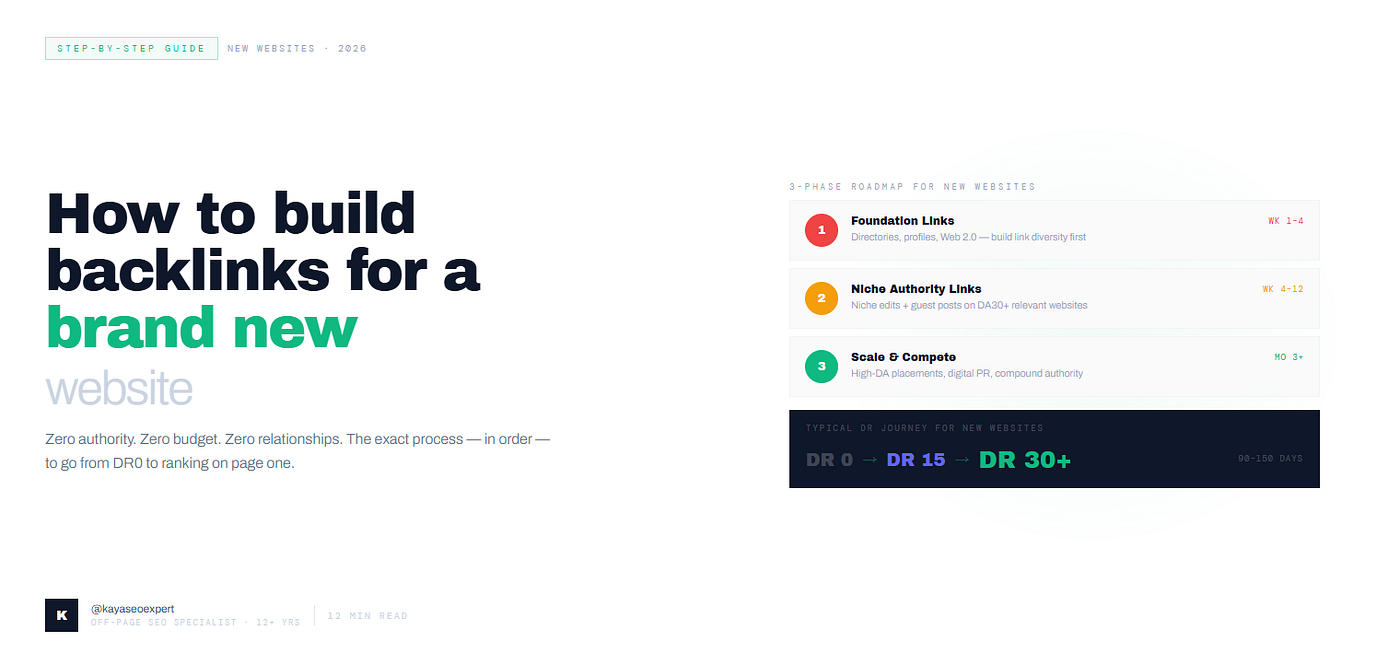
Starting a new website is exciting. Then you check your rankings and realize Google has no idea you exist. No traffic. No authority. No visibility. The fix is backlinks — but where do you start when you have zero domain authority, zero budget for expensive tools, and no existing relationships with other websites?
This guide gives you the exact process, in order, with no fluff.
Why New Websites Struggle to Rank (And Why Backlinks Are the Solution)
Google evaluates websites on two fundamental dimensions: relevance (what your website is about) and trust (how much authority it has).
On-page SEO handles relevance. Your content, keywords, and site structure tell Google what topics you cover. Most new websites get this part reasonably right.
The trust dimension is where new websites fail — and it’s almost entirely determined by backlinks.
A brand new website, regardless of content quality, starts with a Domain Rating (DR) of zero. Google has no external evidence that your website is worth trusting. Without backlinks from established, relevant websites vouching for you, even excellent content sits invisible on page 5 or beyond.
The good news: this is a solvable problem. Domain authority is buildable. And the process for building it — done correctly — produces compounding results that get easier over time, not harder.
Before You Build a Single Backlink: The Foundation
Most new website owners make the same mistake: they start building backlinks before their website is ready to benefit from them.
Backlinks amplify existing signals. If those signals are weak, backlinks underperform. Spend the first two weeks on these foundations before any outreach:
On-page SEO essentials:
- Every page has a unique, keyword-relevant title tag under 60 characters
- Each page has a meta description that accurately describes the content
- Your H1 tag includes your primary keyword naturally
- Your content genuinely addresses the search intent of your target keywords
- Pages load quickly on mobile (test with Google PageSpeed Insights)
Technical foundations:
- Google Search Console set up and your sitemap submitted
- Your website is indexable (check robots.txt isn’t blocking Google)
- SSL certificate active (HTTPS not HTTP)
- No broken internal links
Content minimum: At least 5–8 well-written, genuinely useful pages before you start link building. Google needs enough content to understand what your website is about. A website with 2 thin pages won’t benefit much from backlinks regardless of quality.
Once these are in place, you’re ready to build.
Phase 1: Foundation Links (Week 1–4)
The goal of this phase is to create your first layer of link diversity — making your backlink profile look naturally discovered rather than manufactured.
Business and Brand Directories
Start with legitimate business directories that Google trusts. These are easy wins that establish basic brand signals:
- Google Business Profile — if you serve a local market, this is non-negotiable
- Bing Places — often overlooked, still valuable
- Yelp — relevant for local and service businesses
- Crunchbase — for businesses and startups
- LinkedIn Company Page — creates a high-DA backlink immediately
- Facebook Business Page — same principle
Each of these creates a citation — a mention of your brand, URL, and basic information — that contributes to your early authority signals.
Niche-Relevant Profile Links
Most industries have their own platforms where professionals and businesses create profiles. These vary by niche:
- SEO and digital marketing: Moz Community, SEMrush Academy, Search Engine Journal author profiles
- Software/tech: GitHub, ProductHunt, AngelList
- Creative: Behance, Dribbble, 99designs
- Healthcare: Healthgrades, Zocdoc (where relevant)
- General business: Alignable, Better Business Bureau, Chamber of Commerce
The key is niche relevance. A profile link from a platform in your industry sends a stronger topical signal than a generic directory.
Web 2.0 Properties
Creating simple content on free publishing platforms generates indexable links pointing back to your website. These contribute to link diversity and help Google establish that your website is being discovered across multiple contexts.
Effective platforms include Blogger, WordPress.com, Medium (where you can publish supporting articles), Tumblr, and Weebly. Create genuine content — not thin placeholder pages — and include a natural contextual link back to a relevant page on your website.
Phase 2: Niche-Relevant Authority Links (Week 4–12)
Once your foundation links are in place and your first DR movement is visible (typically around week 4–6), you shift to building links that directly accelerate authority.
Niche Edits (Link Insertions)
This is one of the most effective methods for new websites because it produces results faster than any other approach.
A niche edit involves getting your link inserted into an existing, already-indexed, already-ranking article on a relevant website in your niche. Because the hosting page already has Google’s trust and is receiving traffic, your link starts contributing authority significantly faster than a link on a freshly published page.
The process:
- Identify articles ranking in your niche that are topically related to your target pages
- Reach out to the website owner with a specific, value-adding proposal — your link should enhance the article for their readers
- Agree on placement and anchor text
- Confirm indexation after placement
For new websites, 10–15 well-placed niche edits in the first 60 days can produce more DR movement than 50 lower-quality links.
Guest Posting
Guest posting means writing a genuinely useful article for another website in your niche, in exchange for a contextual backlink to your site.
This remains the most credible link building method available in 2026. An editorial link within original content on a high-DA, niche-relevant website is the highest-authority signal a new website can acquire.
Finding guest post opportunities:
Search Google for:
- your niche + “write for us”
- your niche + “guest post guidelines”
- your niche + “contribute”
- your niche + “submit an article”
Target websites with DA 25+ that cover your topic area and have real organic traffic. Avoid websites that clearly accept anything — editorial standards are what make a guest post link valuable.
Writing the pitch:
Keep it short. Editors receive dozens of pitches. A two-paragraph email with a specific article idea relevant to their audience performs far better than a generic template.
Reference a specific article on their website and explain how your proposed piece would complement or extend it. Include your website URL so they can verify your credibility.
Writing the article:
Make it the best piece on the topic you can produce. A weak guest post gets rejected or, if published, reflects poorly on your brand. A genuinely excellent guest post may earn additional social sharing and secondary links beyond the direct backlink you negotiated.
Phase 3: Scaling Authority (Month 3 and Beyond)
By month 3, if you’ve built consistently through phases 1 and 2, your DR should have moved from zero to somewhere in the 15–25 range. You’re now positioned to pursue higher-authority placements.
Higher-DA Guest Posts
With some authority established, pitching DA 40–60 websites becomes more realistic. These sites often require demonstrated credibility — having published pieces elsewhere helps. Use your earlier guest posts as portfolio evidence when pitching larger publications.
Digital PR
Digital PR means getting your website featured in news articles, roundup posts, expert Q&As, and industry publications. Unlike standard guest posts, these placements are editorially awarded — you’re not negotiating a link, you’re being selected as a source.
Methods that work for new websites:
HARO (Help a Reporter Out) and similar services: Journalists and bloggers post questions seeking expert sources. Responding quickly with specific, quotable expertise can earn links from high-DA news sites and publications.
“Best of” roundup outreach: Many niches have annual or regular roundup articles (“best tools for X,” “top resources for Y”). Reaching out to authors of existing roundups with a specific, compelling reason to include your website can earn high-value placements.
Data and research: Creating original data — surveys, studies, or unique analyses — gives journalists and bloggers a reason to cite and link to your website. Even simple original research generates links that would otherwise be impossible to acquire through outreach alone.
Anchor Text Strategy for New Websites
New websites make a common anchor text mistake: over-optimizing toward exact-match keyword anchors because it feels like the most logical approach.
Exact-match anchors (“best SEO services,” “buy running shoes”) trigger Google’s spam filters when they appear too frequently. A profile that’s heavily weighted toward exact-match anchors looks manufactured — because it is.
The distribution that works for new websites:
- 50% branded (your website name, your URL, your brand): Always natural, always safe, especially important when you have limited history
- 30% partial match (related phrases, not exact keywords): “this SEO guide,” “their link building service,” “this fitness resource”
- 20% generic (“read more,” “click here,” “this article”)
Save exact-match anchors for 5–10% of your profile maximum, and only after you’ve built enough branded and generic anchors to make the profile look natural.
What to Track and When
Checking rankings daily during a new website link building campaign is counterproductive. The data is too noisy and the natural fluctuations will mislead you.
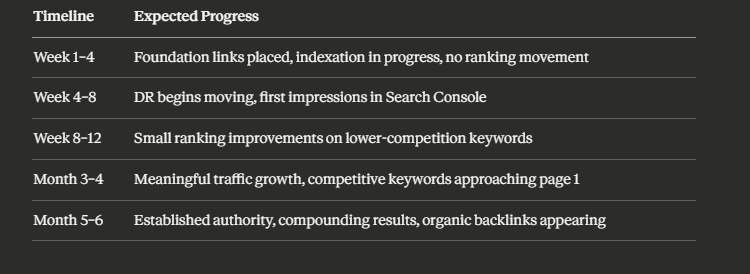
Week 1–4: Track link indexation only. Use site:linkingpageurl.com in Google to confirm your links are being indexed.
Week 4–8: Track DR in Ahrefs free checker and Search Console impressions. Are either moving upward?
Week 8–12: Track keyword positions for your 3–5 primary target pages. Expect small but consistent improvements.
Month 3+: Track organic traffic month-over-month in Search Console. Measure conversion metrics from organic visitors.
How Many Backlinks Does a New Website Need?
There’s no universal number — but there’s a calculable target specific to your niche and keywords.
The methodology: find the average DR of the top 5 websites ranking for your most important keyword. That’s your competition threshold. The gap between their average DR and your current DR tells you approximately how much authority you need to build.
A 15-point gap typically requires 25–50 high-quality links. A 25-point gap requires 50–80. At typical new website starting points, most niches are reachable in 90–150 days with consistent effort.
I covered this full calculation methodology in detail here: how many backlinks do you actually need to rank in 2026
Common Mistakes New Website Owners Make
Starting with too few pages: Google needs enough content to understand your website’s topical focus. Five pages minimum before link building.
Building all links in one burst: 50 links in 48 hours looks unnatural. 8–12 links per week over months looks like organic discovery.
Ignoring topical relevance: A DA60 food blog linking to your accounting software contributes almost nothing. A DA25 accounting community linking to you contributes significantly more.
Stopping at 30 days: The compounding effect that produces visible results typically kicks in at day 60–90. Most new website owners quit before this happens.
Buying cheap bulk packages: These deliver links that Google either ignores or penalizes. The short-term cost saving becomes a long-term ranking problem that takes months to fix.
I covered why backlinks sometimes fail to produce results even when they’re technically built here: why your website is not ranking on Google even with backlinks
The Realistic Timeline for a New Website
Based on consistent link building using the approach in this guide:
Ready to Build Your First Backlinks?
If you want to skip the outreach process and have the link building done professionally — I build manual, white-hat backlinks for new and established websites.
What I offer:
- Web 2.0, profile, and contextual links for foundation building
- Niche-relevant placements from real websites
- Full report with every link delivered
- Safe, Google-compliant methods — no automation, no spam
Before ordering — message me first. Tell me your website URL, your niche, and your target keywords. I’ll review your situation and recommend the right starting package.
👉 **View my backlink service on Fiverr**
How old is your website and what DR are you starting from? Drop it in the comments — I’ll tell you what phase of this guide is most relevant to where you are right now.
About the author: Off-Page SEO specialist with 12+ years of experience helping new and established websites build domain authority through manual, niche-relevant link building. 259+ completed orders. 5.0 rating.
메타데이터
- post_id
- 89b85d5355ff
- slug
- how-to-build-backlinks-for-a-brand-new-website-step-by-step-guide-for-2026-89b85d5355ff
- url
- https://medium.com/@kayaseoexpert/how-to-build-backlinks-for-a-brand-new-website-step-by-step-guide-for-2026-89b85d5355ff
- canonical_url
- https://medium.com/@kayaseoexpert/how-to-build-backlinks-for-a-brand-new-website-step-by-step-guide-for-2026-89b85d5355ff
- author_url
- https://medium.com/@kayaseoexpert
- status
- ok
- fetched_at
- 2026-06-25 12:15:08