Habits That Are Quietly Destroying Your Mental Health (And How to Reclaim Your Peace)
Mental health rarely breaks down overnight.
Habits That Are Quietly Destroying Your Mental Health (And How to Reclaim Your Peace)
Mental health rarely breaks down overnight.
Most of the time, it isn’t a single traumatic event, a dramatic crisis, or one bad decision that causes us to struggle. Instead, it is often the accumulation of countless small habits repeated day after day, month after month, year after year.
Just as a river slowly carves through solid rock, seemingly harmless behaviors can gradually erode our emotional resilience, energy, confidence, and inner peace.
The challenge is that many of these habits feel normal. They are woven into modern life so deeply that we barely notice their impact.
But what if some of the things you do every day are quietly stealing your happiness, draining your energy, and making life feel harder than it needs to be?
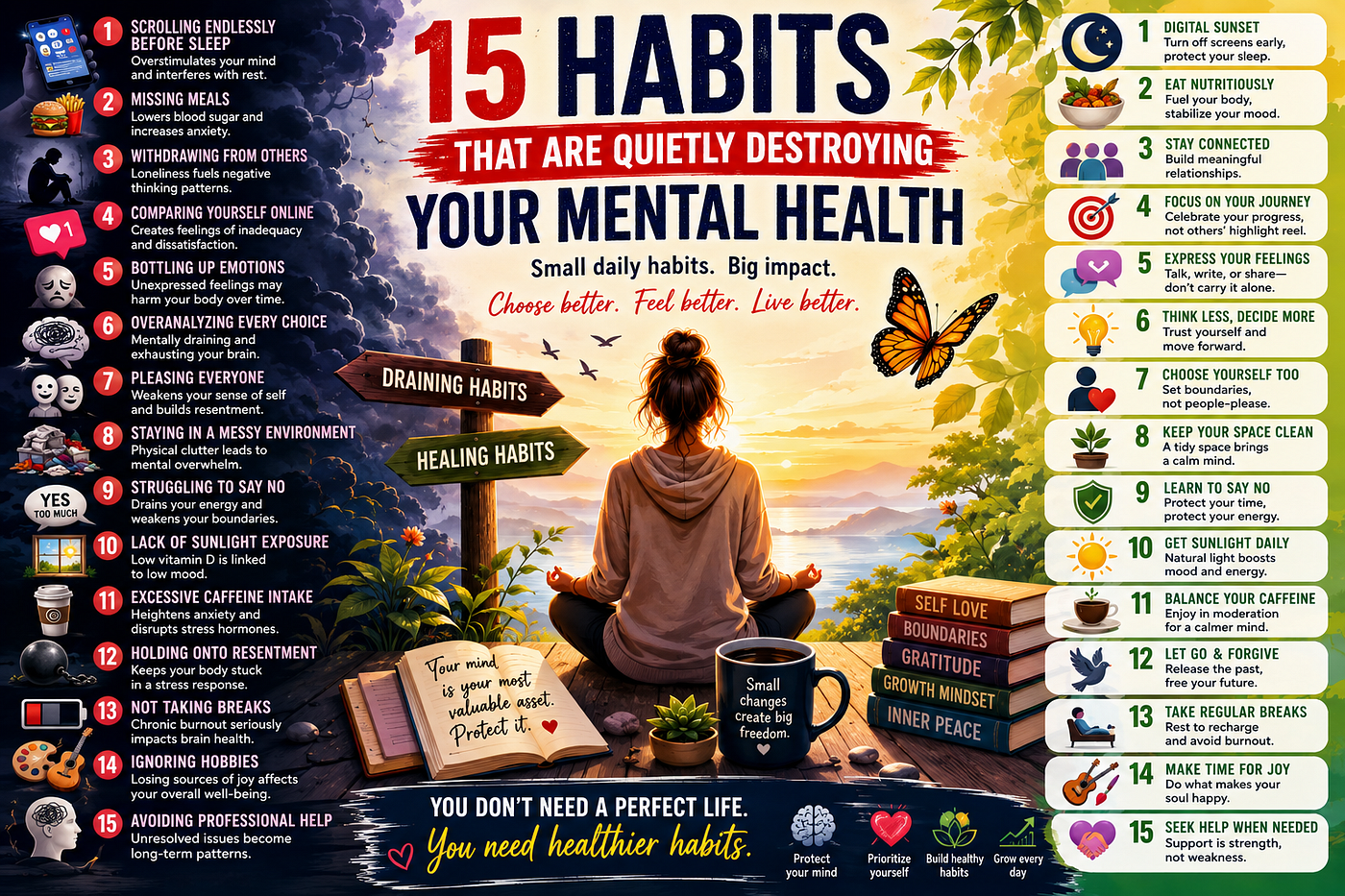
Let’s explore fifteen surprisingly common habits that may be harming your mental well-being — and more importantly, how to replace them with healthier alternatives.
1. Scrolling Endlessly Before Sleep
“I’ll just check one more thing.”
Ten minutes becomes thirty.
Thirty minutes becomes an hour.
Before you know it, you’re lying in bed with tired eyes but an overstimulated mind.
Social media, news feeds, videos, and endless notifications keep your brain in a state of alertness when it should be preparing for rest.
Your brain wasn’t designed to process hundreds of images, opinions, headlines, and emotional triggers right before sleep.
Poor sleep doesn’t just make you tired.
It affects:
- Mood
- Memory
- Focus
- Stress tolerance
- Emotional regulation
A tired brain is often an anxious brain.
Practical Tip
Create a “digital sunset.”
Turn off screens 30–60 minutes before bed.
Replace scrolling with:
- Reading
- Light stretching
- Journaling
- Meditation
- Quiet music
Your mind will thank you.
2. Skipping Meals and Ignoring Nutrition
Many people underestimate the connection between food and mood.
Your brain consumes enormous amounts of energy.
When blood sugar drops dramatically, your body often responds with:
- Irritability
- Anxiety
- Fatigue
- Difficulty concentrating
- Emotional instability
What feels like “stress” may sometimes be your body asking for nourishment.
Mental health is not only psychological.
It is biological.
Practical Tip
Keep simple healthy foods available:
- Nuts
- Fruit
- Yogurt
- Eggs
- Whole grains
Consistency matters more than perfection.
3. Isolating Yourself From Others
Humans are social creatures.
Even highly independent people need meaningful connection.
When stress increases, many people withdraw.
They stop calling friends.
They decline invitations.
They spend more time alone.
Ironically, this often intensifies the very feelings they are trying to escape.
Loneliness changes how we think.
It can distort perspective and make problems appear larger than they actually are.
Practical Tip
Reach out to one person today.
Not because you need something.
Simply because connection matters.
A five-minute conversation can improve an entire day.
4. Constantly Comparing Yourself Online
Social media is often a highlight reel disguised as reality.
You see:
- Promotions
- Luxury vacations
- Perfect relationships
- Fitness transformations
- Business successes
What you rarely see:
- Debt
- Failure
- Anxiety
- Rejection
- Loneliness
- Self-doubt
Comparison is one of the fastest ways to destroy gratitude.
When you constantly compare your everyday life to someone else’s highlight reel, dissatisfaction becomes inevitable.
Practical Tip
Compare yourself to who you were six months ago.
That is the comparison that actually matters.
5. Bottling Up Your Emotions
Many people spend years suppressing emotions.
They tell themselves:
- “I’m fine.”
- “It’s not a big deal.”
- “I’ll deal with it later.”
But emotions rarely disappear simply because they are ignored.
What is not expressed often becomes stored.
Over time, emotional suppression may contribute to:
- Chronic stress
- Irritability
- Sleep problems
- Physical tension
- Emotional numbness
Feelings need healthy outlets.
Practical Tip
Try emotional journaling.
Spend ten minutes writing exactly what you feel without judgment or editing.
You may be surprised by the relief it brings.
6. Overthinking Every Decision
The modern world offers endless choices.
Unfortunately, more choices don’t always create more happiness.
Many people become trapped in analysis paralysis.
They replay conversations.
They second-guess decisions.
They imagine countless worst-case scenarios.
The result?
Mental exhaustion.
Your brain becomes stuck in a loop instead of moving forward.
Practical Tip
Ask yourself:
“Will this matter one year from now?”
If the answer is no, make the decision and move on.
Protect your mental energy.
7. Constantly Trying to Please Everyone
People-pleasing often looks kind on the surface.
But underneath, it can be exhausting.
When your self-worth depends on approval from others, you may:
- Ignore your own needs
- Avoid difficult conversations
- Overcommit
- Feel resentful
You cannot build a peaceful life if your happiness depends on everyone’s opinion.
Practical Tip
Before saying “yes,” pause and ask:
“Would I still do this if nobody approved of me for it?”
8. Living in Constant Clutter
Your environment influences your mind more than you realize.
A cluttered room often creates a cluttered mental experience.
Every unfinished task, misplaced object, and pile of paperwork subtly competes for attention.
The result is cognitive overload.
Sometimes the fastest way to feel calmer is not meditation.
It’s cleaning your desk.
Practical Tip
Spend ten minutes every evening restoring order to your environment.
Small improvements compound quickly.
9. Never Saying No
Every time you say yes to something, you are saying no to something else.
Time.
Energy.
Focus.
Peace.
People who struggle to set boundaries often find themselves overwhelmed, exhausted, and frustrated.
Healthy boundaries are not selfish.
They are necessary.
Practical Tip
Practice saying:
“I’d love to help, but I don’t have the capacity right now.”
Simple.
Respectful.
Honest.
10. Not Getting Enough Sunlight
Modern life has pushed many people indoors.
Unfortunately, our brains and bodies evolved outdoors.
Sunlight helps regulate:
- Circadian rhythms
- Sleep quality
- Hormonal balance
- Mood
Even a few minutes of morning sunlight can have a surprisingly positive effect on mental well-being.
Practical Tip
Take a 15–20 minute walk outdoors shortly after waking up.
You’ll improve both mood and sleep.
11. Relying Too Heavily on Caffeine
Coffee can be wonderful.
Too much coffee can be a problem.
Excessive caffeine may amplify:
- Anxiety
- Racing thoughts
- Heart palpitations
- Sleep difficulties
Many people unknowingly create a cycle:
Poor sleep → More caffeine → More anxiety → Worse sleep.
Practical Tip
Try reducing caffeine gradually rather than suddenly.
Many people notice calmer energy levels within a few weeks.
12. Holding Onto Resentment
Resentment is like carrying a heavy backpack everywhere you go.
The person who hurt you may have moved on.
Yet your mind continues reliving the event.
Forgiveness does not mean what happened was acceptable.
It means you are choosing not to let the experience control your future.
Practical Tip
Ask:
“Is holding onto this helping me heal?”
Often the answer is no.
13. Never Taking Breaks
Many people wear exhaustion like a badge of honor.
But the brain is not a machine.
It requires recovery.
Without rest, productivity eventually declines.
Creativity suffers.
Patience disappears.
Burnout emerges.
High performance is not about working nonstop.
It is about balancing effort and recovery.
Practical Tip
Use the 50/10 rule:
- 50 minutes focused work
- 10 minutes recovery
Your brain performs better when given space to recharge.
14. Neglecting Hobbies and Joy
As adults, many of us slowly abandon the activities that once made us feel alive.
Music.
Art.
Gardening.
Sports.
Writing.
Photography.
We become so focused on responsibilities that we forget the importance of joy.
But hobbies are not a luxury.
They are emotional nourishment.
Practical Tip
Schedule enjoyment the same way you schedule meetings.
If it matters, put it on your calendar.
15. Avoiding Professional Help
Many people wait until they are overwhelmed before seeking support.
But mental health care is not only for crises.
Just as you see a doctor for physical health, there are times when professional guidance can help with emotional well-being.
Seeking help is not weakness.
It is wisdom.
The strongest people are often those willing to ask for support when needed.
Practical Tip
Don’t wait for things to become unbearable.
Early support often prevents larger struggles later.
The Most Important Thing to Remember
Mental health is not built in a single day.
And it is not destroyed in a single day.
It is shaped by hundreds of small choices repeated over time.
The good news is that the same principle works in your favor.
Just as unhealthy habits can gradually drain your well-being, healthy habits can gradually restore it.
A better night’s sleep.
A short walk in the sun.
A meaningful conversation.
A cleaner room.
A stronger boundary.
A few moments of gratitude.
None of these seem life-changing on their own.
But together, they can transform the way you think, feel, and experience life.
Because mental health isn’t merely the absence of illness.
It is the presence of energy, purpose, connection, resilience, and peace — and it is built one small habit at a time. ✨
If you found this post helpful, please consider:
- 👏 Giving it all 50 of your claps!
- 💬 Leaving a comment to share your thoughts.
- 🔍 Highlighting important text for easy reference.
- 🔔 Don’t forget to **subscribe** for more valuable insights!
메타데이터
- post_id
- 89bcad0d8427
- slug
- habits-that-are-quietly-destroying-your-mental-health-and-how-to-reclaim-your-peace-89bcad0d8427
- url
- https://medium.com/empowerment-odyssey-essays-on-growth-success/habits-that-are-quietly-destroying-your-mental-health-and-how-to-reclaim-your-peace-89bcad0d8427
- canonical_url
- https://medium.com/empowerment-odyssey-essays-on-growth-success/habits-that-are-quietly-destroying-your-mental-health-and-how-to-reclaim-your-peace-89bcad0d8427
- author_url
- https://medium.com/@complexitybeauty
- status
- ok
- fetched_at
- 2026-07-09 05:53:33