“Trying to Catch Freedom” Painting, Underground Railroad, and More
Painting by Artist Charles Criner
“Trying to Catch Freedom” Painting, Underground Railroad, and More
Painting by Artist Charles Criner
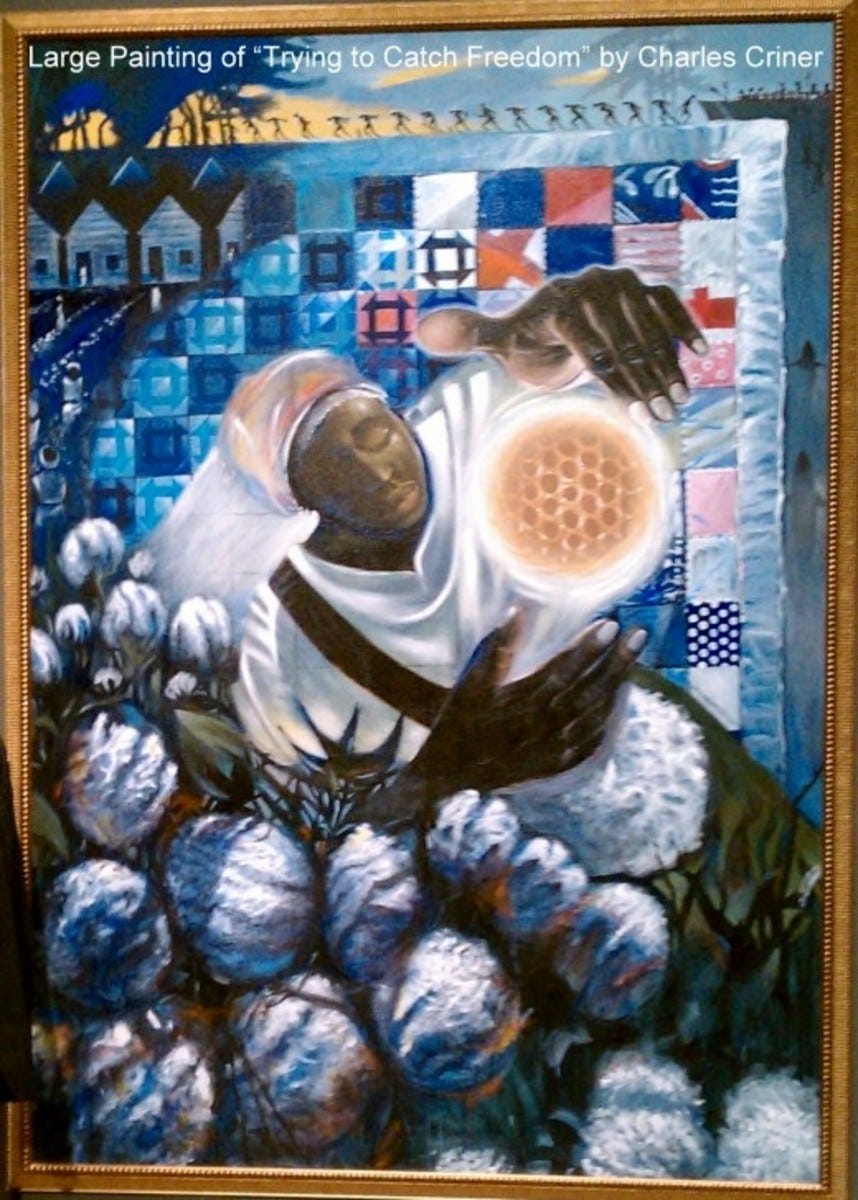
“Trying to Catch Freedom” Painting by Charles Criner | Source: Author
Free link here.
“Trying to Catch Freedom”
Sometimes, in the realm of art, things seem to evolve. This is the case with this particular piece of art created by the well-known artist Charles Criner.
Many people knew him as the resident artist at the Printing Museum in Houston. At the museum, he had his studio, conducted tours, taught lithography classes, and more.
From the painting “Trying to Catch Freedom,” a series of poster prints was created. It is one of many posters given out free of charge to students while visiting the museum.
Many of Mr. Criner’s works of art became posters for Juneteenth celebrations. But this piece of art did not start that way.

Photo of Charles Criner in his studio at the Printing Museum | Source: Author
Evolution of This Piece of Art
Below are direct quotes from writings given to me by Charles regarding how this work of art came to exist.
“Trying to catch freedom: was originally a 22″ X 30” black and white lithograph print. The name of the print was “The Underground Railroad.” I believe that I pulled an edition of forty prints. There was a few prints that was either too light or too dark to be part of the edition. Those prints became original paintings. I made them paintings by adding acrylic paint to them.”

Underground Railroad lithography print by Charles Criner | Source: Author
The Underground Railroad
You can see the print above titled “The Underground Railroad” by Charles Criner. Here is more explanation of how this print evolved into “Trying to Catch Freedom” from Charles:
“As I added and subtracted from the image, “Trying to catch freedom” emerged. The lady was already there. With a little alteration, she emerged in the foreground and instantly became the dominant figure.
After I had finished painting her huge hands, I thought, this lady is picking something, maybe cotton, but then I thought, no, not picking but trying to catch something. The golden ball that symbolized freedom was given to her, and the painting began to paint itself.”
[embed]
More from Charles in his own words:
“After I had finished the lady trying to catch the ball that I labeled as freedom, the cotton begins to sprang up under her and behind her. It was great that I was able to use cotton. I wanted to include it, but I wanted the lady to be involved with something else, and the freedom ball gave me that opportunity.
Previously, I had used the quilt for the Underground Railroad print, so I included it in this print also. I created slave symbols on the quilt to give it an important image in the art.”
[embed]
From Slavery to Freedom
Before the Emancipation Proclamation, many slaves tried to achieve freedom by running away and taking the long and arduous, as well as dangerous, journey north to free states and/or up into Canada. White abolitionists, as well as freed slaves and others, tried their best to help them.
Often, traveling on foot or any other means possible — by night and hiding out by day — became part of that story.
![The reward for a runaway slave | Source: By Wm. T. J. Richards (Special Collections, University of Virginia) [Public domain], via Wikimedia Commons](https://miro.medium.com/v2/resize:fit:1200/0*NolFUOb1PKfGAj0r.jpg)
The reward for a runaway slave | Source: By Wm. T. J. Richards (Special Collections, University of Virginia) [Public domain], via Wikimedia Commons
![Runaway slave notices by Contributors to the Daily Picayune (Above newspaper via copy at [1]) [Public domain], via Wikimedia Commons](https://miro.medium.com/v2/resize:fit:672/0*-Dfq0lBed7JTWufU.jpg)
Runaway slave notices by Contributors to the Daily Picayune (Above newspaper via copy at [1]) [Public domain], via Wikimedia Commons
Signs and Symbols
Many slaves could not read or write, so oral histories were passed from generation to generation.
There were specific patterns built into the quilts that served as codes for runaway slaves, and when tossed over a railing seemingly to air out, those quilts told a story. Distinctive signs and symbols denoted safe places, and designs on specially made quilts aided their escape towards freedom.
[embed]
Patterns on the Underground Quilts
Flying Geese worked into the design would have told the slaves to head north just as the birds had done in the spring and summer months when temperatures were more moderate. Waterways would have been found along the way, which could help hide scent and obliterate footprints if being pursued by bloodhounds.
A Bear’s Paw would have advised following the paths that bears frequented because they would have access to food and water. There was a risk in that, but it was also risky to get caught!
All of the following patterns had specific meanings to the runaway slaves and to the people trying to help them with the use of these designs:
Star, Sailboat, Shoofly, Crossroads, Monkey Wrench, Britches, Double Wedding Ring, Log Cabin, Wagon Wheel, Drunkard’s Path, Broken Dishes, Dresden Wheel, North Star, Bow Tie, Tumbling Blocks or Boxes, and a Rose Wreath.
Colors also had meaning. Yellow, in particular, was welcoming, just like leaving a light or candle in a window when it was dark.
[embed]
Slaves from Africa
Charles Criner continues with this explanation of his print:
“For the print entitled “The Underground Railroad,” I created some people working at the top of the print. Suppose they were slaves just off the ship from Africa coming to America. I created a long line of small figures coming from boats onto dry land.”

Charles Criner in The Printing Museum | Source: Author
“As they crossed the top of the painting and went into the woods which occupied the opposite side of the painting, they emerged from Shot Gun houses that was lined along the left side of the painting. When they emerged from the bottom of the houses, they became ladies working in the cotton field.”
For people unfamiliar with the term shotgun house, it is a small house with a door in front and one in the back. It may be one large room or several rooms, but they are typically small and sometimes without bathroom facilities.

Pair of shotgun houses | Source: https://commons.wikimedia.org/wiki/File:Shotgun_Houses,_Irish_Channel,_New_Orleans.jpg
The Painting
Charles told me the following:
“Trying to Catch Freedom” was bought by the Federal Reserve Bank on Allen Parkway and is a part of their permanent collection. I also created a larger painting with the same name. The art is 8′ x 10′.
In addition to the slaves coming to America, I also added Sharks swimming up from the cold dark waters to the boats that occupied the slaves.
The 8′ x 10′ painting of “Trying to catch freedom” was bought by Pictures Plus in Houston.”

Showing the large size of “Trying to Catch Freedom” painting with the artist’s brother, Joe | Source: Author (Photo used with permission by Charles Criner)
Meaning of the Sharks
Charles wrote the following:
“After I finished the large painting, I looked at it and decided to create a beach with people being hauled from the boats onto it, and then I remembered how many slaves jumped from the boats to the ocean rather than to be hauled from Africa.
There were Africans dumped into the ocean for many other reasons. However, in every case, there was always Sharks. Every book that I have ever read involved sharks.
I don’t remember just why or how I decided to include sharks for the painting, but it is one of the most natural things that I had ever included in a painting. The water is painted in a little strip that comes from the extreme bottom of the painting to the top. I painted the sharks coming from the deep black water to the bottom of the ship, where the slaves was entering the water.
The shark part of the painting was created in a very small space, and looking at the painting, you might miss seeing how they were created. But once you are aware, the shark portion becomes a painting by itself.
Personally, When I finished the painting, it was dark. When I came into my studio the next morning and looked it, to see the painting of the sharks scared me. And even now, I think about it sometimes. The water is so deep and black at the bottom. The ocean stretches far below the bottom of the painting, and the sharks seem to come from beyond death.”
![By Government & Heritage Library, State Library of NC from Raleigh, NC, United States (Detail of a shark mural) [CC BY 2.0 (http://creativecommons.org/licenses/by/2.0) or Public domain], via Wikimedia Commons](https://miro.medium.com/v2/resize:fit:1200/0*vJSgSIIurOlYRr2W.jpg)
By Government & Heritage Library, State Library of NC from Raleigh, NC, United States (Detail of a shark mural) [CC BY 2.0 (http://creativecommons.org/licenses/by/2.0) or Public domain], via Wikimedia Commons
Slave Ships
Travel aboard those slave ships took its toll, and many of the slaves died in the passage. The captives were nothing more than a commodity worth some money to the slave traders.
And yet, once exiting from those ships and, if still alive, many hardships faced them in the days and years ahead while in servitude to others, of which they had no choice.
The ocean breezes plus glistening waters separating the slaves from their homeland would become a memory for those fortunate enough to have survived the journey.
While the slaves had no possessions from their old world, they carried memories of traditions. They passed them along verbally and in song while maintaining their innate dignity until, at last, they achieved their freedom.
“God is not merely interested in the freedom of brown men, yellow men, red men, and black men. He is interested in the freedom of the whole human race.”
— Martin Luther King, Jr.
Sources
- Underground Railroad
- Underground Railroad Quilt Codes
- Personal information about the painting was given to me by the artist, Charles Criner.
© Peggy Woods (Originally published on HubPages)
메타데이터
- post_id
- 89cdc943d016
- slug
- trying-to-catch-freedom-painting-underground-railroad-and-more-89cdc943d016
- url
- https://medium.com/never-stop-writing/trying-to-catch-freedom-painting-underground-railroad-and-more-89cdc943d016
- canonical_url
- https://medium.com/never-stop-writing/trying-to-catch-freedom-painting-underground-railroad-and-more-89cdc943d016
- author_url
- https://medium.com/@wantresiduals
- status
- ok
- fetched_at
- 2026-06-14 11:28:49