Textile DPPs Are Coming Faster Than You Think. Here Is What Most Brands Are Getting Wrong.
The European fashion industry is walking into the largest regulatory transformation it has experienced in decades. Most brands are not…
Textile DPPs Are Coming Faster Than You Think. Here Is What Most Brands Are Getting Wrong.
The European fashion industry is walking into the largest regulatory transformation it has experienced in decades. Most brands are not prepared. Many do not yet understand the scope of what is required.
This is not a story about compliance checklists or sustainability badges. It is a story about data infrastructure, platform architecture, security posture, and the difference between brands that will thrive under the Digital Product Passport regime and brands that will scramble to survive it.
The article is structured in three parts. Readiness, because the timelines are tighter than most teams appreciate. Technology, because the platform decisions being made today will define compliance outcomes for the next decade. And opportunity, because the brands that recognise the DPP as a revenue channel rather than a regulatory burden will be the ones that lead European fashion into its next chapter.
Where the Regulation Stands Today
The Digital Product Passport is no longer a future proposal. It is enacted law.
The Ecodesign for Sustainable Products Regulation (ESPR) came into force in 2024. The EU DPP registry becomes operational on July 19, 2026. On the same date, the ESPR destruction ban under Article 25 takes effect, requiring large enterprises (those with 50 or more employees and annual turnover exceeding €10 million) to document circular alternatives and maintain full audit trails before any unsold stock can be destroyed.
The textile delegated act, the instrument that will prescribe the precise data fields for every fashion and footwear passport, is anticipated in late 2026 or early 2027. After adoption, an 18-month transition period applies before mandatory enforcement begins.
The product categories caught by the regulation are extensive: t-shirts, shirts, sweaters, jackets, trousers, dresses, underwear, socks, scarves, gloves, and accessories. The exclusions are narrow and specific: smart textiles, personal protective equipment, medical devices, and raw textile materials.
Non-compliance carries financial consequences that scale with revenue. Penalties reach up to 4% of EU-wide annual turnover. A €100M brand faces €4M in exposure. A €500M brand faces €20M. Public disclosure of destruction data becomes mandatory. Market access restrictions apply.
This is not a phased rollout with gentle enforcement. It is a hard regulatory boundary with meaningful penalties.
Five Structural Problems the Industry Has Not Solved
Beneath the surface optimism at industry events, the textile sector faces five problems that will determine which brands are ready and which are not.

The Data Assembly Challenge
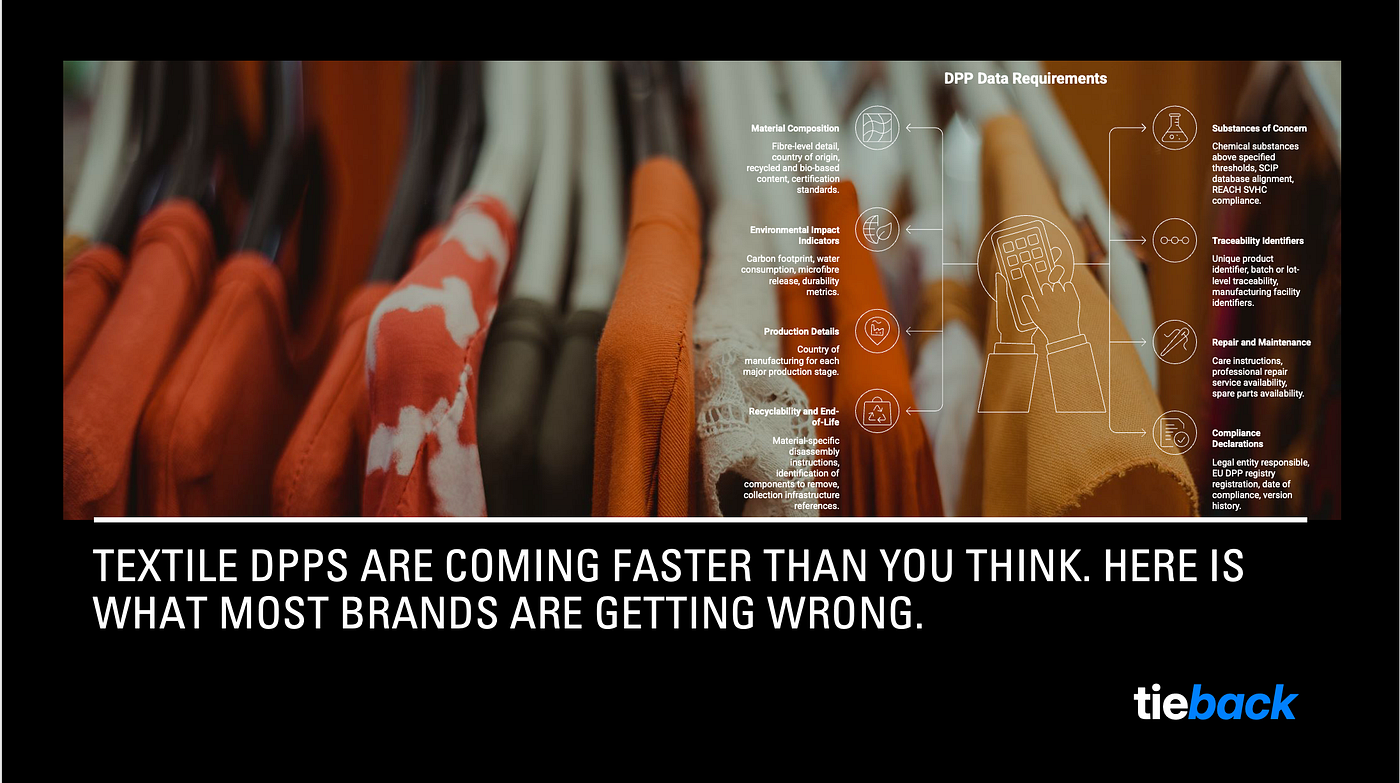
The volume of data a textile DPP will require is substantial. Drawing from JRC preparatory studies and the ESPR framework itself, the delegated act is expected to mandate data across no fewer than eight distinct categories for every product entering the EU market.
Material composition will go far beyond the familiar “80% cotton, 20% polyester” care label. The passport will demand fibre-level granularity: each fibre type identified individually, country of origin declared per fibre, recycled content broken out between pre-consumer and post-consumer sources, bio-based content percentages stated separately, and every claim backed by a named certification standard such as GRS, OCS, or RCS.
Chemical compliance requires alignment with the SCIP database, CAS number declarations, REACH SVHC verification, and awareness of national chemical restriction lists that exceed the EU baseline in specific member states.
Environmental impact will follow Product Environmental Footprint (PEF) category rules currently being finalised for apparel and footwear. Anticipated mandatory fields include carbon footprint per unit, water consumption, microfibre release potential, and durability metrics covering abrasion resistance, dimensional stability after washing, and colour fastness.
Traceability fields call for a unique product identifier compliant with the GS1 Digital Link standard, batch or lot-level traceability, manufacturing facility identifiers, and chain of custody documentation for any product carrying a sustainability claim.
Production origin data extends beyond country of final assembly. The DPP is expected to require country-of-manufacturing declarations for each major production stage: spinning, weaving or knitting, dyeing and finishing, cutting, and sewing. This is multi-tier origin data that most brands do not currently collect from their Tier 2 and Tier 3 suppliers.
Repair and maintenance fields build on existing care labelling rules but expand to include professional repair service availability, spare parts availability, and estimated maximum wash cycles before measurable performance degradation.
Recyclability and end-of-life data requires material-specific disassembly instructions, identification of components that must be separated before recycling (zippers, buttons, elastane-blended panels), and country-specific references to collection and recycling infrastructure.
Compliance declarations must identify the legal entity placing the product on the EU market, the economic operator’s registration in the DPP registry, the date of compliance, and the version history of the passport itself.
The practical challenge is not the passport. It is the data. In a typical fashion enterprise, material composition lives in the PLM. Chemical compliance sits in a separate database maintained by the sustainability team, if it exists at all. PEF data requires lifecycle assessment tools that most brands have never deployed at product level. Traceability information is distributed across supplier spreadsheets, certification portals, and email threads. Multi-stage production data resides with buying agents and Tier 1 factories that often lack visibility into their own upstream suppliers.
Assembling this data is the single largest workstream in DPP readiness. The brands beginning that consolidation today will be positioned when the delegated act arrives. The brands waiting for the delegated act to tell them what is required will discover they do not have enough runway to comply.
The Platform Architecture Decision
The DPP vendor landscape is expanding rapidly. But the platforms competing for enterprise adoption are built on fundamentally different architectural foundations. The model a brand selects now will determine speed, cost, flexibility, and security posture for the foreseeable future.
Traceability-first platforms centre on comprehensive supply chain mapping. Every supplier, every production facility, and every material flow is modelled within the platform before any passport can be generated. For organisations whose primary objective is end-to-end supply chain visibility, this approach has value. But the trade-offs are considerable.
Onboarding requires enrolling every supplier in the chain. For a mid-tier brand working with 40 to 80 Tier 1 suppliers and limited Tier 2 and Tier 3 visibility, the enrolment process alone can consume 6 to 12 months before a single digital passport is minted. The commercial model reflects this complexity: platform licences, per-supplier onboarding charges, integration consulting, and ongoing data stewardship costs. For a brand managing 500 SKUs across three markets, first-year costs can reach six figures before a single consumer interacts with the product.
The passport itself is secondary to the traceability engine. The underlying architecture was designed to map supply networks, not to manage product lifecycles. Warranty orchestration, ownership transfers, recall management, and branded consumer experiences are either absent from the platform or added as peripheral features.
Label-bundled providers package physical data carriers, product identifiers, and digital passports into a single vendor relationship. One contract covers QR codes, NFC tags, and the passport platform. The convenience is appealing on the surface.
The constraint emerges in production. If the brand’s manufacturing lines rely on BarTender, NiceLabel, or Zebra for label generation, the carrier output files must be compatible with those systems. If the label provider does not generate native output for the brand’s existing label software, every production run involves manual file reformatting. The DPP becomes operationally welded to the vendor’s label business. Changing carrier strategy, adding RFID alongside existing QR infrastructure, or switching label vendors requires renegotiating the entire commercial relationship.
The cost model also compounds. Per-label charges, per-scan charges, and per-product charges accumulate on top of the platform subscription. At production scale, these incremental fees can exceed the core platform cost.
Integration-first platforms take a different approach. They layer on top of the brand’s existing systems. The PLM, ERP, and PIM remain in place. The platform ingests product data through API connections or CSV uploads, handles identity minting, passport configuration, carrier output generation, and consumer-facing experiences without displacing any existing infrastructure.
The difference is measured in weeks rather than months. Product master data is imported, classified, and mapped. Digital identities are minted. Carrier files are generated in formats that slot directly into the brand’s existing label workflows. Passports are configured, localised across markets, and published. Supplier onboarding is not a prerequisite because the platform is not a traceability engine. It is a compliance and lifecycle orchestration layer that works with whatever supply chain data the brand already possesses, and enriches progressively as more becomes available.
The practical result: a brand can reach registry-ready status with functioning passports in four weeks, then layer in deeper traceability data over the following months. Compliance readiness and supply chain visibility are decoupled. The brand does not need to solve traceability before it can solve DPP.
The platform selected at this stage is not a procurement line item. It is an architectural commitment with decade-long consequences.
The Security Question Nobody Is Asking
Consider the contents of a textile DPP at enterprise scale. Material compositions with fibre-level sourcing granularity. Supplier identities and factory locations spanning multiple production tiers. Certification records tying sustainability claims to named facilities. Chemical compliance data at substance-level resolution. Cost structures implied by material sourcing patterns. Compliance declarations linked to identified economic operators.
For a brand managing 500 SKUs, this amounts to 500 detailed profiles of its supply chain strategy, sourcing relationships, and competitive positioning. Hosted on a third-party platform. On shared infrastructure. Adjacent to data belonging to other brands. Potentially direct competitors.
The majority of DPP platforms operate as multi-tenant SaaS applications. The mechanism separating one brand’s data from another is application code: tenant ID filters applied by developers who must enforce them consistently across every query, every API endpoint, every analytics pipeline, every caching layer, every background process, and every software release.
This approach is known as application-layer tenant isolation. Its failure rate is well documented. IBM’s 2024 Cost of a Data Breach report places the average cost of a multi-tenancy breach at $4.5 million.
These failures rarely begin with sophisticated attacks. They begin with ordinary software defects. A developer omits a tenant filter on an internal API call. A shared cache serves data belonging to the wrong customer. An analytics job aggregates across tenant boundaries. An asynchronous worker process loses track of which brand context it is operating within. A connection pool carries session state from one tenant into the next request. In one documented case from 2024, a healthcare SaaS platform found that altering a single URL parameter exposed any customer’s records. The vulnerability had been present in production for eleven months.
The failure surface extends beyond application logic into the database layer itself. CVE-2024–10976 demonstrated that database row security policies could be bypassed through subquery execution paths. CVE-2025–8713 showed that database optimizer statistics could leak sampled data from rows that security policies were meant to conceal, creating a side-channel through which one tenant could infer another tenant’s data via query plan analysis.
Translate those failure modes to a DPP platform holding textile supply chain intelligence. A missed filter, a cache misconfiguration, or an optimizer side-channel exposes supplier lists, factory certifications, sourcing strategies, and material compositions to a competing brand. In the DPP context, a tenant isolation failure is not merely a data breach. It is competitive intelligence delivered by architectural weakness.
The question every brand should ask before committing to a platform: how does this system isolate my data from every other brand on the same infrastructure?
The answer enterprise brands need is database-engine-level tenant isolation, where every query is cryptographically bound to the authenticated brand identity before execution. Immutable append-only audit trails, where every state change is permanently recorded with unforgeable timestamps. Zero standing access to production, where no engineer maintains persistent access to live brand data. And AI that operates on a strictly read-only path with zero write access to compliance records, because a model that can alter passport data introduces a vector through which regulatory records can be modified by a process that cannot explain its reasoning.
The gap between “should not” return another tenant’s data and “cannot” return another tenant’s data is an architectural distinction with material consequences.
The Revenue Opportunity Brands Are Missing
The most widespread error in the industry right now is framing the DPP as a compliance expense. A box to tick. An obligation to satisfy by 2027 and then set aside.
A Digital Product Passport is not a regulatory filing. It is a persistent digital identity that connects a brand to every product, every owner, and every stage of the product lifecycle. The organisations that understand this distinction will build infrastructure that generates revenue. Those that do not will spend money meeting the minimum and capture nothing beyond regulatory clearance.
Every scan of a product passport is a direct consumer interaction requiring no advertising spend, no application download, and no account registration. The consumer scans a QR code or taps an NFC tag and arrives at a branded experience presenting the product narrative, material provenance, care guidance, warranty status, and sustainability credentials. For brands investing millions in customer acquisition through paid channels, the passport introduces a zero-cost engagement layer embedded in the physical product. Every unit in circulation becomes a permanent touchpoint.
The economics of authenticated resale sharpen the case further. The secondhand apparel market is forecast to reach $367 billion by 2029, expanding at three times the rate of first-hand retail. The luxury resale segment alone exceeds $41 billion in 2026. Authentication is the lever that determines whether the brand participates in that value or watches it erode. Authenticated items demonstrate 40% lower cart abandonment compared to unverified listings and recover 40 to 60% of original retail price. A passport carrying verified provenance and immutable ownership history is the authentication infrastructure that protects resale value for consumer and brand alike.
When a product changes hands on the secondary market, the digital identity travels with it. Warranty status, care instructions, authenticity verification, and full provenance history are assembled into a Handover Pack: a branded welcome experience delivered to the new owner. Every resale transaction becomes a customer acquisition event. The new owner enters a direct relationship with the brand at zero acquisition cost. For brands spending €20 to €80 to acquire a single customer through conventional marketing, the financial impact is substantial.
Warranty transforms from a cost centre into a loyalty driver. In the traditional model, claims depend on paper receipts and proof-of-purchase records. The process is slow, adversarial, and frequently denied on technicalities. When warranty is tied to the product’s digital identity, the consumer scans the product, the platform confirms authenticity and eligibility, and the claim is routed. No documentation required. The product authenticates itself. Frictionless warranty experiences drive satisfaction and repeat purchases. The warranty interaction shifts from bureaucratic friction to a positive brand moment.
Product recalls gain precision. Traditional recall campaigns reach an estimated 10 to 20% of affected product owners through press releases and public notices. Through the passport, a recall notification is delivered directly to every registered owner of every affected unit. Severity levels, distribution windows, and impression analytics are managed centrally. The operational difference is between announcing a recall and confirming that every affected owner received it.
End-of-life guidance becomes compliance evidence. The ESPR destruction ban demands that brands document circular alternatives before any product destruction. A passport can deliver material-specific, jurisdiction-specific recycling instructions. A polyester jacket and a wool coat require fundamentally different end-of-life pathways. Those pathways vary by country. When a consumer scans the passport, the guidance is tailored to the product composition and the consumer’s location. For the brand, this constitutes documented circular alternative evidence satisfying destruction ban audit requirements.
The brands that architect DPP as lifecycle infrastructure will generate value from every module. The brands that architect it as a compliance exercise will capture none of the upside.
The Timeline Most Brands Have Not Mapped
The industry is operating under a misapprehension about how much time remains. Here is the regulatory calendar mapped against the implementation workstreams that must fit within it.
July 19, 2026. The EU DPP registry becomes operational. The Article 25 destruction ban takes effect simultaneously, applying to large enterprises across apparel, footwear, and accessories.
Late 2026 to early 2027. The textile delegated act is expected to reach finalisation. This instrument defines the binding data fields, formats, and verification requirements. Until publication, brands work against anticipated specifications drawn from JRC preparatory work and the ESPR framework. After publication, the requirements become enforceable.
18 months post-adoption. The transition period concludes. Every product placed on the EU market within the defined categories must carry a compliant Digital Product Passport. Provisions for existing inventory may require retrospective passporting depending on the delegated act’s treatment of stock already in circulation.
Mid-2028 to 2029. Full mandatory enforcement. Penalties at scale. Market access restrictions. Mandatory public reporting.
The implementation workstreams that must be completed between now and enforcement are extensive. Platform evaluation and selection. Data auditing across PLM, ERP, PIM, and supplier ecosystems. Data consolidation and quality remediation. Supplier engagement programmes targeting Tier 2 and Tier 3 production visibility. Product Environmental Footprint assessments. Platform deployment and configuration. Digital identity minting across the product catalogue. Carrier integration covering QR generation, NFC encoding, RFID manifests, and output file compatibility with production label systems. Passport template design and brand configuration. Market-specific localisation covering languages, date formats, measurement systems, recycling guidance, and legal disclaimers. Lifecycle module activation for warranty, ownership transfers, recalls, and recycling guidance. Cross-functional training spanning compliance, product, IT, marketing, and supply chain teams. Staged testing. Go-live. Scaling. Progressive data enrichment.
On a traceability-first platform, that is a 12 to 18-month programme. On an integration-first platform, the core deployment compresses to weeks, but the surrounding workstreams of data consolidation, supplier engagement, and organisational change still demand sustained attention.
The brands that begin now will be registry-ready by July 2026 and delegated-act-ready by late 2027. The brands that defer until the delegated act publishes will find the runway insufficient. They will be attempting to compress 18 months of preparation into the transition window while their competitors are already operational, scaling, and capturing the lifecycle revenue opportunity.
What the Technology Layer Actually Requires
In the DPP landscape, the technology discussion is not about feature matrices. It is about foundational architecture. The choices made at the infrastructure layer govern compliance posture, security risk, operational velocity, and total cost of ownership across the next decade.
GS1 Digital Link is the foundational standard. The EU has designated GS1 Digital Link as the identifier architecture underpinning Digital Product Passports. Every compliant DPP must support it. A GS1 Digital Link is a URI encoded in a QR code, NFC tag, or RFID chip that resolves to different experiences depending on the requesting context. A consumer sees the branded passport. An auditor sees the compliance record. A recycling facility sees disassembly and end-of-life instructions. A warranty system sees eligibility status. One identifier. One carrier. Multiple experiences. No reprinting when information changes. No parallel identifier systems for different audiences.
Platforms that are not GS1-native introduce a translation layer between product identifiers and the regulatory infrastructure. That translation layer creates complexity, latency, and failure points that multiply as the brand scales across thousands of SKUs and dozens of markets.
Immutable records are a regulatory necessity, not a feature differentiator. The ESPR requires data accuracy, auditability, and demonstrable compliance over time. The platform holding DPP data must prove that records have not been modified.
This means WORM (Write Once, Read Many) storage for published passports. Append-only ledgers capturing every lifecycle event: identity minted, passport published, status updated, ownership transferred, recall issued, passport revoked. Every mutation permanently records the authenticated actor and an unforgeable server-side timestamp. Point-in-time reconstruction of any passport at any historical moment.
The practical test: when an auditor requests the state of a specific passport on a specific date six months prior, the answer should arrive in seconds. Not through backup restoration. Not through log reconstruction. Through an immutable ledger that preserves every version. The difference between “we can probably reconstruct what happened” and “we can prove what happened” is the difference regulators care about. That distinction will carry increasing weight as the EU publishes requirements for DPP service providers covering data integrity and access governance.
AI boundaries must be structural. AI capabilities deliver genuine value in the DPP context. Automated classification and categorisation for large catalogue uploads. Continuous threat detection analysing scan patterns to flag counterfeiting attempts, geographic diversion, and anomalous rescan behaviour. Data quality checks that surface missing or inconsistent fields before passports reach production.
But AI with write access to compliance records is a vulnerability, not a feature. A model that can modify passport data, alter batch statuses, or amend regulatory declarations creates a pathway through which auditable compliance records can be changed by a process incapable of explaining its decisions. Whether through prompt injection, model hallucination, or conventional software error, the result is the same: a regulatory record modified by automation without human oversight at the point of change.
The only architecture that survives enterprise security scrutiny places AI on a strictly read-only path, structurally separated from regulatory data. AI strengthens the security posture. It never touches the compliance record. That separation must be enforced architecturally. It cannot be overridden by configuration, by a prompt, or by a software release.
Database-engine-level tenant isolation is the minimum standard for any platform holding competitive supply chain intelligence on behalf of multiple brands. Application-layer filters that depend on developers consistently applying the correct query constraints are insufficient for the sensitivity of the data involved. Engine-level enforcement means a query physically cannot return another tenant’s data. Not “should not.” Cannot. The isolation is structural and exists independently of application logic.
The Compounding Economics of Lifecycle Infrastructure
The opportunity is concrete, not aspirational.
A brand with 10,000 products in circulation, each carrying a Digital Product Passport, maintains 10,000 permanent consumer engagement touchpoints that require no media spend, no application installation, and no marketing budget to activate. Every scan generates data: geographic distribution, scan frequency, verification outcomes, engagement patterns. That intelligence informs product strategy, market prioritisation, and consumer behaviour analysis that brands currently commission research agencies to approximate.
When 20% of those products enter the secondary market (a conservative assumption given that resale is expanding at three times the rate of first-hand retail), each transaction generates a Handover Pack introducing a new consumer to the brand. At 2,000 resale transactions annually, that represents 2,000 zero-cost customer acquisitions. Against a conventional acquisition cost of €30 to €50 per customer, the equivalent marketing value ranges from €60,000 to €100,000 per year. From a single product category.
Project that across a complete catalogue, multiple geographies, and several years of accumulated product lifecycle data. The economics shift from cost centre to compounding asset. The DPP is not an expense. It is infrastructure whose value increases with every product sold, every resale completed, every warranty interaction resolved, and every scan recorded.
Brands that treat DPP as a compliance obligation will spend money and receive regulatory clearance. Brands that treat it as lifecycle infrastructure will capture authenticated resale revenue, loyalty from seamless warranty experiences, operational precision from targeted recalls, and audit-ready evidence from documented end-of-life guidance. Every product becomes a channel. Every lifecycle event becomes a brand interaction.
The organisations building the most consequential infrastructure in this space are not necessarily the ones with the largest marketing presence. Some of the most important work is being done by teams that prefer shipping product to purchasing exhibition space.
The Questions Worth Asking
The platform commitments made in the next twelve months will shape compliance outcomes for the decade that follows. Before signing a contract, these are the questions that matter:
How does the platform isolate my data from every other brand on the same infrastructure? Can artificial intelligence write to my compliance records? Are my audit trails immutable, or merely backed up? What does the implementation timeline actually look like in practice? What happens when the delegated act publishes and the data requirements shift?
The answers will reveal whether a platform was engineered for enterprise compliance or retrofitted to approximate it.
*tieback is an AI-native enterprise B2B SaaS platform for Digital Product Passports. GS1-native identity layer. Zero-trust architecture. Built to integrate with your existing systems, not replace them. Go live in weeks, not months.*
메타데이터
- post_id
- 89cfb6d2c2da
- slug
- textile-dpps-are-coming-faster-than-you-think-here-is-what-most-brands-are-getting-wrong-89cfb6d2c2da
- url
- https://medium.com/@pydtcptk/textile-dpps-are-coming-faster-than-you-think-here-is-what-most-brands-are-getting-wrong-89cfb6d2c2da
- canonical_url
- https://medium.com/@pydtcptk/textile-dpps-are-coming-faster-than-you-think-here-is-what-most-brands-are-getting-wrong-89cfb6d2c2da
- author_url
- https://medium.com/@pydtcptk
- status
- ok
- fetched_at
- 2026-06-25 16:53:31