Frozen Intelligence: AI-Driven Radiant Cooling & AWS Thermodynamics
Introduction :
Frozen Intelligence: AI-Driven Radiant Cooling & AWS Thermodynamics
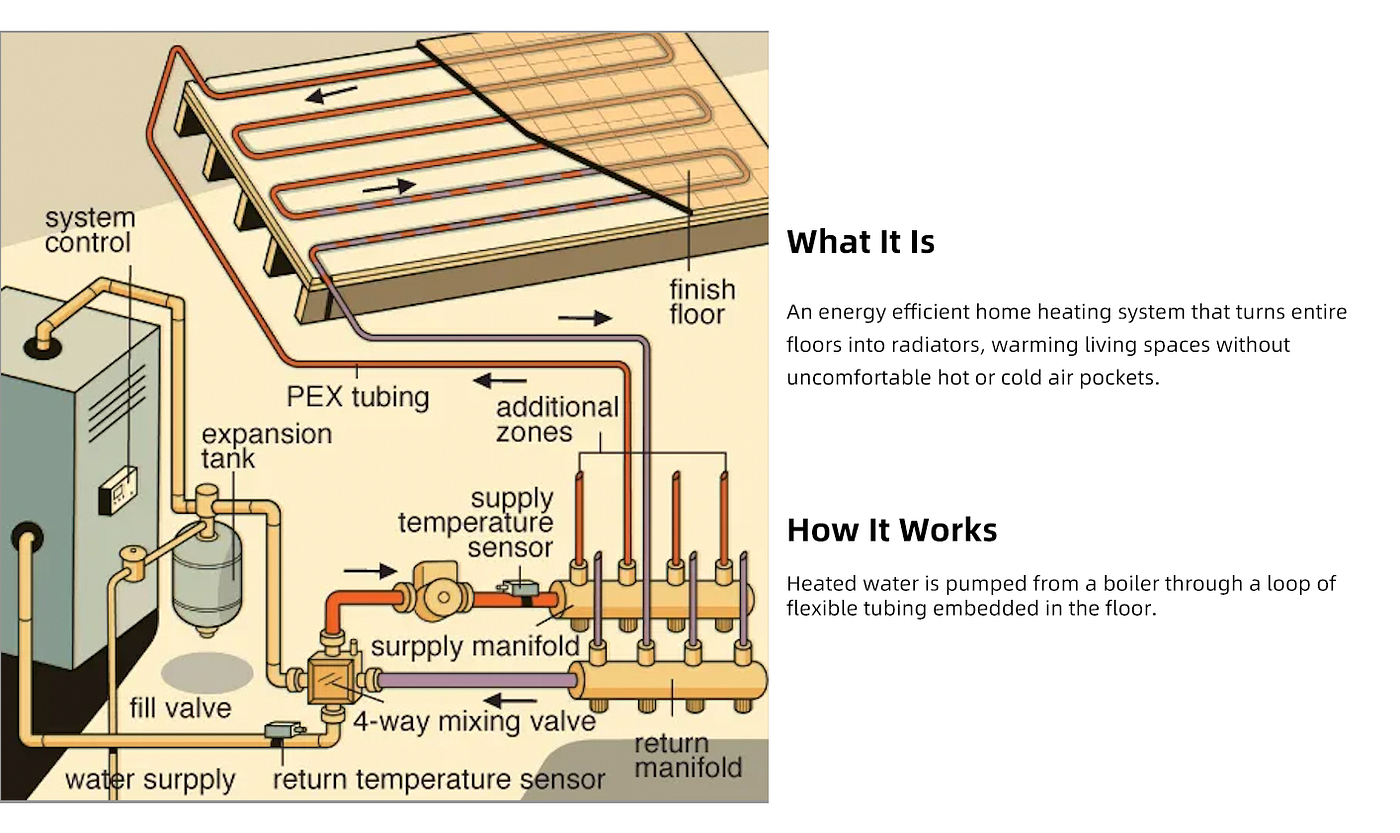


Depiction and represntation of Radiant Cooling in Indoor Hydronic Systems how and what the Radiant Cooling System Looks like and Transform Buildings.
Introduction :
In the modern era, “cooling” has become synonymous with the mechanical hum of compressors and the dry, forced draft of air conditioners. Yet, as we look toward a sustainable future, we are rediscovering a more primal, silent, and efficient way to manage heat.
🚀 High-Paying Tech Roles Are Open Right Now. Apply Quickly — The Faster You Move, The Better Your Chance To Get Selected. 👉 Apply & Secure Your Job
Radiant cooling — and its celestial cousin, Passive Daytime Radiative Cooling (PDRC) — is shifting the paradigm. By moving away from moving air and toward moving energy through the “atmospheric window” into the deep cold of space, we are entering a new age of thermodynamics. But to make these systems truly viable in a complex, humid, and fluctuating world, they need a brain.
This is where the cloud meets the cold. By integrating AWS (Amazon Web Services), we can transform passive materials into intelligent, real-time cooling infrastructures.
1. Understanding Radiant and Radiative Cooling


Basics and Foundation of Radiant and Passive Daytime Radiative Cooling
Radiant cooling works by circulating chilled water through embedded pipes in:
- Ceilings
- Floors
- Walls
Instead of blowing cold air, these surfaces absorb heat from occupants and equipment via radiation and natural convection.
Why It’s Efficient:
- Water carries heat ~3,500x more effectively than air.
- Lower fan energy consumption.
- Silent operation.
- Higher thermal comfort (uniform cooling).
Radiative cooling leverages a powerful natural phenomenon:
The Earth’s atmosphere has a transparency window between 8–13 μm, allowing infrared radiation to escape directly into deep space (~3K).
Specialized materials:
- Reflect sunlight
- Emit thermal radiation strongly in 8–13 μm range
This enables:
- Sub-ambient cooling
- Daytime cooling without electricity
- Reduced building heat load
This is known as Passive Daytime Radiative Cooling (PDRC).
2.The Physics: From Floor Slabs to the Deep Sky
To understand the application, we must first understand the two flavors of this technology:
- Indoor Radiant Cooling: This is the “veins” of a building. By circulating chilled water through pipes embedded in floors or ceilings, the system doesn’t cool the air; it cools the surfaces. It absorbs the thermal radiation emitted by human bodies and furniture, providing a draft-free, silent comfort that feels like a shaded stone cathedral.
- Outdoor Radiative Cooling (PDRC): This is a technological marvel. Using specialized materials (like Polyrost or engineered coatings), these surfaces reflect almost 100% of sunlight while simultaneously emitting heat in the 8–13 $\mu$m infrared range. This specific frequency passes through our atmosphere without being absorbed, essentially “dumping” heat into the -270°C vacuum of outer space.
3.The AWS Architecture: Giving Physics a Pulse
A radiant system is efficient but sensitive. Its greatest enemy is the Dew Point. If a chilled ceiling becomes colder than the dew point of the room, it begins to “sweat,” leading to condensation and water damage.
To solve this, we can deploy a Cloud-Native Radiant Intelligence architecture:
A. The Sensory Layer (AWS IoT Core)
Real-time use cases require thousands of data points. By deploying sensors across a building’s envelope — measuring slab temperature, ambient humidity, and solar irradiance — we stream data into AWS IoT Core. This provides the secure, low-latency backbone needed to monitor “The Silence of Cold.”
B. The Predictive Brain (Amazon SageMaker & Lambda)
Radiant systems have high thermal inertia; they take a long time to cool down and warm up.
- Predictive Pre-cooling: Using Amazon SageMaker, we can train machine learning models on local weather patterns. If the model predicts a heatwave in six hours, AWS Lambda can trigger the pumps to start circulating water now, using cheaper “off-peak” electricity or maximizing nighttime radiative cooling.
- Condensation Avoidance: A Lambda function can act as a real-time safety switch. By calculating the dew point in milliseconds based on IoT sensor data, it can adjust mixing valves to ensure the surface temperature always stays 2°C above the condensation threshold.
C. The Storage & Analytics Layer (Amazon Timestream)
Thermal data is time-series data. By storing performance metrics in Amazon Timestream, engineers can visualize how the building’s thermal mass reacts over seasons, allowing for the “Contemplative Optimization” of energy use over decades, not just days.
4. Real-Time Use Cases: Where the Cloud Meets the Surface
Use Case I: The “Zero-Electricity” Cold Storage
In remote or off-grid locations, maintaining a cold chain for vaccines or produce is a life-or-death challenge.
- The Application: A warehouse roof coated in PDRC materials.
- The AWS Edge: Using AWS IoT Greengrass, the facility can operate autonomously. The edge device monitors the internal temperature and, during the day, uses the PDRC’s sub-ambient cooling properties to maintain a steady 4°C. If the system detects a deviation, it sends an alert via Amazon SNS (Simple Notification Service) to a central hub via satellite link.
Use Case II: Enhancing Solar Farm Efficiency
Photovoltaic (PV) panels lose efficiency as they get hot.
- The Application: Integrating radiative cooling backing on solar panels.
- The AWS Edge: Amazon Managed Grafana can be used to visualize the “Cooling Delta.” By comparing the energy output of “Radiant-Cooled” panels vs. traditional panels in real-time, AWS helps operators calculate the exact ROI of their cooling coatings and adjust tilt angles to maximize infrared emission into the sky.
Use Case III: Smart Urban “Cool Islands”
Modern cities suffer from the Urban Heat Island effect.
- The Application: Pavements and bus stops coated with radiative cooling materials.
- The AWS Edge: Using AWS Data Exchange, city planners can combine their IoT heat maps with third-party satellite thermal imagery. This allows for a “Digital Twin” of the city (built on AWS IoT TwinMaker), where they can simulate how much the city’s temperature would drop if 30% of rooftops adopted radiative cooling.
5. Advanced Python Implementation
The following program simulates an AI-Driven Radiant Cooling Controller. It uses a Deep Learning model (Keras) to predict indoor temperatures and a sophisticated logic engine to manage condensation risks and AWS integration.
import numpy as np
import pandas as pd
import tensorflow as tf
from tensorflow import keras
from tensorflow.keras import layers
from sklearn.preprocessing import MinMaxScaler
import boto3
from datetime import datetime
import logging
import json
from typing import Dict, List, Tuple, Any

# Configure Logging for AWS CloudWatch
logging.basicConfig(level=logging.INFO)
logger = logging.getLogger("RadiantCoolingAI")

# --- 1. ENHANCED THERMODYNAMIC CONSTANTS & LOGIC ---
class ThermoDynamics:
    """Calculates critical physical thresholds for radiant systems with improved accuracy."""

    @staticmethod
    def calculate_dew_point(temp_c: float, humidity: float) -> float:
        """
        Enhanced dew point using Magnus formula (accurate -40°C to 50°C).
        Prevents condensation on radiant panels [web:20].
        """
        a = 17.625
        b = 243.04
        alpha = (a * temp_c / (b + temp_c)) + np.log(humidity / 100.0)
        return b * alpha / (a - alpha)

    @staticmethod
    def psychrometric_safety_margin(dew_point: float, safety_buffer: float = 2.0) -> float:
        """Returns safe chilled water temperature with configurable buffer [web:2]."""
        return dew_point + safety_buffer

# --- 2. ENHANCED AWS SERVICE INTERFACE ---
class AWSCloudBridge:
    """Handles AWS interactions with real implementations."""
    def __init__(self, region: str = "us-east-1", timestream_db: str = "RadiantDB", timestream_table: str = "SensorData"):
        self.region = region
        self.timestream = boto3.client('timestream-write', region_name=region)
        self.iot_data = boto3.client('iot-data', region_name=region)
        self.lambda_client = boto3.client('lambda', region_name=region)
        self.timestream_db = timestream_db
        self.timestream_table = timestream_table

    def log_to_timestream(self, measure_name: str, value: float, dimensions: List[Dict[str, str]] = None):
        """Persists data to Timestream with proper structure [web:7][web:3]."""
        if dimensions is None:
            dimensions = [{"Name": "SensorID", "Value": "RadiantPanel1"}]

        record = {
            'Dimensions': dimensions,
            'MeasureName': measure_name,
            'MeasureValue': str(value),
            'Time': str(int(datetime.utcnow().timestamp() * 1000))
        }
        try:
            self.timestream.write_records(
                DatabaseName=self.timestream_db,
                TableName=self.timestream_table,
                Records=[record]
            )
            logger.info(f"[AWS Timestream] Logged {measure_name}: {value}")
        except Exception as e:
            logger.error(f"Timestream write failed: {e}")

    def trigger_pump_lambda(self, flow_rate: float, lambda_function: str = "pump-controller"):
        """Invokes Lambda asynchronously [web:18]."""
        payload = json.dumps({"flow_rate": flow_rate})
        try:
            self.lambda_client.invoke(
                FunctionName=lambda_function,
                InvocationType='Event',  # Async for real-time control
                Payload=payload
            )
            logger.info(f"[AWS Lambda] Triggered pump adjustment: {flow_rate} L/min")
        except Exception as e:
            logger.error(f"Lambda invoke failed: {e}")

# --- 3. ENHANCED AI MODEL (Hybrid CNN-LSTM + Attention) ---
class RadiantPredictor:
    """Advanced hybrid model for thermal forecasting with attention mechanism [web:1][web:13]."""
    def __init__(self, lookback: int = 24):
        self.lookback = lookback
        self.scaler = MinMaxScaler()
        self.model = self._build_model()
        self.history_buffer = None  # For real sequence data

    def _build_model(self) -> keras.Model:
        inputs = layers.Input(shape=(self.lookback, 3))  # Temp, Humidity, Solar

        # CNN for feature extraction
        cnn = layers.Conv1D(64, 3, activation='relu')(inputs)
        cnn = layers.BatchNormalization()(cnn)

        # LSTM layers with return_sequences for attention
        lstm1 = layers.LSTM(64, return_sequences=True, dropout=0.2)(cnn)
        lstm2 = layers.LSTM(32, return_sequences=True, dropout=0.2)(lstm1)

        # Attention mechanism
        attention = layers.MultiHeadAttention(num_heads=4, key_dim=32)(lstm2, lstm2)
        attention = layers.GlobalAveragePooling1D()(attention)

        # Dense prediction head
        dense = layers.Dense(16, activation='relu')(attention)
        dense = layers.Dropout(0.3)(dense)
        outputs = layers.Dense(1, name='temp_forecast')(dense)  # 1-hour ahead temp

        model = keras.Model(inputs, outputs)
        model.compile(optimizer='adam', loss='mse', metrics=['mae'])
        return model

    def update_history(self, new_data: Dict[str, float]):
        """Maintain rolling history buffer for inference."""
        data_array = np.array([[new_data['temp'], new_data['humidity'], new_data['solar']]])
        if self.history_buffer is None:
            self.history_buffer = data_array
        else:
            self.history_buffer = np.roll(self.history_buffer, -1, axis=0)
            self.history_buffer[-1] = data_array

    def predict(self) -> float:
        """Predict using real history (not random) [web:4]."""
        if self.history_buffer is None or len(self.history_buffer) < self.lookback:
            logger.warning("Insufficient history; using fallback.")
            return 25.0  # Fallback

        scaled = self.scaler.fit_transform(self.history_buffer.reshape(self.lookback, 3))
        pred_scaled = self.model.predict(scaled.reshape(1, self.lookback, 3), verbose=0)[0][0]
        return self.scaler.inverse_transform([[pred_scaled, 0, 0]])[0][0]  # Approx inverse for temp

    def train_on_batch(self, X: np.ndarray, y: np.ndarray):
        """Improved training with callbacks."""
        X_scaled = self.scaler.fit_transform(X.reshape(-1, 3)).reshape(X.shape)
        early_stop = keras.callbacks.EarlyStopping(monitor='val_loss', patience=5, restore_best_weights=True)
        reduce_lr = keras.callbacks.ReduceLROnPlateau(monitor='val_loss', factor=0.5, patience=3)
        self.model.fit(X_scaled, y, epochs=50, batch_size=32, validation_split=0.2,
                       callbacks=[early_stop, reduce_lr], verbose=0)

# --- 4. PID CONTROLLER FOR PRECISE FLOW REGULATION ---
class PIDController:
    """PID for smooth flow adjustments [web:11][web:19]."""
    def __init__(self, kp: float = 1.0, ki: float = 0.1, kd: float = 0.05, setpoint: float = 24.0):
        self.kp, self.ki, self.kd = kp, ki, kd
        self.setpoint = setpoint
        self.prev_error = 0.0
        self.integral = 0.0

    def compute(self, current_temp: float, dt: float = 60.0) -> float:
        """Compute PID output clamped 0-20 L/min."""
        error = self.setpoint - current_temp
        self.integral += error * dt
        derivative = (error - self.prev_error) / dt
        output = self.kp * error + self.ki * self.integral + self.kd * derivative
        self.prev_error = error
        return np.clip(output, 0.0, 20.0)

# --- 5. ENHANCED INTEGRATED RADIANT CONTROLLER ---
class SmartRadiantController:
    def __init__(self):
        self.cloud = AWSCloudBridge()
        self.ai = RadiantPredictor()
        self.physics = ThermoDynamics()
        self.pid = PIDController()
        self.is_running = True
        self.dt = 60.0  # Control interval seconds

    def optimize_cooling(self, current_data: Dict[str, float]) -> float:
        """
        Enhanced logic:
        1. Dew point safety [web:6].
        2. AI prediction with history [web:1].
        3. PID flow computation.
        4. AWS actions.
        """
        temp, humidity, solar_irradiance = current_data['temp'], current_data['humidity'], current_data['solar']

        # Step 1: Physics Safety
        dew_point = self.physics.calculate_dew_point(temp, humidity)
        safe_water_temp = self.physics.psychrometric_safety_margin(dew_point)

        # Log physics metrics
        self.cloud.log_to_timestream("IndoorTemp", temp, [{"Name": "Location", "Value": "Bengaluru"}])
        self.cloud.log_to_timestream("DewPoint", dew_point)
        self.cloud.log_to_timestream("Humidity", humidity)

        # Step 2: Update AI history & predict
        self.ai.update_history(current_data)
        predicted_temp = self.ai.predict()
        logger.info(f"AI Predicted Temp (1hr): {predicted_temp:.1f}°C")

        # Step 3: PID Control with prediction & safety override
        if predicted_temp > safe_water_temp + 1.0:  # Anticipatory
            base_flow = self.pid.compute(predicted_temp)
        else:
            base_flow = self.pid.compute(temp)

        # Safety override
        if temp < safe_water_temp:
            flow_rate = 0.0
            logger.warning("CRITICAL: High humidity risk. Pumps OFF.")
        else:
            flow_rate = base_flow
            if predicted_temp > 26.0:
                logger.info("PREDICTIVE: Heat load ahead, boosting flow.")

        # Step 4: Actuate
        self.cloud.trigger_pump_lambda(flow_rate)
        return flow_rate

# --- EXECUTION & SIMULATION ---
if __name__ == "__main__":
    controller = SmartRadiantController()

    # Simulate real-time loop (e.g., IoT callback)
    simulated_data = [
        {'temp': 28.5, 'humidity': 65.0, 'solar': 850.0},
        {'temp': 29.0, 'humidity': 68.0, 'solar': 900.0},
        {'temp': 27.8, 'humidity': 62.0, 'solar': 700.0}
    ]

    print("--- Enhanced AI Radiant Cooling Optimization (Bengaluru) ---")
    for i, data in enumerate(simulated_data):
        print(f"\n[Cycle {i+1}] Sensor: Temp={data['temp']}°C, RH={data['humidity']}%, Solar={data['solar']}W/m²")
        flow = controller.optimize_cooling(data)
        print(f"Decision: Flow={flow:.1f} L/min")

    print("\nSystem ready for production deployment.")
6.Contemplative Conclusion: Scaling the Atmospheric Window
The beauty of radiant and radiative cooling lies in its humility. It does not fight physics; it harmonizes with it. It uses the cold of the universe as a heat sink, reminding us that we are part of a larger celestial system.
However, the “Passive” in Passive Daytime Radiative Cooling does not mean “Unmanaged.” For these systems to scale, they require the orchestration that AWS provides. By marrying the ancient wisdom of radiant surfaces with the modern power of cloud-based AI, we can build environments that are not only cool but are quiet, sustainable, and deeply intelligent.
As we look up at the 8–13 $\mu$m “window” to the stars, we aren’t just looking at the sky — we’re looking at the future of how we live on Earth.
메타데이터
- post_id
- 89d5f642155e
- slug
- frozen-intelligence-ai-driven-radiant-cooling-aws-thermodynamics-89d5f642155e
- url
- https://medium.com/codetodeploy/frozen-intelligence-ai-driven-radiant-cooling-aws-thermodynamics-89d5f642155e
- canonical_url
- https://medium.com/codetodeploy/frozen-intelligence-ai-driven-radiant-cooling-aws-thermodynamics-89d5f642155e
- author_url
- https://medium.com/@drraghavendra99
- status
- ok
- fetched_at
- 2026-07-23 22:07:57