Architecting with GQL: SQL’s Graph-Powered Successor?
Why the new Graph Query Language (GQL) could change how we model and query connected data.
Architecting with GQL: SQL’s Graph-Powered Successor?
Why the new Graph Query Language (GQL) could change how we model and query connected data.
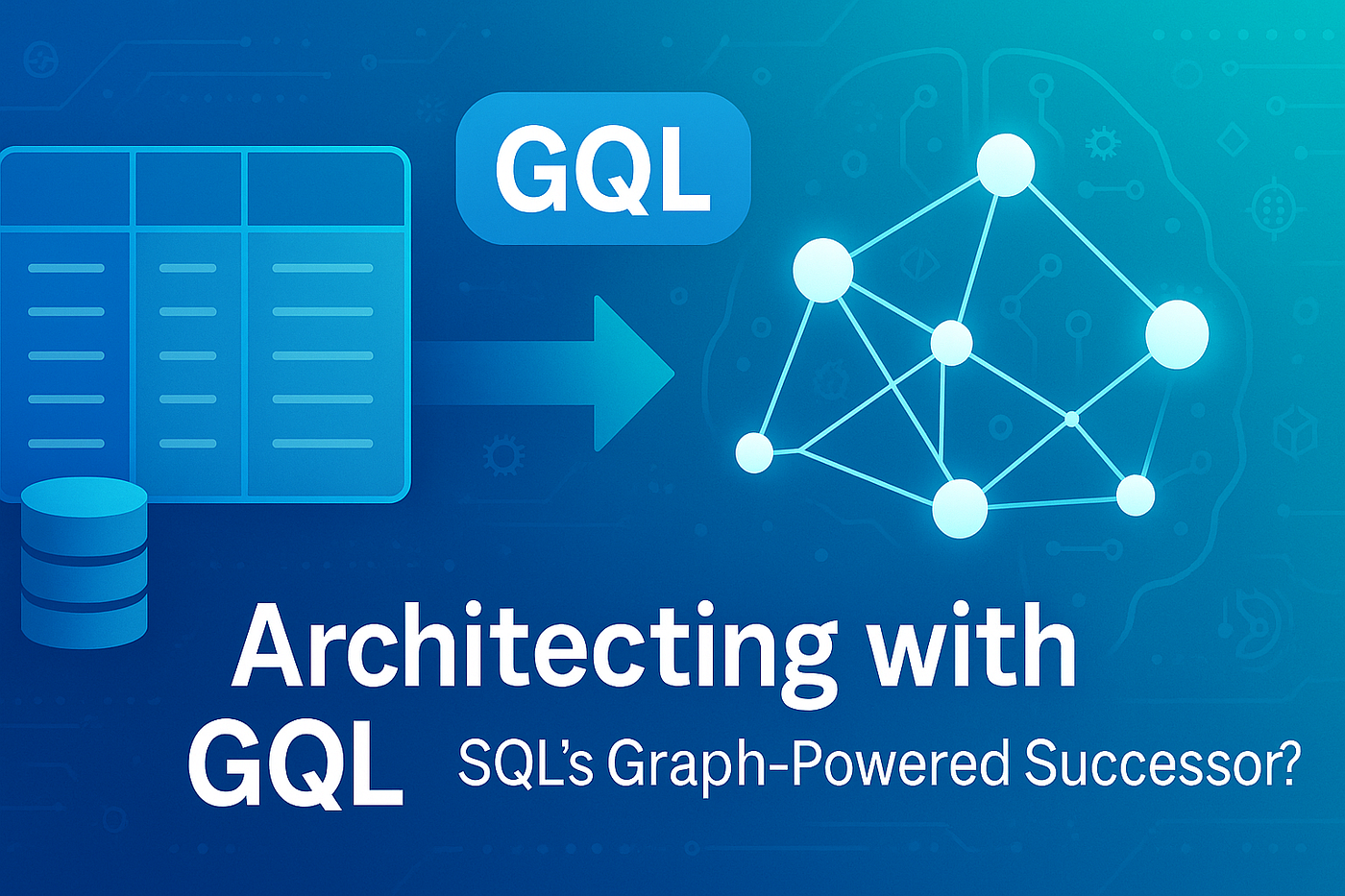
Explore GQL, the ISO-standard Graph Query Language, and how it might become SQL’s graph-powered successor for modern data architecture.
Let’s be real: SQL has been the backbone of data for half a century. But today’s data isn’t just rows and columns — it’s networks, relationships, and complex connections that don’t fit neatly into tables.
That’s why the industry is buzzing about GQL (Graph Query Language), the first ISO standard language designed specifically for graph databases. Some are calling it SQL’s natural successor. But is it really?
Let’s unpack this shift and see what it means for architects, developers, and data teams.
A Quick History: From SQL to Graph
SQL emerged in the 1970s, formalized by IBM and eventually standardized by ISO. It became the lingua franca of relational databases. If you touched data, you used SQL — no debate.
Fast forward to the 2000s, and graph databases like Neo4j, TigerGraph, and JanusGraph started gaining traction. They solved problems relational databases struggled with:
- Social network connections.
- Fraud detection with multi-hop relationships.
- Knowledge graphs linking billions of entities.
- Supply chain or logistics modeling.
But the query language landscape was fractured. Each vendor built its own: Cypher, Gremlin, SPARQL, PGQL. Developers faced fragmentation.
That’s the gap GQL aims to fill.
What Is GQL?
GQL (Graph Query Language) is the emerging ISO standard query language for property graph databases. Think of it as what SQL did for relational, but for graph data.
Its design goals:
- Vendor Neutrality: A single standard across graph DBs.
- Property Graph First: Supports nodes, edges, and attributes as first-class citizens.
- Declarative Semantics: Like SQL, you say what you want, not how to traverse.
- Composable: Built on familiar patterns from SQL and Cypher.
Why Graphs Matter Now
Data is increasingly relational — not in the SQL sense, but in the connected sense.
Examples:
- AI/LLMs: Knowledge graphs help models ground responses in structured facts.
- Fraud Detection: Identifying fraud rings requires tracing multi-hop transactions.
- Recommendations: “Users who bought this also bought that” is inherently graph-shaped.
- Cybersecurity: Attack path analysis thrives on graph models.
In short, relational databases are brilliant at structured rows, but not at messy webs. Graphs excel here.
A Side-by-Side Look
Here’s a simple query comparison:
SQL (relational join):
SELECT p.name, o.order_id
FROM Person p
JOIN Orders o ON p.id = o.person_id
WHERE o.amount > 100;
GQL (graph pattern match):
MATCH (p:Person)-[:PLACED]->(o:Order)
WHERE o.amount > 100
RETURN p.name, o.order_id;
Notice the difference:
- SQL joins tables by keys.
- GQL traverses relationships directly.
That’s a big deal for developers who want to model real-world connections more naturally.
Architecture Sketch
Here’s a mental model of where GQL fits in the data stack:
+---------------------+
|  Applications       |
|  (AI, Analytics, IoT)|
+---------+-----------+
          |
          v
+---------------------+
|   Query Language    |
|   (GQL for Graphs)  |
+---------+-----------+
          |
          v
+---------------------+
|   Graph Databases   |
|   (Neo4j, TigerGraph|
|    Memgraph, etc.)  |
+---------+-----------+
          |
          v
+---------------------+
|   Graph Storage     |
|   (Nodes + Edges +  |
|    Properties)      |
+---------------------+
This mirrors how SQL sits between apps and relational DBs — but now optimized for graphs.
The Bullish Case for GQL
1. Standardization Will Unlock Adoption
When SQL became a standard, it fueled mass adoption. GQL could do the same for graph DBs by removing fragmentation.
2. Developer-Friendly
If you know SQL, GQL feels familiar: declarative, pattern-driven, and readable.
3. Graph-Native Use Cases Are Exploding
From financial compliance to knowledge graphs for AI, demand is growing. GQL arrives at the right moment.
4. Bridging SQL + GQL
Since many workloads need both tables and graphs, GQL’s ties to SQL make hybrid querying realistic.
The Skeptical Case
Of course, not everyone is convinced.
- Vendor Lock-In Risks: Will every vendor truly adopt the ISO GQL, or keep pushing their dialects?
- Performance Questions: SQL has decades of query optimization. GQL optimizers are still young.
- Niche vs. Mainstream: Graph DBs are growing, but will they ever rival relational in market size?
- Learning Curve: Despite similarities, thinking in graphs is a shift for many teams.
Case Study: Fraud Detection with GQL
Consider a bank fighting fraud rings. In SQL, tracing multi-hop relationships across dozens of tables is painful: complex joins, recursive queries, performance bottlenecks.
In GQL, the model is natural:
MATCH (p1:Person)-[:TRANSFERRED]->(p2:Person)-[:TRANSFERRED]->(p3:Person)
WHERE p1.id = '123'
RETURN p1, p2, p3;
A simple pattern match exposes a 3-hop chain. Scale this to billions of edges, and you see why financial institutions are watching GQL closely.
SQL vs. GQL: Competitors or Complements?
It’s tempting to frame GQL as “SQL’s replacement,” but that’s not quite accurate.
- SQL will remain the king of structured/tabular data.
- GQL aims to be the king of connected data.
The likely future is hybrid systems: relational + graph side by side, with queries bridging them. We’re already seeing this in platforms like Oracle, SQL Server, and PostgreSQL extensions that support both.
What This Means for Architects
If you’re architecting modern systems, here’s what to keep in mind:
- Model relational data in SQL, but use graphs where connections matter.
- Keep an eye on vendors announcing ISO GQL adoption.
- Consider GQL for AI pipelines, fraud detection, knowledge graphs, and network analysis.
- Start small — pilot a graph workload before betting the farm.
Wrapping Up
So, is GQL the successor to SQL? Not exactly. But it is the long-awaited standard that could propel graphs from niche to mainstream.
For architects, the question isn’t “SQL or GQL?” It’s how to blend both to model reality more faithfully. Because in a world of AI, IoT, and global-scale systems, our data isn’t just tables — it’s networks, webs, and stories waiting to be connected.
💡 What do you think — will GQL become the SQL of graphs, or will it remain a specialized tool? Share your thoughts in the comments. And follow me for weekly deep dives on data, AI, and architecture.
메타데이터
- post_id
- 89da7f6eb6ad
- slug
- architecting-with-gql-sqls-graph-powered-successor-89da7f6eb6ad
- url
- https://medium.com/@connect.hashblock/architecting-with-gql-sqls-graph-powered-successor-89da7f6eb6ad
- canonical_url
- https://medium.com/@connect.hashblock/architecting-with-gql-sqls-graph-powered-successor-89da7f6eb6ad
- author_url
- https://medium.com/@connect.hashblock
- status
- ok
- fetched_at
- 2026-07-17 20:23:32