Stopping Lead Diversion Before It Starts: How TouchNow Protects Every Lead
In sales, the worst lost deal is not the one that is rejected — it is the one that quietly slips out of the system.
Stopping Lead Diversion Before It Starts: How TouchNow Protects Every Lead

In sales, the worst lost deal is not the one that is rejected — it is the one that quietly slips out of the system.
This is the hidden problem behind lead diversion. A lead enters the pipeline, a conversation begins, and then the interaction moves outside company visibility. Maybe the sales representative copies contact details. Maybe the buyer is contacted privately. Maybe the opportunity is redirected through a side channel. Whatever the method, the result is the same: the company loses control, the team loses confidence, and revenue begins to leak without warning.
This is why lead protection is no longer just a sales concern. Instead, it is an ethics issue, a revenue issue and a leadership/strategic issue. In organizations where lead ownership is unclear or communication is uncontrolled, even good teams can end up with bad outcomes. The solution is not only a tighter process, a system that makes lead handling visible, accountable, and fair from the start.
Table of contents
- What lead diversion really means
- Why lead diversion is an ethical problem
- How lead diversion happens in real teams
- Research & Data: The Hidden Cost of Lead Leakage
- Why CRM alone cannot solve it
- Here is the solution: TouchNow
- You should know why conversation intelligence matters
- The business impact of lead integrity
- Building a stronger sales culture
- Bringing It All Together
What lead diversion really means
Lead diversion happens when customer communication moves outside the company’s controlled sales environment. In simple terms, the opportunity is no longer being handled where the organization can see it clearly. That could mean a rep copies contact details and follows up privately, or it could mean a buyer is guided into a separate communication path that the company cannot monitor.
The danger is not just that the lead is being used elsewhere. It is that the company can no longer verify what is happening. Once visibility is lost, ownership becomes fuzzy, attribution becomes unreliable, and the pipeline becomes harder to trust.
In many organizations, this behavior is casually called lead theft. But the deeper issue is not just who took the lead. It is how weak process design made that possible in the first place. When systems leave room for hidden behavior, revenue leakage becomes easier to create and harder to prove.
Why Lead Diversion Raises Ethical Concerns
Lead diversion is an ethics problem because it breaks the basic contract of trust between the company and its salespeople. A business invests in marketing, lead generation, and sales infrastructure with the expectation that opportunities will be handled responsibly. If a rep turns that access into private advantage, the issue goes beyond workflow. It becomes a breach of integrity.
There is also a fairness issue inside the team. When one person can bypass the process and claim or control a lead outside the system, the rest of the team is forced to compete with behavior that cannot always be seen or measured. That creates resentment, weakens morale, and damages the culture of accountability.
Ethical sales systems are built on transparency. People should know where leads come from, who owns them, how they are handled, and what happens if something unusual occurs. When communication slips outside that structure, ethics and performance both suffer.
How lead diversion happens in real teams
Lead diversion rarely happens as a single, obvious act. It usually develops through small actions that seem normal at first but gradually move the deal outside the system. In environments where controls are limited, these small shifts in behavior can slowly reduce visibility and weaken ownership clarity.
This typically shows up in ways such as:
- Reps initiating or continuing conversations with prospects outside the official platform
- Follow-ups being carried out through personal channels that are not tracked by the organization
- Reps attempting to influence the deal outside the assigned ownership
- Conversations being steered toward alternate paths that reduce system visibility
Over time, these actions create gaps in tracking and accountability. What makes lead diversion difficult to detect is that it does not appear as a clear violation — it unfolds through a series of small, everyday decisions that gradually take the opportunity out of view.
Research & Data: The Hidden Cost of Lead Leakage

To understand the scale of the problem, let’s look at real industry data:
Key Statistics
- According to research by Marketing Sherpa, nearly 79% of marketing leads never convert into sales, highlighting a significant gap between lead generation and conversion.
- A study by Harvard Business Review found that companies that respond to leads within 5 minutes are 21 times more likely to qualify them compared to delayed responses.
- According to the Salesforce State of Sales Report, sales teams lose up to 30–40% of their time dealing with untracked or poorly managed leads.
- Research by Gartner indicates that only 53% of sales leaders fully trust the accuracy of their pipeline data.
- As per the Experian Data Quality Report, poor data visibility and quality can reduce a company’s revenue by up to 10% annually.
Why CRM alone cannot solve it
CRM systems are essential for managing pipelines, but they are not designed to fully prevent lead diversion. They record activities, store data, and track deal progress, but they cannot always verify whether interactions remain within the company’s control.
This creates a gap between recorded data and actual behavior. A pipeline may appear complete and accurate in the system, while key conversations may already be happening outside it. Without visibility into how interactions actually take place, early signs of diversion often go unnoticed.
Here is the solution: TouchNow
TouchNow is designed to protect lead integrity from the beginning. Instead of reacting to problems later, it ensures that lead handling remains controlled, visible, and accountable at every stage of the sales process.
This is enabled through key capabilities such as:
- Restricted deal visibility — Sales reps cannot access each other’s leads, reducing internal interference and clearly defining ownership boundaries
- Protected customer data — Contact details remain hidden, preventing misuse and keeping all communication within the platform
- Platform-first communication — All calls, messages, and follow-ups happen within the system, ensuring complete visibility and a reliable interaction trail
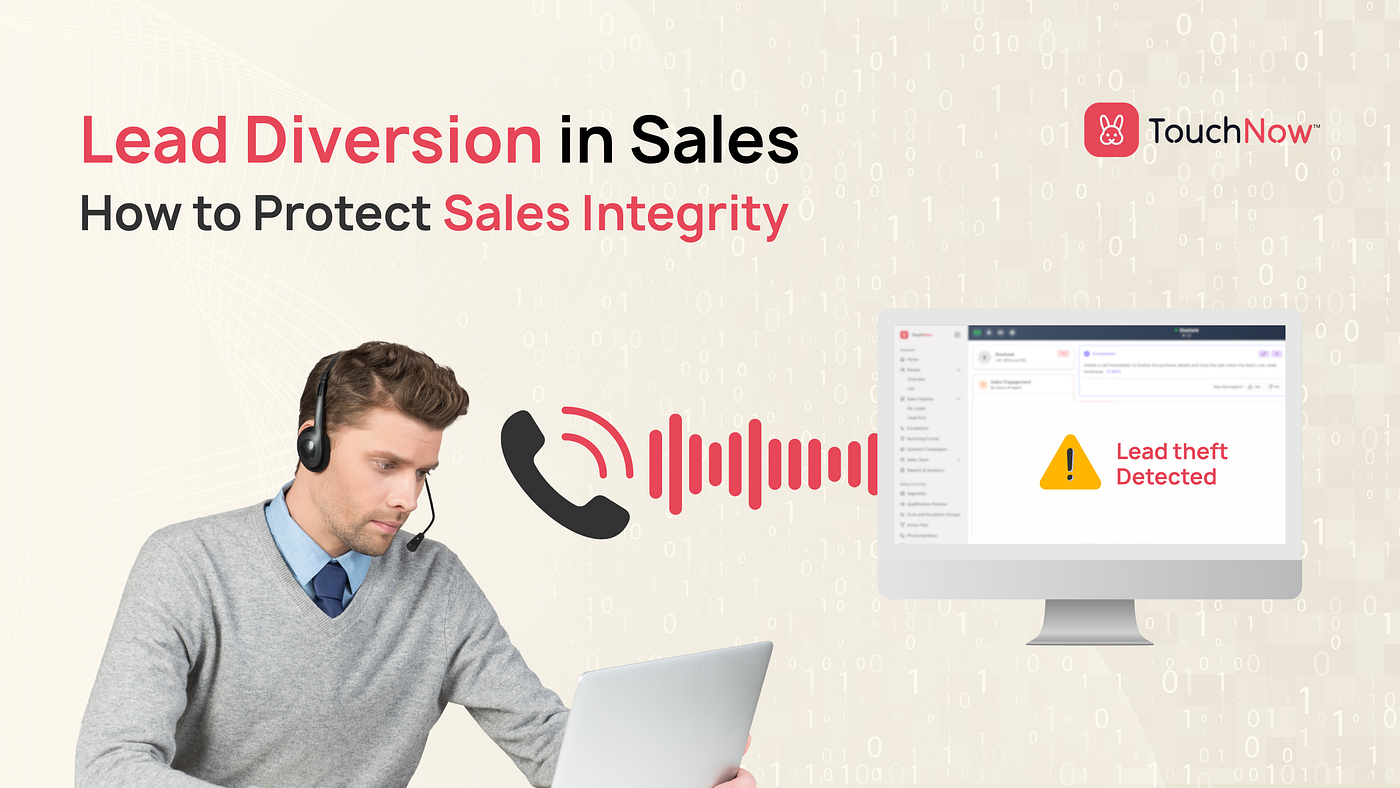
- Early risk detection — Conversation intelligence identifies unusual patterns and flags potential diversion before it impacts the deal
If any suspicious activity is detected — such as attempts to move conversations off-platform or irregular engagement behavior — the system raises an alert for timely review. This allows organizations to take action before the opportunity is affected.
That is what makes **TouchNow** more than just a lead management tool. It functions as a system built to protect revenue by maintaining control, clarity, and accountability throughout the sales process.
You should know why conversation intelligence matters
Conversation intelligence strengthens this approach by adding behavioral visibility to sales interactions. Instead of only recording actions, it helps identify patterns and detect deviations early.
Read our full article on behavioural integrity (https://medium.com/signals-conversions/are-your-sales-conversations-going-off-track-heres-how-to-catch-it-early-381953b54326)
This makes it possible to spot signs of off-platform movement or irregular engagement before they become visible in reports. Rather than reacting after a deal is lost, teams can intervene while the opportunity is still active.
The goal is not surveillance, but structured protection. In fast-moving sales environments, speed is important — but without visibility, it increases risk. Conversation intelligence ensures that speed and control work together.
The business impact of lead integrity
Protecting leads is not just about preventing misuse — it also improves how the business functions. When ownership is clear and communication stays within the system, organizations gain better control and more reliable visibility. It’s about early stage avoidance of any “conflict of interest” within or outside the system.
This leads to:
- Accurate revenue attribution, ensuring the right work is properly credited
- Better forecasting, as the pipeline reflects real engagement
- Stronger decision-making, based on cleaner and more trustworthy data
- More consistent customer experience, with structured and professional communication
- Greater trust within teams, as reps feel their work is protected fairly
- Reduced friction and improved discipline, making performance easier to manage
Overall, lead integrity strengthens both execution and outcomes across the sales process
Building a Stronger Sales Culture
Technology alone cannot prevent lead diversion — it needs the right culture to support it. Organizations must establish clear ownership rules and ensure that all communication stays within defined systems. Equally important is consistency. When unusual behavior is flagged, it must be reviewed and addressed quickly. If ignored, the system loses credibility. If handled properly, it reinforces accountability across the team.
Culture is also shaped by what gets rewarded. When only outcomes matter, shortcuts follow. But when transparency, discipline, and structured execution are valued, teams begin to operate with greater integrity. This is the basis of large organizations based on strong foundations.
***TouchNow supports this by making visibility and accountability part of everyday workflows, turning integrity from an expectation into a standard.***
Bringing It All Together
Lead diversion is not just a revenue risk — it’s a trust risk. When communication moves outside visibility, control over ownership and accountability begins to slip, often before teams even realize it. The strongest sales teams don’t just move fast — they operate with clarity and discipline. What you don’t see in your sales process is often what costs you the most.
TouchNow addresses this at the source by keeping interactions structured, visible, and accountable — so every lead stays protected.
If you want more visibility, control, and confidence in how your leads are handled, Touchnow can help you make that shift.
👉 Visit https://touchnow.ai to book a demo 👉 Reach out at contact@touchnow.ai
메타데이터
- post_id
- 89dd7065a32f
- slug
- stopping-lead-diversion-before-it-starts-how-touchnow-protects-every-lead-89dd7065a32f
- url
- https://medium.com/signals-conversions/stopping-lead-diversion-before-it-starts-how-touchnow-protects-every-lead-89dd7065a32f
- canonical_url
- https://medium.com/signals-conversions/stopping-lead-diversion-before-it-starts-how-touchnow-protects-every-lead-89dd7065a32f
- author_url
- https://medium.com/@blogs_28696
- status
- ok
- fetched_at
- 2026-06-14 11:28:49