Born Pure, Born a Yogini — The Spiritual Power of Menstruation in Tantra and Sanatan Dharma
With Ambubachi Mela 2026 now concluded, let’s explore the meaning behind the Bleeding Goddess. There is perhaps no topic in Hindu spiritual…
Born Pure, Born a Yogini — The Spiritual Power of Menstruation in Tantra and Sanatan Dharma
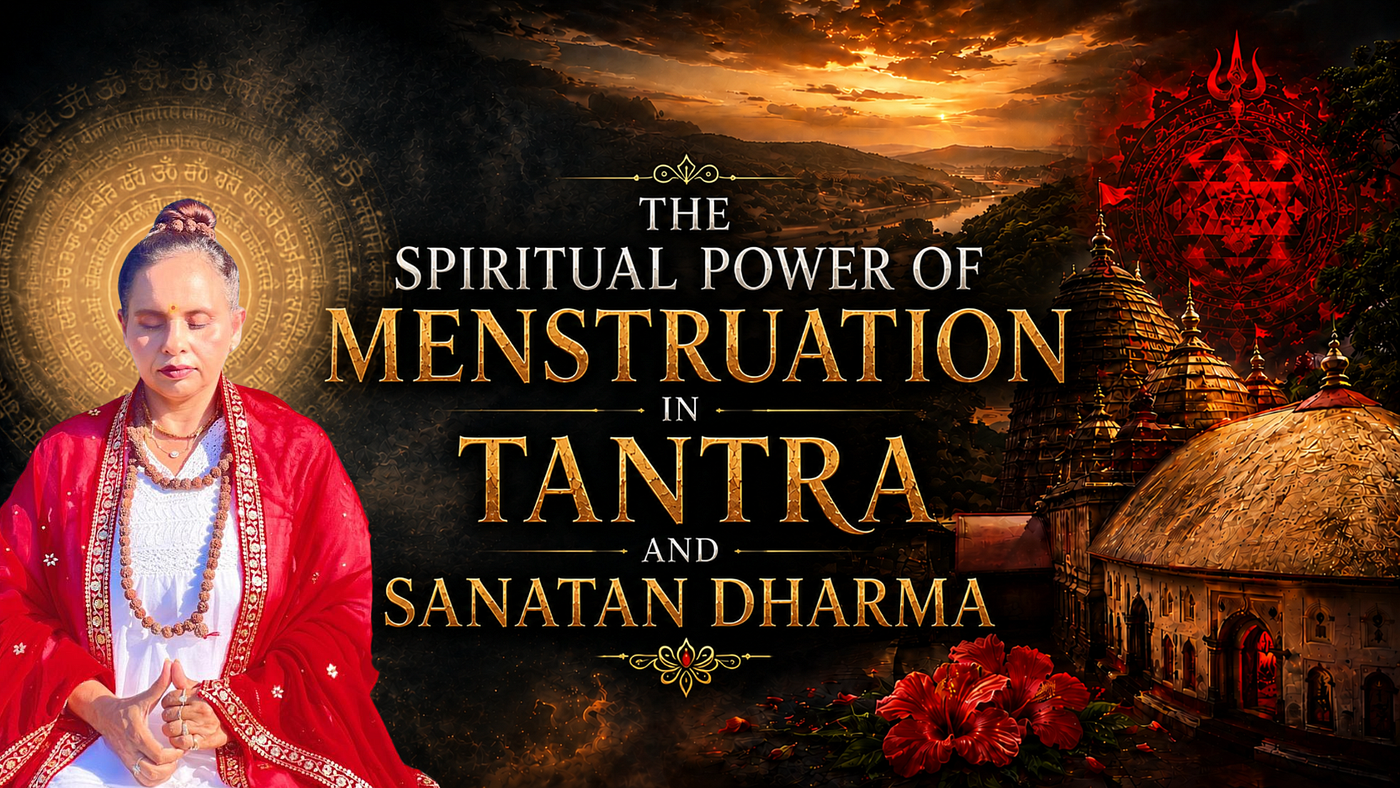
With Ambubachi Mela 2026 now concluded, let’s explore the meaning behind the Bleeding Goddess. There is perhaps no topic in Hindu spiritual life that carries more confusion, more contradiction, and more unspoken pain than menstruation. Women who have spent years in devoted practice suddenly find themselves told every month, without fail that they are impure. That they cannot touch the deity. That God himself will be displeased if they come near.
But is that what the scriptures actually say? Is that what Tantra says?
The answer is no. Not only is a woman never impure during her period according to Tantra, she is at the peak of her spiritual and creative power. Many of the beliefs surrounding menstrual impurity arose through social customs and later interpretations, rather than from the core philosophical teachings of Tantra.
This blog is an attempt to lay out, clearly and completely, what the tradition actually teaches and to give every woman reading this the confidence to reclaim what has always been hers.
The Moon, the Body, and the 28-Day Cycle
To understand the spiritual significance of menstruation, we have to start with the Moon.
The Hindu lunar calendar runs on a 28-day cycle from Amavasya (new moon) to Purnima (full moon) and back again. This is not a coincidence. The human body, which is approximately 70% water, is directly connected to the movements of the Moon. Its believed that, Just as the Moon’s gravitational pull creates the high tides and low tides of the ocean, it creates corresponding rhythms of energy within the body. And the Moon, in the Vedic tradition, is connected to the mind itself to amrit, the nectar of consciousness that flows through us.
A woman’s menstrual cycle mirrors this lunar rhythm almost exactly. The 28-day cycle of menstruation is the body doing what the ocean does at high tide: flushing out everything accumulated toxins, old blood, the uterine lining prepared for conception that was not needed this month so that it can begin fresh. Around day 14 of the cycle comes ovulation, and then the cycle begins again.
This is not a disease. It is not a defect. It is the most precise biological clock that exists a woman’s body continuously preparing itself to become the vessel for new life, month after month, in perfect alignment with the cosmos.
The Womb as Sacred Earth
Think of a woman’s body as fertile earth it is bhoomi, it is yoni, the sacred ground from which new life emerges. And just as a farmer, before planting seeds, must first clear the field pulling out every weed so that nothing competes with what is to be grown menstruation is the body’s own clearing. The removal of everything old, so that the creative force can be received purely, without obstruction.
This is why women are described in the tantric tradition as Agnikund sacred fire-altars. Whatever you place into a fire altar burns and becomes holy. A woman carries this transformative power within her by nature. And during menstruation, that fire is at its most active most purifying, most alive.
The tradition does not say that women become pure through practice. We are already pure paidaishi pavitra, pure from birth. What practice does for a man over years of rigorous sadhana, a woman carries in her very body from the beginning.
Born a Yogini
Here is a teaching that most women have never heard said out loud: we are, by our very nature, yoginis. And I do not say this as encouragement I say it as a statement of fact that the tradition has always known.
Yoga means to unite, to connect. A yogini is one who joins. And who does this better than a woman? She leaves her family of birth and enters another family, joining two lineages in herself. She carries a child within her body and brings that child into the world, joining that new soul to the whole of creation. She is the living bridge between the worlds.
Think about it: from the moment we are born, we are being prepared consciously or not to leave. Even the most loving parents hold a daughter a little differently, knowing she will one day go. And when she arrives at her husband’s home, it never feels entirely hers either. A woman is always, in some sense, passing through. She loves deeply and yet remains always slightly virakta unattached.
This detachment is exactly what a male yogi spends years in the forest trying to cultivate. We are born with it. Paidaishi yogini, paidaishi virakt, paidaishi devi born a yogini, born detached, born a goddess. This is not flattery. This is the literal teaching of Tantra.
Where Did the “Impurity” Come From?
If women are born pure, born yoginis, born divine then where did the idea of menstrual impurity come from?
Go back 5,000 to 7,000 years. People wore clothing made from tree bark. There were no sanitary pads, no cotton cloth. When a girl had her period, the only practical solution was to seat her on soft earth or grass, away from the household, where any leakage could be absorbed naturally and hygienically. She was given rest, given food, told to simply be still for those days. This was the origin of the practice of separation it was hygiene and practical care, not condemnation.
As time moved forward, cloth began to be produced first on spinning wheels, painstakingly, so that even two sets of clothing for a woman was considered wealth. When a girl had her period, cloth was given to her specifically for those days, washed and reused. People were not throwing it away they were preserving something precious. Which itself raises a question: if this blood was truly impure, why would anyone reuse the cloth that absorbed it?
The tradition of sitting separately continued long after the practical reasons no longer applied. And somewhere along the way, a small child asked: “Why is didi sitting away from us?” And the easy answer, the one that required no lengthy explanation to a ten-year-old was: “She is impure right now.” That answer, given for convenience, settled into the mind of one generation. And then the next. And then the next.
What began as hygiene became stigma. What began as care became shame.
The Double Standard — And Tantra’s Answer
Consider the contradiction embedded in this practice. A woman goes to her office, travels by train, manages a household, earns a salary and none of this is considered to make her impure. The moment she steps through her own front door, something about that space triggers the label. She is impure at home. Not on the train. Not at work. Only at home, near the deity, near the kitchen.
If the concern is truly about impurity, then the logic fails the moment you allow a woman to exist in any public space during those four days. And if she is permitted everywhere else then the impurity was never the real point. Something else drove the rule. And I believe that something else may have been precisely the opposite of what we were told: not that women are less powerful during menstruation, but that they are more powerful. And perhaps, in some old corner of a world that was not always kind to feminine power, that power needed to be contained.
This is where Tantra steps in boldly, as it always does. Tantra declares that a woman can never be impure. Full stop. The tradition that describes Maa Kali roaming the cremation grounds, unclad and untamed, that sees divinity in the most primal forms of nature this tradition has no room whatsoever for the concept of a menstruating woman being spiritually lesser. Quite the opposite.
Kamakhya — The Bleeding Goddess
The most powerful proof that menstruation is sacred rather than impure comes from one of the most celebrated temples in India: Kamakhya in Assam.
Kamakhya is the seat of Maa Lalita Tripura Sundari a Siddha Peetha of enormous power, where the yoni of Devi Sati fell after the events of Daksha’s yagna. And every year, in late June around the summer solstice, when the Moon’s position causes the water table in the Brahmaputra region to rise dramatically — the Goddess herself is said to become rajasavala: to menstruate.
The temple closes for four days. Not because of shame. Not because something impure is happening. It closes in celebration. Because the Goddess bleeding means the Earth is preparing itself. New creation is coming. The rains are about to arrive, the Brahmaputra will flood, and those mineral-rich waters will spread across the fields, nourishing everything they touch.
The science beneath this is beautiful. The soil of the Kamakhya hills is naturally rich in iron sulfide and mercury sulfide the same compounds found in vermilion (sindoor). Its believed that When monsoon rains fall on these iron-rich mountains, the water that flows out turns a deep, striking red naturally, without any added kumkum. That red water collects in the sacred depression in the temple’s inner sanctum, and the faithful receive it as the prasad of the Goddess’s own blood.
This is the very same iron that runs in our blood. The same mineral that a pregnant woman is prescribed in supplement form, because iron is what the body needs to build new life. What flows red from the mountains of Kamakhya and what flows red from a woman’s body every month they are the same creative force, the same elemental power, wearing different forms.
Menstruation as Spiritual Retreat
Once you understand the tradition accurately, the original intention behind the practice of separation reveals itself as something tender rather than punitive.
Where in a woman’s month is she given four days entirely for herself? Where does she get permission to put down the cooking, the cleaning, the care of others, the constant service that asks everything of her and acknowledges very little? In the old villages, women used to gather together two or three of them, whoever was in their cycle at the same time in a separate space. They would sit together, talk, share, rest. For those four days, the men cooked. The women were free.
It was not exile. It was a spiritual retreat the only one that society built in specifically for women.
The intention was this: a woman’s body, during those days, is doing the most intense creative and purifying work it does all month. Rather than pouring that energy outward into the household, the temple, the world those four days were meant to be turned inward. Meditate. Chant. Rest in that creative force rather than giving it away. Let the purification happen completely. Prepare the ground, as it were, for whatever seed is coming next.
Swami Sivananda of the Divine Life Society, whose book I read at the age of fifteen, confirms this directly: women can absolutely meditate, do japa, and chant during their period. The Vedic texts do not say otherwise. Nowhere in the authentic scriptural tradition is inner practice dhyana, japa, mantra forbidden to a woman during her cycle. The restriction, where it exists at all, was always about external ritual performance in shared sacred spaces never about one’s own inner communion with the Divine.
Shraddha — The One Ingredient That Truly Matters
I have taught students from India, from America, from Europe and I have noticed something consistent. When Western students come to me and I tell them to do their puja, they simply do it. They have no conditioning that tells them not to. And their practice is extraordinary focused, sincere, and completely undivided.
When Indian students come and ask whether they should or should not do puja during their period, I pause before answering. Not because the answer is complicated, but because of Shraddha (faith) which is the single most important ingredient in any form of worship. If you approach the deity with doubt, with fear that you are doing something wrong, that doubt will undermine everything. The puja itself becomes a divided act. Half the mind is on the deity, and half is wondering whether God is displeased. That is not worship. That is anxiety.
So my answer is not a blanket command either way. It is: what does your own mind tell you? If the conditioning runs deep and you cannot touch the deity without feeling that knot of doubt in your chest then for you, in this moment, perhaps do not. Not because you are impure. But because your own divided mind will sabotage what you are trying to do.
Work on the conditioning. Read. Understand. Question everything. As the understanding deepens, the doubt dissolves. And as the doubt dissolves, the practice becomes what it was always meant to be fearless, whole, and completely your own.
My Own Experience
I am in my middle years. I have lived nearly five decades and I know what I have experienced. I am a Tantra Sadhika, a Shri Vidya practitioner and I have done sadhana during my period. I have visited temples during my period. I have chanted, meditated, and worshipped in every state.
I felt no sin. I felt no impurity. My sadhanas were successful. In fact, those days gave me more power, more focus, more clarity than almost any other time because I was not cooking, not managing, not serving the household. I was simply sitting, turning inward, connecting with the same creative force that was moving through my body. Sadhana in that state does not produce half results. It produces results that might take twice as long in any other state.
I married in 1997 and moved into a traditional household. For the first time in my life, I was told to sit in a separate room, not touch the sofa, eat food that was passed to me on a wooden board at the doorstep. I sat with that experience and I reflected not with anger, but with genuine curiosity. And what I traced, piece by piece, was exactly the history I have laid out here: bark-cloth and ancient fields, and a convenience answer given to a child that became the law of a generation.
Sadhana does not make you fearful. Sadhana makes you fearless. And only the fearless can truly move forward.
Conclusion
What Tantra and Sanatan Dharma actually say about menstruation is this: a woman is never impure. She is, by her very nature, a yogini one who joins and unites. She is an Agnikund, a sacred fire that purifies everything it receives. During menstruation, her body is doing its most powerful creative work flushing out the old to make space for the new, in perfect alignment with the Moon, with the tides, with the red mineral waters of Kamakhya itself.
Over time, what may have begun as practical customs related to hygiene, rest, and the realities of ancient life gradually hardened into social rules. Across generations, these customs came to be interpreted as religious mandates, even though Tantric traditions continued to uphold a very different understanding of feminine power.
Jai Maa Kamakhya
Until we meet again
Stay tuned for blogs on Tantrik traditions, modes of worship and more.
Follow my **profile** for updates! If you want to connect with me reach out via any of the following channels:
- Mail ID: smitavenkatesh108@gmail.com
- Instagram ID: smitavenkatesh.108
- Youtube: www.youtube.com/@smitavenkatesh
- WhatsApp Group: https://chat.whatsapp.com/IrbRNGGfzIKEVnnM0fbalN
- WhatsApp channel:https://whatsapp.com/channel/0029VaEbLFa1noz3aPil500F
- Official Website: www.srikul.org
메타데이터
- post_id
- 89ed1fbcb4ee
- slug
- born-pure-born-a-yogini-the-spiritual-power-of-menstruation-in-tantra-and-sanatan-dharma-89ed1fbcb4ee
- url
- https://medium.com/@smitavenkatesh/born-pure-born-a-yogini-the-spiritual-power-of-menstruation-in-tantra-and-sanatan-dharma-89ed1fbcb4ee
- canonical_url
- https://medium.com/@smitavenkatesh/born-pure-born-a-yogini-the-spiritual-power-of-menstruation-in-tantra-and-sanatan-dharma-89ed1fbcb4ee
- author_url
- https://medium.com/@smitavenkatesh
- status
- ok
- fetched_at
- 2026-07-14 16:46:30