Introduction to Convolutional Neural Networks (CNNs): The Foundation of Computer Vision
Hello everyone 👋
Introduction to Convolutional Neural Networks (CNNs): The Foundation of Computer Vision
Hello everyone 👋
So far in our deep learning journey, we have explored:
- Artificial Neural Networks (ANN)
- Activation functions
- Backpropagation
- Gradient descent
- Optimizers
- Overfitting and regularization
We now understand how neural networks learn patterns from data.
But now comes a very important challenge:
Can traditional neural networks efficiently understand images?
Because images are very different from structured numerical data.
An image contains:
- Thousands or millions of pixels
- Spatial relationships
- Shapes, edges, textures, and patterns
And this creates a major problem for traditional Artificial Neural Networks.
This challenge led to one of the biggest breakthroughs in deep learning:
Convolutional Neural Networks (CNNs)
CNNs completely transformed:
- Computer Vision
- Image Recognition
- Medical Imaging
- Self-driving Cars
- Facial Recognition
- Modern AI systems
In this blog, we’ll understand:
- Why traditional neural networks struggle with images
- How CNNs solve these problems
- Why CNNs became the foundation of computer vision.
What is a Convolutional Neural Network (CNN)?
A Convolutional Neural Network (CNN) is a specialized deep learning architecture designed for:
- Processing images
- Extracting visual patterns
- Understanding spatial information
Unlike traditional neural networks:
- CNNs are built specifically for visual data.
They automatically learn:
- Edges
- Shapes
- Textures
- Objects
- Complex visual features.
Why Traditional ANN Struggles with Images
To understand why CNNs are important, we first need to understand the limitations of regular ANN.
Suppose we have:
- A 256 × 256 RGB image.
Total input values become:
256 × 256 × 3 = 196,608 pixels
If every pixel connects to every neuron:
- The number of parameters becomes extremely large.
This creates major problems:
- Huge memory usage
- Slow training
- Overfitting
- Computational inefficiency.
A traditional ANN does not scale efficiently to image data.
Images Contain Spatial Information
Images are not just random numbers.
Nearby pixels are related.
Example:
- Edges form shapes
- Shapes form objects
Traditional ANN ignores these spatial relationships.
CNNs solve this problem by:
- Preserving spatial structure.
This is one of the biggest reasons CNNs became revolutionary.
The Core Idea Behind CNNs
CNNs work by:
- Detecting small visual patterns first
- Combining them into larger patterns
For example:
- First layer learns edges
- Next layer learns shapes
- Deeper layers learn objects
This hierarchical learning is what makes CNNs powerful.
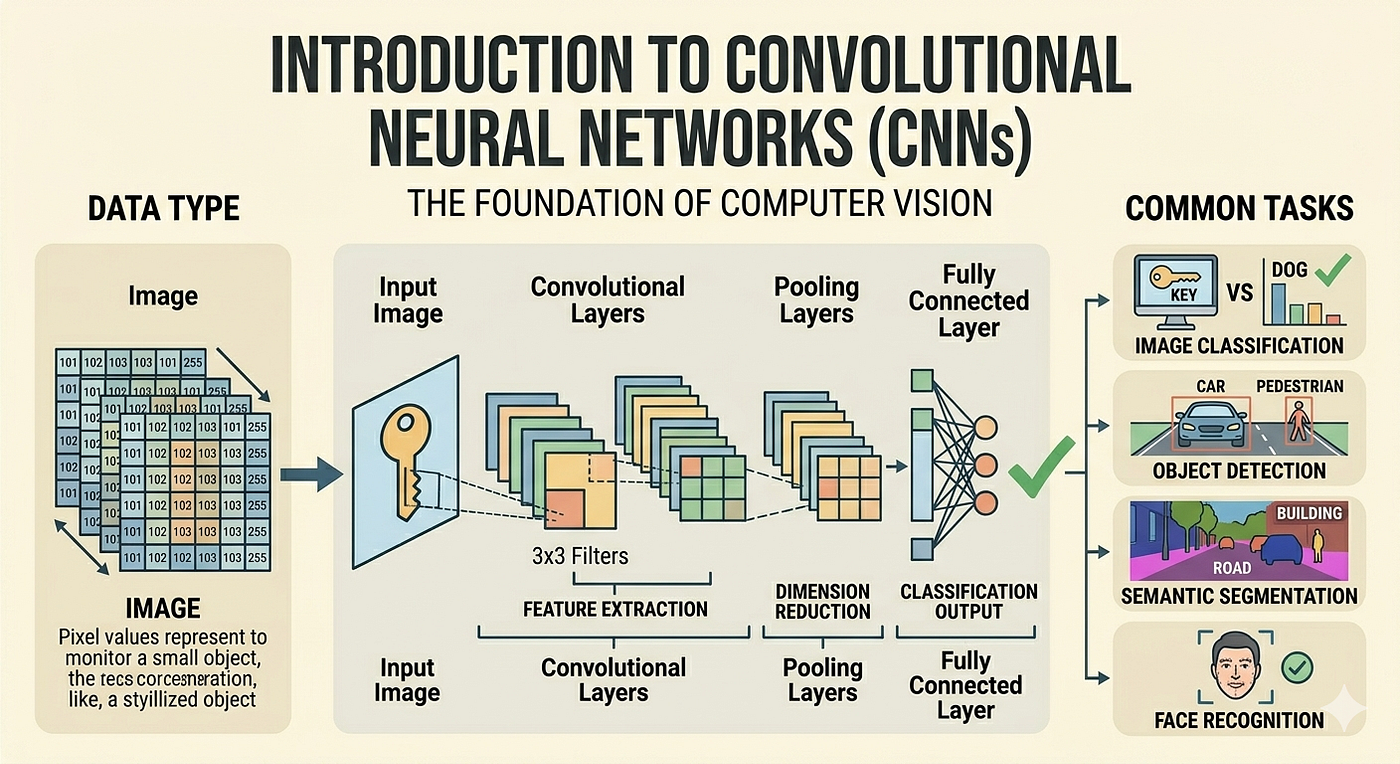
Main Components of CNN
A CNN mainly consists of:
- Convolution Layer
- Activation Function
- Pooling Layer
- Fully Connected Layer
Let’s understand them briefly.
1. Convolution Layer
This is the most important part of CNN.
The convolution layer uses:
- Small filters (kernels)
These filters scan across the image to detect patterns.
Example:
- Vertical edges
- Horizontal edges
- Curves
- Textures
This process is called: Convolution
Why Convolution is Powerful
Instead of learning every pixel independently:
- CNN learns local patterns.
This dramatically reduces:
- Parameters
- Computation cost
And improves:
- Feature extraction.
Example of Feature Learning
Imagine detecting a cat in an image.
CNN layers may learn:
- Edges
- Ears
- Eyes
- Fur textures
- Full cat face
Deeper layers gradually build more meaningful representations.
2. Activation Function
After convolution:
- Activation functions introduce non-linearity.
Most CNNs use:
- ReLU activation function.
This helps the network:
- Learn complex visual relationships.
3. Pooling Layer
Pooling helps reduce:
- Image size
- Computation
- Overfitting
It keeps:
- Important information while removing:
- Unnecessary details.
Example: Max Pooling
Max Pooling selects:
- The maximum value from small regions.
This helps preserve:
- Strong visual features.
4. Fully Connected Layer
At the end:
- Extracted features are passed to fully connected layers.
These layers:
- Perform final classification.
Example:
- Cat or Dog
- Tumor or No Tumor
- Face Identification.
Real-World Applications of CNNs
CNNs power many modern AI applications:
- Face recognition
- Self-driving cars
- Medical image diagnosis
- Security systems
- Satellite image analysis
- OCR and handwriting recognition
Computer vision became practical largely because of CNNs.
Why CNNs Are So Powerful
CNNs offer several major advantages.
Parameter Sharing
Filters are reused across the image.
This reduces:
- Total parameters have changed dramatically.
Local Connectivity
CNN’s focus on:
- Nearby pixel relationships.
This improves:
- Visual understanding.
Hierarchical Feature Learning
CNNs learn:
- Simple features first
- Complex features later.
This creates deep visual intelligence.
Challenges in CNNs
Despite their power, CNNs also have challenges:
- Require large datasets
- Computationally expensive
- Need GPUs for efficient training
- Can overfit on small datasets
Still, CNNs remain one of the most important breakthroughs in AI history.
CNN vs ANN
Traditional ANN
- Fully connected architecture
- Poor for image scaling
- Ignores spatial structure.
CNN
- Specialized for images
- Efficient feature extraction
- Preserves spatial relationships.
This makes CNNs far superior for computer vision tasks.
How CNNs Revolutionized AI
Before CNNs:
- Image recognition performance was limited.
After CNNs:
- AI systems began outperforming humans in many visual tasks.
CNNs became the foundation for:
- Modern computer vision
- Deep image understanding
- Advanced AI applications.
Why CNNs Matter in Your AI Journey
CNNs are one of the most important architectures in deep learning.
Understanding CNNs helps you move toward:
- Computer Vision
- Medical AI
- Autonomous systems
- Advanced deep learning projects.
This is a major step toward modern AI engineering.
In Short
Convolutional Neural Networks:
- Are specialized neural networks for image processing
- Extract visual patterns efficiently
- Preserve spatial relationships
- Form the backbone of modern computer vision systems.
Final Thoughts
This blog marks the beginning of one of the most exciting parts of deep learning.
Because now:
- Neural networks are no longer just learning numbers
They are beginning to:
- Understand images
- Detect objects
- Interpret visual information.
This is where deep learning starts becoming truly intelligent.
And this is what separates:
- Basic machine learning systems from
- Modern AI vision systems.
Because CNNs gave machines something extraordinary:
The ability to see.
What’s Next?
Now that you understand the foundation of CNNs…
In the next blog, we’ll explore:
“How Convolution Works in CNNs: Understanding Filters, Kernels & Feature Maps”
You’ll learn:
- How filters scan images
- What feature maps are
- How CNNs detect patterns step-by-step
Until then, keep learning, keep building, and keep growing 🚀
메타데이터
- post_id
- 89fec519f82a
- slug
- introduction-to-convolutional-neural-networks-cnns-the-foundation-of-computer-vision-89fec519f82a
- url
- https://medium.com/@parulsingh1074/introduction-to-convolutional-neural-networks-cnns-the-foundation-of-computer-vision-89fec519f82a
- canonical_url
- https://medium.com/@parulsingh1074/introduction-to-convolutional-neural-networks-cnns-the-foundation-of-computer-vision-89fec519f82a
- author_url
- https://medium.com/@parulsingh1074
- status
- ok
- fetched_at
- 2026-06-10 18:44:10






