How AI Is Reshaping Embedded Software Development Services in 2026
Roughly 75% of enterprise-generated data will be created and processed outside the traditional data center by 2026, according to forecasts…
How AI Is Reshaping Embedded
Software Development Services in 2026
Photo by James Harrison on Unsplash
Roughly 75% of enterprise-generated data will be created and processed outside the traditional data center by 2026, according to forecasts published by Gartner. For anyone shipping connected hardware, that one number reframes the entire stack. Inference is moving onto the device. Firmware is no longer a static binary you flash once and forget. And the buying criteria for embedded software development services have shifted in less than 24 months.
If you are a CTO, VP of Engineering, or hardware founder shipping a connected product, AI is now changing three things at once: how firmware is written, what runs on the MCU, and how your vendor is judged. This article gives senior engineering leaders a clear read on:
-Where AI is actually adding measurable value in firmware engineering -What it means for RTOS firmware development, Embedded Linux, and edge AI MCU workloads -How AI changes IoT firmware security, compliance, and OTA strategy -A practical decision framework for embedded software outsourcing in the AI era -The skills and tools your partner should already have in production
Why AI Is a Structural Shift, Not a Feature
For two decades, embedded teams optimized for one axis: deterministic behavior on constrained hardware. AI breaks that axis open in two directions.
First, AI is now a workload that runs on the device itself. A Cortex-M55 with Helium extensions can run a keyword-spotting model in under 100 KB of RAM. An NXP i.MX 93 or STM32N6 can handle vision inference at the edge without a cloud round-trip. The MCU is no longer just a controller; it is a tiny inference engine.
Second, AI is changing how firmware is produced. Code generation, automated test synthesis, static analysis tuned by LLMs, and AI-assisted hardware-software co-design are quietly compressing engineering cycles. McKinsey research on generative AI in software engineering points to meaningful productivity gains in code documentation, refactoring, and unit test generation, even in safety-adjacent domains.
For buyers of embedded software development services, this means the conversation with a vendor has changed. You are no longer just hiring people who know FreeRTOS or Yocto. You are hiring a team that can ship ML on a microcontroller, harden it against adversarial inputs, and prove it to a regulator
Key insight: The new differentiator in custom firmware development is not just lines of clean C code. It is the ability to integrate model lifecycle, secure boot, and OTA into a single, certifiable release pipeline.
What Does AI Actually Change Inside Firmware
Engineering?
AI shows up in embedded work in three distinct layers. Mixing them up is the most common mistake leaders make when scoping a project.
1. AI in the Product (On-Device Inference)
This is the edge AI MCU layer. Models run directly on the target, often in C or C+ + generated by tools like TensorFlow Lite for Microcontrollers, ONNX runtime variants, or vendor-specific stacks such as STM32Cube.AI, NXP eIQ, or Arm EthosU integrations.
Typical workloads: — Keyword spotting and voice wake-up on battery-powered devices — Predictive maintenance on industrial sensors over CAN bus or Modbus -Vision-based defect detection on factory lines — Anomaly detection in medical wearables governed by IEC 62304
2. AI in the Toolchain (AI-Assisted Development)
This is where engineering velocity improves. Senior teams now use AI copilots to draft MISRA-C compliant skeletons, generate JTAG debug scripts, propose RTOS firmware development task partitioning, and accelerate Yocto recipe authoring. The work still needs a human reviewer who understands the silicon, but the first draft is faster.
3. AI in Operations (Fleet Intelligence)
After deployment, models analyze telemetry from millions of devices to predict field failures, prioritize OTA rollouts, and detect security anomalies. This loop only works if your firmware was designed for observability from day one.
How Is AI Changing RTOS and Embedded Linux Choices?
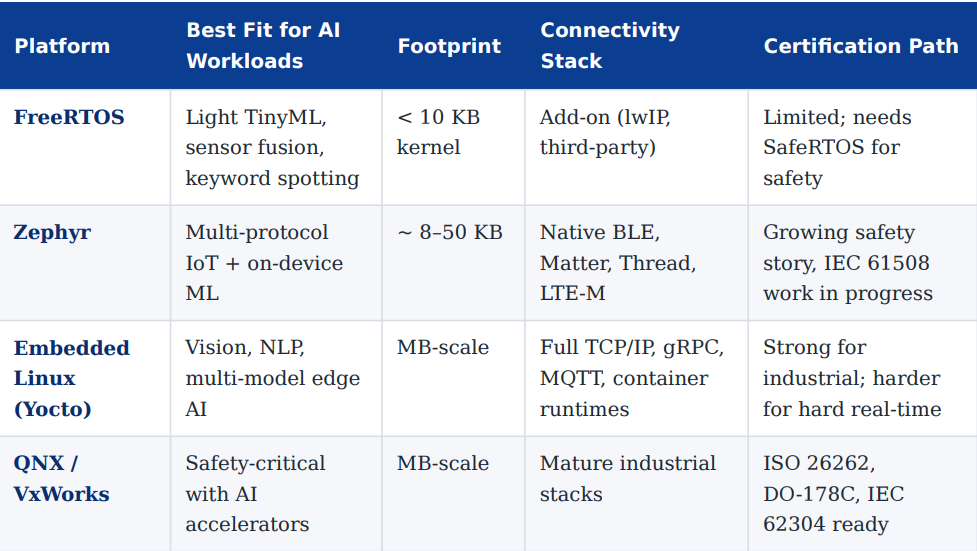
Short answer: AI workloads are pushing teams toward Zephyr and Embedded Linux with Yocto, while FreeRTOS remains the default for ultra-constrained, battery-first designs. Here is a practical comparison most engineering managers ask for:
Trade-off you should own as a leader:
FreeRTOS is lighter and cheaper to certify for narrow use cases, but Zephyr gives you a modern, vendor-neutral connectivity stack and better long-term AI tooling. Embedded Linux Yocto wins when your model is too large for an MCU and you need a reproducible BSP across product variants. If your roadmap includes vision, sensor fusion, or multi-protocol gateways, plan for a heterogeneous stack: an MCU running Zephyr for real-time control, plus a Yoctobased Linux SoC for inference.
Where Does Edge AI on MCUs Actually Pay Off?
AI is both a new attack surface and a new defense layer. Treat it as both. New attack surface: — Adversarial inputs that fool on-device classifiers — Model extraction through side channels (power, timing) — Poisoned OTA model updates — Supply chain risks in pre-trained model weights
New defense layer: — Anomaly detection on device telemetry — AI-assisted fuzzing of firmware interfaces — Behavioral baselining of fleet activity to flag compromise.
Strong IoT firmware security in 2026 assumes the model is part of the trusted computing base. That means signed model artifacts, secure boot anchored in hardware (Arm TrustZone, PSA Certified, or equivalent), encrypted model storage, and OTA pipelines that can roll back a bad model as fast as a bad binary.
NIST IR 8259 and the NIST Cybersecurity Framework are the right baselines for IoT device security posture, and they map cleanly onto firmware release gates if you set them up early.
How Does AI Affect Compliance in Regulated Industries?
Regulators are catching up faster than most teams expect. Medical (FDA, IEC 62304): AI/ML-enabled device software now falls under FDA guidance on Predetermined Change Control Plans. Your firmware release process must handle model updates as a controlled change, not a silent OTA. Automotive (ISO 26262, ISO/SAE 21434): Safety and cybersecurity are now joined at the hip. AI components used in ASIL-rated functions need argument-based safety cases. Aerospace (DO-178C): AI in flight-critical paths is still constrained, but DO-178C-adjacent tooling is being adapted for ML components via emerging guidance such as EASA AI roadmap documents. Industrial (IEC 61508, IEC 62443): Functional safety plus OT cybersecurity is now a combined audit.
A capable embedded software development company should be able to map your AI features to these standards without flinching, and produce the evidence pack auditors expect.
Build In-House or Use Embedded Software Outsourcing?
This is the question every CTO actually wants answered. Here is a direct framework.
Build in-house when: — AI on the device is your core IP and product moat — You have stable, multi-year hiring for RTOS firmware development, BSP, and ML engineers — Your domain knowledge is rare and cannot be transferred quickly.
Use embedded software outsourcing when: — You need to compress time-tomarket by 6 to 12 months — You need rare combinations (Yocto + Edge AI + ISO 26262) that are expensive to hire — You are scaling from prototype to mass production and need a hardened release pipeline — You want a fixed-cost path through certification.
Industry research from IoT Analytics and similar firms suggests the global shortage of senior embedded talent, especially engineers fluent in both firmware and ML, is the single biggest constraint on connected product roadmaps. Outsourcing is not a discount lever; it is a capacity and capability lever.
When evaluating an embedded software development company, judge them on three things: silicon fluency across MCU and MPU families, a documented secure SDLC, and a portfolio of shipped AI-on-device products under regulation.
A Practical 6-Step Adoption Plan for AI in Embedded Projects
For engineering leaders starting now, this is the sequence that works: Pick one high-value workload. Wake-word, anomaly detection, or vision QA. Avoid horizontal AI strategies. Profile the silicon honestly. Measure RAM, flash, MAC throughput, and worst-case latency on the actual target, not a dev board. Choose the runtime. TensorFlow Lite Micro, ONNX Runtime, vendorspecific (STM32Cube.AI, NXP eIQ, Renesas), or a hand-written kernel. Bake security in. Secure boot, signed models, encrypted OTA, hardware root of trust. Non-negotiable. Design for the regulator. Treat model updates as controlled changes from day one. Instrument the fleet. No on-device AI without telemetry that lets you debug model drift in production.
This is also the rough order in which a senior embedded software consulting partner should structure a discovery engagement.
Conclusion: What to Do Next
AI is not a feature you bolt onto firmware. It is a structural change to how embedded products are designed, secured, certified, and operated. The key takeaways for engineering leadership:
On-device AI is now a mainstream embedded workload, not a research project. Plan silicon, RTOS, and BSP choices around it. Security and compliance are inseparable from AI in regulated industries. Bake secure boot, signed models, and controlled updates into your release pipeline. The talent gap is the real constraint. Strategic embedded software outsourcing is a capability lever, not a cost lever. Pick one high-value AI workload and ship it well before scaling horizontally.
If you are scoping an AI-enabled connected product and want a senior team that has shipped on-device ML under real regulatory constraints, talk to tkxel. Explore our embedded software development services or book a consultation with our embedded engineering leadership to pressure-test your roadmap.
메타데이터
- post_id
- 8a0d83ef010b
- slug
- how-ai-is-reshaping-embedded-software-development-services-in-2026-8a0d83ef010b
- url
- https://medium.com/@z1845732/how-ai-is-reshaping-embedded-software-development-services-in-2026-8a0d83ef010b
- canonical_url
- https://medium.com/@z1845732/how-ai-is-reshaping-embedded-software-development-services-in-2026-8a0d83ef010b
- author_url
- https://medium.com/@z1845732
- status
- ok
- fetched_at
- 2026-06-15 22:55:51