1.The Global Shift to CTC: ViDA, Clearance and Real-Time Reporting
For a long time, paying VAT worked like cleaning your room only when guests are coming. You collected tax on your sales, you kept your…
1.The Global Shift to CTC: ViDA, Clearance and Real-Time Reporting
For a long time, paying VAT worked like cleaning your room only when guests are coming. You collected tax on your sales, you kept your invoices in a drawer, and once a quarter you filled a return and told the tax office a few summary numbers. The tax office trusted you for now. If they ever got suspicious, they would show up later and audit your drawer.
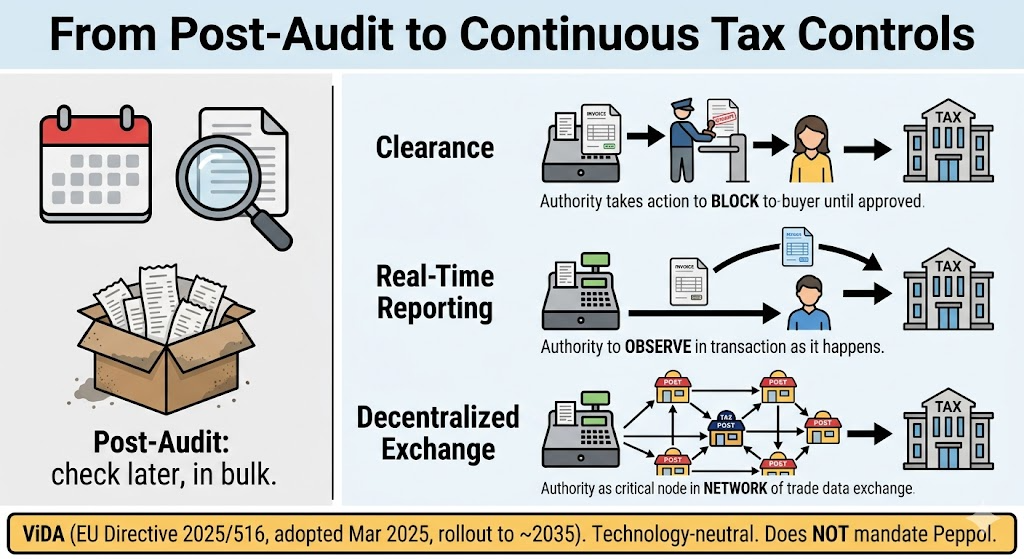
That old way has a name: the post-audit model. The audit happens after the fact, sometimes years later.
Now governments are changing the rules. They no longer want to wait years to look in your drawer. They want to see each transaction as it happens. This new approach is called Continuous Transaction Controls, or CTC. If you build invoicing software, ERP integrations, or Access Points, this shift changes your job. So let us break it down in plain language.
Think of It Like a Shop and a Tax Inspector
Imagine a small shop. In the post-audit world, the inspector visits once a year, asks for the box of receipts, and checks the maths. Slow, and easy to cheat.
In the CTC world, the inspector is connected to the shop’s till. Every time the shop rings up a sale, a copy of that sale slip is shared with the tax office right away, or within minutes.
That is the whole idea. CTC moves tax checking from “later and in bulk” to “now and per transaction.” Everything else in this series is just detail on top of that one change.
Why Governments Are Changing the Model
The reason is simple: money and speed.
The gap between the VAT that should be collected and the VAT that is actually collected is called the VAT gap. It is huge, billions every year, lost to fraud and mistakes. Post-audit is too slow to catch fast fraud. By the time an auditor finds a fake invoice, the company is often gone.
CTC closes that gap. When the tax office sees data in near real time, it can spot fraud early, pre-fill VAT returns, and reduce manual paperwork for honest businesses. So this is not only a tax-office wish. It can make life easier for compliant companies too.
The Three CTC Models
CTC is not one single design. There are three main models, and they differ in one key question: does the tax office block the deal, or just watch it?
1. The Clearance Model
Think of clearance like passport control at an airport. You cannot board until an officer stamps your passport.
In a clearance model, the supplier must send the invoice to the tax authority first. The authority checks it and clears it. Only after that stamp is the invoice legally valid and allowed to reach the buyer.
This is powerful for the tax office, because nothing slips through. But it puts the authority directly in the middle of every sale. Italy and many countries in Latin America pioneered this style.
2. The Real-Time Reporting Model
Think of this like sending a copy of a letter to a friend at the same moment you post the original.
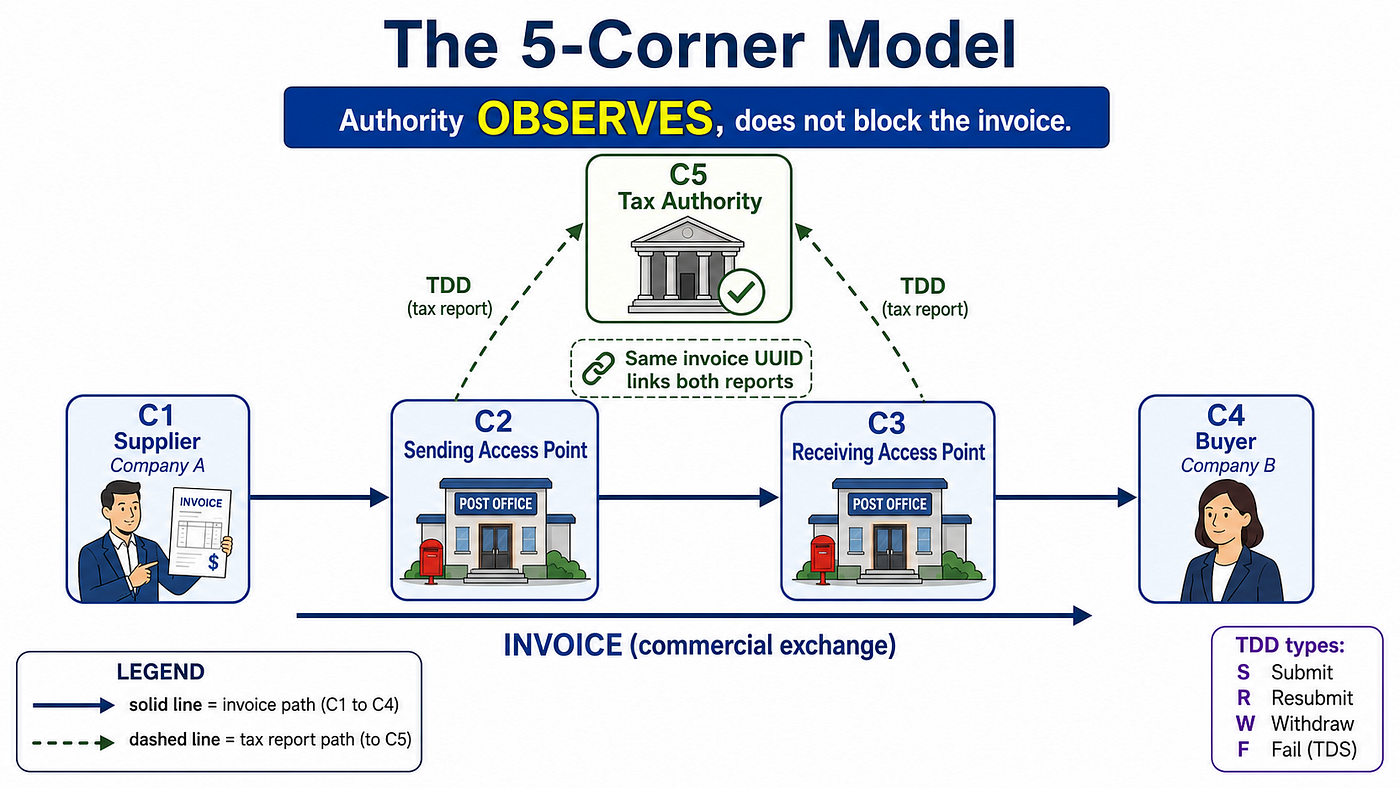
Here the invoice goes straight to the buyer as normal. At the same time, or within a short window, the supplier reports the transaction data to the tax authority. The authority receives the data but does not stand in the way of the deal.
The business exchange is not blocked. The authority is an observer, not a gatekeeper. Spain and Hungary use reporting-style systems.
3. The Decentralized CTC and Exchange Model
This is the newest model, and it is the one this whole series focuses on. It is usually called the decentralized model, sometimes written out as decentralized continuous transaction control and exchange.
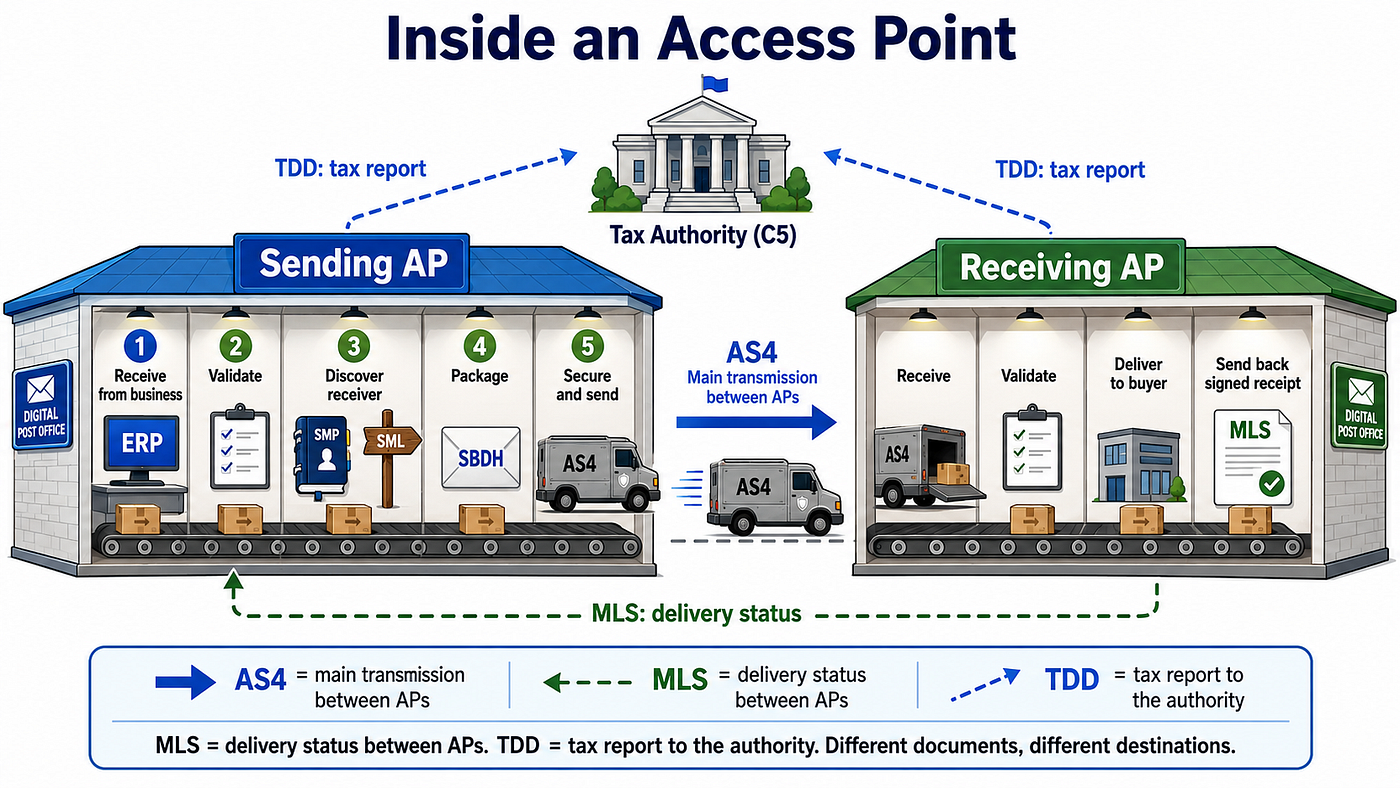
Think of it like a national network of trusted post offices. Businesses do not connect to one giant government portal. Instead, accredited service providers exchange invoices with each other over a shared, secure network. The tax authority simply joins that same network as one more participant and receives a tax report on the side.
“Decentralized” is the important word. There is no single central portal that everyone must plug into. The network does the routing, and the authority is one node on it. A growing number of countries are moving in this direction, and it fits naturally with the Peppol network that we will explore in later articles.
Two quick clarifications so the models do not blur together:
- Clearance and reporting are modes, meaning “block” versus “observe.”
- Decentralized exchange is an architecture, meaning “how the network is shaped.” It usually runs in reporting mode, but it can be configured for clearance.
Where ViDA Fits
If you work anywhere near European e-invoicing, you will hear the word ViDA. It stands for VAT in the Digital Age. It is the European Union’s legal package to modernize VAT for a digital economy.
Here are the facts worth pinning down:
- ViDA was adopted as Council Directive (EU) 2025/516 on 11 March 2025. It updates the older EU VAT Directive.
- It rolls out in stages, over several years, up to around 2035. As things stand today, mandatory structured e-invoicing and near-real-time digital reporting for cross-border business-to-business trade inside the EU is set for around 2030.
- It pushes member states from post-audit toward digital reporting, using structured invoices that follow the European standard known as EN 16931.
Now an important point that many articles get wrong.
Important: ViDA does not force you to use Peppol. The law is technology-neutral. It requires structured invoices and digital reporting. It does not name a single network. Peppol is the leading candidate to carry this traffic, and there is a Peppol pilot for it, but “ViDA requires Peppol” is simply not true. Be careful when you read confident claims online.
Also, treat the dates as “as currently legislated, and subject to change.” These timelines have already been renegotiated more than once. When you write or plan around them, link to the official source and add the year you checked.
Do Not Make It Only About Europe
ViDA is the loudest example, but it is not the only one. Different countries pick different control models for their own reasons.
- Some run central clearance, where the authority stamps each invoice.
- Some run real-time or near-real-time reporting alongside the normal invoice.
- Some are building decentralized networks where the authority is just a participant.
So when you design a system, do not assume every country works like the one you read about last week. Build for the model, not for one country.
A Quick Real-World Journey
Let us follow one sale.
Company A in a CTC country sells goods to Company B.
- In the post-audit past: Company A issues the invoice, both sides file periodic returns, and nobody at the tax office sees this specific invoice unless an audit happens years later.
- In a clearance country: Company A must send the invoice to the authority, wait for a clearance stamp, and only then can it reach Company B.
- In a reporting or decentralized country: Company B receives the invoice as normal, and at the same time a tax report about the sale flows to the authority in the background.
Same sale. Three very different data flows. Your software has to know which world it is operating in.
Why Developers Must Understand Tax Architecture, Not Just APIs
It is tempting to treat all of this as “just another API to call.” That mindset will hurt you here.
In CTC, the shape of the law decides the shape of your system. Whether the authority blocks or observes changes your retry logic. Whether reporting is real time changes your timeouts. Whether the model is centralized or decentralized changes how you discover endpoints and how you handle failures.
If you understand the tax architecture, you will design the right states, the right error handling, and the right monitoring. If you only learn the API, you will build something that passes a demo and breaks in production.
Summary
- The world is moving from the post-audit model (audit later) to CTC, meaning Continuous Transaction Controls (check now).
- The driver is the VAT gap: billions lost to fraud and error that slow audits cannot catch.
- There are three CTC models: clearance (the authority blocks the invoice), real-time reporting (the authority observes), and decentralized exchange (a shared network where the authority is a participant).
- Clearance and reporting are modes (block versus observe). Decentralized exchange is an architecture (how the network is shaped).
- ViDA is the EU package, adopted as Directive (EU) 2025/516 on 11 March 2025, rolling out in stages toward roughly 2035.
- ViDA does not mandate Peppol, and all rollout dates should be treated as subject to change.
- Different countries choose different models, so build for the model, not for one country.
- For engineers, the tax architecture decides the software architecture. Learn both.
For the developer: the control model decides your states, retries, and timeouts. Read the model before you write the client.
For the architect: design for “block versus observe” as a first-class choice, because it ripples through your whole flow.
For the business owner: CTC is not just a cost. Done well, it means fewer manual returns, faster fraud detection, and cleaner books.
In the next article, we get concrete. We will follow a single invoice through the decentralized model, meet the five corners of the network, and finally see what a Tax Data Document actually is.
메타데이터
- post_id
- 8a11f2e8d258
- slug
- the-global-shift-to-ctc-vida-clearance-and-real-time-reporting-8a11f2e8d258
- url
- https://medium.com/@kamal.indika.n/the-global-shift-to-ctc-vida-clearance-and-real-time-reporting-8a11f2e8d258
- canonical_url
- https://medium.com/@kamal.indika.n/the-global-shift-to-ctc-vida-clearance-and-real-time-reporting-8a11f2e8d258
- author_url
- https://medium.com/@kamal.indika.n
- status
- ok
- fetched_at
- 2026-06-27 18:20:27