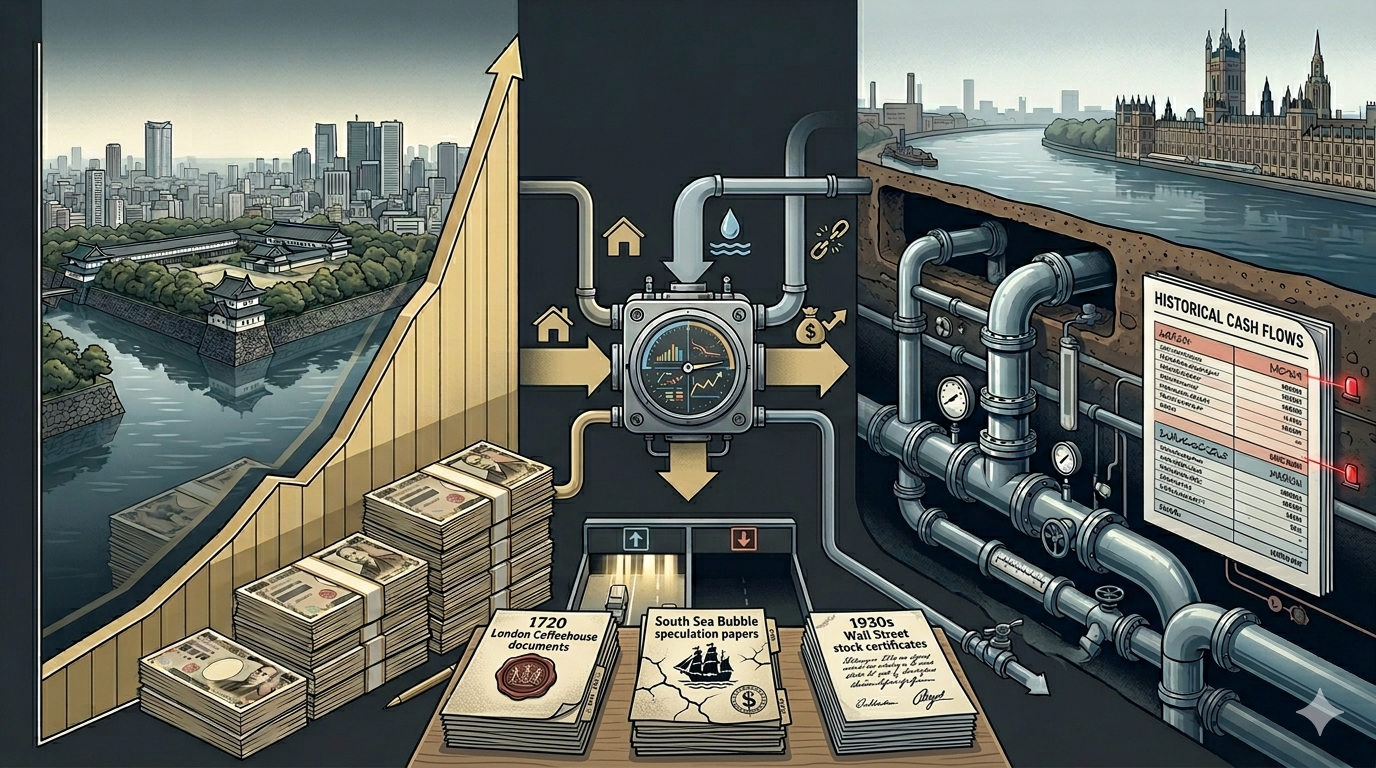
The Oracle Problem: The Last Mile of Private-Asset Pricing
CF Token sounds simple until one sentence is spoken out loud:
The Oracle Problem: The Last Mile of Private-Asset Pricing

CF Token sounds simple until one sentence is spoken out loud:
The token holder receives the asset’s actual cash flow.
Those last three words carry the hardest part of the design.
Who tells the contract how much rent a private real-estate fund collected this quarter?
Where does that number come from?
Who verifies it?
What happens if the manager says the fund collected $10 million, the bank records show $8.7 million, and the tenants say part of the payment was a disputed security deposit?
That is the oracle problem.
In public crypto markets, the oracle problem is often framed as a price-feed problem. Bitcoin trades on many venues. ETH trades on many venues. A price oracle aggregates market data and publishes a reference price on-chain. This is not trivial, and it can still fail, but the number already exists in public markets before the oracle touches it. Chainlink Data Feeds, Pyth, exchange indices, and similar systems are built around that reality.
Private assets are different.
Their cash flows do not live on public order books. They live in leases, servicing reports, bank statements, trustee reports, platform dashboards, invoices, side letters, amendments, and sometimes in someone’s inbox.
Moving that data on-chain is not a transport problem.
It is a verification problem.
That distinction is the whole article.
1. Price Oracles Move Numbers. Cash-Flow Oracles Establish Facts.
A price oracle answers a relatively narrow question:
What is the market price of this asset right now?
A cash-flow oracle must answer a harder question:
What economic event actually happened?
Did the tenant pay rent?
Was it base rent, reimbursement, arrears, termination fee, or deposit?
Did the borrower pay scheduled interest, default interest, amendment fee, or principal?
Did the royalty platform report gross revenue, net revenue, or payable revenue after deductions?
These are not just data fields. They are legal and accounting categories.
That is why private-asset oracles face four problems that price oracles usually avoid.
The source is often interested
For a private fund, the original cash-flow data usually starts with the GP, manager, servicer, trustee, platform, or property operator. Some of these parties are more independent than others, but none should be treated as a magic source of truth.
If the GP controls the reported NAV, we already know the conflict. If the issuer of a CF Token can influence reported cash flows, the conflict changes but does not disappear. A short issuer may prefer lower reported cash flows because lower cash flows reduce payments to token holders. A long-biased sponsor may prefer higher reported cash flows because they support a stronger token price.
The point is not that every participant is dishonest.
The point is that the oracle cannot assume innocence as a mechanism.
Cash flows are discrete and irregular
Bitcoin has a price every second.
A private loan may pay quarterly. A rent roll may update monthly. A receivables pool may resolve over 30, 60, 90, or 180 days. A private equity fund may distribute nothing for years and then make one large exit distribution.
The oracle cannot be a constant price stream. It has to be an event-verification system.
Cash flows have legal context
“The fund received $1 million” is not precise enough.
Received by whom?
Into which account?
For which reference asset?
Under which contract?
Before or after fees?
Subject to clawback, dispute, tax withholding, escrow, or reserve?
For a cash-flow claim, the settlement definition must decide what counts before trading begins. Otherwise every settlement event becomes a negotiation.
Disputes are substantive, not just technical
A price oracle dispute can be about exchange outage, stale data, latency, manipulation, or bad aggregation.
A cash-flow dispute can be about whether an invoice was valid, whether a borrower cured a default, whether a rent concession changed the payment schedule, whether a recovery belongs to one period or another, or whether a side letter changed distribution priority.
At that point, the oracle touches law.
This is why the last mile is so hard.
2. Three Ways Oracles Fail
Before designing a better system, we need to name the failure modes.
Random error
This is the easiest failure.
A timestamp is wrong. A file is misformatted. A payment is assigned to the wrong reporting period. A bank API call fails. A duplicate payment is counted twice and then corrected.
Random error creates noise. It widens spreads. It increases dispute costs. But if errors are independent and correctable, they do not destroy the market’s basic credibility.
The right tools are redundancy, reconciliation, delay windows, correction rules, and audit trails.
Systematic bias
This is more dangerous.
Systematic bias happens when the oracle is persistently tilted because the people producing or validating the data have distorted incentives.
The historical analogy is not perfect, but it is useful: credit-rating agencies before 2008. The Financial Crisis Inquiry Commission described rating agencies as “key enablers” of the mortgage securitization boom, and the issuer-pays model created a conflict that market participants badly underestimated.
The problem was not one wrong rating.
It was a system that made optimistic ratings normal.
A cash-flow oracle can fail the same way. If the verifier is chosen and paid by the party that benefits from a favorable number, and if bad reports are rarely punished, small biases can accumulate until the market discovers all at once that the reference data was never as neutral as it looked.
Active manipulation
This is the direct attack.
A party may try to underreport cash flows to reduce payments owed to CF Token holders.
A party may try to overreport cash flows before selling tokens into the market.
A manager may reclassify cash flows so that they fall outside the contract definition.
A servicer may delay recognizing defaults.
A sponsor may route payments through entities not covered by the reporting scope.
This is not a reason to abandon the design. It is a reason to design the oracle as an adversarial system from the beginning.
The common feature is simple:
The more opaque the asset, the more fragile the oracle.
That gives us a launch rule:
Start where verification is easiest.
3. Existing Oracle Designs Help, but None Is Enough Alone
There is no single oracle architecture that solves private cash flows.
Each existing design solves part of the problem and fails somewhere else.
Centralized trusted oracle
The simplest design is to appoint one trusted institution: an accounting firm, an independent valuation agent, a trustee, a loan servicer, or a regulated reporting agent.
The advantage is practical. The legal responsibility is clearer. Existing finance already knows how to work with named institutions, contracts, audit trails, engagement letters, and liability.
The weakness is also obvious.
It creates a single point of failure.
It may be captured by the paying client.
It moves trust upward instead of distributing it.
For early professional or regulated pilots, a centralized oracle may still be useful. But it should be treated as a bridge, not the final design.
Multi-source aggregation
The standard crypto instinct is to use multiple nodes, aggregate their reports, and penalize bad behavior.
This works best when independent nodes can observe independent market data. It is much weaker when all nodes are reading the same GP report.
Ten nodes repeating one conflicted document are not ten independent facts.
For cash-flow oracles, aggregation helps only if the underlying evidence is diverse: bank records, contracts, borrower confirmations, tenant confirmations, servicer files, trustee statements, platform reports, and accounting records.
Node diversity is not the same as evidence diversity.
Cryptographic proofs
Zero-knowledge proofs, zkTLS, signed bank data, and open-banking APIs are promising because they can prove something about a source without revealing everything about it.
For example, a system might prove that a specified account received payments above a threshold during a period without exposing the entire bank statement. Open-banking regimes such as PSD2 in Europe have already pushed banks toward standardized account-data access, though coverage, permissions, and implementation vary by jurisdiction.
But cryptography does not make economic truth appear from nowhere.
A proof can show that a bank account received money.
It may not prove that the money was rent under the reference lease, interest under the reference loan, or royalties covered by the token contract.
It may not prove that the payment is not subject to reversal, dispute, reserve, tax withholding, or side agreement.
Cryptographic proofs reduce some trust assumptions. They do not eliminate the need for legal definitions and evidence mapping.
Challenge and dispute mechanisms
Protocols such as UMA’s Optimistic Oracle and Kleros explore a different pattern: publish a claim, allow a challenge window, require bonds, and send disputes to an arbitration process.
This is philosophically close to what private cash-flow markets need.
Instead of pretending that the oracle is always right, the system assumes reports are provisional until the challenge period closes.
If someone can prove the report is wrong, they can challenge it and earn a reward.
That turns verification into a market activity.
The limitation is that private cash-flow disputes may require off-chain evidence and legal interpretation. A decentralized jury can help with simple factual disputes, but complex fund-accounting or insolvency disputes may still need regulated arbitration, courts, trustees, or contractual expert determination.
The right answer is probably hybrid:
on-chain challenge economics,
off-chain evidence,
and legally recognized dispute resolution.
4. Different Assets Need Different Oracle Stacks
The wrong question is:
What is the oracle for private assets?
The right question is:
Which assets are verifiable enough for which oracle design?
Layer one: high-verifiability assets
These are the only sensible starting point.
Commercial rent is a candidate when the lease set is defined, tenant identities are known, rent accounts are segregated, and property-management records can be reconciled with bank receipts.
The oracle stack could combine:
lease documents,
tenant confirmations,
property-manager reports,
bank-account evidence,
and a 30-day challenge window.
But even here, the article must stay honest. Tenants may be affiliated. Rent concessions may be private. Deposits, reimbursements, arrears, and termination payments may be misclassified. A rent oracle is feasible only if the contract defines these categories carefully.
Private-credit interest is another candidate, especially where there is a third-party loan servicer, trustee, or administrator.
But a servicer is not automatically neutral. Servicers have contracts, fees, discretion, and operational incentives. The better design is not “trust the servicer.” It is:
servicer as primary reporter,
bank/trustee records as reconciliation,
borrower payment evidence as supporting data,
independent audit sampling,
and a challenge process.
Layer two: medium-verifiability assets
Royalties are attractive because platforms can generate detailed usage and payment reports.
Music, app-store, software, patent, and content royalties can sometimes be traced through platform statements and payment rails. The reporting party may have less incentive to inflate payable royalties because it is often the payer.
But royalty systems are messy. Deductions, territory splits, recoupment, minimum guarantees, catalog ownership, publishing splits, delayed statements, and platform-specific rules can make the settlement definition hard.
Infrastructure tolls or usage fees can also be verifiable when electronic tolling or metering systems exist and when regulators or concession agreements already require reporting.
But here too, the oracle depends on the contract: gross tolls, net tolls, availability payments, regulated tariffs, maintenance deductions, taxes, subsidies, and force-majeure adjustments are different numbers.
Layer three: low-verifiability assets
Private equity fund distributions are the hardest.
They are often controlled by the GP, depend on fund documents, may involve complex waterfalls, recycling, reserves, clawbacks, fee offsets, continuation vehicles, side letters, and valuation marks.
For this layer, there is no satisfying generic oracle today.
That does not mean never.
It means not first.
The implementation roadmap should begin with assets whose cash flows can be independently observed, then move outward only as evidence standards improve.
5. The Economics: Verification Must Become a Market
The most important point is not technical.
It is economic.
Oracle verification is information production.
Information production is costly.
Costly information production requires incentives.
This is an old problem in finance. In the language of economic theory, private cash flows are a version of costly state verification. Townsend’s classic 1979 paper, “Optimal Contracts and Competitive Markets with Costly State Verification”, formalized the idea that verifying the true state of a borrower or project is costly, so contracts must decide when verification is worth paying for.
CF Token changes the incentive map.
If a cash-flow claim trades, then someone loses money when the reported cash flow is wrong.
Longs lose when cash flows are underreported.
Short issuers lose when cash flows are overreported.
Arbitrageurs gain when they can detect a reporting error before the market prices it.
Analysts can specialize in one reference asset, find inconsistencies, challenge reports, and get paid.
This is the core idea:
The market does not merely consume oracle data.
It can create the incentive to improve oracle data.
That is the difference between CF Token and many current private-asset products. In today’s private markets, a bad valuation may annoy LPs, but many LPs cannot trade the disagreement, cannot short the asset, and may not want to embarrass the GP publicly.
The negative view has no liquid instrument.
So the verification incentive remains weak.
A tradable cash-flow claim changes that. It does not guarantee truth. It pays people to look for it.
But this only works if the challenge mechanism is real.
If challenging is expensive, slow, legally uncertain, and poorly rewarded, no one will do it.
If challenges are cheap and frivolous, the system becomes harassment.
The design problem is to price challenges correctly: meaningful bonds, clear evidence standards, rewards for valid challenges, penalties for bad reports, and visible reputational records for oracle participants.
6. The 2008 Lesson: Do Not Rebuild the Rating-Agency Problem
The easiest way to fail is to recreate the structure that failed in mortgage finance.
Before 2008, credit ratings sat at the center of a massive trust chain. Investors, banks, regulators, and structured-product desks relied on ratings. The rating agencies were paid by issuers. The products were complex. The errors looked small until they became systemic.
That is the nightmare version of a cash-flow oracle.
One oracle.
Paid by the party who benefits.
Widely relied upon.
Rarely challenged.
Wrong in the same direction for years.
CF Token must avoid that pattern.
At minimum, it needs:
multiple evidence types, not just multiple reporting nodes;
economic penalties for bad reports;
challenge windows with real standing for affected traders;
public histories of oracle corrections and disputes;
exposure limits by reference asset and oracle provider;
and transparent aggregate open interest.
That last point matters. One lesson of CDOs and CDS was that total system exposure can become opaque. CF Token markets should make gross exposure visible by design.
The oracle should not become another private priesthood.
It should be an accountable information layer.
7. The Honest Boundary
The oracle problem will not disappear.
For highly opaque assets, no mechanism design can fully eliminate the information advantage of the party closest to the asset.
This is not a CF Token problem only.
It is the central limitation of every private-asset financial product, including tokenized RWAs, private-credit funds, NAV loans, continuation vehicles, and secondary-market marks.
The honest claim for CF Token is narrower:
It can make verification economically valuable.
It can force cash-flow definitions into contracts.
It can create a public record of disputes and corrections.
It can let skeptical capital pay for better information.
That is not perfect truth.
It is better pressure.
And in private markets, better pressure would already be a major improvement.
The Last Mile Is Also the First Mile
“Last mile” comes from logistics. The hardest part of delivery is often the final step from the network to the actual door.
Private-asset pricing has the same problem.
The mechanism can be elegant. The collateral model can be careful. The trading venue can be liquid. But eventually, someone has to answer the question:
Did the cash flow actually happen?
That answer cannot be hand-waved into existence.
It has to be engineered through contracts, evidence, incentives, dispute rules, and legal interfaces.
The point is not that the oracle problem is easy.
It is not.
The point is that every serious financial market has had to solve some version of this problem. Stock markets had to make company reports credible. Bond markets had to make repayment and default observable. Derivatives markets had to make reference events and settlements reliable.
They did not solve those problems before markets existed.
They solved them because markets existed, capital was at stake, and enough people had reason to care whether the numbers were true.
That is the real promise of CF Token.
Not that it magically solves trust.
That it gives mistrust a market.
메타데이터
- post_id
- 8a17bd54d803
- slug
- the-oracle-problem-the-last-mile-of-private-asset-pricing-8a17bd54d803
- url
- https://medium.com/@yueru.li83/the-oracle-problem-the-last-mile-of-private-asset-pricing-8a17bd54d803
- canonical_url
- https://medium.com/@yueru.li83/the-oracle-problem-the-last-mile-of-private-asset-pricing-8a17bd54d803
- author_url
- https://medium.com/@yueru.li83
- status
- ok
- fetched_at
- 2026-06-09 15:37:30