The Royal Enfield Turnaround: How a Dying Brand Became India’s Premium Status Symbol
The Royal Enfield enterprise traces its roots back to 1891 in Redditch, England, when entrepreneurs Bob Walker Smith and Albert Eadie…
The Royal Enfield Turnaround: How a Dying Brand Became India’s Premium Status Symbol
The Royal Enfield enterprise traces its roots back to 1891 in Redditch, England, when entrepreneurs Bob Walker Smith and Albert Eadie acquired a needle-manufacturing firm. They began building bicycles in 1893. The very first official Royal Enfield motorcycle was built in 1901. The major problem Royal Enfield solved for Indian customers — initially for the Indian government and later for the public — was the complete lack of a heavy-duty, reliable vehicle capable of surviving India’s brutal, unpaved terrains and hostile border environments. In the early 1950s, the Indian Army faced a massive logistical challenge patrolling the tough, snow-capped mountains of Jammu & Kashmir and the harsh deserts of Rajasthan. The lightweight, fragile motorcycles available at the time frequently broke down under harsh conditions. The Royal Enfield Bullet 350 solved this by offering a heavily built chassis, a high-torque, low-RPM engine, and simple mechanics that could take a beating without failing. The Indian government did not want to rely indefinitely on imported foreign machinery to secure its borders. By partnering with Madras Motors to create “Enfield India” in 1955, the brand solved a critical national defense supply problem. They localized production, ensuring the Indian Army had a steady, domestic supply of rugged transportation. As the motorcycles entered the civilian market, rural and semi-urban Indian customers lacked reliable long-distance transportation. Most roads were unpaved, filled with potholes, or flooded during monsoons. The heavy metal build of Royal Enfield bikes effortlessly plowed through muddy fields, carried massive farm loads, and safely ferried multiple family members across long distances where standard commuter bikes failed. Before India’s automobile sector modernized, finding specialized spare parts for complex imported vehicles in small towns was nearly impossible. Royal Enfield’s simple, “made like a gun” mechanical design allowed any local roadside mechanic to fix the bike using basic tools. This made it the most practically viable vehicle for cross-country Indian travel.
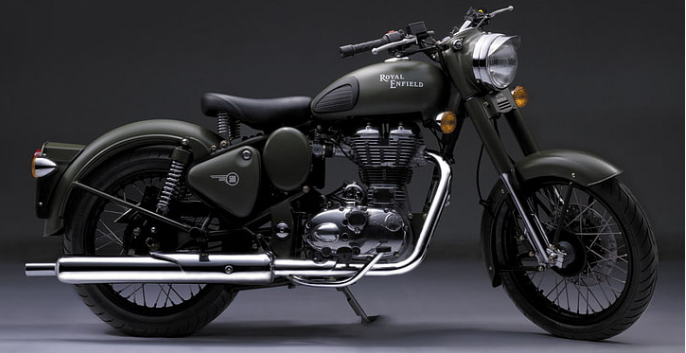
However, Royal Enfield suffered its most devastating economic and operational setback during the late 1980s and the entire decade of the 1990s. By the year 2000, the company was bleeding cash so severely that its parent conglomerate, the Eicher Group, was in a New Delhi boardroom preparing to shut down the legendary brand forever. When India liberalized its economy in 1991, Japanese auto giants like Honda, Yamaha, and Suzuki flooded the Indian market. They introduced sleek, lightweight, highly reliable, and — crucially — extremely fuel-efficient commuter bikes. In a cost-conscious nation like India, a heavy, expensive, fuel-gulping 350cc Royal Enfield quickly lost its mass appeal. While competitors moved forward, Royal Enfield continued using ancient cast-iron engines with a separate 4-speed gearbox. The gear shifter was counterintuitively located on the right foot (while the rear brake was on the left), directly opposing the global standard adopted by every other bike manufacturer in India. This alienated a younger generation of riders. By 1994, when Eicher Motors fully took over Enfield India, sales had plummeted to barely 24,000 to 25,000 bikes per year. The factory plants were operating at a small fraction of their capacity, and the massive financial losses threatened to pull down the entire parent group.
In 2000, 26-year-old Siddhartha Lal (son of Eicher’s head, Vikram Lal) begged the board for one final chance to resurrect the brand. He made three radical shifts: To fix the notorious oil leaks, he slowed down the factory assembly line. He placed white paper sheets under every single finished bike. If even a single drop of oil leaked, the entire production line was halted until engineers fixed the flaw. The gear shifter was moved to the standard left side, electric starters were introduced, and they engineered a brand-new Unit Construction Engine (UCE) that swapped cast iron for reliable aluminum while painstakingly keeping the signature “thump” exhaust audio note intact.
As a core subsidiary of Eicher Motors Limited (EML), Royal Enfield generated an annual revenue of ₹18,730 crore to ₹18,978 crore (~$2.25 billion USD) according to audited annual results. Powered by massive volume growth into 2026, the parent group’s annual revenue run-rate sits above ₹24,000 crore (~$2.8 billion USD) based on quarterly pacing. Because the brand is generating record-breaking cash reserves, its parent company is reinvesting heavily in future infrastructure. This includes setting up a massive ₹2,500 crore manufacturing hub and vendor park in Andhra Pradesh, alongside expanding its global EV design capabilities through investments in firms like Stark Future.
메타데이터
- post_id
- 8a245fb22c9a
- slug
- the-royal-enfield-turnaround-how-a-dying-brand-became-indias-premium-status-symbol-8a245fb22c9a
- url
- https://medium.com/the-story-well/the-royal-enfield-turnaround-how-a-dying-brand-became-indias-premium-status-symbol-8a245fb22c9a
- canonical_url
- https://medium.com/the-story-well/the-royal-enfield-turnaround-how-a-dying-brand-became-indias-premium-status-symbol-8a245fb22c9a
- author_url
- https://medium.com/@siddhiriddhi197
- status
- ok
- fetched_at
- 2026-07-09 06:11:55