From Control to Continuity: How Hyper-V and System Center Power Enterprise IT
Enterprise IT today is a complex, interwoven ecosystem. It’s no longer enough to simply keep systems running—organizations must architect…
From Control to Continuity: How Hyper-V and System Center Power Enterprise IT
Enterprise IT today is a complex, interwoven ecosystem. It’s no longer enough to simply keep systems running—organizations must architect infrastructure that is agile, secure, and strategically aligned with business goals. Virtualization is central to this transformation, and Microsoft’s Hyper-V and System Center together form a powerful foundation for modern infrastructure.
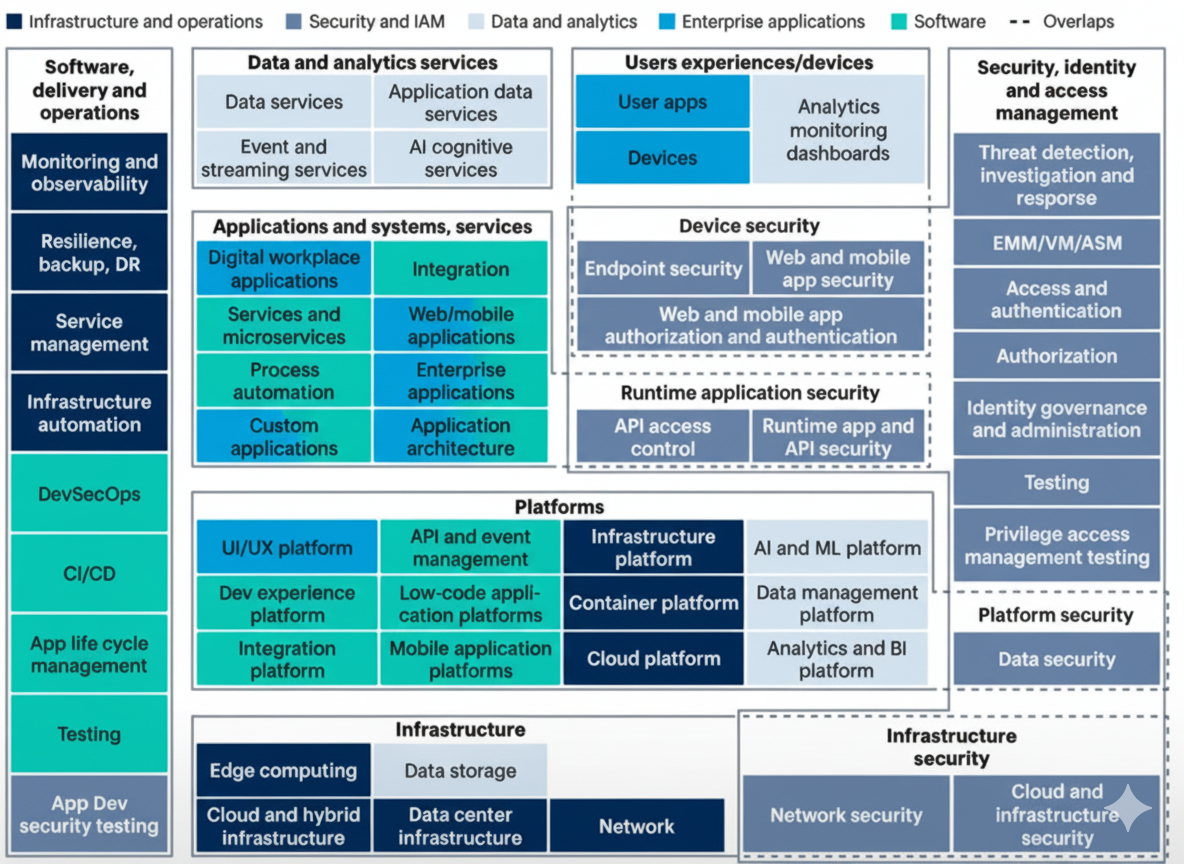
Enterprise Technical Reference Architecture by Gartner
This post explores how Hyper-V and System Center enable each domain of the IT stack—software delivery, data analytics, security, applications, platforms, and infrastructure—based on the structured framework you provided. We’ll focus on environments built around Remote Desktop Services (RDS) farms, where centralized application delivery takes precedence over full desktop virtualization.
Software Delivery and Operations: Automating Resilience and Agility
Software delivery is no longer linear—it’s iterative, fast-paced, and deeply integrated with infrastructure. Hyper-V enables this agility by providing isolated, scalable environments for development, testing, and deployment. System Center enhances it with automation, monitoring, and policy enforcement.
In RDS environments, Hyper-V hosts the session hosts, brokers, gateways, and licensing servers that form the backbone of centralized access. System Center Virtual Machine Manager (SCVMM) simplifies provisioning with templates and service models, ensuring consistency across deployments.
System Center Orchestrator adds automation for patching, failover, and scaling. Combined with Hyper-V Replica, it supports robust disaster recovery strategies that minimize downtime and data loss.
DevSecOps teams benefit from disposable VMs for CI/CD pipelines, checkpoints for rollback, and integration with Configuration Manager (SCCM) for patch compliance and configuration baselines.
This synergy between Hyper-V and System Center transforms infrastructure from a static resource into a dynamic engine for software delivery.
Security, Identity, and Access Management: Enforcing Trust Across the Stack
Security is no longer a perimeter—it’s a posture. Hyper-V and System Center embed security into every layer of the virtualized environment, supporting zero-trust architectures and regulatory compliance.
Hyper-V’s Shielded VMs encrypt virtual disks and prevent tampering, even from administrators. Secure Boot and TPM integration ensure trusted startup processes. Virtual switches support VLAN tagging, ACLs, and traffic isolation.
System Center Operations Manager (SCOM) monitors runtime application security, endpoint behavior, and network anomalies. SCCM enforces identity and access policies, integrates with Active Directory, and ensures that only authorized users can interact with infrastructure components.
In RDS farms, where multiple users share session hosts, this layered security model is essential. It protects sensitive applications, enforces user segmentation, and provides audit trails for compliance.
Together, Hyper-V and System Center deliver a security framework that is proactive, scalable, and deeply integrated with enterprise governance.
Data and Analytics Services: Driving Insight and Optimization
Data is the lifeblood of modern enterprises. Hyper-V provides the infrastructure to host databases, analytics engines, and monitoring tools. System Center reveals the insights that drive operational decisions.
Organizations can deploy SQL Server, analytics platforms, and BI dashboards in isolated VMs. These services support real-time insights, predictive modeling, and performance optimization.
SCOM provides telemetry across RDS session hosts, application servers, and data services. SCCM integrates with reporting tools to visualize compliance, usage trends, and patch status.
This visibility empowers IT leaders to make data-driven decisions about capacity planning, scaling, and incident response. It also supports business intelligence initiatives by ensuring that data platforms are performant, secure, and aligned with enterprise goals.
User Experiences and Devices: Streamlining Access Without VDI
In RDS-driven environments, the focus is on centralized application access—not full desktop virtualization. Hyper-V hosts the infrastructure that delivers RemoteApps and full sessions via RDS. System Center ensures that session hosts are patched, monitored, and compliant.
SCOM tracks session responsiveness, application launch times, and resource bottlenecks. SCCM manages software deployment to session hosts and enforces configuration baselines.
This combination ensures a consistent, secure experience for users across devices. It simplifies endpoint management, reduces resource overhead, and enhances user productivity—without the complexity of VDI.
Hyper-V and System Center together support a streamlined access model that is efficient, scalable, and aligned with operational needs.
Applications and Systems Services: Hosting the Engines of Business
Enterprise applications are mission-critical. Hyper-V provides the platform to host them; System Center manages their lifecycle.
Organizations can run ERP, CRM, and custom apps on RDS session hosts. Web services, middleware, and APIs operate in dedicated VMs, isolated for performance and security.
SCVMM provisions these workloads with precision. SCCM handles updates and configuration enforcement. SCOM monitors application health, user experience, and integration points.
This ensures that business-critical applications remain performant, secure, and aligned with operational goals. It also supports agile development by enabling rapid deployment, rollback, and testing in isolated environments.
Hyper-V and System Center together provide a robust, flexible platform for application delivery and lifecycle management.
Platforms and Infrastructure: Unifying the Stack
Modern IT platforms span multiple domains—compute, storage, networking, containers, low-code development, and AI. Hyper-V and System Center support them all.
Hyper-V hosts container runtimes, low-code platforms, and machine learning frameworks in secure, scalable VMs. System Center manages these resources as a unified fabric.
SCVMM integrates with fabric resources, automates provisioning, and enforces policy across platforms. SCOM provides monitoring and alerting. SCCM ensures compliance and configuration consistency.
This unified management model supports innovation without disruption. It enables organizations to adopt new platforms incrementally, without overhauling existing infrastructure.
Hyper-V and System Center together provide the flexibility to evolve, the control to govern, and the visibility to optimize.
Infrastructure and Connectivity: Scaling with Confidence
Infrastructure is no longer confined to the data center. It spans edge compute, hybrid models, and centralized storage. Hyper-V supports this scale; System Center manages it.
Organizations can deploy infrastructure where it’s needed—branch offices, remote sites, or centralized hubs. Hyper-V enables lightweight VMs for edge processing, reducing latency and bandwidth usage.
System Center integrates with fabric resources, automates deployment, and monitors performance across locations. API access and connectivity are managed through secure gateways and virtual switches.
This ensures that infrastructure is agile, scalable, and secure—whether it’s supporting RDS farms, analytics platforms, or custom applications.
Hyper-V and System Center together provide the tools to scale with confidence and control.
Overlapping Domains: Strategic Integration
Some infrastructure components span multiple domains. Hyper-V and System Center excel in these intersections.
- Infrastructure Security: Shielded VMs, secure boot, and network segmentation protect workloads.
- Network Security: Virtual switches enforce traffic isolation and policy-based controls.
- Cloud and Infrastructure Security: System Center maintains consistent security policies across hybrid environments.
- Analytics Monitoring Dashboards: SCOM provides unified visibility across infrastructure, applications, and user sessions.
These overlapping capabilities ensure that the entire stack is integrated, secure, and strategically aligned.
Hyper-V and System Center don’t just support individual domains—they unify them.
Strategic Deployment Practices
To maximize the strategic value of Hyper-V and System Center, organizations should adopt best practices that align with long-term goals:
- Use Generation 2 VMs to leverage modern hardware features and improve security posture.
- Enable Secure Boot and TPM for all infrastructure roles.
- Automate provisioning and scaling using PowerShell, SCVMM, and Orchestrator.
- Segment RDS roles using virtual switches and VLANs.
- Monitor VM health and performance using SCOM dashboards.
- Enforce compliance with SCCM baselines and patch policies.
- Regularly test disaster recovery plans using Hyper-V Replica and simulated failover scenarios.
These practices ensure that infrastructure is not only functional—but future-proof.
Conclusion
Hyper-V provides the virtualization layer. System Center brings automation, visibility, and control. Together, they form a strategic foundation for enterprise infrastructure—especially in environments built around Remote Desktop Services.
This combination empowers IT leaders to deliver secure, scalable, and resilient infrastructure that supports every domain of the modern IT ecosystem. It enables centralized application access, enforces policy, and drives operational intelligence—all without the complexity of VDI or dependency on cloud platforms.
For organizations seeking control, performance, and strategic alignment, Hyper-V and System Center are not just tools—they’re infrastructure strategy in action.
References
- Hyper-V virtualization in Windows Server and Windows https://learn.microsoft.com/en-us/windows-server/virtualization/hyper-v/overview
- Microsoft Learn: System Center Documentation https://learn.microsoft.com/en-us/system-center/
- Microsoft’s official RDS overview https://learn.microsoft.com/en-us/windows-server/remote/remote-desktop-services/remote-desktop-services-overview
메타데이터
- post_id
- 8a2ba5c5d414
- slug
- from-control-to-continuity-how-hyper-v-and-system-center-power-enterprise-it-8a2ba5c5d414
- url
- https://medium.com/@leoyeh.me/from-control-to-continuity-how-hyper-v-and-system-center-power-enterprise-it-8a2ba5c5d414
- canonical_url
- https://medium.com/@leoyeh.me/from-control-to-continuity-how-hyper-v-and-system-center-power-enterprise-it-8a2ba5c5d414
- author_url
- https://medium.com/@leoyeh.me
- status
- ok
- fetched_at
- 2026-08-20 09:57:17