What Is YOLOv8? An Introduction to the YOLOv8 Model Family
“Not every Computer Vision project requires the same model. So why does YOLOv8 offer multiple model variants?”
What Is YOLOv8? An Introduction to the YOLOv8 Model Family
“Not every Computer Vision project requires the same model. So why does YOLOv8 offer multiple model variants?”
What Is YOLOv8?
In our previous article, we explored what YOLO (You Only Look Once) is and why it has become one of the most influential algorithms in the field of Object Detection.
However, YOLO has continuously evolved over the years. Each new version has aimed to provide higher accuracy, faster inference, and more efficient model architectures.
One of the biggest milestones in this evolution is YOLOv8.
In this article, we’ll explore what YOLOv8 is, how it differs from previous YOLO versions, and the different models included in the YOLOv8 family.
What Is YOLOv8?
YOLOv8 is a modern Object Detection model developed by Ultralytics.
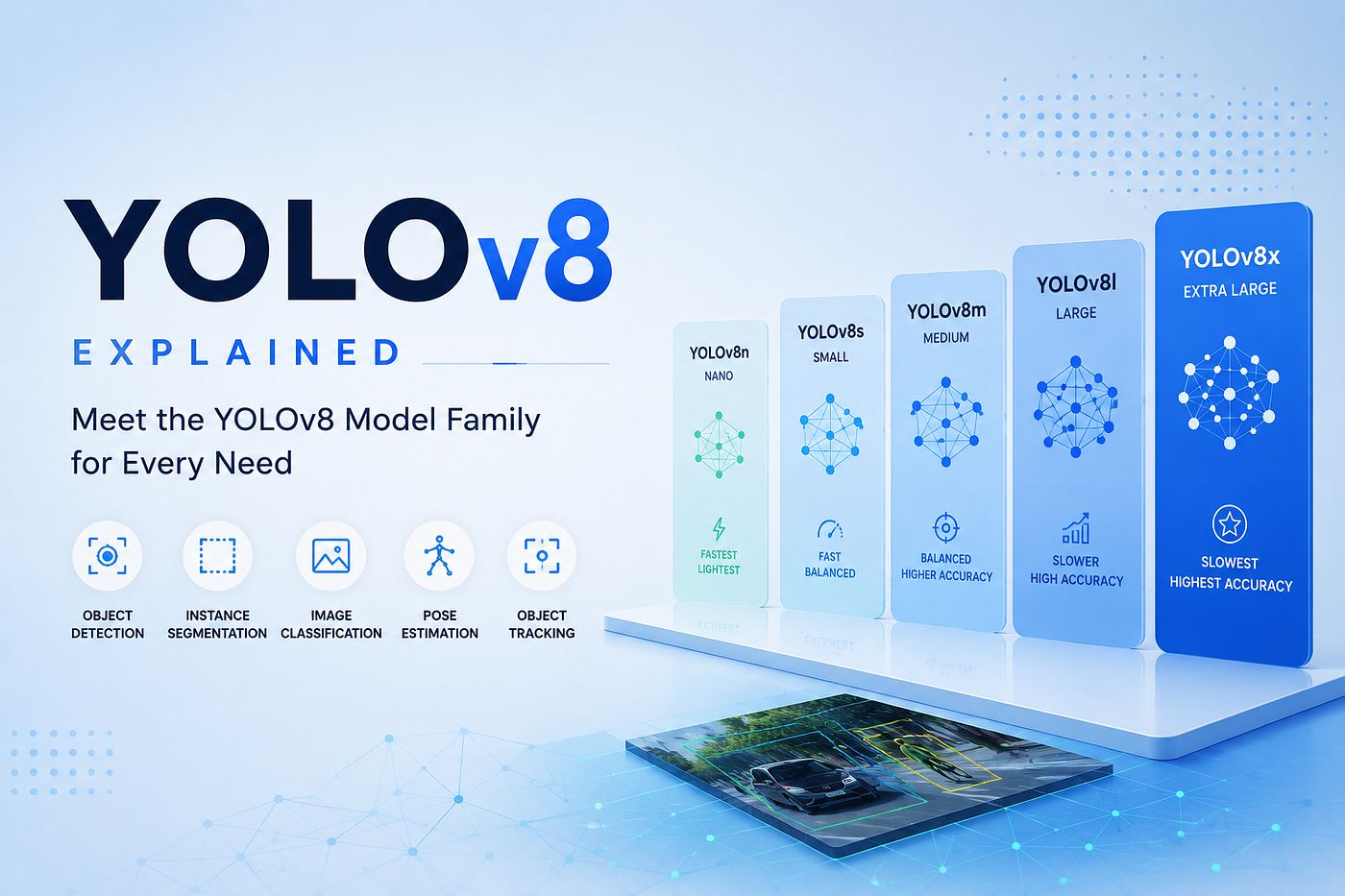
It supports not only Object Detection but also several other Computer Vision tasks, including:
- Object Detection
- Instance Segmentation
- Image Classification
- Pose Estimation
- Object Tracking
Thanks to its ease of use, strong performance, and active development, YOLOv8 has become one of the most widely used versions of YOLO today.
The YOLOv8 Model Family
YOLOv8 is not a single model.
Instead, it offers five different model variants designed for different hardware capabilities and application requirements.
🔹 YOLOv8n (Nano)
YOLOv8n is the smallest model in the YOLOv8 family.
Advantages
- Extremely fast
- Can run on low-resource hardware
- Small model size
It is commonly used for:
- Learning projects
- Mobile applications
- Embedded systems
🔹 YOLOv8s (Small)
YOLOv8s is larger and more powerful than YOLOv8n.
Advantages
- Higher accuracy
- Still very fast
- Excellent balance between speed and performance
It is a great starting point for many real-world applications.
🔹 YOLOv8m (Medium)
YOLOv8m provides a stronger balance between speed and accuracy.
Advantages
- Higher accuracy
- Better feature learning capability
In return, it requires more computational resources.
🔹 YOLOv8l (Large)
YOLOv8l is designed for larger datasets and applications that demand higher performance.
Advantages
- Improved accuracy
- Better performance in complex scenes
However, it requires more training time and more powerful hardware.
🔹 YOLOv8x (Extra Large)
YOLOv8x is the largest model in the YOLOv8 family.
It is designed to achieve the highest possible accuracy.
This model requires a high-performance GPU and a large amount of memory.
It is commonly used in research projects and applications where maximum accuracy is the primary goal.
Which YOLOv8 Model Should You Choose?
There is no single correct answer.
The best model depends on several factors, including:
- Your hardware
- Your project requirements
- Your speed expectations
- Your accuracy requirements
Smaller models provide faster inference, while larger models generally achieve higher accuracy.
The right choice should always be based on your project’s specific needs.
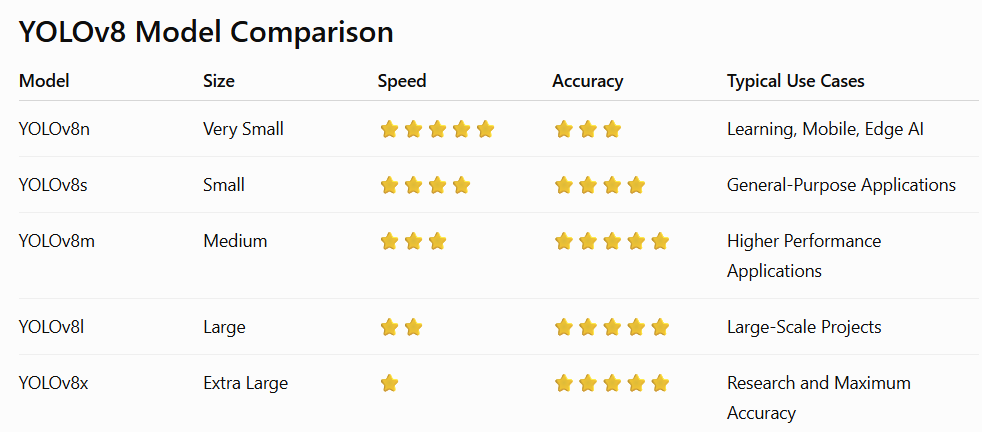
YOLOv8 Model Comparison
What Have We Learned?
In this article, we explored YOLOv8 and the different models available in the YOLOv8 family.
We learned that YOLOv8 supports not only Object Detection but also multiple Computer Vision tasks. We also examined the core characteristics of YOLOv8n, YOLOv8s, YOLOv8m, YOLOv8l, and YOLOv8x, along with the scenarios where each model is best suited.
Since every model is designed for different requirements, selecting the right one depends on your project goals, available hardware, and the balance you want between speed and accuracy.
메타데이터
- post_id
- 8a2c2c0a01c8
- slug
- what-is-yolov8-an-introduction-to-the-yolov8-model-family-8a2c2c0a01c8
- url
- https://medium.com/@m.edakulahci/what-is-yolov8-an-introduction-to-the-yolov8-model-family-8a2c2c0a01c8
- canonical_url
- https://medium.com/@m.edakulahci/what-is-yolov8-an-introduction-to-the-yolov8-model-family-8a2c2c0a01c8
- author_url
- https://medium.com/@m.edakulahci
- status
- ok
- fetched_at
- 2026-07-15 22:45:01