The US Cannot Afford To Open Hormuz
What would happen if the Strait of Hormuz were to open tomorrow? There would be some uncertainty around insurance and shipping lanes, but…
Photo by Marek Studzinski on Unsplash
The US Cannot Afford To Open Hormuz
What would happen if the Strait of Hormuz were to open tomorrow? There would be some uncertainty around insurance and shipping lanes, but after that ships would start moving again and shortages of oil, fertilizer, and helium would come to an end. Inflation would come back down and uncertainty would go down. Sounds great. Well, except for one country: The US.
See, oil is still primarily priced in US dollars. When Hormuz closed there was a massive spike in demand for oil and, by extension, US dollars. We can see this in the DXY chart:
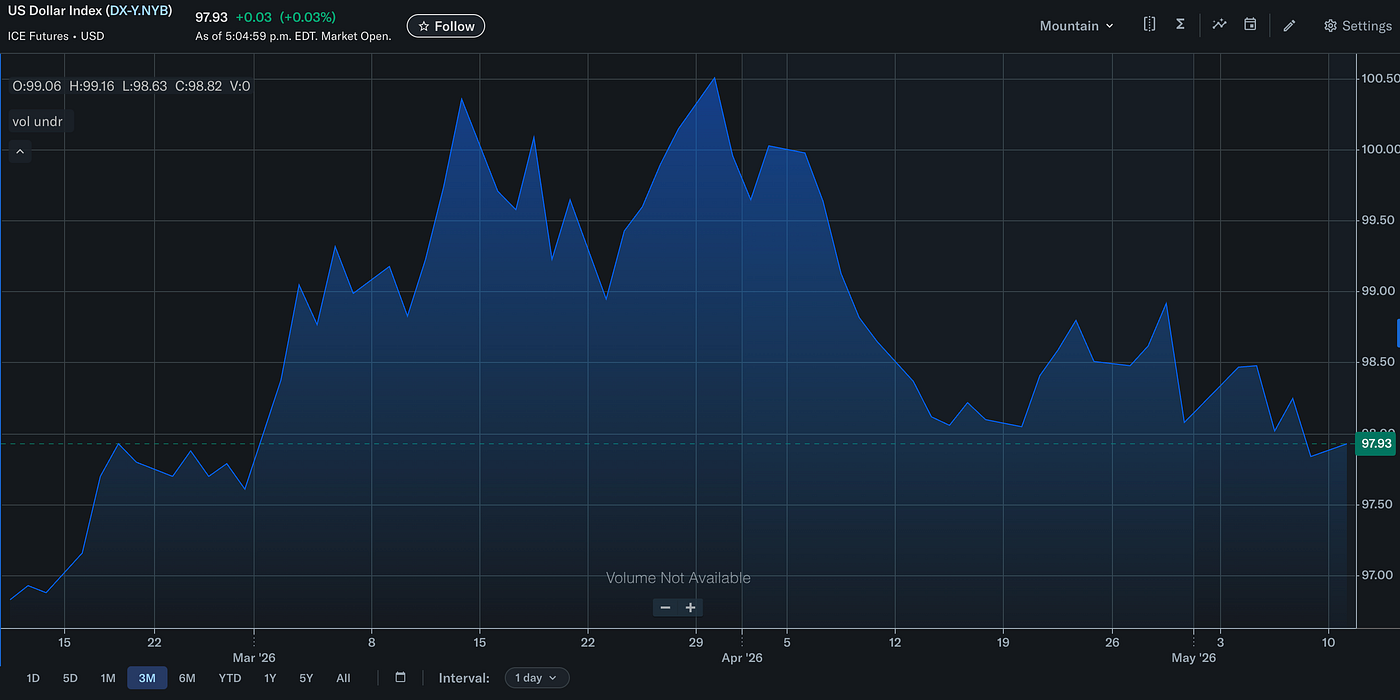
The DXY is the value of the USD compared to a basket of currencies. On February 27th it was 97.59. And then it started growing and growing and growing, eventually peaking at over 100 in March, a value not seen in months. But… wait. The DXY now is 98.25. So it has gone down to almost where it was before the war. And this is despite everyone scrambling for US dollars to buy oil. What is going on here?
And what would happen if the war suddenly ended and Hormuz opened? Well, countries don’t need so much USD anymore so they’d sell them. We would see a similar collapse to the one seen on Liberation Day. On Liberation Day the DXY was 104. By July it had fallen to 97. A 7 point drop. If that same drop happened today, we could see the DXY approach 91. Which means on average, US imports would be 7% more expensive.
This is also another idea I was thinking about. Everyone’s talking about tariffs. But no one is talking about the USD’s loss of buying power. Sure, the Supreme Court has outlawed Trump’s tariffs. But the Supreme Court can’t magically restore the USD’s buying power. And now it looks like the USD is going to get devalued again.
But, wait a second, why is this even happening? Why is the US dollar crashing? Well, because the US economy is in a slow motion car crash. This was described in the paper Decoupling Dollar and Treasury Privilege.
This paper talks about convenience. How much of a premium will people pay for assets. Obviously the US dollar, being the reserve currency, has exhibited quite a high convenience. So if US dollars have high convenience, you would expect all assets that you can easily exchange for US dollars to also exhibit high convenience. Namely US treasuries. But something changed in the great financial crisis (GFC) of 2008.
From a pricing perspective, despite the persistently positive USD convenience observed in the post-GFC period, our results suggest that U.S. Treasury securities are no longer inherently more special than synthetic dollar bonds created by swapping foreign government bonds in G10 currencies.
Why would US dollar convenience stay high while US treasuries (so bonds) lost their convenience? You’d expect them to move together. You buy US dollars and convert them into bonds which give you a guaranteed return.
Well, what this paper says is you don’t actually have to do that. You can use an FX swap to get the currency and never touch a US bond or other asset priced in USD. An FX Swap is sort of like a loan, one where the collateral is in another currency. According to this paper, companies have been taking out FX swaps a lot. So much so that US Treasuries are no longer more ‘special’ than these FX swaps.
This started in 2008 with 30 year bonds as those are the most risky. But since then it has started to move to lower and lower duration bonds. Eventually hitting all durations in 2023.
So the question is: if investors don’t want US treasuries, then why do they still want US dollars? The answer is simple: a lot of things are still priced in US dollars. And a lot of corporate bonds are still priced in USD. But that may be changing.
Something odd has begun to happen. US companies are increasingly starting to move away from USD denominated bonds. These are called ‘reverse Yankee bonds’.
Apple and Amazon have issued bonds in euros. Alphabet (Google) has issued a ‘century bond’ in pounds. Yes, pounds, don’t know why you’d issue them in pounds because it seems like the UK has the exact same problem as the US, but OK. Most big US companies have issued reverse Yankee bonds at this point. And they’re doing this for one simple reason: US bond yields are too high.
If a company were to issue bonds in USD, they’d have to compete with the government. And because the government can always print more money, they are seen as much safer and can get a better yield. So what to do? Just issue bonds in different currencies.
But if no one wants USD anymore because the demand is drying up, then what is propping up the USD? Well, nothing. It would have to follow the negative convenience yield of US bonds eventually.
When would this happen? I don’t know. Hormuz could be one possible catalyst. It could be that after Hormuz opens, the DXY starts dropping. And then it keeps dropping and dropping and dropping.
메타데이터
- post_id
- 8a2eea7a8f7d
- slug
- the-us-cannot-afford-to-open-hormuz-8a2eea7a8f7d
- url
- https://medium.com/@impure/the-us-cannot-afford-to-open-hormuz-8a2eea7a8f7d
- canonical_url
- https://medium.com/@impure/the-us-cannot-afford-to-open-hormuz-8a2eea7a8f7d
- author_url
- https://medium.com/@impure
- status
- ok
- fetched_at
- 2026-06-09 15:37:30