EBV: A Virus Almost Everyone Has
Disclosure: I wrote this article and used AI as a “professional editor” to refine and shorten overly long or complicated sentences.
EBV: A Virus Almost Everyone Has
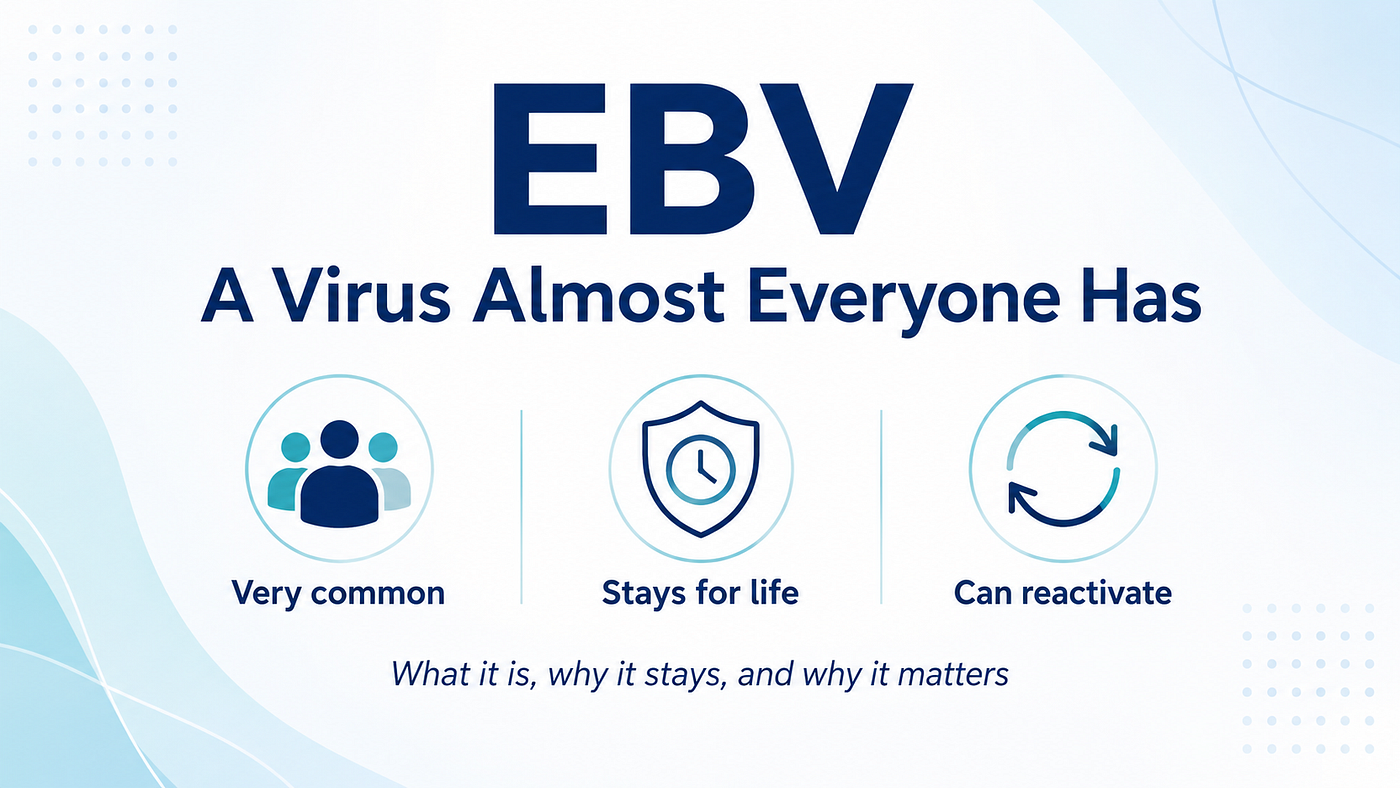
Image generated with the assistance of AI.
Disclosure: I wrote this article and used AI as a “professional editor” to refine and shorten overly long or complicated sentences.
.
When we think of a viral infection, we immediately think of influenza or, following the COVID-19 pandemic, SARS-CoV-2, the virus that causes COVID-19. In either case, people get infected, may show symptoms, and usually clear the infection on their own. Our bodies get rid of the virus.
But there are viral infections that our bodies cannot clear. Once infected, the virus stays with us. Human immunodeficiency virus (HIV), the virus that can cause AIDS, is an infamous example. People infected with HIV need to take medication to suppress the virus and prevent the serious illness it can otherwise cause.
But there are also viruses that stay with us that are not deadly. There is the Torque teno virus (TTV), which we pretty much all have, but it doesn’t appear to cause any disease. But there are also some that can cause disease. Among those is the Epstein-Barr virus, or EBV for short.
EBV is one of the viruses we almost all have. An estimated 90 to 95 percent of adults worldwide have been infected with the virus.
EBV belongs to the herpesvirus family, the same family that includes the viruses responsible for cold sores and chickenpox. EBV infection typically causes mild or no symptoms at all. When EBV does cause noticeable illness, it’s usually when the infection happens in teenagers or young adults. EBV is the most common cause of infectious mononucleosis, often nicknamed “mono” and sometimes called the “kissing disease” because the virus spreads primarily through saliva. Symptoms of mono typically include fatigue, sore throat, swollen lymph nodes, and fever that can last for several weeks. Liver inflammation is also common during mono, usually mild and resolving on its own, though in some cases it can be more pronounced. There is no specific antiviral treatment for EBV, and management is mostly supportive: rest, fluids, and time. The good news: most people recover fully from the symptoms.
Once infected, we never completely get rid of the virus.
.
Why EBV Doesn’t Really Leave
What makes EBV (and herpesviruses in general) different from many other infections is that we never fully remove the virus from our bodies. Instead, the virus establishes what’s called latency. EBV remains inside certain immune cells, specifically B cells, and essentially goes dormant (meaning it produces little or no new virus to stay largely hidden from our immune system).
This is not unique to EBV. Several other well-known viruses follow the same strategy. The varicella-zoster virus, which causes chickenpox in children, retreats into nerve cells after the initial infection and can re-emerge decades later as shingles, sometimes a painful reminder that the virus never truly left. Herpes simplex virus type 1, responsible for cold sores, hides in nerve clusters (ganglia) and resurfaces periodically throughout life. Cytomegalovirus (CMV), another member of the herpesvirus family that most adults carry without ever knowing it, does the same.
For most people, this latent virus remains harmless and largely quiet throughout life.
.
What If EBV Wakes Back Up?
Periodically, EBV can reactivate, meaning the dormant virus becomes active again and begins producing new copies of the virus. This can happen without causing any symptoms at all, as our immune system can quickly respond and suppress any viral activity.
However, EBV reactivation may occur when the body’s immune control of the virus is disrupted, such as during periods of significant physical or emotional stress, alongside other infections, or when the immune system is weakened by illness or medication. Reactivation often causes no symptoms, but symptoms can occur even in otherwise healthy people. Immunosuppressed people are more likely to develop symptoms and may face more serious complications, which is why EBV is taken especially seriously and may be actively monitored after an organ transplant.
When EBV reactivation does produce symptoms, symptoms can include swollen lymph nodes, a sore throat, and low-grade fever, all of which can easily be mistaken for a common cold or mild flu. But reactivation may also be associated with symptoms that are subtler and harder to pin down: persistent fatigue that doesn’t resolve with rest, a general sense of weakness or physical heaviness, and what many patients describe as “brain fog”: difficulty concentrating, slower thinking, or trouble finding words.
.
EBV Beyond Mono: Long-Term Associations
EBV has also attracted significant scientific attention for its role in the development of multiple sclerosis (MS), an autoimmune disease affecting the central nervous system. Large studies have found a strong association between prior EBV infection and the later development of this condition. This does not mean EBV infection alone is enough to cause MS; the vast majority of EBV carriers never develop the condition. But the strength of the evidence has made EBV one of the most actively studied triggers in MS research today and has reignited serious interest in developing an EBV vaccine.
EBV is also classified as a known human carcinogen. It has been linked to certain cancers, including some lymphomas, a subset of stomach cancers, and nasopharyngeal carcinoma, a cancer of the upper throat region that is more prevalent in certain parts of the world. To be clear: carrying EBV does not mean someone will develop cancer. The vast majority of infected people never will. But in a small number of cases, the virus contributes to the development of cancer.
There is also growing scientific interest in whether EBV reactivation plays a role in certain chronic conditions, such as myalgic encephalomyelitis/chronic fatigue syndrome (ME/CFS), though this remains an active area of investigation.
.
In Summary
For the vast majority of people, EBV infection is a non-event: a forgettable childhood illness, or at most, a rough few weeks of mono as a teenager or young adult.
But the virus itself stays with us, lifelong. And it can reactivate. In some people, it has been associated with more serious long-term health conditions, including certain cancers and, as recent research suggests, multiple sclerosis.
For most people, EBV will remain an infection they never knew they had. But with 90 to 95 percent of adults worldwide carrying the virus, the sheer number of people affected makes developing an EBV vaccine a real scientific priority.
.
If you’d like to keep reading:
Subscribe to my newsletter on **Substack** (free, email delivery)
If you’d like to follow my work professionally (and read articles there as well):
Connect with me on **LinkedIn**
If you find this writing useful and want to support independent science communication:
You can support my work on **Patreon**
메타데이터
- post_id
- 8a32e802d9dc
- slug
- ebv-a-virus-almost-everyone-has-8a32e802d9dc
- url
- https://medium.com/@scienceworthknowing/ebv-a-virus-almost-everyone-has-8a32e802d9dc
- canonical_url
- https://medium.com/@scienceworthknowing/ebv-a-virus-almost-everyone-has-8a32e802d9dc
- author_url
- https://medium.com/@scienceworthknowing
- status
- ok
- fetched_at
- 2026-07-08 16:17:31