I Was Looking for a Hetzner Alternative. Here’s the Best One I Found With AI.
A friend of mine got his Hetzner account rejected three times. He had a valid passport, Business registration, and Payment card. Still…
I Was Looking for a Hetzner Alternative. Here’s the Best One I Found With AI.

A friend of mine got his Hetzner account rejected three times. He had a valid passport, Business registration, and Payment card. Still rejected. No reason given.
That was the moment I started paying closer attention.
I had been using and recommending Hetzner for a while. Cheap servers, decent uptime, good enough for EU workloads.
But that story stuck with me, because he’s not alone. Scroll through Reddit or LowEndTalk and you’ll find hundreds of developers from India, Turkey, and Southeast Asia with the exact same experience.
So I started actually looking at what else was out there. Not just “another VPS” but something that solved the real problems people run into with Hetzner.
I compared 10 providers. I looked at pricing, where their data centers are, what managed services they offer, and honestly, how much time each one would eat up in ongoing server work.
Here’s what I found.
The Problems With Hetzner

Hetzner works well for a specific type of user: EU-based, technically comfortable, price-first. If that’s you, it’s still fine. But outside that profile, things get frustrating quickly.
Account rejections
If you’re based in India, Southeast Asia, or anywhere outside Western Europe, there’s a real chance Hetzner’s automated system flags your account. It happens even with valid ID and payment. No explanation, no appeal. It’s a known issue and Hetzner hasn’t fixed it.
Latency outside Europe
Hetzner’s best pricing is tied to Germany and Finland. Their US and Singapore locations exist, but the price advantage disappears there. If your users are in India or the US, you’re routing through Frankfurt and adding 150–200ms of extra latency. That’s not a small thing, slower load times directly hurt conversions.
No managed services
Hetzner gives you a server and stops there. No managed databases, no app platform, no built-in monitoring. Everything else, deployments, backups, scaling, security patches is your problem. Fine early on. But as your app grows, that pile of infrastructure work grows with it.
Support when things break
On unmanaged plans, which is most Hetzner customers, you handle everything yourself. If something goes wrong at 2AM, there’s no one to call.
None of this makes Hetzner a bad product. It makes it the wrong product for a lot of developers.
The 10 Alternatives I Compared
Here’s my honest take on each one starting with the one that genuinely surprised me.
And if you want the detailed platform comparisons, here is the full breakdown of all 10 hetzner alternatives in 2026 with pricing details.
1. Kuberns: The One That Actually Won
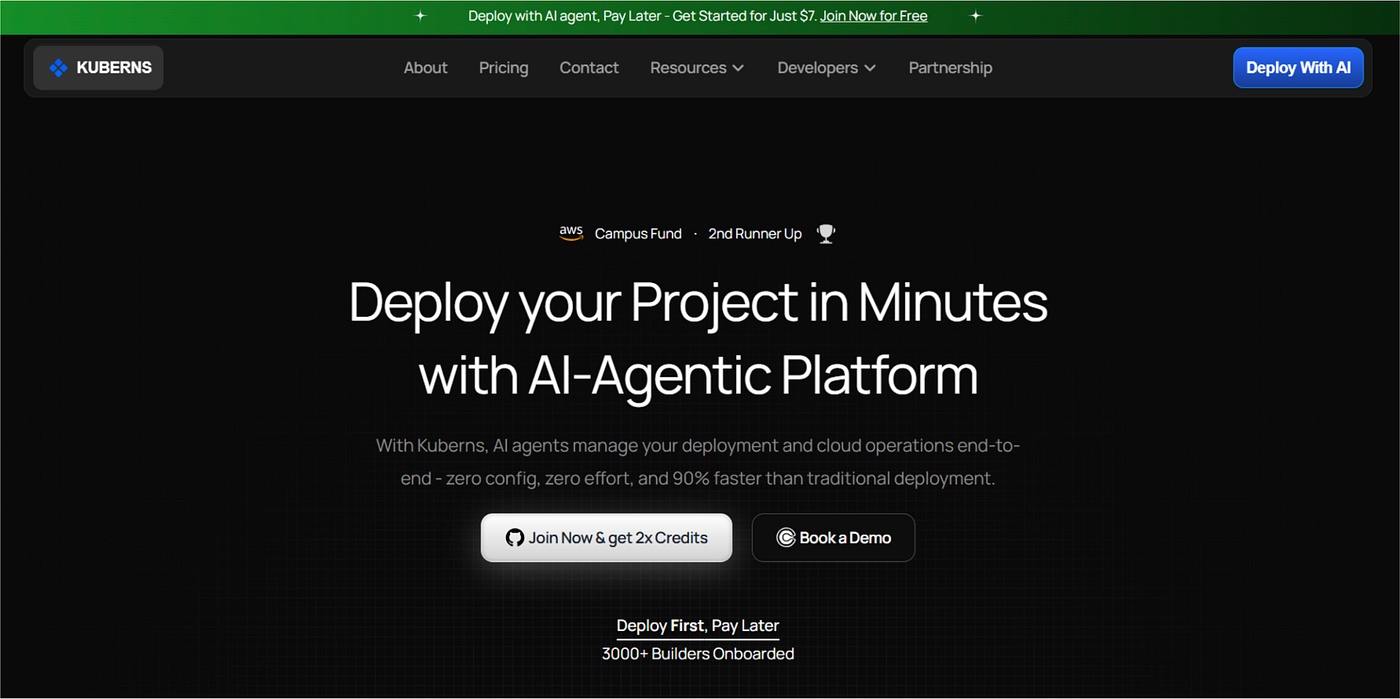
Every other provider on this list gives you a server. better or cheaper or more global than Hetzner’s. Kuberns skips the server entirely and just runs your project on the cloud.
Here’s how it works: you connect your GitHub repo, hit deploy, and the platform takes it from there. It figures out your tech stack, sets up the deployment pipeline, handles scaling when traffic goes up, monitors everything, and fixes issues before they cause downtime. You never SSH in. You never write a config file. You never wake up to a broken server.
It runs on AWS infrastructure, which means the reliability is enterprise grade. And because it optimises how it uses AWS resources, it ends up being up to 40% cheaper than running the same app on AWS directly.
The thing that got me: I realised I was spending a few hours every week on infrastructure stuff. Deployments, checking logs, updating configs. Kuberns just removes that entirely. That time goes back to actually building.
For most solo developers and small teams, the time savings alone make it worth it.
2. SSD Nodes: Best If You Want Maximum Specs for Minimum Price

If you’re committed to managing your own server and want the most RAM and CPU per dollar, SSD Nodes are hard to beat. Their long-term plans give you specs that would cost two or three times as much elsewhere.
They’re also one of the very few providers that support nested virtualisation, something Hetzner flat out blocks. If you need to run Android emulators, isolated test environments, or VMs inside VMs for CI pipelines, this matters.
The trade-off: it’s fully unmanaged. No managed databases, no platform services, no hand-holding. You need to know what you’re doing.
3. DigitalOcean: Best If You Want Managed Services Without AWS Complexity

DigitalOcean is probably the most popular Hetzner alternative among developers, and for good reason. It has managed databases, an App Platform where you push code and it handles the rest, and managed Kubernetes, none of which Hetzner offers.
The Bangalore data center is a big deal for Indian developers specifically. No more routing through Europe.
It costs more than Hetzner for raw compute in the EU, but you’re getting actual managed services in return.
4. Vultr: Best for Global Coverage

If you’re serving users across multiple regions and latency is a priority, Vultr’s coverage is genuinely impressive. 32 locations, high-frequency compute, bare metal options, and hourly billing across everything.
It’s still self-managed at its core, you handle everything beyond the server. But if geographic reach is the main thing you’re missing on Hetzner, Vultr solves it at a very low price.
5. OVHcloud: Best for EU Teams With Compliance Requirements

If you’re staying in Europe and need unmetered bandwidth or strict GDPR compliance, OVHcloud is the strongest Hetzner competitor. Bandwidth overages are a real cost on Hetzner after 20TB. OVHcloud includes it on many plans. DDoS protection is also built in at no extra cost.
The dashboard is less polished than DigitalOcean and the setup takes more effort, but for EU compliance workloads it makes a lot of sense.
6. Linode (Akamai Cloud): Best for Predictable Billing and Good Support

Linode’s biggest selling point has always been trust. Honest pricing, no surprise bills, and 24/7 support that developers actually rate highly. Since Akamai acquired them, the network reliability has only improved.
It’s still unmanaged at the core, but if Hetzner’s support gaps and occasional billing confusion were pain points for you, Linode is a clean, dependable step up.
7. Kamatera: Best for Custom VM Configurations

Kamatera is the most flexible infrastructure provider on this list. You configure CPU, RAM, and storage independently, no forced tier upgrades and you’re billed per second. Good 30-day free trial with $100 credit so you can test your exact configuration before paying.
If your workload is unusual and you always feel like you’re overpaying for the wrong tier on other providers, Kamatera fixes that.
8. ScalaHosting: Best If You Want a Managed VPS With Security Included

ScalaHosting sits in the gap between a raw VPS and a full platform. They handle server maintenance, updates, and patching for you. Their SShield tool monitors for threats in real time and blocks attacks automatically. They also offer free migration from Hetzner if you don’t want to deal with the move yourself.
More expensive than unmanaged options, but you’re paying for the management overhead to be taken off your plate.
9. Hostwinds: Best Budget Option for US-Based Teams

Hostwinds has an unusually strong uptime guarantee, 99.9999%, which works out to less than 32 seconds of downtime per year. If you miss it, you get service credits automatically. Managed plan includes server optimisation and proactive monitoring.
Only worth considering if your users are in North America. US-only data centers make it a non-starter for anyone serving global or APAC audiences.
10. Contabo: Best Pure Budget Option

Contabo gives you more hardware per dollar than almost anyone. $6.99 gets you 4 vCPUs, 8GB RAM, 100GB NVMe, those specs cost $20–40/month elsewhere. The Mumbai data center is a genuine plus for Indian developers on a tight budget.
The downsides are well documented: slow support, inconsistent network performance under load, and zero managed services. Fine for dev environments and personal projects. Risky for production apps where uptime matters.
Quick Comparison

So Which One Should You Pick?
Depends on what actually frustrated you about Hetzner.
If the problem was account rejections or latency outside Europe, Kuberns, Vultr (Mumbai), or DigitalOcean (Bangalore) all solve that.
If the problem was having no managed services and spending too much time on infrastructure, Kuberns is the right choice.
If the problem was just price and you want to keep managing your own server, Contabo or SSD Nodes.
If you want to stop thinking about servers entirely and just have your project run on cloud, Kuberns is the only one on this list that actually does that.
I’ll be honest: I went into this comparison expecting to land on DigitalOcean. But after spending time with Kuberns, the gap was clear. The others give you a server. Kuberns gives you back your time to focus on building.
If you want to go deeper on any of these, this full guide on hetzner alternatives covers every provider with actual pricing breakdowns and a detailed comparison.
메타데이터
- post_id
- 8a37a10f8772
- slug
- i-was-looking-for-a-hetzner-alternative-heres-the-best-one-i-found-with-ai-8a37a10f8772
- url
- https://medium.com/@jevin925/i-was-looking-for-a-hetzner-alternative-heres-the-best-one-i-found-with-ai-8a37a10f8772
- canonical_url
- https://medium.com/@jevin925/i-was-looking-for-a-hetzner-alternative-heres-the-best-one-i-found-with-ai-8a37a10f8772
- author_url
- https://medium.com/@jevin925
- status
- ok
- fetched_at
- 2026-07-15 11:28:21






