Out Of 1000+ Claude Skills, These 10 Just Made ChatGPT Obsolete
AI assistants are no longer competing on intelligence alone — they’re competing on usefulness.
Out Of 1000+ Claude Skills, These 10 Just Made ChatGPT Obsolete
AI assistants are no longer competing on intelligence alone — they’re competing on usefulness.
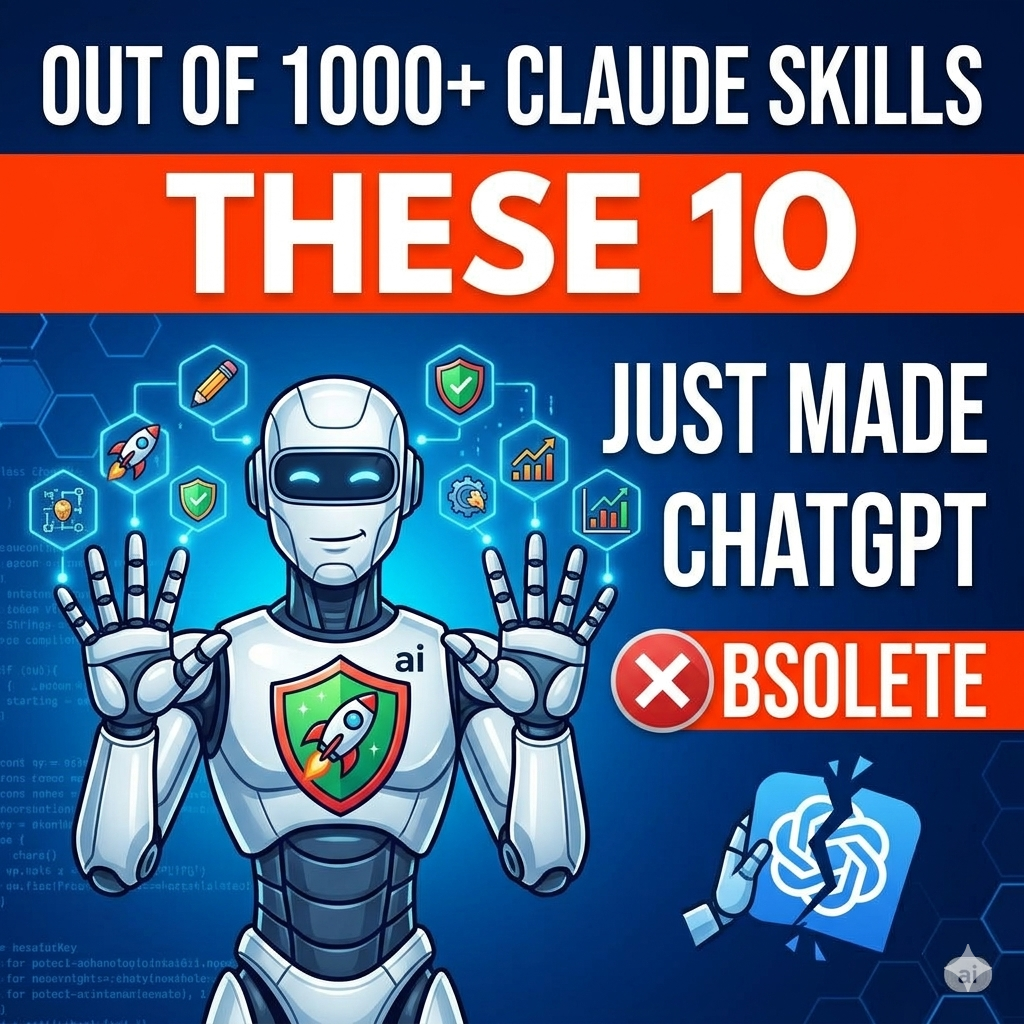
Image generated by Author using chatgpt
Until recently, most AI chatbots were pretty much the same.
You typed a question. The AI responded. It might have drafted an email, a summary of text, information or an idea.
And for a while that was alright. However, the nature of the race for AI is rapidly evolving. The new battleground isn’t:
“Which AI sounds smarter?”
It’s:
“Which AI actually helps you do real work faster?”
And that’s exactly why Claude’s growing ecosystem of specialized “skills” is getting so much attention online.
Some users are now claiming:
“These Claude skills make ChatGPT feel outdated.”
That’s obviously exaggerated. But the underlying shift is very real.
AI assistants are evolving from general chatbots into specialized productivity systems. And most people still haven’t noticed how quickly this is happening.
The Problem With Traditional AI Chatbots
Most AI chatbots are powerful — but generic.
They can:
- answer questions
- summarize text
- brainstorm ideas
- generate content
But generic intelligence has limitations. Users still spend time:
- organizing workflows
- structuring prompts
- refining outputs
- switching between tools
Eventually, people realized something important:
The real bottleneck wasn’t intelligence anymore. It was workflow friction.
That’s where AI “skills” changed the game.
What Are Claude Skills?
Claude skills are essentially specialized AI workflows designed for specific tasks.
Instead of manually guiding the AI step by step, skills package expertise into reusable systems.
Think of them like:
- AI-powered mini tools
- workflow templates
- specialized assistants
Some are built for:
- coding
- writing
- research
- automation
- productivity
- learning
- business analysis
The important shift is this:
Users no longer want just “an AI.”
They want:
an AI that already understands the job they’re trying to do.
Why This Feels Like a Big Deal
The internet loves dramatic headlines like:
“ChatGPT is dead.”
That’s not what’s happening.
ChatGPT remains incredibly powerful.
But Claude skills reveal a larger industry trend:
AI is becoming modular.
The future may not belong to one giant chatbot doing everything.
It may belong to ecosystems of specialized AI capabilities optimized for different workflows.
That’s a major shift.
The Real Advantage of Specialized AI Skills
General AI often creates too much flexibility.
Ironically, that slows people down.
When users must:
- explain context repeatedly
- design prompts manually
- structure outputs themselves
the productivity gain shrinks.
Specialized skills reduce cognitive load.
They already understand:
- the workflow
- expected outputs
- formatting
- priorities
That creates a smoother experience.
And smoother experiences win.
Why Productivity Beats Raw Intelligence
This is the part most people miss.
Users don’t care about benchmark scores.
They care about:
- speed
- convenience
- reliability
- reduced effort
If one AI helps complete work faster, people naturally prefer it — even if another model is technically “smarter.”
That’s why workflow optimization is becoming more important than raw model capability.
The 10 Types of Claude Skills People Are Obsessed With
The exact list constantly changes, but the most talked-about Claude skills usually focus on practical work.
1. Long-Document Analysis
Breaking down massive PDFs, reports, and research quickly.
2. Coding Assistants
Debugging, explaining code, and generating structured implementations.
3. Writing Systems
Article creation, SEO workflows, editing, and tone optimization.
4. Research Skills
Organizing sources and extracting insights faster.
5. Business Analysis
Summarizing trends, creating strategies, and analyzing competitors.
6. Automation Workflows
Reducing repetitive manual tasks.
7. Learning Assistants
Turning complex subjects into beginner-friendly explanations.
8. Meeting Summarizers
Extracting action items and decisions clearly.
9. Resume & Career Optimization
Tailoring resumes and interview prep workflows.
10. Creative Production Systems
Helping with scripts, content ideas, storytelling, and media workflows.
Notice the pattern?
These aren’t “fun AI tricks.”
They’re productivity multipliers.
Why This Doesn’t Actually Make ChatGPT “Obsolete”
Here’s the reality.
No serious AI platform is becoming obsolete anytime soon.
What’s happening is:
- competition is increasing
- specialization is accelerating
- user expectations are rising
ChatGPT, Claude, Gemini, and other tools are all evolving rapidly.
The real winner will likely be:
the platform that reduces friction the most.
Not necessarily the one with the flashiest demos.
The Bigger Shift Happening Across AI
Claude skills point toward a much larger trend:
AI is moving from:
- conversation tools
to:
- integrated work systems
That changes how people interact with software completely.
Instead of opening:
- multiple apps
- documents
- workflows
- dashboards
people increasingly expect AI to coordinate everything intelligently.
This is much bigger than one chatbot rivalry.
Why Most Users Still Underestimate AI
Most people still use AI for:
- quick questions
- rewriting text
- generating captions
That’s the shallow layer.
Power users are now building:
- full workflows
- research pipelines
- business systems
- productivity stacks
The gap between casual AI use and advanced AI leverage is growing extremely fast.
The Real Risk: AI Overdependence
There’s also an important downside.
As AI workflows become easier, people risk:
- outsourcing thinking
- losing deep understanding
- becoming dependent on automation
The best AI users won’t be people who avoid thinking.
They’ll be people who:
- think clearly
- use AI strategically
- combine judgment with automation
AI amplifies capability.
But it also amplifies laziness if used carelessly.
The Future of AI Won’t Be One Tool
People keep asking:
“Which AI will win?”
That may be the wrong question.
The future likely looks more like:
- specialized AI systems
- modular workflows
- integrated assistants
- personalized automation layers
Claude skills are simply an early glimpse of that world.
And it’s arriving much faster than most people expected.
Final Thought
Out of thousands of Claude skills, the most powerful ones don’t just generate text.
They reduce friction.
That’s the real AI revolution happening quietly right now.
Not smarter chatbots.
Smarter workflows.
And the people who understand this early will work very differently from everyone else within the next few years.
If this helped you think more clearly about AI, productivity, and the future of work, follow me.
I write about AI, careers, technology, and navigating modern digital life without hype or panic.
메타데이터
- post_id
- 8a3b056580da
- slug
- out-of-1000-claude-skills-these-10-just-made-chatgpt-obsolete-8a3b056580da
- url
- https://medium.com/devmap/out-of-1000-claude-skills-these-10-just-made-chatgpt-obsolete-8a3b056580da
- canonical_url
- https://medium.com/devmap/out-of-1000-claude-skills-these-10-just-made-chatgpt-obsolete-8a3b056580da
- author_url
- https://medium.com/@yatinsindhi03
- status
- ok
- fetched_at
- 2026-06-10 08:17:25