One Pool Mines a Third of Every Bitcoin Block. Here’s Why That Isn’t the Threat It Looks Like.
The most-quoted centralization stat in Bitcoin is real. It is also measuring the wrong thing, and once you see why, you cannot unsee it.
One Pool Mines a Third of Every Bitcoin Block. Here’s Why That Isn’t the Threat It Looks Like.
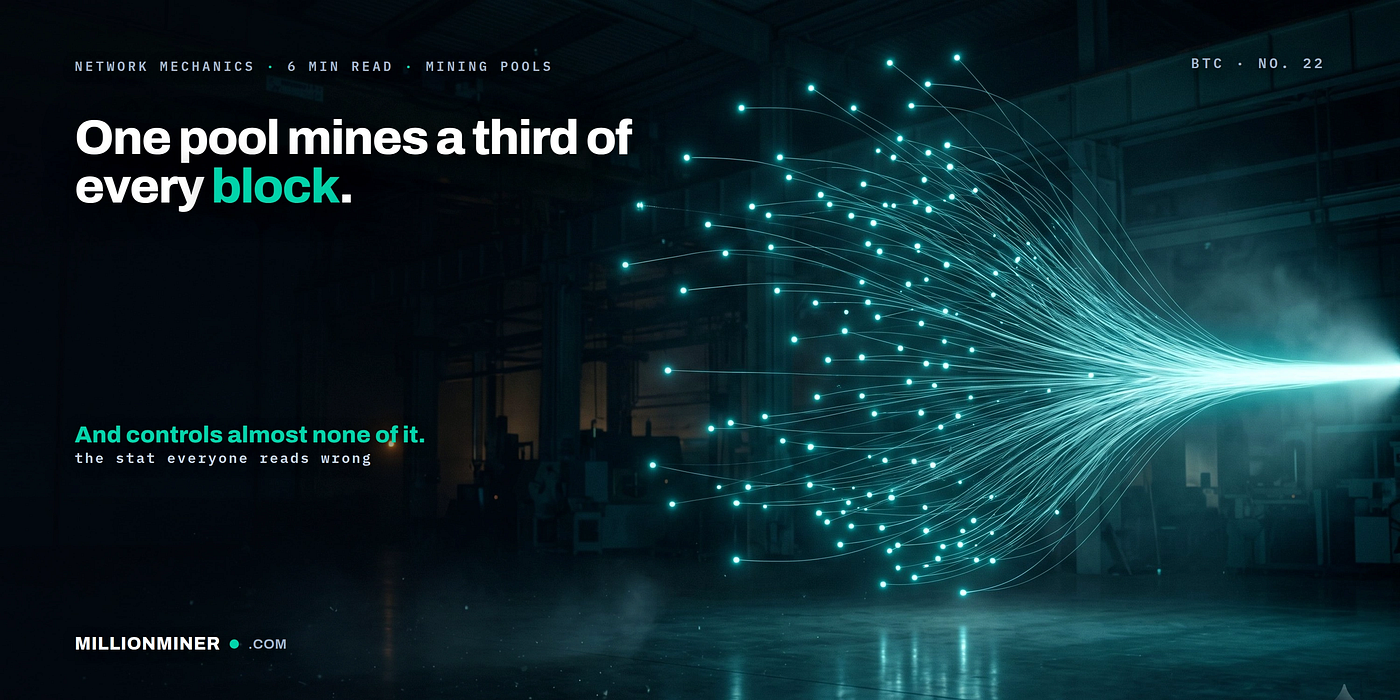
The most-quoted centralization stat in Bitcoin is real. It is also measuring the wrong thing, and once you see why, you cannot unsee it.
Every few weeks the same chart goes viral. One mining pool sits at the top with somewhere between a quarter and a third of all Bitcoin blocks. Add the second-place pool and the two of them clear half the network between them. The caption writes itself: Bitcoin is centralized, a couple of companies run the whole thing.
The chart is accurate. The conclusion is wrong. And the space between those two sentences is one of the most useful things you can understand about how Bitcoin works, because it is the difference between who shows up and who is in charge.
First, what a pool is actually for
Mining is a lottery. Your machine makes trillions of guesses a second, a winning guess takes the entire block reward, and on a network this size a single modern machine mining alone might wait years between wins. The work is constant. The income is a slot machine.
A pool fixes the income without touching the odds. Thousands of independent miners aim their machines at one coordinator. Their combined hashrate finds blocks on a steady schedule, and each reward gets split among the members in proportion to the work each contributed, minus a small fee. You hand over your lottery ticket and walk away with a paycheck.
Hold onto this: A pool is a payment-smoothing cooperative. It pays for steadiness, not control.
Now the part everyone misreads
When a pool shows up at thirty percent of the network, the instinct is to read that as one company owning thirty percent of Bitcoin’s mining power. It owns almost none of it. A pool is not a miner. The machines pointed at it belong to thousands of separate operators, from a hobbyist with one box in a garage to an industrial farm with tens of thousands, and every one of them can unplug and repoint to a rival pool in the time it takes to change a setting.
So the percentage is not ownership. It is attendance. It tells you how much hashrate chose to coordinate through that pool this week, the way a stadium headcount tells you how many people showed up, not how many the venue owns. The crowd can leave, and when a pool has misbehaved, it has.
The line worth stealing: A pool’s share is attendance, not ownership. The hashrate is rented, and it can walk.
Where the real centralization question hides
There is a genuine concern underneath the noise, and it is sharper than the chart. For most of Bitcoin’s history, the individual miners supplied the raw hashrate, but the pool operator decided which transactions actually went into the blocks the pool found. The crowd brought the power. One entity wrote the block.
That, and not the size of any bar on a pool chart, is the centralization question worth arguing about. It is about who selects transactions, which is editorial control, not raw compute. And it is exactly what the newest pool protocols are built to fix, by handing block construction back to individual miners so the people supplying the power also choose what goes in. That shift deserves its own piece, and it only makes sense once you stop confusing a pool’s size with a pool’s power, which is the same foundation we lay out in how Bitcoin mining actually works.
So the next time the chart goes viral
You will know to ask the better question. Not how big is the biggest pool, but how much of that hashrate would stay if the pool stepped out of line, and who is choosing the transactions inside those blocks. The answer to the first is not much, and not for long. The answer to the second is the one actually worth watching.
A pool is a crowd, not a kingdom. Read the percentage as a headcount and the panic dissolves into a clearer view of where Bitcoin is genuinely centralized and where it only looks that way. If you want the economics that decide who is in that crowd, that is whether Bitcoin mining still pays, and the forces thinning the field are in the miner shakeout.
메타데이터
- post_id
- 8a3baae635ef
- slug
- one-pool-mines-a-third-of-every-bitcoin-block-heres-why-that-isn-t-the-threat-it-looks-like-8a3baae635ef
- url
- https://medium.com/@social_25594/one-pool-mines-a-third-of-every-bitcoin-block-heres-why-that-isn-t-the-threat-it-looks-like-8a3baae635ef
- canonical_url
- https://medium.com/@social_25594/one-pool-mines-a-third-of-every-bitcoin-block-heres-why-that-isn-t-the-threat-it-looks-like-8a3baae635ef
- author_url
- https://medium.com/@social_25594
- status
- ok
- fetched_at
- 2026-06-22 12:55:45