Custom Software vs Multiple SaaS Tools
Which is better for your business in the long run?
Custom Software vs Multiple SaaS Tools
Which is better for your business in the long run?
Three years ago, a small distribution company had everything under control.
There were only eight employees, a few loyal customers, and two online tools that handled almost everything. Work moved quickly, everyone knew where to find information, and there were very few delays.
Then the business started to grow.
New customers arrived every month. The team expanded. New departments were created. As new challenges appeared, the company did what most businesses do. It found another software solution.
Need better project management? Buy a project management tool. Need better customer support? Add a help desk platform. Need accounting software? Subscribe to one. Need email marketing? Another subscription. Need file sharing? Yet another platform.
None of these decisions were wrong. In fact, each one solved an immediate problem. But after a few years, something unexpected happened.
Employees spent more time moving between software than doing their actual work. Customer information was spread across different systems. Managers had to combine reports from multiple platforms before they could make a decision.
Instead of making work easier, technology had quietly become another job.
If this sounds familiar, you are not alone. Many growing businesses eventually face the same question: should we keep using multiple SaaS tools, or is it time to invest in custom software?
The answer is not as simple as choosing one over the other. Let’s look at why.

Software as a Service, better known as SaaS, has completely changed how businesses use technology.
Years ago, buying business software often meant paying a large amount upfront, installing it on company servers, and hiring specialists to maintain it. Today, businesses can simply create an account, pay a monthly subscription, and start working within minutes.
That convenience is one of SaaS’s greatest strengths. Whether it’s customer relationship management, accounting, project management, cloud storage, or communication, there is almost always a SaaS solution ready to use.
For startups and small businesses, this is often the perfect choice. Instead of spending months building software, they can focus on growing their business.

There is a reason millions of companies rely on SaaS every day.
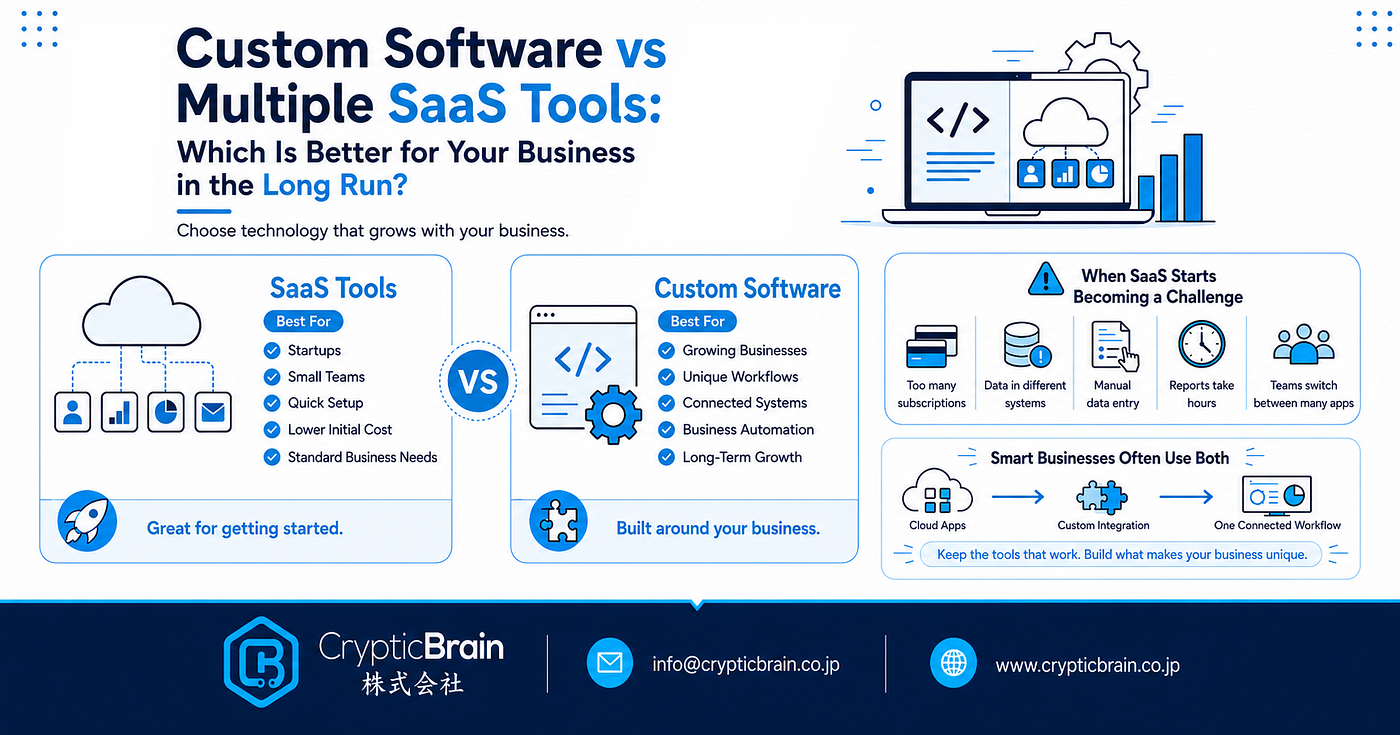
It is quick to set up. It usually costs less at the start. Updates happen automatically. Security and maintenance are handled by the provider. Many platforms also connect with other popular apps.
For businesses that need a reliable solution without a large investment, SaaS makes perfect sense. In many cases, it is exactly the right decision.

The challenge does not appear with the first SaaS tool. It appears with the tenth.
Imagine a growing company. Sales keeps customer details in one platform. Marketing stores campaign data somewhere else. Finance uses accounting software. Customer support has its own ticketing system. The operations team manages projects using another application.
Each department is happy because it has software designed for its own work. But the business as a whole begins to struggle.
Information is no longer in one place. Employees copy data from one system to another. Reports need information pulled from multiple platforms. Nobody has a full picture without opening several apps.
The business has not become inefficient because its people are less capable. It has become inefficient because its systems no longer work together.

Most businesses calculate software costs by adding up monthly subscription fees. But subscriptions are only part of the picture. The real costs often stay hidden.
Think about how often these situations happen. An employee enters the same customer information twice. Someone spends hours preparing a report because the data comes from different systems. A customer calls, but the support team cannot see their order history right away because it is stored somewhere else. A manager waits on information from three departments before making a decision.
None of this shows up on a monthly invoice. Yet it costs businesses time, productivity, and sometimes even customers. As companies grow, these hidden costs keep adding up.

Custom software is built specifically for your business.
Instead of asking your team to adjust their workflow to match the software, the software is designed around the way your business already works.
That does not mean every feature has to be unique. It simply means the software focuses on solving your specific challenges.
Maybe your approval process works differently. Maybe your inventory system needs to connect with suppliers. Maybe your sales team needs reports that standard software cannot provide. Custom software gives businesses the flexibility to build exactly what they need.

Many people believe the biggest benefit of custom software is having more features. Actually, the biggest advantage is simplicity.
Imagine logging into one system every morning. Sales information is already there. Customer history is available. Projects are up to date. Financial reports are connected.
Instead of jumping between different platforms, employees can focus on serving customers and getting their work done. Technology becomes less visible, and that is exactly how it should be.

This is where many articles get unrealistic. They make it sound like every business should immediately replace its SaaS tools with custom software. That is not true.
If you are running a small business with straightforward processes, SaaS may keep meeting your needs for years. Replacing reliable software just because custom development sounds appealing would be an unnecessary expense.
Technology should solve problems, not create new ones. The goal is not to own custom software. The goal is to build a better business.

Many successful businesses do not choose one option over the other. They combine both.
They keep using trusted SaaS platforms for common tasks like accounting, email, or communication. Then they build custom software for the parts of the business that make them unique.
Some businesses build a custom dashboard that pulls information from several SaaS platforms into one place. Others automate repetitive tasks between different systems. Some build internal software that connects existing tools instead of replacing them.
This approach often gives the best balance between flexibility and cost.

Every business grows differently, but there are common warning signs.
- Your team spends too much time switching between apps.
- The same information gets entered into multiple systems.
- Reports take hours instead of minutes.
- Employees complain about repetitive work.
- Different departments struggle to share information.
- You keep buying new software, but productivity does not improve.
If these problems sound familiar, your business may not need another SaaS subscription. It may need a better technology strategy.

Before making any decision, ask yourself a few simple questions:
- Are our current tools helping us grow?
- How much time do employees spend on manual work?
- Are we paying for software that people rarely use?
- Can our systems support the business we want to become in five years?
The answers often reveal whether your business simply needs better software management, or a more custom solution.

Every successful business changes over time. Customer expectations evolve. Teams grow larger. Operations become more complex.
Technology should grow alongside the business, not hold it back. What worked when you had ten employees may not work when you have one hundred.
That does not mean your earlier decisions were mistakes. It simply means your business has reached a new stage. Recognizing that moment is one of the smartest decisions a business leader can make.

The honest answer is neither.
SaaS tools are excellent for solving common business needs quickly and affordably. Custom software is valuable when your business needs solutions that standard platforms cannot provide.
For many growing companies, the best answer is not choosing one over the other. It is knowing when each one makes sense.
Technology should never be chosen because it is popular. It should be chosen because it helps people work better, supports business growth, and creates a better experience for customers.
At the end of the day, customers do not care how many software subscriptions you have. They care that you respond quickly, deliver consistently, and provide a great experience. The right technology is the technology that helps you do exactly that.
메타데이터
- post_id
- 8a432a88f771
- slug
- custom-software-vs-multiple-saas-tools-8a432a88f771
- url
- https://medium.com/@crypticbrain/custom-software-vs-multiple-saas-tools-8a432a88f771
- canonical_url
- https://medium.com/@crypticbrain/custom-software-vs-multiple-saas-tools-8a432a88f771
- author_url
- https://medium.com/@crypticbrain
- status
- ok
- fetched_at
- 2026-07-26 13:09:28

