THE KARACHI REMIX
Introduction
THE KARACHI REMIX
Introduction
Karachi is not just a city, it’s a contrast constantly in motion. A place where two completely different worlds don’t just exist side by side, but blend into each other in the most unexpected ways. From the quiet, aesthetic coffee shops of DHA to the loud, lively chai dhabas tucked into busy streets, the city carries both a polished “burgor” culture and a deeply rooted desi one.
In one corner, there are five-star restaurants with curated menus and ambient lighting; in another, the irresistible pull of street-side food that needs no branding to prove its worth. You’ll find the rush of modern shopping malls standing tall, while just a few minutes away, old markets continue to thrive with their chaos, history, and character. It’s a city where a Range Rover can pause behind a rickshaw, and neither feels out of place.
This is the Karachi Remix, a rhythm made of contrasts, where privilege and simplicity, modernity and tradition, don’t compete but coexist. And somewhere in between these extremes, the true identity of Karachi quietly unfolds.
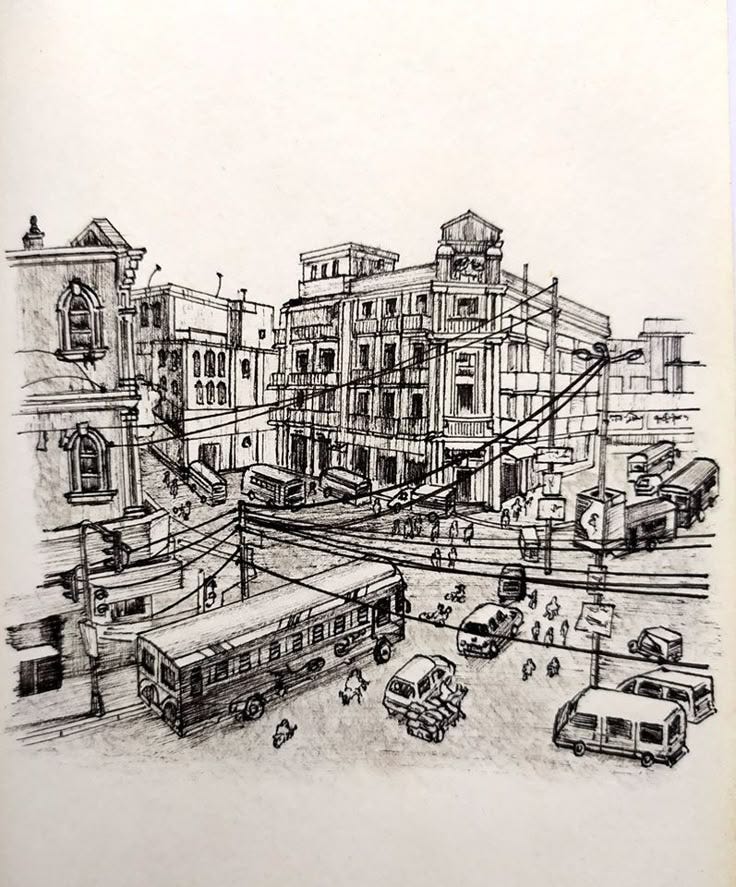
Burns Road, Karachi
About the Author

Author — Abeeha Shakil
Hii, my name is Abeeha and I’m 19, born and raised in Karachi, a city I don’t just live in, but deeply feel connected to. I’ve always been someone who notices the little things: the way streets change from one neighborhood to another, the shift in conversations, the contrast in lifestyles, and the stories hidden in everyday moments. No matter where I travel, I find myself missing Karachi, because for me, it isn’t just a place, it’s home, comfort, and a part of who I am.
Karachi, to me, is a world of its own. It holds endless cultures, trends, and experiences all within one city. On one side, there’s the fast-paced, modern life, coffee shops, big cars, designer brands, and malls shaped by Gen Z energy. And on the other, there’s the timeless desi essence, bun kebabs, street food, sugarcane juice stalls, rickshaws, and traditional markets like Zainab Market. What fascinates me the most is how effortlessly these two worlds coexist.
This blog comes from a place that’s very personal to me. It’s my way of capturing the beauty of these contrasts, of telling stories that often go unnoticed, and of showing how everything that seems so different still belongs to the same city. Because to me, Karachi isn’t just the best, it’s everything!!!
Lastly, I would say Karachi is a city that lives in me as much as I live in it.

AD: Read Now https://anabiaharif.wixsite.com/betweenlinesframes
Matcha vs Chai: Two Cups, One City
If someone asked me to describe Karachi in a single image, I wouldn’t choose a landmark or a skyline. I would choose two cups sitting side by side on a table: one filled with traditional doodh patti chai and the other with an iced matcha latte.
To many people, these drinks represent two completely different worlds. Chai belongs to crowded dhabas, late-night conversations, roadside hotels, and family gatherings. Matcha belongs to aesthetic cafés, social media stories, carefully curated interiors, and a younger generation eager to explore global trends.
Growing up in Karachi, I have witnessed both worlds. Some people see the rise of matcha culture as a sign that the city is changing too much. They believe Karachi’s true identity lies in its chai culture. To them, chai is not simply a drink; it is a tradition. It is what brings families together after dinner. It is what friends order during long conversations. It is comfort, familiarity, and home.
On the other hand, many people embrace matcha as a symbol of a modern Karachi. They see it as evidence that the city is evolving and becoming more connected to global culture. For them, trying matcha is not about rejecting chai; it is about experiencing something new.
I understand both perspectives because I find myself somewhere in the middle.
There is something magical about chai in Karachi. Some of my favorite memories involve sitting with family members, holding a warm cup of chai while stories and laughter filled the room. Chai reminds me of evenings that felt endless and moments that seemed ordinary at the time but later became precious memories.
At the same time, I genuinely enjoy visiting cafés and ordering matcha. There is a different kind of excitement in discovering new places, trying new flavors, and experiencing the more modern side of the city. Matcha represents curiosity and change, and I think there is beauty in that too.
What fascinates me most is that these two cultures coexist. On one street, you can find a crowded tea stall serving dozens of customers. A few minutes away, you might find a café where people are discussing work, university, or life over matcha. Both places are full of conversations, dreams, and connections.
That is why I don’t believe Karachi is a city divided between chai and matcha. I think it is a city that makes room for both.
The real beauty of Karachi is not choosing one side over the other. It is accepting that a city can honor its traditions while embracing change. Just like I can enjoy chai one day and matcha the next, Karachi can hold onto its roots while continuing to grow.
Perhaps that is what makes this city special. It does not ask us to choose between old and new. It simply allows both to exist together, one cup at a time.
Expensive Dining vs Dhabas: A Tale of Two Tables
Food has always been one of the easiest ways to understand Karachi. Every meal tells a story, and in this city, those stories are often told at two very different tables.
On one side are elegant restaurants with carefully designed interiors, reservation lists, and menus that feel like experiences rather than meals. On the other side are dhabas: simple, noisy, and full of life, where plastic chairs, steel plates, and the smell of fresh karak chai creates an atmosphere no luxury restaurant can replicate.
Many people believe dhabas represent the “real” Karachi. They argue that expensive restaurants are disconnected from the city’s roots and everyday realities. To them, the heart of Karachi beats strongest in places where people from all walks of life gather without worrying about dress codes or prices.
Others believe the city’s growing fine-dining culture reflects progress. These restaurants create new experiences, introduce international cuisines, and show that Karachi is capable of offering the same modern lifestyle found in major cities around the world.
I understand both viewpoints because both have shaped my experience of the city.
There is something special about sitting at a dhaba late at night. The conversations are louder, the atmosphere feels more alive, and the food somehow tastes better because of the environment around it. Dhabas are imperfect, but that imperfection is exactly what makes them memorable.
Yet I also appreciate the experience of visiting a beautiful restaurant. Sometimes it is not just about the food but about celebrating milestones, creating memories, and experiencing something different. There is a certain excitement in dressing up, trying a new cuisine, and spending an evening in a thoughtfully designed space.
What I find fascinating is how both worlds coexist within Karachi. A person can have breakfast at a roadside dhaba and dinner at an upscale restaurant on the same day. Neither experience cancels out the other.
The debate is often framed as tradition versus modernity, but I think it is much more complicated than that. Both spaces bring people together. Both create memories. Both contribute to the city’s identity.
Karachi’s beauty lies in the fact that it can accommodate both the simplicity of a dhaba and the sophistication of fine dining. One reminds us where we come from; the other shows us where we can go.
Perhaps the city does not need to choose between them. Perhaps the city is strongest because it embraces both.
Rickshaws vs Revos: Different Roads, Same City
If Karachi had a soundtrack, the sound of a rickshaw engine would certainly be part of it. Yet alongside these colorful three-wheelers, luxury vehicles glide through the same streets every day. Few contrasts capture Karachi better than the difference between a rickshaw and a Revo.
To some people, the rickshaw represents the soul of the city. It is affordable, accessible, and deeply woven into everyday life. It carries students rushing to class, families running errands, and workers heading home after a long day.
Others see vehicles like the Revo as symbols of success, ambition, and progress. They represent a Karachi that is modern, growing, and constantly reaching for more.
Many people treat these vehicles as symbols of two separate worlds. But living in Karachi has taught me that the city is far more interconnected than it appears.
There is a unique feeling that comes with riding in a rickshaw. The city feels closer. You hear the sounds, smell the food stalls, and experience Karachi without any barriers. Every turn feels like a small adventure.
At the same time, luxury vehicles tell their own story. For many people, owning one represents years of hard work and achievement. It reflects dreams that have been pursued and goals that have been reached.
What interests me most is not the difference between these vehicles but what they reveal about the city. They travel on the same roads. They stop at the same traffic signals. They exist within the same urban landscape.
Karachi often appears divided by class, lifestyle, and opportunity. Yet moments like these remind me that everyone shares the same city. Whether someone is looking out from a rickshaw or a Revo, they are witnessing the same sunset, the same sea breeze, and the same chaotic beauty.
The true story is not about which vehicle is better. It is about how both reflect different realities of Karachi.
One speaks of simplicity and everyday life. The other speaks of aspiration and achievement. Together, they create a fuller picture of the city than either could alone.
Karachi is not defined by one road or one vehicle. It is defined by the thousands of journeys happening simultaneously across its streets.

AD: Read Now https://laibasyed60.wixsite.com/before-it-vanishes/blog
Luxury Malls vs Local Markets
Local markets are where Karachi feels most alive. The bargaining, the crowds, the endless rows of shops, and the excitement of finding something unexpected create an experience that no shopping mall can fully replace.
Many people see local markets as the true face of the city. Places like these are full of stories, traditions, and human connections. Shopping is not simply a transaction; it becomes an interaction.
At the same time, Karachi’s luxury malls offer something entirely different. They provide comfort, convenience, and a carefully designed experience. For many people, malls represent a more modern version of the city.
I enjoy both.
There is a thrill in walking through a crowded market, hearing vendors call out prices and watching people negotiate over every purchase. The energy feels authentic and unpredictable.
But there is also comfort in a mall. Everything is organized, accessible, and familiar. Sometimes that convenience is exactly what people need.
Many assume these spaces compete with one another, but I don’t think they do. They serve different purposes and fulfill different needs.
The local market reminds us of Karachi’s traditions. The mall reflects its growth and modernization. Together, they show a city that continues to evolve without abandoning its roots.
When I think about Karachi, I don’t picture only one of these spaces. I picture both. The crowded streets outside a market and the bright lights inside a mall are equally part of the city’s identity.
That is what makes Karachi unique. It allows multiple realities to exist side by side, each contributing something valuable to the larger story.
High-Rises vs Old Makaans
When I look at Karachi’s skyline, I see a city caught between memory and ambition.
Towering high-rises continue to reshape the horizon. They represent growth, opportunity, and a future that seems to stretch endlessly upward. Yet hidden between these buildings are old houses, carrying decades of stories within their walls.
Many people celebrate the rise of modern buildings. They see them as evidence that Karachi is developing and moving forward. To them, every new tower symbolizes possibility.
Others worry about what gets left behind. Old homes hold memories, family histories, and pieces of Karachi that cannot be rebuilt once they disappear.
I find myself torn between these perspectives.
There is something inspiring about high-rises. They reflect confidence and progress. They show a city that refuses to stand still.
At the same time, old houses possess a kind of warmth that modern buildings often struggle to recreate. Their walls have witnessed generations grow up, celebrate milestones, and create memories.
Whenever I pass through older neighborhoods, I feel connected to a version of Karachi that existed long before me. These places remind me that cities are not built only from concrete and glass. They are built from stories.
Yet I also understand the need for change. Cities evolve because people evolve. New buildings emerge because new needs emerge. The challenge is not choosing between old and new. The challenge is learning how to value both.
Karachi’s identity is not found exclusively in its future or its past. It exists somewhere in between. The high-rises tell us what the city hopes to become. The old makaans remind us of where it came from.
And perhaps the most beautiful thing about Karachi is that, despite all its contrasts, it continues to carry both at the same time.

AD: Read Now https://beginner-friendly-food-series.blogspot.com/
메타데이터
- post_id
- 8a5f3a7b06a5
- slug
- the-karachi-remix-8a5f3a7b06a5
- url
- https://medium.com/@abeehashakil/the-karachi-remix-8a5f3a7b06a5
- canonical_url
- https://medium.com/@abeehashakil/the-karachi-remix-8a5f3a7b06a5
- author_url
- https://medium.com/@abeehashakil
- status
- ok
- fetched_at
- 2026-06-17 10:21:25




