Bob Bly’s secret of getting great testimonials
A 3-Step Follow-Up That Turns Client Results Into Testimonials
Bob Bly’s secret of getting great testimonials
A 3-Step Follow-Up That Turns Client Results Into Testimonials
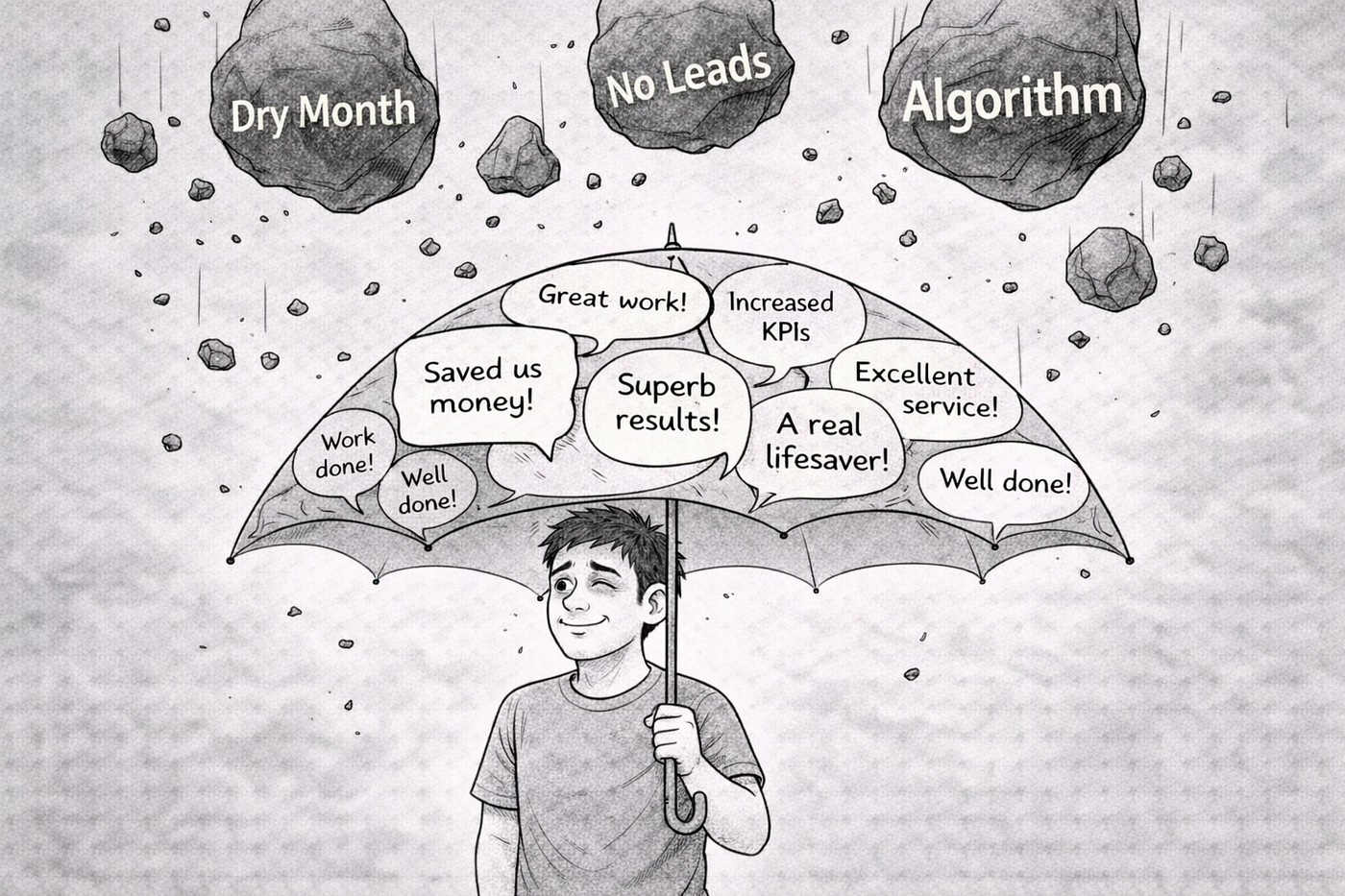
AI-Generated sketch by the author
Some time ago, Legendary direct-response marketer Bob Bly shared a deceptively simple yet incredibly helpful framework for getting strong client testimonials.
Before we go on any further, let’s get a few things straight first.
Testimonials are the real leverage.
People talk about followers and social media presence. Experts keep bragging about numbers and KPIs. And as of late, others parrot about leveraging ideas, empathy, and a noble goal.
However, in practice, you know as much as I do, these don’t hold a candle to one positive testimonial.
Trust is becoming a valuable real estate. And a testimonial from someone of renown, particularly outside the current clout chasers, can build the foundation for your business.
Thus, learning how to farm them is a skill you must have.
That being said, what’s this deceptively simple yet incredibly helpful framework for getting client testimonials?
In a way that will seem very comfortable for you
And doesn’t involve you awkwardly hovering around the send button of your “Can you write me something nice?” emails.
…
Here’s the framework, distilled to three steps:
1. Follow up after delivery
A few weeks after completing work for a client, reach out and ask whether the promotion or asset has run yet.
For some projects, a few weeks isn’t enough for your work to start bringing results. So the window depends and can go for up to six months to a year.
There is no absolute limit.
But the shorter the notice, the more relevant the project is.
You could send something along the lines of “Hey, we usually check in with previous clients to see how projects are going.
An after service of sort.
Checking out the X project launched Y weeks ago. Has it run yet?”
2. Ask about results
If so, ask what the results were in terms of response rate, inquiries, sales, ROI, and other quantifiable metrics.
“Is it possible to see the actual numbers. It’d be of great help for future projects.
In return, we’d offer… something” (A breakdown, one or two strategies to improve numbers, an inconsistency that could plug a hole in the system…)
3. Ask for permission
Assuming the performance was good, ask the client for permission to post her comments on your website.
If she says yes, you have just gotten a testimonial , one that is true, sincere, and best of all, in the client’s own words.
Notice that you have not explicitly asked for a testimonial, praise, or a pat on the back.
You are simply doing due diligence follow-up to find out how well your work served your client.
Now, a few concerns arise.
If the answer s/he gives to step 2 is specific , e.g., generated hundreds of good leads , you have a strong testimonial.
But what happens if…
They don’t share numbers
If the client answers you with specific KPIs, that’s the strongest testimonial you could ever ask for.
If the clients drop vague compliments, take them on it. It’s still a positive review from a client known in his circle.
(And maybe point out how they need to track and split test for better results. And maybe offer to do it for them.)
Results Aren’t Great?
If the answer to step 2 is mediocre or poor, and the work does not require much effort, you can offer to fix it for free. Otherwise, set a symbolic price for the extra work.
Courtesy of the after-service for our dear clients.
Fixing isn’t the only way to go about it.
You could offer an Audit to figure out why things didn’t work. Or a consulting session to put things back in line.
The effort you spend here depends on whether you want to have a longer relationship with said client.
Once they take you on your offered fix, and if the fix works, the client is most likely to give you a positive testimonial.
The Same Strategy, Taught from a Different Angle
Interestingly, this exact approach mirrors what Graham McGregor (The Money King) teaches as a marketing strategy to delight your clients, netting you recurrent jobs and referrals.
When you reach out to your client after a job well done, they feel appreciated. And they will appreciate you in return.
Not many businesses do this, that’s why it’s noticeable.
Your Turn:
Have any old clients you’d like to work with again? The practical steps are straightforward:
Step 1: Reach out to past clients and ask whether your work has run.
Step 2: If it has, ask what results it produced.
Step 3: Respond accordingly.
- If they share clear KPIs, that’s your strongest testimonial.
- If they offer vague praise, push gently for specifics , and educate them on tracking if needed.
- If the results were weak, offer to improve the work.
If the fix is minor, you can do it for free.
If it requires effort, charge a symbolic fee.
Either way, you win.
Clients feel supported. You demonstrate professionalism and appreciation. And testimonials become a by-product, not a request.
One final reminder
Always ask for permission before posting client comments publicly.
Unprofessionalism compounds too.
Cheers.
A special thank you for taking the time to read. I make sure to respond to all inquiries. If you’ve got any, feel free to leave a comment.
If you’ve enjoyed reading this article, you might also like:
[embed]Relax, the future still needs you Why I believe AI won’t replace usmedium.com
메타데이터
- post_id
- 8a65ea9e0da4
- slug
- bob-blys-secret-of-getting-great-testimonials-8a65ea9e0da4
- url
- https://blog.venturemagazine.net/bob-blys-secret-of-getting-great-testimonials-8a65ea9e0da4
- canonical_url
- https://blog.venturemagazine.net/bob-blys-secret-of-getting-great-testimonials-8a65ea9e0da4
- author_url
- https://medium.com/@a.madji2020
- status
- ok
- fetched_at
- 2026-08-11 06:01:17