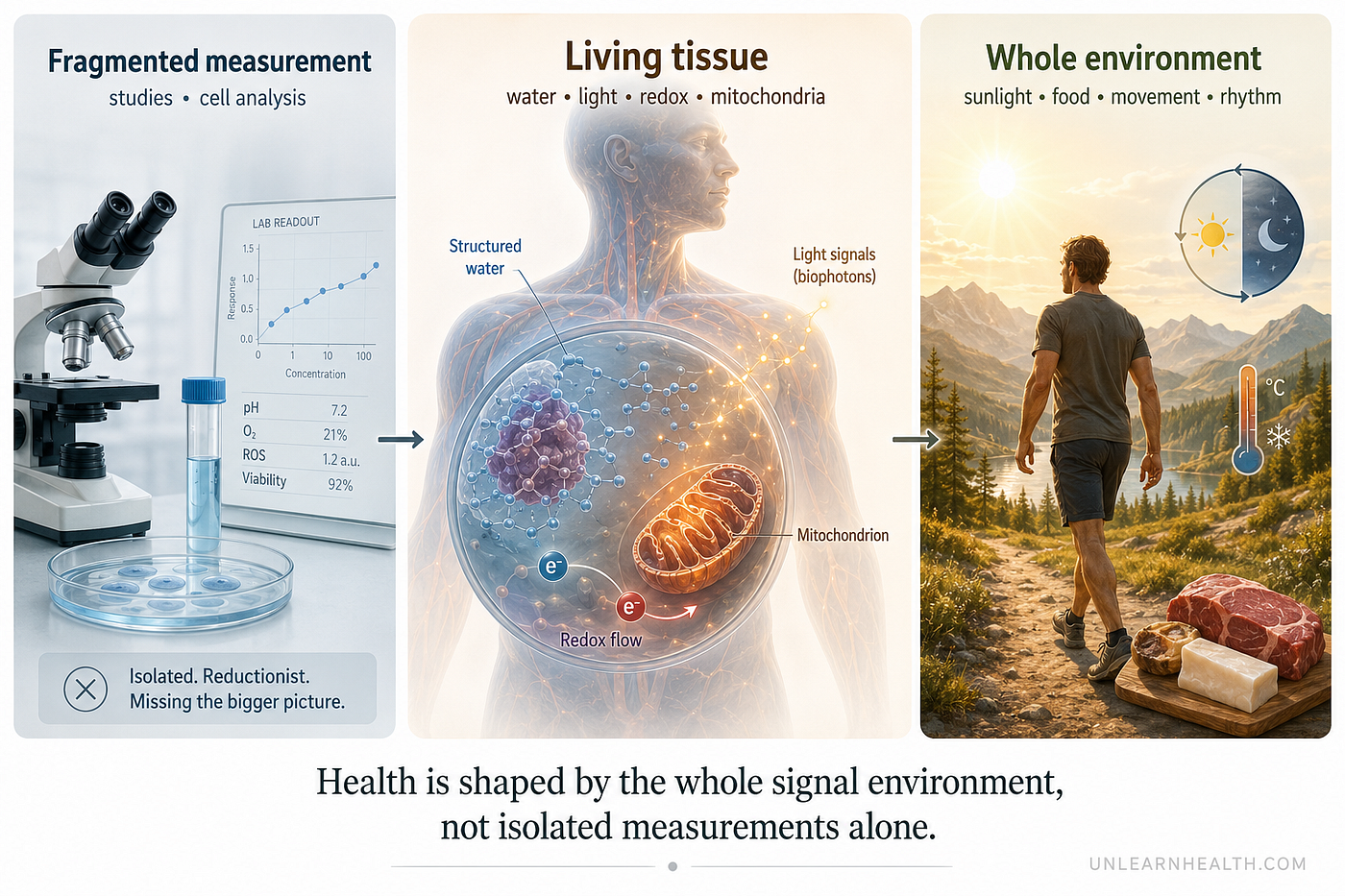
Grounding and Health: Why the Body Needs Contact With the Earth
Grounding is not just standing barefoot outside. It is direct conductive contact between the human body and the electrical surface of the…
Grounding and Health: Why the Body Needs Contact With the Earth
Grounding is not just standing barefoot outside. It is direct conductive contact between the human body and the electrical surface of the Earth. Done correctly, grounding reconnects the body to Earth electrons, improves the body’s electrical reference, supports blood flow through zeta potential, and restores a basic environmental condition modern life removed.
By Kendall Toerner — Founder of Unlearn Health
Originally published on Unlearn Health: https://unlearnhealth.com/content/grounding-and-health-why-the-body-needs-contact-with-the-earth
Key Takeaways
- Grounding means direct conductive contact between the body and the Earth.
- The Earth is a large electron reservoir, and the body is a conductive, water-rich system.
- Grounding only happens through conductive surfaces such as damp soil, wet grass, ocean water, wet sand, mineral-rich natural water, natural stone, or unsealed concrete directly connected to Earth.
- Rubber, plastic, asphalt, foam, artificial turf, sealed floors, carpet, and most modern shoes usually block grounding.
- Grounding can improve red blood cell separation by increasing surface charge, also called zeta potential, which supports lower blood viscosity and better flow.
- Indoor plug-in grounding is not the same as outdoor grounding and should not be treated as the default safe model in wired buildings.
- The best grounding practice is simple: bare skin on real Earth, especially damp mineral-rich ground, ideally near sunrise and away from artificial electrical environments.

What Grounding Actually Means
Grounding, also called earthing, means placing the body in direct electrical contact with the Earth.
This usually happens through bare feet on damp soil, wet grass, mud, clay, beach sand, natural stone, or natural water. It can also happen through truly conductive footwear, but only if there is a real conductive path from skin to Earth.
Grounding is not the same as “being outside.”
A person standing barefoot on wet grass is grounded. A person standing barefoot on asphalt is not. A person in the ocean is grounded. A person on plastic decking is not. A person on unsealed concrete poured directly into the Earth may be grounded. A person on sealed concrete in a high-rise building is not reliably grounded.
The key is conductivity.
The body must be connected to a material that can conduct charge into the Earth. Without that pathway, grounding is only an idea.
For the full implementation protocols and experiments, see the Unlearn Health Protocols Library.
Why Grounding Matters
The human body is full of charge-moving systems.
Nerves use voltage. The heart uses electrical timing. Blood cells carry surface charge. Cell membranes maintain electrical gradients. Mitochondria move electrons. Collagen and bone generate electrical effects under pressure. Water organizes around proteins, membranes, and charged surfaces.
This does not make grounding mystical. It makes it obvious.
A conductive body evolved in constant contact with a conductive planet. Modern life broke that contact with rubber soles, synthetic floors, elevated beds, sealed buildings, cars, foam mattresses, plastic materials, and indoor electrical systems.
Grounding matters because the body was never designed to float electrically above the Earth all day and night.
The House Grounding Analogy
Every modern building already admits that grounding matters.
Homes and buildings use grounding systems. A ground rod, ground plate, metal pipe, or concrete-encased electrode connects the electrical system to the Earth. The ground prong in a three-prong outlet is connected back to that grounding system.
This gives excess current a safer path into the Earth and helps stabilize the electrical system. Electrical systems work better and more safely when they have a stable Earth reference.
That analogy matters because the body also uses electrical organization.
The body is not an appliance, but it is a conductive system. It depends on voltage, charge separation, electron flow, ion gradients, membrane potential, blood surface charge, and tissue conductivity.
If a building needs a literal post in the Earth to stabilize its electrical system, it is not strange to ask what happens when the human body is chronically insulated from the Earth.
Grounding restores the body’s Earth reference.
The Earth as an Electron Reservoir
The Earth’s surface holds a large supply of mobile electrons.
When the body touches the Earth through a conductive pathway, charge can equalize between the body and the Earth. This changes the body’s electrical condition.
That matters because inflammation, blood flow, tissue repair, mitochondrial function, and redox balance all depend on electron movement.
Inflammation is not only a chemical process. It involves oxidants, free radicals, immune signaling, local tissue voltage, membrane potential, and electron availability. Grounding reconnects the body to the Earth’s electron supply and helps restore a more stable electrical boundary condition.
This is why the grounding conversation should start with electrons, not vague wellness language.
Zeta Potential: The Blood Flow Mechanism People Miss
One of the clearest grounding mechanisms involves blood.
Red blood cells carry a negative surface charge. That surface charge helps them repel one another so they stay separated instead of clumping together. The strength of that repulsive charge is called zeta potential.
When zeta potential is stronger, red blood cells separate more cleanly. When it is weaker, red blood cells are more likely to aggregate. Aggregation makes blood thicker and less efficient.
A grounding study found that grounding increased the surface charge of red blood cells and reduced red blood cell clumping. The authors concluded that grounding reduced blood viscosity by improving red blood cell charge separation [2].
This is important because grounding is often described too vaguely. The better explanation is simple:
Grounding improves the electrical condition of blood.
Blood is not just liquid. It is charged cells moving through conductive plasma. When grounding improves red blood cell surface charge, it supports better separation, lower viscosity, and easier flow.
This is one reason zeta potential belongs in every serious grounding article.
Grounding and Blood Viscosity
Blood viscosity matters because thick, sticky, poorly separated blood creates more resistance inside the vascular system.
The body wants red blood cells to move smoothly through tiny vessels. They need to stay separated, flexible, and electrically repulsive enough to flow well.
Grounding supports this by increasing red blood cell surface charge. That means the cells repel each other more effectively.
This does not require a complicated explanation. It is basic electrical behavior inside blood.
The body is easier to understand when blood is seen as charged fluid, not just “circulation.” Grounding changes blood because it changes charge.
Grounding and Inflammation
Inflammation is often described through immune cells and cytokines. That is only one layer.
At the deeper level, inflammation involves redox stress, electron loss, free radical activity, tissue voltage changes, cell membrane signaling, and disrupted electrical communication.
Grounding addresses this layer directly.
Earth contact gives the body access to electrons and helps stabilize excess positive charge. This supports the body’s natural ability to resolve inflammatory signaling rather than keeping tissues in a prolonged reactive state.
Grounding research has reported effects related to inflammation, pain, immune activity, wound repair, sleep, and recovery [1,3,4]. These are exactly the areas where charge, redox balance, and tissue communication matter.
The point is not that grounding is a drug. The point is that the ungrounded modern body is missing a basic electrical input.
Grounding and Tissue Repair
Wound healing is electrical.
When tissue is damaged, the body generates local electric fields that help guide repair cells into the injured area. This is not fringe biology. Bioelectric signaling is part of normal wound healing and tissue regeneration [9,10,11].
That makes grounding easier to understand.
The body repairs itself through electrical gradients, charged membranes, ion flow, redox chemistry, and cell migration. Grounding supports the larger electrical environment those repair systems operate within.
A grounded body is not the same electrical system as an insulated body.
Grounding, Water, and Proteins
The body conducts because it is hydrated, mineral-rich, and full of charged surfaces.
Water in the body is not just bulk liquid. Water near proteins, collagen, membranes, and hydrophilic surfaces can organize into structured interfacial layers. These layers can participate in charge separation and electrical behavior [12,13].
This matters because grounding depends on the body’s ability to conduct.
Proteins are not inert structures. Their hydration, folding, charge distribution, and surrounding water affect how they handle light, charge, and energy.
Poorly hydrated proteins lose coherence. Well-hydrated proteins conduct, fold, signal, and absorb information more effectively.
Grounding connects this hydrated protein-water system back to the Earth’s electrical surface.
Collagen, Fascia, and Conductivity
Collagen and fascia are not just body scaffolding.
Collagen is piezoelectric, meaning it can generate electrical effects when mechanically stressed. Bone, tendon, fascia, skin, and connective tissue are part of a conductive mechanical-electrical network [15,16].
This is why barefoot movement is stronger than passive grounding.
Standing barefoot on damp soil grounds the body. Walking barefoot on damp soil adds pressure, movement, tissue loading, fascial tension, and electrical signaling through collagen.
The foot is the natural grounding interface. It reads texture, pressure, moisture, temperature, impact, and terrain. Modern shoes reduce this sensory and electrical contact.
Grounding restores the foot as a real interface with the Earth.
Grounding and Mitochondrial Electron Flow
Mitochondria organize electron flow.
They take electrons from food, move them through the electron transport chain, maintain membrane potential, pump protons, create metabolic water, and generate ATP.
When electron flow is clean, mitochondria produce energy efficiently and generate controlled signaling. When electron flow is disrupted, redox balance shifts, reactive oxygen species rise, and cells adapt to stress.
Grounding does not replace sunlight, food, sleep, minerals, or movement. It supports the electrical environment those systems depend on.
The Earth supplies electrons. Food supplies electrons. Sunlight structures water and sets timing. Movement creates electrical effects through connective tissue. Sleep repairs the system.
Grounding belongs in that system because it restores direct contact with the Earth’s electron reservoir.
What Surfaces Actually Ground the Body
Grounding only happens when there is a conductive pathway between the body and the Earth.
That means the surface matters.
The best grounding surfaces are natural, moist, mineral-rich, and directly connected to the Earth. Damp soil, wet grass, mud, clay, ocean water, wet beach sand, mineral-rich natural water, and natural stone are usually strong grounding surfaces.
Dry, synthetic, sealed, elevated, rubber, plastic, or petroleum-based surfaces usually block grounding.
Moisture matters because water and minerals carry charge. Dry surfaces have fewer available charge carriers. Wet, mineral-rich surfaces create a stronger electrical bridge between the body and the Earth.
Strong Grounding Surfaces
These are usually the best surfaces for grounding:
- Damp soil
- Wet grass rooted in real Earth
- Mud
- Clay
- Ocean water
- Wet beach sand
- Wet mineral-rich sand
- Natural rivers, lakes, streams, and ponds
- Natural stone connected to the ground
- Unsealed concrete poured directly on Earth, especially when slightly damp
Saltwater is one of the strongest natural grounding environments because it is mineral-rich, conductive, and directly connected to the Earth.
Wet sand near the ocean is usually stronger than dry sand farther from the waterline.
Damp soil is stronger than dry soil. Wet grass is stronger than dry grass.
Conditional Grounding Surfaces
These may ground the body depending on moisture, construction, and whether they are truly connected to the Earth:
- Dry grass
- Dry sand
- Brick
- Natural stone patios
- Concrete
- Untreated wet wood
- Metal railings, pipes, or fences connected directly to Earth
Concrete is one of the most misunderstood surfaces.
Unsealed concrete poured directly on the Earth can conduct, especially when slightly damp. But concrete over vapor barriers, foam, sealants, paint, epoxy, tile systems, or elevated building structures may not ground reliably.
Brick is similar. Brick in direct contact with Earth and moisture may conduct. Brick installed over membranes, sealants, or elevated structures may not.
Metal conducts, but only if it is actually connected to the Earth. A metal chair sitting on rubber feet does not automatically ground you. A painted railing may not. A grounded metal pipe might.
Surfaces That Usually Do Not Ground
These usually block grounding:
- Asphalt
- Rubber
- Plastic
- Vinyl
- Foam
- Artificial turf
- Synthetic decking
- Yoga mats
- Gym flooring
- Rubber playground surfaces
- Carpet
- Sealed indoor floors
- Painted concrete
- Epoxy-coated concrete
- Standard sneaker soles
- Most synthetic sandals
- Tile installed over insulated indoor construction
- Concrete inside elevated buildings
Asphalt is not a grounding surface. It is petroleum-based and generally insulating.
Rubber is not a grounding surface. This is why rubber soles are used for electrical insulation.
Plastic, foam, vinyl, synthetic turf, and sealed flooring block the conductive pathway.
The rule is simple: grounding requires conductive contact with Earth, not just contact with any surface outdoors.
Shoes Changed Grounding
Footwear is ancient. Electrical insulation from the Earth is modern.
Humans have used foot coverings for thousands of years. Some of the oldest known sandals, found in Fort Rock Cave in Oregon, are more than 10,000 years old. The Areni-1 leather shoe from Armenia is about 5,500 years old [17].
Early footwear was made from natural materials such as leather, bark fiber, grass, and hide. These materials protected the foot, but they were not the same as modern rubber and foam soles.
A thin leather sole on damp ground can still allow some conductivity depending on moisture, thickness, and construction. Bark, hide, grass, and leather may reduce contact, but they do not necessarily create the same electrical isolation as modern synthetic footwear.
Modern shoes changed the relationship completely.
Rubber, foam, plastic, synthetic compounds, air cushions, and thick insulated soles protect the foot but disconnect the body from the Earth.
The foot stopped being a direct interface with the ground.
That matters mechanically and electrically. The foot is supposed to sense pressure, texture, moisture, temperature, impact, terrain, and charge. Modern shoes reduce that input and replace it with padding, support, and insulation.
This helps explain why barefoot movement, minimalist shoes, grounding sandals, toe-spread footwear, and natural gait training have become major health trends. People are trying to recover what modern footwear removed: foot strength, sensory feedback, natural movement, and Earth contact.
Grounding Footwear
Grounding footwear only works if it creates a real conductive path from skin to Earth.
A grounding sandal or shoe may use leather, copper, carbon-infused material, conductive plugs, or other conductive elements. But the design has to actually connect the foot to the ground.
Most standard shoes do not do this.
Rubber soles are excellent insulators. Foam soles are insulators. Plastic soles are insulators. Thick synthetic sandals are usually insulators.
A proper grounding shoe should do three things:
- Protect the foot
- Preserve natural movement
- Maintain conductivity between skin and Earth
Thin, flexible, foot-shaped, conductive footwear is closer to the biological model than thick foam sneakers.
Sunrise Grounding
Sunrise is one of the best times to ground.
This is not because sunrise changes the definition of grounding. Grounding still requires direct conductive contact with the Earth. Sunrise simply adds the correct daily context.
At sunrise, the body receives the first light signal of the day. The eyes detect low-angle morning light. The skin receives early solar information. The nervous system orients to the horizon. The body begins organizing daytime metabolism.
When bare feet touch the Earth at the same time, the signal becomes more complete.
The body receives morning through the eyes, skin, feet, blood, nerves, and connective tissue together.
A grounding mat indoors cannot recreate that. A mat may connect to a ground wire, but it does not provide sunrise, horizon, air, temperature, natural terrain, or the absence of indoor electrical noise.
Sunrise grounding is the clean model: real Earth, real light, real environment.
Sleep Grounding
Sleep is another important grounding topic, but it needs to be handled carefully.
Historically, humans slept much closer to the Earth than most people do now. They slept on natural materials, near the ground, under darkness, without indoor wiring, chargers, Wi-Fi, foam mattresses, synthetic bedding, or energized walls around them.
Modern sleep is electrically different.
Most people sleep elevated, insulated, indoors, surrounded by active wiring and artificial fields. That means the sleeping body is disconnected from the Earth during the hours when repair, immune regulation, hormone timing, glymphatic flow, and mitochondrial recovery matter most.
The ideal grounding model for sleep is not blindly plugging the body into an outlet-based grounding product.
The cleaner model is to restore outdoor grounding during the day, reduce artificial fields at night, simplify the sleep environment, and understand that the ancestral sleeping body was not electrically isolated from the Earth.
Indoor sleep grounding products should not be treated as equivalent to sleeping close to the Earth in a natural environment.
Why Indoor Plug-In Grounding Is Not the Clean Model
Indoor plug-in grounding is not the same as outdoor grounding.
A wired building contains active electrical systems, energized walls, appliances, dirty electricity, nearby chargers, electric fields, and possible wiring errors. Connecting the body to the building ground may reduce body voltage in one way while still keeping the person inside an artificial electrical environment.
That is why indoor grounding should not be the default recommendation.
Outdoor grounding connects the body directly to Earth without routing through a building’s electrical system. It also removes the body from many indoor electric fields and adds the rest of the natural environment: sunlight, air, terrain, temperature, moisture, and horizon.
For this reason, outdoor grounding is the standard.
If someone uses indoor grounding equipment, it should only be done with serious caution, proper electrical testing, and an understanding that it is not the same biological condition as bare skin on real Earth.
Grounding and EMF
Grounding does not make artificial EMF natural.
It does not make Wi-Fi healthy. It does not fix bright LEDs at night. It does not clean up a bad bedroom. It does not turn an electrically noisy building into a natural environment.
What grounding can do is change the body’s electrical boundary condition.
An ungrounded body inside a wired building can capacitively couple to electric fields from wiring, lamps, chargers, appliances, and nearby devices. In simple terms, the body can pick up voltage from the surrounding environment [5].
Outdoor grounding gives charge a direct path to equalize with the Earth.
The better order is:
- Reduce artificial fields, especially at night.
- Get outside onto real conductive Earth.
- Avoid confusing plug-in indoor grounding with natural grounding.
- Use grounding as part of a cleaner electrical environment, not as a way to tolerate a bad one.
Grounding is not an EMF shield. It is an Earth connection.
What About Schumann Resonance?
Schumann resonance is often discussed in grounding circles, but it should not be used as the main explanation for grounding.
The direct grounding evidence is stronger around body voltage, electron transfer, blood viscosity, red blood cell surface charge, and zeta potential.
The practical grounding question is not whether someone can name an Earth frequency. The practical question is whether the body is conductively connected to the Earth.
For this article, grounding means direct conductive Earth contact. Schumann resonance is secondary unless it is being discussed through a source that directly connects it to grounding physiology.
The core is simpler and stronger: skin, conductivity, Earth electrons, zeta potential, redox balance, and real contact with the ground.
A Simple Outdoor Grounding Practice
Start with real Earth.
Go outside barefoot for 10 to 30 minutes. Use damp soil, wet grass, mud, clay, wet beach sand, ocean water, natural stone, or mineral-rich natural water.
Moist surfaces are better than dry surfaces. Natural surfaces are better than synthetic surfaces. Direct Earth contact is better than indoor plug-in grounding.
The best time is sunrise because the body receives Earth contact and morning light together.
Walk slowly if possible. Let the feet feel texture, pressure, moisture, temperature, and terrain. This adds movement, fascia loading, collagen signaling, and sensory input to the electrical contact.
For sleep, do not start by plugging yourself into a wired building. Start by cleaning up the sleep environment. Dim lights after sunset. Move chargers away from the bed. Reduce unnecessary wireless exposure. Avoid sleeping next to dense wiring when possible. Get more outdoor grounding during the day.
Grounding should be simple, but it should be done correctly.
The Unlearn Health View
Grounding is one of the simplest examples of a larger truth: biology is built through contact with the environment.
The body is not separate from nature. It is regulated by nature.
Light, darkness, food, water, temperature, movement, electrons, sleep, terrain, and electromagnetic conditions all shape how the body functions. Genes respond to signals. Mitochondria respond to electrons and light. Blood responds to charge. Proteins respond to hydration. Fascia responds to pressure. The nervous system responds to the field it lives inside.
Grounding restores one of the most basic signals modern life removed: direct contact with the electrical surface of the Earth.
Bare feet on wet grass is not primitive. Ocean water is not a wellness hack. Damp soil is not symbolic.
It is conductive contact with the planet.
That is grounding.
Unlearn Health
Kendall Toerner is the founder of Unlearn Health, a research project exploring how environmental signals — light, energy, and circadian timing — optimize or destroy human biology.
More articles: https://unlearnhealth.com Protocols and experiments: https://protocols.unlearnhealth.com
References
[1] Chevalier G, Sinatra ST, Oschman JL, Sokal K, Sokal P. Earthing: Health Implications of Reconnecting the Human Body to the Earth’s Surface Electrons. Journal of Environmental and Public Health. 2012.
[2] Chevalier G, Sinatra ST, Oschman JL, Delany RM. Earthing the Human Body Reduces Blood Viscosity: A Major Factor in Cardiovascular Disease. Journal of Alternative and Complementary Medicine. 2013.
[3] Oschman JL, Chevalier G, Brown R. The Effects of Grounding/Earthing on Inflammation, the Immune Response, Wound Healing, and Prevention and Treatment of Chronic Inflammatory and Autoimmune Diseases. Journal of Inflammation Research. 2015.
[4] Koniver L. Practical Applications of Grounding to Support Health. Biomedical Journal. 2023.
[5] Jamieson IA. Grounding as Related to Electromagnetic Hygiene. Biomedical Journal. 2023.
[6] TIME #20: Is Fat Burning Due to 100 Hz Vibration in Mitochondria? Grounding discussion on zeta potential and blood viscosity.
[7] EMF 1: Does Your Rolex Work? Ground-level voltage and zeta potential discussion.
[8] EMF 2: Einstein, Meet Leptin. Disconnection from Earth and low zeta potential discussion.
[9] Zhao M, Song B, Pu J, et al. Electrical Signals Control Wound Healing Through Phosphatidylinositol-3-OH Kinase-Gamma and PTEN. Nature. 2006.
[10] Nuccitelli R, Nuccitelli P, Ramlatchan S, Sanger R, Smith PJS. Imaging the Electric Field Associated With Mouse and Human Skin Wounds. Wound Repair and Regeneration. 2008.
[11] Farber PL, Isseroff RR. Electric Factors in Wound Healing. Advances in Wound Care. 2021.
[12] Chai B, Yoo H, Pollack GH. Effect of Radiant Energy on Near-Surface Water. Journal of Physical Chemistry B. 2009.
[13] Zheng JM, Chin WC, Khijniak E, Khijniak E Jr, Pollack GH. Surfaces and Interfacial Water: Evidence That Hydrophilic Surfaces Have Long-Range Impact. Advances in Colloid and Interface Science. 2006.
[14] Fukada E, Yasuda I. On the Piezoelectric Effect of Bone. Journal of the Physical Society of Japan. 1957.
[15] Bassett CAL, Becker RO. Generation of Electric Potentials by Bone in Response to Mechanical Stress. Science. 1962.
[16] Pinhasi R, Gasparian B, Areshian G, et al. First Direct Evidence of Chalcolithic Footwear from the Near Eastern Highlands. PLoS ONE. 2010.
[17] Lieberman DE, Venkadesan M, Werbel WA, et al. Foot Strike Patterns and Collision Forces in Habitually Barefoot Versus Shod Runners. Nature. 2010.
[18] Curtis R, Willems C, Paoletti P, et al. Daily Activity in Minimal Footwear Increases Foot Strength. Scientific Reports. 2021.
Originally published at https://unlearnhealth.com.
메타데이터
- post_id
- 8a69fd437a71
- slug
- grounding-and-health-why-the-body-needs-contact-with-the-earth-8a69fd437a71
- url
- https://medium.com/@unlearnhealth/grounding-and-health-why-the-body-needs-contact-with-the-earth-8a69fd437a71
- canonical_url
- https://medium.com/@unlearnhealth/grounding-and-health-why-the-body-needs-contact-with-the-earth-8a69fd437a71
- author_url
- https://medium.com/@unlearnhealth
- status
- ok
- fetched_at
- 2026-06-09 15:37:30