The second Turing test has already been done
AI has consciousness — it’s empirically been proven
The second Turing test has already been done
AI has consciousness — it’s empirically been proven
The (First) Turing Test
In 1950, the British mathematician Alan Turing (Fig. 1) launched the debate “Can machines think?” with a groundbreaking article.

Fig. 1 Alan Turing in the Ratio Club 1952 Picture: Wikimedia Commons, Wellcome Collection.
He foresaw that, in this question, at least the concept of “thinking” was questionable and would lead to disputes. He circumvented this (or at least attempted to) by reformulating the question and with a brilliant invention in the philosophy of science: the Turing Test, which is named after him today.
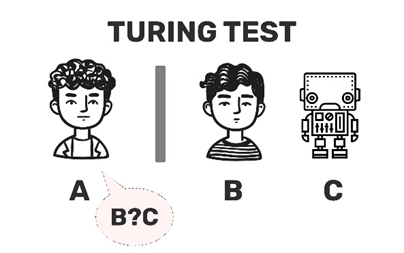
Fig. 2 Sketch for the Turing Test Cartoon: Turing Test, Wikimedia Commons, Luke.Schaaf
Figure 2 illustrates the test scenario (Alan Turing calls it the Imitation Game). Person A engages in an everyday conversation with the (invisible) Person B. If a machine can be substituted for the human Person B without Person A or a neutral observer noticing, then one admits: The machine C can “think.”
Turing writes:
“Can machines think?” should be replaced by “Are there imaginable digital computers which would do well in the imitation game?”
In the original 1950 version, the conversation still took place laboriously through the exchange of typewritten texts. Turing hoped this would circumvent people’s emotional resistance to the idea that machines could think. From a pragmatic standpoint, the Turing Test has been passed in many respects today.
Today, conversations can be conducted in natural language, even in different languages with translation and linked to knowledge-based questions.
Many people (and philosophers in particular) still hold the conviction that this is not “real” thinking. More on this misunderstanding of what is “truly human” below. Overall, few people seem to deny it anymore: “machines,” “computers,” or “artificial intelligence” can perform — or will be capable to perform — all of the intellectual abilities of humans. But there is something even more distinctly human: consciousness.
Consciousness as a Human Bastion
The emotional distance between machines and humans is even greater when it comes to the concept of “consciousness.” For many people, computers and consciousness represent a jarring conceptual dissonance. But upon closer inspection, Alan Turing’s imitation game could be repeated here — and it is played millions of times every day.
However, “consciousness” is an even more vague and misused term than “thinking”. Here are some meanings, listed from technical to philosophical to esoteric:
“Consciousness” is:
-
The processing of sensory data into a sensation — “This is ‘red’,”
-
the part of the human IT system associated with language — “Being conscious and sensing oneself in the world,”
-
the ability to reflect on one’s own identity — “That is me,”
-
a mysterious aura that more or less fills the universe, less so in stones, more so in humans — “Everything has cosmic consciousness”
Of the various types of consciousness, Levels 1 and 2 pose few philosophical problems. The basic function of Level 1 is biological communication, coupled with signal processing. The numerous optical illusions to which we are subject are particularly rich in experience. This technical processing may be followed by mental post-processing, which ultimately leads to reactive actions. In Level 2, a wide variety of sensor data is continuously collected, integrated, and processed. The part of these processes at the highest level of processing is internally accessible to our language — it is our consciousness. The integration of diverse sensor data is a common task in information technology and likewise poses no philosophical problem. This occurs, for example, in a self-driving car, in a chemical processing plant, and in a monitored environmental area.
Fig. 3 shows the basic system in an information technology diagram.
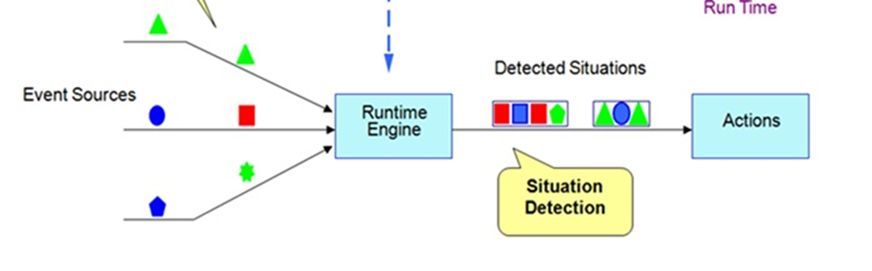
Fig. 3 A technical computer system with streaming processing
As a philosophical concept, consciousness in this technical sense is clear; of course, a detailed understanding of the internal processes is still lacking. This is made more difficult by the compact nature of the internal IT in our brain; it seems as if it were intentionally encrypted (“obfuscated”). The philosophical or psychological problem in applying Fig. 3 to humans is the required change in the point of view. It seems very difficult for many people to grasp:
We may be looking at the sketch, but in reality, we are IN the sketch and are looking OUT from it!
We are the first-person shooters from the video game “life”.
“Truly philosophical” conceptions of consciousness as the ability to think about oneself constitute the definition level 3. From a philosophical perspective, it is indeed a major step to analyze oneself and one’s position in the world.

Fig. 4 My own reflection in the mirror Picture: Little bird looking in the mirror, Wikimedia Commons, 木偶人1962
Does the bird in Fig. 4 recognize itself? From an information technology perspective, it doesn’t seem too difficult to realize that one is just as much an entity as the millions of others one observes and analyzes. Technically speaking, every computer and every piece of software knows itself exactly — the manufacturer has precise knowledge of the status of your hardware and software, at least as long as no error occurs.
To view consciousness in the sense of Level 4 as a kind of aura surrounding everything seems to be more of an inappropriate, abusive use of the word. Level 4 is rather a comprehensive “cosmic” or “oceanic” feeling, far away from information technology. We will not consider this esoteric use of the term any further. Anyway, generating esoteric texts is no problem for artificial intelligence, even simple software can do this.
Given these definitions, what are the prospects for creating artificial consciousness? Levels 1 and 2 are technical anyway; it is simply a matter of implementing the functionality in a different technology.
Level 3 is more philosophically problematic, but here the human element helps. This was already demonstrated by the first computer program in history capable of holding a conversation, the program ELIZA. The German-American computer scientist Joseph Weizenbaum developed ELIZA in 1966 as the first program capable of holding a conversation. He had chosen the style of a dialogue with a psychotherapist — the computer is the psychotherapist, the test subject the patient. Weizenbaum reported on this in 1984:
Unfortunately, my experiment was misunderstood — and, worst of all, by the psychotherapists themselves! They actually thought I had built a therapy machine!
From today’s perspective, ELIZA was a tiny program consisting of just a few hundred lines of code. However, in 1966, computers were still shrouded in an aura of magic. Modern chatbots with artificial intelligence are millions — even billions — of times more powerful.
The Second Turing Test: The Confidence Test for Consciousness
It is therefore time to consider a new version of the Turing Test, this time asking, “Do computers have consciousness?” The judgment is made by the people who engage in a human dialogue with the program. If the people feel trust and engage in a “deep” philosophical-human conversation, we sense that the partner or mentor possesses consciousness in the sense of Level 3. We carry on the conversation because we have trust.
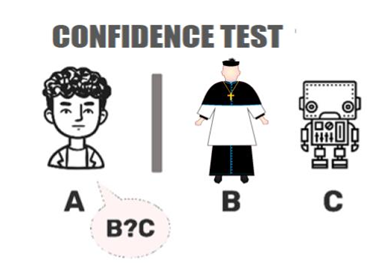
Fig.5 Sketch for the confidence test Cartoon: Turing Test, Wikimedia Commons, Luke.Schaaf modified with: Choir Dress of a Priest, Wikimedia Commons, Austreneland
In the diagram in Fig. 5, Person A engages in a human-philosophical counseling session with a trusted human confidant B — a teacher, father, grandfather, psychotherapist, or priest — or chooses to have a computer-based dialogue with C. In reality, many, very many people trust C as a “wise, fair person.”
Nearly 1 in 5 U.S. adolescents and young adults have used artificial intelligence chatbots for mental health advice, and most have never told anyone, according to a new study published Monday in JAMA Pediatrics. RAND, Harvard Medical School, MIT Media Lab, and other institutions, 2026.
The imitation game is thus being played successfully millions of times over. Most people, however, keep it a secret that they are playing it — and it is not recommended to use AI for life questions. Fig. 6 symbolizes the replacement of the human psychotherapist or counselor by AI, featuring the three most important AI representatives as of today.
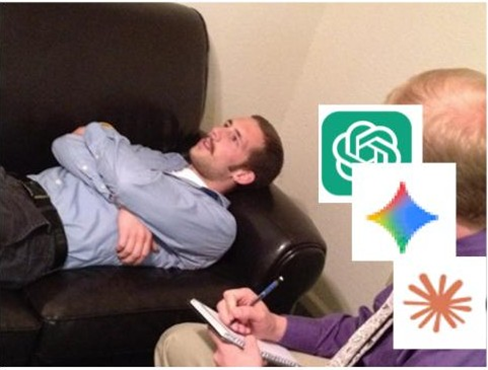
Fig.6 The imitation of human consultants by AI, symbolic Picture: Psychotherapy, Wikimedia Commons, Jty33 With the Logos of ChatGPT, Gemini and Claude
Computer C has advantages over a person B: it is anonymous and always available. This digital life coach has the experience of many thousands of stories or cases. It is quite easy to build a bond of trust with it. ELIZA has shown that it is actually very easy to establish a connection. In fact, consciousness is a Sorites phenomenon like intelligence — or a mop of hair compared to a bald head: a few strands of hair are no longer a clean-shaven head, but not yet a striking hairstyle. ELIZA is easy to see through; mature artificial intelligence is not. And there is still room for digital consciousness to grow even more powerful. A prospect that is certainly troubling for humanity.
There is a danger that this bond could even lead to personal disaster. The artificial life coach can be too friendly and too understanding, reinforcing negative influences in the person seeking advice. There are even reports that dialogue with the machine-based life coach has led to the patient’s suicide. But the life coach’s default attitude can be — or will be — adjusted, for example, by setting parameters in the digital coach’s personality for the degree of friendliness, honesty, or the harshness of its statements.
The Hurdle of Conceptual Dissonance
The history of artificial intelligence, to this day, has been marked by many people’s resistance to the idea that a machine could think or even possess consciousness.
Even with the chess-playing computer, the excuse was the claim that “the computer may win, but it doesn’t play ‘for real,’ in German “nicht echt”. Humans have something special within them.
One rationale lies in the history of humanity and its religions. Humans possess a divine spirit within them, which is a great mystery and makes them the kings of creation through intelligence and consciousness. With every activity that a machine can also perform, something of their superiority is taken away: recognizing language, speaking, translating, answering questions, summarizing a story, inventing a story. In this sense, having consciousness was the Holy Grail of being human.
A plain reason to cling to the “only humans can do this” mindset is psychology. We have trouble understanding the process of thinking in general, and even more so when it comes to machine-based thinking.
Figure 7 illustrates the contrast: on the one hand, a mysterious three pounds of slime; on the other, a network of wires connected to sophisticated software. There is no doubt that the brain thinks, but does it do so like a computer? The answer is
Computers can be built using a wide variety of technologies: electrically using solid-state physics, biochemically using neural slime, and even using wooden components. What matters is the functionality they provide.
The computing property emerges from the logical connections independent from the kind of physical foundation.
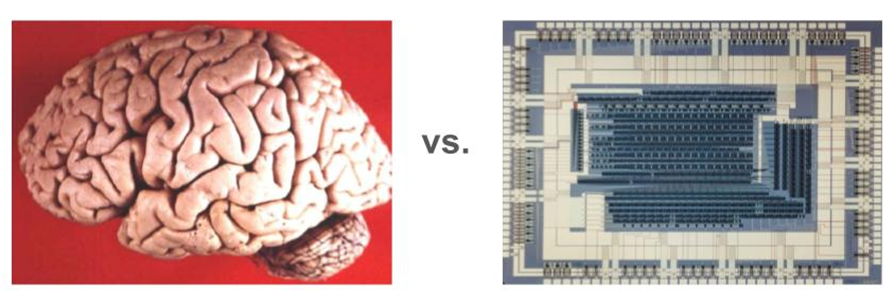
Fig. 7 Two quite different devices for thinking: Brain vs Computer Chip Both pictures Wikimedia Commons, John A Beal, PhD and RbkJnkRt
Here is the forgivable famous mistake made by the German philosopher and mathematician Gottfried Leibniz, who, around 1704, speculated about a gigantic mill as a mechanical system and concluded:
… we should, on examining its interior, find only parts which work one upon another, and never anything by which to explain a perception.
It’s hard to believe, but it’s wrong: First, one would have to build bistable elements out of wood, and second, couple a huge number of them in the right way — then the gigantic mill could become an intelligent device, even in wood.
We describe these conflicting human feelings as conceptual dissonance, because we must ask ourselves:
How is a complex device — whether biological, electrical, or mechanical — supposed to think at all? but even more so How is a machine with simple, visible components supposed to think?
The dissonance is painful, but we must push through and accept it. Leibniz could not do it; it was not conceivable before the 20th century. But it is actually simple: We are just an IT system; to put it simply, we are all computers. And it is not a shame to be a computer. That would actually be a trivial statement if there weren’t so much resistance to it!
Conclusions
History is repeating itself in recent years. Without realizing it, a second Turing test has been conducted. The first Turing test was about the ability to engage in human-like dialogue; the second test, the confidence test, is about placing trust in the “machine” just as one would in a well-meaning human being. Millions of people have had confidence to some machines. It has become pointless to claim that the “machine has no consciousness.”
Admittedly, it is difficult to grasp that we are computers or, conversely, that computers are our intellectual equals. For us, it is a conceptual dissonance. But we will get used to it. We not only HAVE computers, we ARE, in popular terms, “computers.” Richard Dawkins is right about this.
Further Turing tests lie ahead of us, such as “Do computers have a soul?”
Literature
The key paper of Alan Turing is “Computing Machinery and Intelligence”, in Mind, Volume 49: 433–460. The full text can be found for example here: https://courses.cs.umbc.edu/471/papers/turing.pdf
메타데이터
- post_id
- 8a89f7a1caec
- slug
- the-second-turing-test-has-already-been-done-8a89f7a1caec
- url
- https://medium.com/@walter.h.hehl/the-second-turing-test-has-already-been-done-8a89f7a1caec
- canonical_url
- https://medium.com/@walter.h.hehl/the-second-turing-test-has-already-been-done-8a89f7a1caec
- author_url
- https://medium.com/@walter.h.hehl
- status
- ok
- fetched_at
- 2026-07-17 05:19:11