The Hidden Cost of Watching Charts All Day
There was a time when I believed that the more, I watched the market, the better trader I would become.
The Hidden Cost of Watching Charts All Day
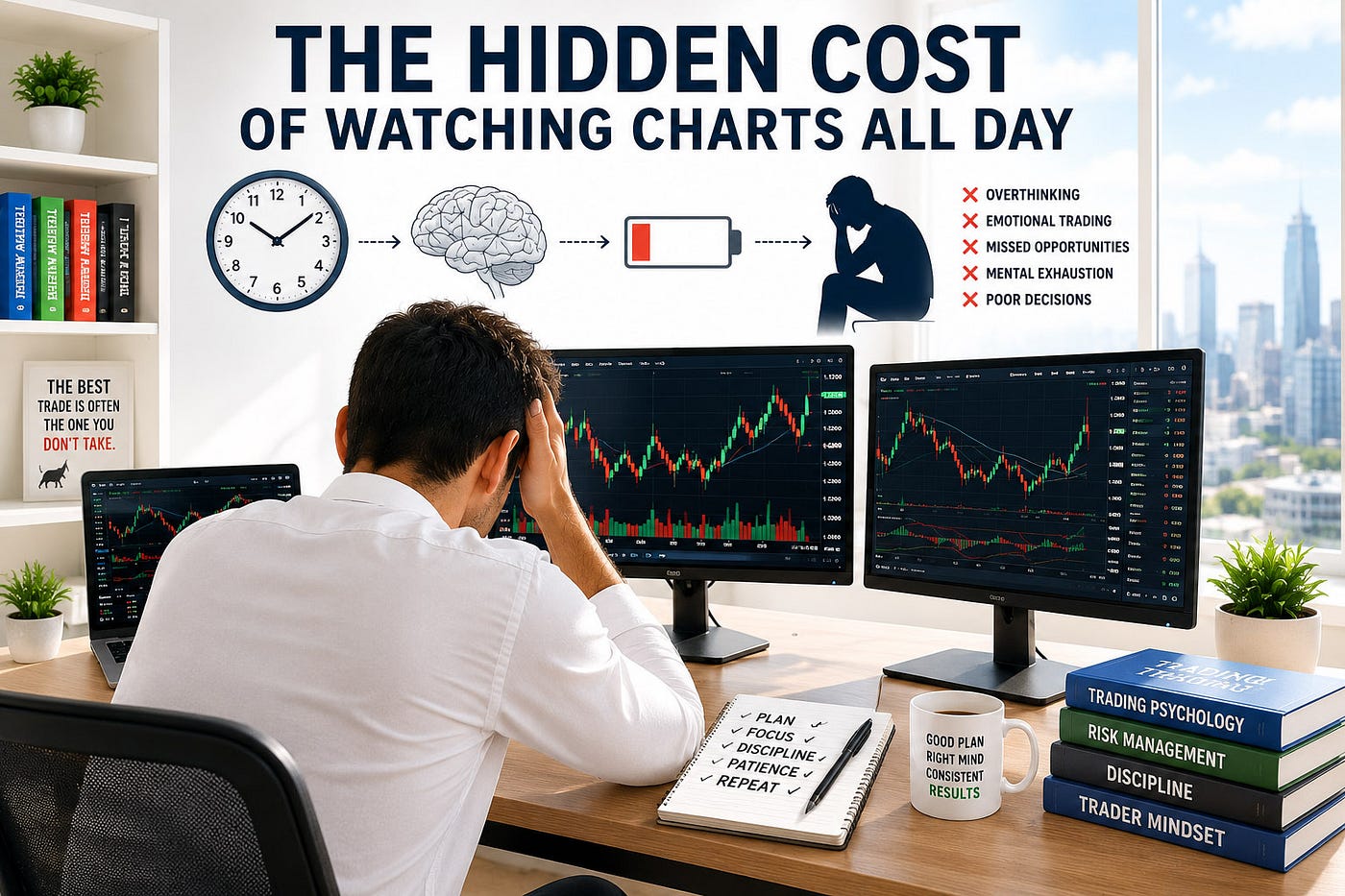
There was a time when I believed that the more, I watched the market, the better trader I would become.
I thought a serious trader should always be near the charts.
If the market was open, I wanted to be there.
If there was no setup, I still wanted to watch.
Maybe something would happen.
Maybe the next candle would give me a signal.
Maybe price would break a level.
Maybe there was a trade I was missing.
So I kept watching.
One chart became two.
Two became three.
Then I started changing timeframes, checking indicators, drawing new levels, removing old levels, checking the same price again and again.
I was not trading more professionally.
I was simply becoming more tired.
And slowly, I understood something that took me much longer to learn than it should have:
Watching the market all day does not make you a better trader. Sometimes, it makes you a worse one.
The market does not charge you money for every hour you watch it.
It charges you in something more difficult to notice:
your attention, your patience, your confidence, and eventually your decisions.
That is the hidden cost.
The Screen Can Create Problems That Were Not There Before
A trade can be simple when you look at the chart with a clear mind.
You have a setup.
Your conditions are met.
You enter.
You manage the trade.
You accept the result.
But when you sit in front of the chart for six or eight hours, something changes.
You start seeing things.
Too many things.
A small candle starts looking like a signal.
A tiny pullback suddenly looks like a reversal.
A random price movement starts looking like a breakout.
You begin asking questions that were not important before:
“Should I enter now?”
“Maybe the market is going to move.”
“Maybe I should take this small trade.”
“What if I miss it?”
And that last question is dangerous.
What if I miss it?
This is where watching charts turns into forcing trades.
I Learned That More Screen Time Does Not Mean More Opportunity
One of the biggest mistakes I made was confusing screen time with trading experience.
I thought that if I watched enough charts, I would understand the market better.
But the market does not reward the person who watches the longest.
It rewards the person who can recognize the right situation and stay out when the situation is wrong.
Think about it.
Suppose your strategy gives you only two good opportunities in a day.
You watch the market for ten hours.
What happens during the other eight hours?
Nothing.
But your brain does not like nothing.
It wants action.
So after watching price move up and down for hours, you may eventually feel that you have to do something.
You start looking for a reason to enter.
And this is where a good strategy can become a bad trading day.
Not because the strategy stopped working.
Because you stopped waiting for the strategy.
The First Hidden Cost: Overtrading
Overtrading does not always begin with greed.
Sometimes it begins with boredom.
This is something many traders do not talk about.
You sit in front of the chart.
You wait. — Nothing happens.
You wait another hour. — Still nothing.
Then price moves a little.
You suddenly feel that you are missing something.
You enter.
Maybe the trade works.
Maybe it does not.
If it loses, you tell yourself:
“Next one will be better.”
So you keep watching.
Then another setup appears.
But this time you are emotionally involved because you already lost money.
The second trade is no longer just a trade.
It becomes a chance to recover.
And now you are no longer following your plan.
You are reacting to the previous trade.
This is how a quiet trading day can slowly turn into a bad trading day.
The Second Hidden Cost: You Start Seeing Signals Everywhere
Charts are dangerous because they can explain almost anything after it happens.
Price goes up? — You can find a reason.
Price goes down? — You can find another reason.
Price rejects a level? — You call it confirmation.
Price breaks the level? — You call it momentum.
Price comes back? — You call it a fake breakout.
If you stare at a chart long enough, you can convince yourself that almost every movement has meaning.
But not every movement matters.
This is one of the most important lessons I have learned from trading.
A moving market does not automatically mean there is a trade.
Sometimes price is simply moving.
That is all.
The professional decision may be to do absolutely nothing.
The Third Hidden Cost: Your Patience Gets Destroyed
Patience sounds easy when you are away from the market.
Everyone says:
“Wait for the right setup.”
“Do not chase.”
“Follow your rules.”
But try sitting in front of a chart for five hours while waiting for one specific setup.
That is different.
The longer you watch, the harder waiting becomes.
Your brain starts saying:
“Come on, something should happen.”
And when nothing happens, you may lower your standards.
First, you wanted perfect conditions.
Then you accept good conditions.
Then average conditions.
And finally, you enter simply because you are tired of waiting.
That is not patience.
That is screen-time fatigue.
A Simple Example
Imagine a trader has one clear setup.
His rule is simple:
“If these conditions appear, I take the trade. If they do not appear, I stay out.”
At 9:00 AM, he opens his chart.
Nothing. — 10:00 AM.
Nothing. — 11:00 AM.
Still nothing. — 12:00 PM.
Price starts moving.
He watches every candle.
12:30 PM.
He sees a small breakout.
His setup is not complete.
But he thinks:
“Maybe this is the move.”
He enters.
Five minutes later, price comes back.
He exits with a loss.
Then the actual setup appears later.
But now his mind is different.
He is angry.
He wants his money back.
He enters again.
This time he is not trading the setup.
He is trading the emotional result of the previous decision.
The problem started hours earlier.
The first mistake was not the losing trade.
The first mistake was believing that because he was watching the market, he needed to participate in it.
The Fourth Hidden Cost: You Lose Trust in Your Own Strategy
This one is especially painful.
When you watch charts all day, you will see many situations where your strategy does not enter.
Then you see price move strongly without you.
You think:
“My strategy missed that.”
So you change something.
You add an indicator.
Change the EMA.
Change the timeframe.
Add another confirmation.
Change the entry rule.
Now the strategy becomes more complicated.
Then another move happens.
You miss it again.
So you change the strategy again.
After some time, you are no longer testing a strategy.
You are constantly modifying it because of what happened five minutes ago.
This destroys something more important than a trading setup:
trust.
A trader needs to know:
“This is my setup. If it comes, I take it. If it does not, I leave it.”
Without that clarity, every candle becomes a debate.
The Market Can Make You Feel Productive Without Making You Productive
This is another uncomfortable truth.
Watching charts feels like work.
You are sitting at the desk.
Candles are moving.
You are checking levels.
You are analyzing.
You are thinking.
It feels productive.
But activity is not the same as progress.
A trader can spend seven hours looking at charts and learn almost nothing.
Another trader can spend one focused hour reviewing five good setups and learn much more.
The difference is not screen time.
It is quality of attention.
What I Believe Now: Trade the Market, Don’t Watch the Market
I do not believe a trader needs to watch every candle.
I believe a trader needs to know when to watch and when to walk away.
There is a big difference.
If your strategy is based on a particular session, particular timeframe, particular setup and particular risk, then your job is not to monitor the market all day.
Your job is to be available when your conditions matter.
For example, if your setup is built around the 15-minute chart, you do not need to keep jumping between 1-minute, 5-minute, 15-minute, 1-hour and 4-hour charts every few minutes.
That often creates more confusion than clarity.
You need a process.
Something like:
Prepare → Wait → Identify → Enter → Manage → Record → Leave.
Simple.
Not exciting.
But trading is not supposed to entertain you.
Give Your Strategy a “No Trade” Condition
This changed the way I think about trading.
Most traders spend a lot of time defining when to enter.
Very few spend enough time defining when not to trade.
But “no trade” is also a decision.
If the setup is incomplete: — No trade.
If the market is moving without your conditions: — No trade.
If you are entering because you are bored: — No trade.
If you are entering because you missed the previous move: — No trade.
If you are trying to recover a loss: — No trade.
If you cannot clearly explain why you are entering: — No trade.
That last one is powerful.
If you cannot explain your trade in one or two simple sentences, you probably should not be taking it.
One More Thing I Learned: Missing a Trade Is Not Losing Money
This sounds obvious.
But emotionally, traders often treat a missed trade like a loss.
Price moves 30 pips without them and they feel terrible.
They say: — “I could have made 30 pips.”
No. — You did not lose 30 pips.
You missed an opportunity to potentially make 30 pips.
Those are not the same thing.
The difference matters.
Because when you treat a missed trade like a loss, you feel pressure to make the next trade.
And pressure is a terrible trading partner.
There will always be another chart.
Another session.
Another setup.
Another day.
The market does not owe you the move you missed.
What I Would Do Differently Today
If I could go back and give my earlier trading self one practical rule, it would be this:
Stop watching the market when there is nothing to trade.
I would define my trading window.
I would define my setup.
I would define my risk.
I would decide what conditions are required.
Then I would wait.
Not stare.
Not predict.
Not force.
Just wait.
And if nothing happens, I would close the chart without feeling guilty.
That is a skill too.
In fact, I think it is one of the most underrated skills in trading.
Knowing when to leave the screen.
The Real Cost of Watching Charts All Day
The cost is not just tired eyes.
It is not just a headache.
It is much deeper.
Too much screen time can slowly turn:
Patience into impatience.
Analysis into over-analysis.
Confidence into doubt.
Discipline into temptation.
A strategy into confusion.
And trading into emotional entertainment.
That is why I no longer believe that a trader should measure his seriousness by how many hours he spends looking at charts.
A serious trader is not the person who watches every candle.
A serious trader is the person who can watch the market without feeling the need to trade it.
That is a very different skill.
What Actually Deserves Your Time?
Instead of watching the market all day, spend more time doing things that improve your decision-making.
Review your previous trades.
Study your mistakes.
Read your trading rules.
Record why you entered.
Record why you exited.
Look at the trades you missed.
Ask yourself why you missed them.
Look at the trades you should not have taken.
Ask yourself what you were feeling before entering.
This type of work may feel less exciting than live trading.
But it builds something live charts cannot give you automatically:
self-awareness.
And self-awareness is a huge part of trading psychology.
A Trader Does Not Need More Charts. He Needs More Clarity.
This is probably the biggest lesson I have taken from my own experience.
When trading feels complicated, my first reaction used to be:
“Maybe I need more information.”
Now I ask:
“Maybe I already have enough information and just need to follow it better.”
That is a completely different mindset.
More indicators will not automatically create discipline.
More screen time will not automatically create patience.
More trades will not automatically create experience.
Sometimes the next improvement is not adding something.
Sometimes it is removing something.
Remove the unnecessary chart.
Remove the unnecessary indicator.
Remove the unnecessary trade.
Remove the need to be involved in every market move.
And you may finally see what was already in front of you.
The Trader I Am Still Becoming
I have learned that trading is not only about understanding the market.
It is also about understanding what the market does to you.
For me, that has been one of the hardest parts.
I have watched charts for too long.
I have waited for confirmation until the move was already gone.
I have overthought simple situations.
I have seen a move happen without me and felt that I had to catch the next one.
And I have learned that sometimes the best trading decision is the one nobody sees.
You do not enter.
You do not chase.
You do not revenge trade.
You simply close the chart.
That may not look impressive from the outside.
But inside, something important has happened.
You won the fight against yourself.
A Note from Me
I wrote Zero To Trader for the person I once was — the person who wanted to understand trading, make better decisions, and find a practical path from confusion to consistency.
The book is not about finding a magic strategy.
It is about learning the foundations, discipline, risk management and mindset that a trader needs before expecting consistent results.
Because over time, I have come to believe that becoming a trader is not simply about learning how the market moves.
It is about learning how you move when money is involved.
And that journey — from zero knowledge to becoming a more disciplined trader — is what Zero To Trader is about.
You Don’t Have to Catch Every Move
The market will move without you.
It moved before you opened your account.
It will move while you are sleeping.
It will move when you are away from your computer.
And it will move after you close your chart.
You cannot catch everything.
You were never supposed to.
The goal is not to be present for every candle.
The goal is to be present when your opportunity appears — and disciplined enough to stay away when it does not.
So the next time you find yourself staring at the charts for hours, ask yourself one simple question:
“Am I watching the market because my setup is coming — or because I am afraid of missing something?”
That question can save you more money than another indicator.
Because sometimes the best trade you can take..
is turning off the screen.
메타데이터
- post_id
- 8a8a9267c4d3
- slug
- the-hidden-cost-of-watching-charts-all-day-8a8a9267c4d3
- url
- https://medium.com/@traderstdl/the-hidden-cost-of-watching-charts-all-day-8a8a9267c4d3
- canonical_url
- https://medium.com/@traderstdl/the-hidden-cost-of-watching-charts-all-day-8a8a9267c4d3
- author_url
- https://medium.com/@traderstdl
- status
- ok
- fetched_at
- 2026-08-09 13:04:28




