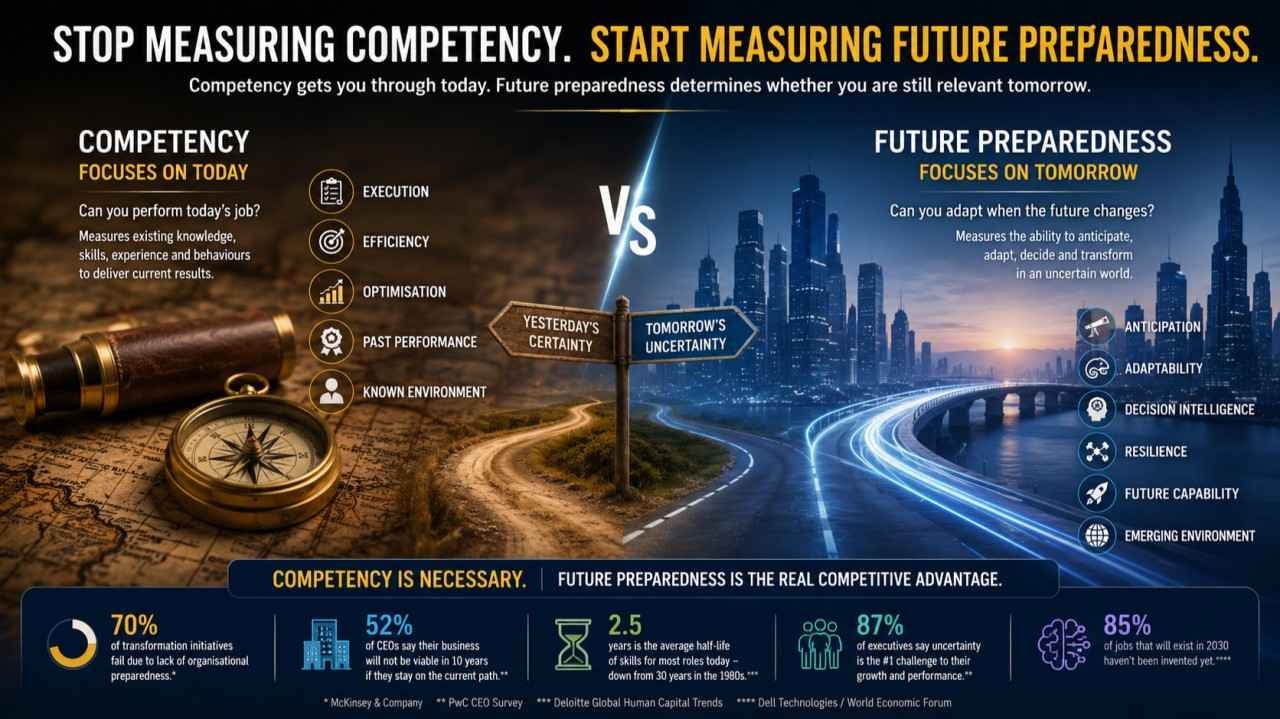
How We Design Human Capability for the Now, the Next, and the Nonlinear Future
For years, talent development was largely treated as a functional intervention.
How We Design Human Capability for the Now, the Next, and the Nonlinear Future

For years, talent development was largely treated as a functional intervention.
- A training need.
- A competency gap.
- A succession issue.
- A learning requirement.
- A performance concern.
That made sense when organisations operated in relatively stable systems.
- Roles were clearer.
- Markets moved slower.
- Leadership cycles were longer.
- Capability assumptions were more predictable.
That operating reality is changing faster than many talent systems were built to handle.
- AI acceleration is compressing decision windows.
- Behavioural drift is changing trust, engagement, and workforce expectations.
- Digital ecosystems are redefining collaboration and access.
- Geopolitical fragmentation is influencing supply chains, labour realities, and leadership priorities.
- Interconnected risks are amplifying second-order consequences across systems.
Yet many organisations still design capability as though the future will resemble the past.
That may now be one of the biggest strategic blind spots in leadership.
Why We Began Designing Capability Differently
Since 2023, as we strengthened this advisory work across clients globally, one pattern became increasingly clear.
Traditional talent development often improved activity.
It did not always strengthen capability under volatility.
Many organisations were building development around visible needs.
But increasingly struggling with invisible pressures.
- Decision fragility.
- Leadership fatigue.
- Trust erosion.
- Capability drift.
- Role misalignment.
- Reduced adaptability.
- Contextual blind spots.
That gap reshaped how we began designing Human Capability Architecture.
Not simply around training.
But around consequence.
Not just what people needed to learn.
But what organisations needed to preserve, strengthen, and redesign before pressure became visible.
1. We Read the Present Before It Becomes a Problem
Many organisations wait for visible breakdown.
- Declining performance.
- Weak succession depth.
- Capability gaps.
- Retention pressure.
- Leadership stress.
- Behavioural decline.
By then, intervention is often reactive.
Across our advisory work, one recurring pattern has remained consistent.
Weak signals often appear before organisational symptoms.
That is why we begin with present-state visibility.
- Learning velocity.
- Decision maturity.
- Behavioural drift.
- Leadership resilience.
- Cognitive adaptability.
- Trust patterns.
- Collaboration stress.
- Risk appetite.
- Role fragility.
- Capability depth.
This helps identify where capability pressure may be forming before performance visibly weakens.
2. We Extrapolate from the Now to the Future
Once present-state visibility is clearer, we ask:
If current patterns continue, what may emerge.
This is forward capability foresight.
We examine:
- What leadership assumptions may weaken.
- Which roles may become structurally fragile.
- What capability gaps may become strategic risk.
- Where decision quality may decline.
- What human strengths must remain protected.
This strengthens anticipation.
It reduces blind spots.
It improves continuity.
3. We Extrapolate from the Future Back to the Now
This is where stronger advisory becomes more valuable than traditional development logic.
We work across:
Probable Futures What is most likely if current trajectories continue.
Plausible Futures What may realistically emerge through weak signals, structural drift, and interconnected risk.
Possible Futures What could emerge through disruption, discontinuity, AI acceleration, or nonlinear pressure.
Then we ask a harder question.
If this future emerges, what must strengthen now.
- If trust weakens, what relational capability becomes critical.
- If AI expands, what must remain deeply human.
- If decision windows shrink, what judgment must deepen.
- If volatility rises, what resilience must already exist.
- If ecosystems become fluid, what leadership architecture must evolve.
This is reverse capability foresight.
Not reacting after disruption becomes visible.
But redesigning before structural weakness appears.
That is where capability asymmetry begins.
4. We Design Beyond Skill
Many organisations still over-focus on narrow development language.
- Upskilling.
- Reskilling.
- Competency mapping.
- Annual learning hours.
These remain useful.
But increasingly insufficient.
Why.
Because many of these models were built for slower environments, clearer roles, and relatively stable assumptions.
Today, volatility is different.
- A highly skilled leader may still fail under ambiguity.
- A digitally trained workforce may still struggle with judgment.
- A technically advanced team may still weaken under trust erosion or systemic pressure.
The issue is no longer only skill.
It is capability depth.
That is why our work increasingly focuses on:
- Judgment under uncertainty.
- Adaptability.
- Cognitive resilience.
- Systems thinking.
- Decision quality.
- Trust maturity.
- Ethical discernment.
- Contextual intelligence.
- Relational depth.
This is where Human Capability Architecture becomes stronger than competency logic.
5. We Build for Context, Not Generic Models
No two organisations operate under the same pressure.
Capability cannot be designed in abstraction.
It must be contextualised to:
- Industry exposure.
- Leadership maturity.
- Strategic risk.
- Workforce behaviour.
- Technology pressure.
- Operating complexity.
- Regulatory realities.
- Future-state conditions.
This is where many generic frameworks begin to fail.
Because context shapes consequence.
6. We Measure Transfer, Not Attendance
Many organisations still measure development by activity.
- Courses. Hours.
- Certifications.
- Completion rates.
These can show participation.
They do not always show stronger capability.
Capability is rarely built through attendance alone.
It is strengthened through:
- Application.
- Reflection.
- Simulation.
- Scenario exposure.
- Decision-making under pressure.
- Feedback loops.
- Behavioural reinforcement.
That is where capability transfer becomes visible.
What Science, Markets, and Reality Are Already Showing
This is no longer conceptual.
It is increasingly reinforced by evidence.
World Economic Forum continues to identify analytical thinking, resilience, flexibility, systems thinking, curiosity, and AI-related capability as rising workforce priorities.
McKinsey & Company has repeatedly shown that long-term oriented organisations often outperform peers in resilience, growth, and strategic adaptability.
Amy Edmondson demonstrated how psychological safety improves learning, adaptation, and performance.
Daniel Kahneman showed how leaders often over-rely on recency and linear assumptions.
Gary Klein demonstrated that judgment improves when leaders mentally simulate future-state conditions before acting under uncertainty.
Across our advisory engagements, one pattern has remained clear.
Organisations that redesign capability around judgment, adaptability, context, and resilience often identify fragility earlier than those relying only on competency-led systems.
That directly affects:
- Decision quality.
- Succession depth.
- Strategic resilience.
- Execution continuity.
- Trust maturity.
- Long-term competitiveness.
The Real Strategic Shift
Human Capability Architecture is no longer only a people issue.
It is a strategic issue.
Most organisations still develop talent for the roles they currently have.
Stronger organisations will begin designing human capability for the futures they may face.
That is where the next competitive asymmetry may emerge.
Because the future may not belong to organisations that simply train faster.
It may belong to those that can read fragility earlier, strengthen judgment deeper, and redesign capability before volatility becomes structural weakness.
The question is no longer only what people need to learn. It is what human capability must remain deeply strong when the future becomes increasingly nonlinear.
메타데이터
- post_id
- 8a8db2d7ceed
- slug
- how-we-design-human-capability-for-the-now-the-next-and-the-nonlinear-future-8a8db2d7ceed
- url
- https://medium.com/@vsravi28/how-we-design-human-capability-for-the-now-the-next-and-the-nonlinear-future-8a8db2d7ceed
- canonical_url
- https://medium.com/@vsravi28/how-we-design-human-capability-for-the-now-the-next-and-the-nonlinear-future-8a8db2d7ceed
- author_url
- https://medium.com/@vsravi28
- status
- ok
- fetched_at
- 2026-07-10 22:07:19