The Issos Mosaic
Reading the masterpiece of Philoxenus of Eretria
The Issos Mosaic
Reading the masterpiece of Philoxenus of Eretria

‘The Issos Mosaic’ (c. 325 BC) by Philoxenus of Eretria. Mosaic. 272 x 513 cm. National Archaeological Museum of Naples. Image source Wikpedia
Could this mosaic be the best-known artistic icon of Antiquity?
Now, that it is the best-known icon is debatable, but what is not debatable is that it is an image that is already part of our society’s collective memory. That Alexander the Great controls his horse, indeed raised on its hind legs in a powerful position (we do not know for sure because the rest of the animal’s body is missing), with the face of the Macedonian conqueror in profile. Pronounced nose, vigorous eyes. Unforgettable.

Detail of ‘The Issos Mosaic’ (c. 325 BC) by Philoxenus of Eretria. Mosaic. 272 x 513 cm. National Archaeological Museum of Naples. Image source Wikpedia
And it is not even an original work of art.
It turns out that the famous Mosaic of Issos (his name), which was found in Pompeii, is a copy from Roman times (around the 1st century B.C.).
Do we know whose original it was? There are two theories. In the first one, it is said that the mosaic copies a painting that the artist Apelles painted when Alexander was still alive. The other theory believes that the original piece was a fresco by the painter Philoxenus of Eretria, who in the 4th century B.C. worked on the decoration of the royal palace.
What is going on in this mosaic?
We see the battle of Issos, one of the high points of the military history of the Macedonian conqueror. Specifically, the scene recounts the moment when the Alexandrian troops (with Alexander himself at the head) stalk the Persian king Darius III. He takes refuge behind his men and ends up abandoning the battle. Thus began a game of cat and mouse throughout the Middle East, ending with Darius’ troops killing him, tired of so much senseless flight.
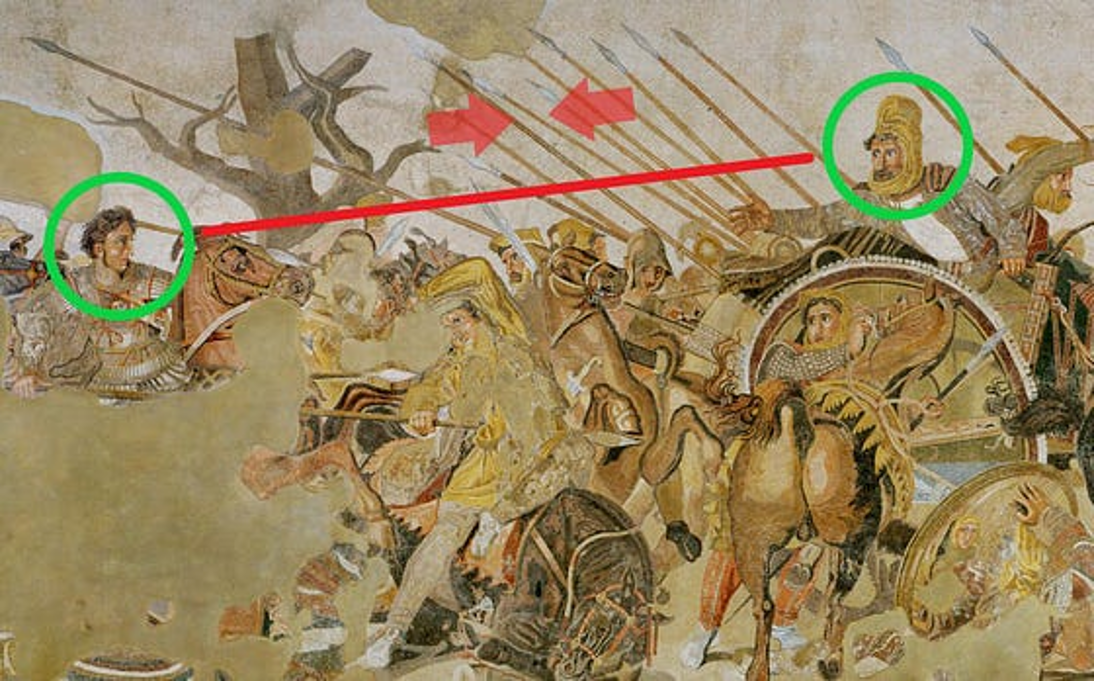
We can clearly distinguish Alexander and Darius in the mosaic, tending to the center but dividing the composition into two sides. The two leaders see each other, cross their gazes, and it could be said that the Persian king is one of haste. At the same time, that of the Macedonian is full of decision and security; undoubtedly a psychological plane recreated on purpose since we already know how the contest ended.
There are more than 50 autonomous figures in the battle, which shows the complexity of the piece and the richness of what we can find in it. The two commanders of the armies are placed in front and are easy to recognize, making the scene interpretation effortless.
Alexander rides his horse, called Bucephalus, while shown in profile. He makes it easy to enhance his most characteristic features: his nose and curly hair are complemented by a vigorous and determined look. Although we cannot see the figure entirely, it is possible to observe that the Macedonian carries a spear in his right hand and uses it to attack and try to approach Darius.
Although he always wore a helmet in battle, it is not shown in the mosaic so that Alexander’s face appears clearly. Another interesting detail is the representation of the gorgon Medusa on the pectoral area of his breastplate.

For his part, the Persian king Darius is on top of his chariot, which is easily seen. He seems to be giving orders hurriedly while behind him, the charioteer uses his whip to spur the horses.
In contrast to Alexander, who seems calm and majestic, the Persian is desperate, and all around him is chaos.
He extends his right hand in a gesture that has several interpretations: a plea to his opponent, some directive to his army, or some movement within the battle.

We can also observe Oxiartes, Darius’s brother and on his right, die pierced by Alexander’s spear. A sacrifice to save the life of his king.
Perhaps another aspect that may be surprising is the use of depth in pieces of art from antiquity.
It is a battle: dynamism (the diagonal spears) and violent clashes (the intersecting spears). There are men whose faces face each other. Some are hidden in the crowd, as are the horses. The use of diagonal and intersecting spears has two consequences: it gives mass to the whole background and increases the scene’s realism.
The whole rear part of the scene is represented at a smaller size than the two protagonists of the mosaic; this contrast of lengths gives a surprising sensation of depth. A use of the dimension never seen in ancient art, and that probably was more common than you might think in pictorial pieces; unfortunately, we have only a few examples preserved in our days.

While the bloody battle rages in the background, in the foreground, time seems to stand still in the human drama.
If we go into more detail and forget for a moment about the protagonist couple, we can see fallen horses and anonymous Persian soldiers who see their death reflected in the gleam of the shields.

Detail of ‘The Issos Mosaic’ (c. 325 BC) by Philoxenus of Eretria. Mosaic. 272 x 513 cm. National Archaeological Museum of Naples. Image source Wikpedia
Observing the detail with which the dying soldier can be appreciated is shocking. The shield’s reflection shows a face that has accepted death but cannot help but feel great sorrow. How he rests his right hand adds to that small drama in an already terrible battle.
Fact for curious people: there is a recreation (yes, “a copy of the copy”) installed in the House of the Faun in Pompeii, where the Roman mosaic was found; it is made of clay, and trying that each piece is in the same place. Although it is difficult to assess without being able to see it live, it is often said that: It is impossible to imitate Voltaire without being Voltaire.
And in this case, it would be a triple Voltaire.
Thanks for reading!
Love this story? Buy Alejandro a coffee and show your appreciation for his writings.
I will be eternally grateful to you.
And don’t forget to subscribe to Counter Arts, an essential publication for art lovers in all its expressions!
메타데이터
- post_id
- 8aa7a049f281
- slug
- the-issos-mosaic-8aa7a049f281
- url
- https://medium.com/counterarts/the-issos-mosaic-8aa7a049f281
- canonical_url
- https://medium.com/counterarts/the-issos-mosaic-8aa7a049f281
- author_url
- https://medium.com/@alejandro.orradre
- status
- ok
- fetched_at
- 2026-07-08 20:12:56