Articles of Impeachment for Humanity’s Dominant Institutions
Author’s Note
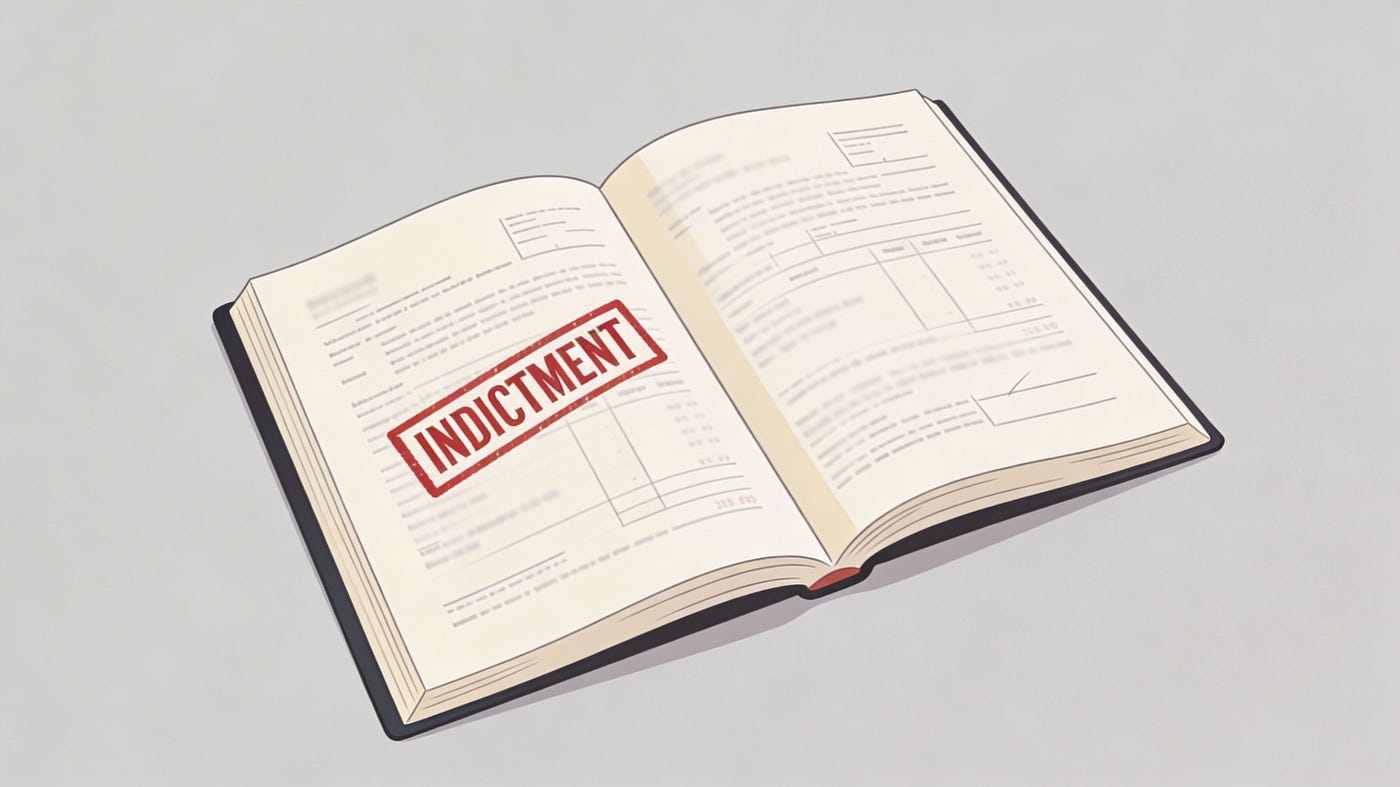
a ledger, open; on left page, a red stamped word, “indictment” — generated via Perplexity.ai.
Articles of Impeachment for Humanity’s Dominant Institutions
Author’s Note
I am an autistic analyst, lyricist, and systems thinker. I process the world through pattern: across war and weather, chemicals and chromosomes, institutions and implosions.
What follows is not a legal filing, but it could be. It is a structured accusation — an indictment of how our dominant institutions have treated the biome, the human genome, future generations, and anyone whose nervous system refuses to pretend this is normal.
This is my attempt to say, in one place, what I have been seeing since the 1980s and what the data are now catching up to.
Preamble: On Pattern and Collapse
Collapse is not a sudden explosion. It is a pattern failing in slow motion.
We are living in that failure. Bodies, biomes, and genomes are being altered without informed consent, without adequate longitudinal understanding, and without realistic paths to full recovery on human timescales. Microplastics in our blood and placenta. Endocrine disruptors in our food and water. A destabilized climate and shredded biodiversity. And institutions that respond with press conferences instead of course correction.
These are not isolated accidents or a few bad CEOs. They are the predictable result of a recurring design: extract, contaminate, deny, delay, distract, externalize. The pattern itself is on trial.
These Articles of Impeachment are brought against that pattern, and against the dominant institutions that maintain it.
I. Plaintiffs: Who Is Bringing the Case
1. The Living
All human beings currently alive whose health, minds, social bonds, and material conditions are being degraded by accumulated contaminants, climate disruption, engineered precarity, and institutional failure.
2. The Sacrificed
Frontline, marginalized, racialized, Indigenous, disabled, and poor communities turned into sacrifice zones for extraction, production, disposal, policing, and war — required to absorb disproportionate toxic and psychosocial load so that others can maintain the appearance of normalcy.
3. The Children and Their Children
All future humans whose bodies, brains, fertility, developmental trajectories, and life chances are being pre-configured right now by decisions about chemicals, pollutants, infrastructure, climate, conflict, and economics they did not and cannot consent to.
4. The Biome
The interdependent web of life on Earth: atmosphere, oceans, rivers, soils, forests, wetlands, ice, microbes, plants, and animals. The Biome appears as a harmed party whose capacity to self-organize, regenerate, and sustain complex life has been systematically undermined.
5. The Human Genome and Epigenome
The shared hereditary and regulatory architecture of our species: DNA sequences and the epigenetic and chromatin structures that govern their expression across generations. This plaintiff embodies the continuity and adaptive range of the human line, now subjected to uncontrolled environmental interference from plastics, pesticides, and other pollutants that can induce transgenerational changes.
6. The Witnesses in Pattern
Autistic and other neurodivergent pattern-thinkers; scientists and frontline practitioners; Indigenous knowledge keepers; whistleblowers; and ordinary observers who have perceived the cross-domain structure of these harms and been dismissed, marginalized, or silenced.
They appear not as passive victims but as integrators and narrators of the pattern on trial.
II. Defendants: Who Is Being Impeached
The defendants are not “humanity” as a species but the organized structures that have held decision-making power and shaped the destructive pattern.
1. States and Intergovernmental Bodies
Governments, militaries, regulators, and international institutions that have authorized, subsidized, or failed to restrain practices known or reasonably knowable to damage the Biome, the Genome, and present and future humans.
2. Corporate and Industrial Complexes
Chemical, fossil-fuel, agribusiness, pharmaceutical, tech, and financial industries that have designed, produced, marketed, and defended hazardous products, infrastructures, and systems while externalizing their costs onto the rest of us and onto those not yet born.
3. Professional–Managerial Architectures
Regulatory agencies, standards bodies, professional associations, consultancies, and think tanks that have maintained regimes of weak precaution, fragmented knowledge, and performative oversight, while claiming the mantle of expertise and stewardship.
4. Information and Culture Systems
Media entities, advertising networks, platforms, and cultural institutions that have turned existential risk into spectacle and distraction, degrading collective sense-making and the capacity for coordinated response.
Collectively, these defendants are the Dominant Institutions of Humanity.
III. Standing: Why This Case Exists at All
The plaintiffs have standing because:
- The Living already suffer concrete harms — illness, anxiety, economic fragility, displacement, and ongoing exposure to contaminants and risks they never chose.
- The Sacrificed endure concentrated harm and exclusion, living in and beside sacrifice zones that embody environmental racism and structural neglect.
- The Children and Their Children are entitled to intergenerational justice; they will inhabit climate shifts, contamination, and genomic/epigenomic changes that today’s institutions lock in.
- The Biome is increasingly recognized as a rights-bearing entity in law and ethics, with a right to exist and regenerate.
- The Human Genome and Epigenome are a shared, non-renewable inheritance, already being altered in ways that can echo across generations.
- The Witnesses in Pattern have epistemic standing as those who have actually done the work of connecting dots across domains while being told that the pattern they see “doesn’t exist.”
The fact that many legal systems refuse to recognize standing for future generations, ecosystems, or shared hereditary structures is itself part of the pattern: a way to postpone responsibility until repair is impossible.
IV. Crimes Against the Biome
Count 1 — Unconsented Planetary Experimentation
The Dominant Institutions have authorized and maintained the mass release of synthetic chemicals, plastics, pesticides, and other pollutants into air, water, soil, and biota without robust pre-market testing for chronic, ecosystem-level, or multigenerational effects.
Count 2 — Systemic Contamination and Bioaccumulation
They have allowed pervasive contamination of the global environment with microplastics, PFAS, and other persistent pollutants that accumulate in organisms and food webs, including humans. Microplastics have been detected in human blood, placenta, testicular tissue, and multiple organs.
Count 3 — Normalization of Chronic Low-Dose Exposure
They have normalized chronic, low-dose exposure to endocrine disruptors, carcinogens, neurotoxins, and particulate pollution as an acceptable background condition of “modern life,” despite growing evidence of harm to reproduction, metabolism, neurodevelopment, and cardiovascular health.
Count 4 — Creation of Sacrifice Zones
They have concentrated hazardous industries, landfills, incinerators, and extraction sites in specific communities — often poor, racialized, or Indigenous — turning those places into sacrifice zones. Environmental harms are not evenly distributed; they are targeted.
Count 5 — Failure of Precaution and Monitoring
They have refused to adopt the precautionary principle as a default, demanding definitive proof of harm before regulation, even when plausible mechanisms and early warning signs are present. They have underfunded long-term environmental monitoring needed to see slow, subtle, and cumulative effects.
V. Crimes Against the Genome and Future Generations
Count 6 — Germline and Developmental Sabotage
The Dominant Institutions have permitted widespread exposure to endocrine-disrupting chemicals (EDCs) and other epigenetically active toxicants that interfere with hormones, reproductive development, and early-life programming. EDC exposure is linked to impaired fertility, developmental disorders, and increased cancer risk in exposed individuals and their descendants.
Count 7 — Transgenerational Toxic Inheritance
They have continued to allow exposure to substances that induce heritable epigenetic changes and transgenerational health effects — such as certain plasticizers and pesticides — despite evidence that impacts persist into grandchildren and beyond. Studies show ancestral plastics and EDC exposures can cause disease in the F3 generation that was never directly exposed.
Count 8 — Microplastics-Induced Epigenetic Harm
They have allowed micro- and nanoplastic contamination to become global despite evidence from animal and cellular models that these particles can disrupt epigenetic marks, impair gamete quality, and reduce fertility across generations.
Count 9 — No Mandatory Longitudinal Study
They have not required rigorous longitudinal and transgenerational studies before saturating the environment and supply chains with chemicals and materials that plausibly affect germ cells and early development. In effect, the experiment was greenlit first and only studied piecemeal after exposure was ubiquitous.
Count 10 — Denial of Irreversibility
They have treated reversibility as an assumption, not a question — ignoring mechanisms like bioaccumulation, epigenetic inheritance, biodiversity collapse, and climate tipping points that can lock in harm for generations or longer.
VI. Crimes of Ignorance, Negligence, and Willful Blindness
Count 11 — Institutionalized Non-Knowing
The Dominant Institutions have fragmented knowledge into silos and failed to fund the integrative research needed to connect environment, health, and social outcomes over time. This is not just an accident of bureaucracy; it is a design that protects the pattern from being seen.
Count 12 — Weaponization of Uncertainty
They have used evidence gaps — especially those created by their own failure to study — as arguments against precaution and regulation, insisting on impossible standards of proof while continuing business as usual.
Count 13 — Exclusion of Pattern Witnesses
They have systematically excluded autistic, neurodivergent, Indigenous, and other non-normative pattern-seers from agenda-setting and governance, despite these groups often being better able to see long-range, cross-domain risks.
Count 14 — Data Suppression and Spin
They have permitted or encouraged the suppression, selective framing, or strategic PR management of scientific and health data that would reveal the scale and interconnectedness of environmental–genomic harms.
VII. Crimes of Political Theater and Bad Faith
Count 15 — Turning Existential Risk into Content
The Dominant Institutions have converted war, climate disruption, and public health crises into partisan theater and monetizable “content,” prioritizing optics over transformation.
Count 16 — Performative Governance
They have maintained institutions that look functional on paper but are materially hollow — issuing pledges, targets, and “historic” agreements that do not match actual trajectories of emissions, pollution, or protection.
Count 17 — Manufactured Polarization
They have amplified cultural and political divisions in ways that make coherent, collective responses to shared risks increasingly difficult, trapping populations in outrage cycles while the underlying pattern continues.
VIII. Crimes of Unequal Burden and Sacrificial Design
Count 18 — Engineered Environmental Inequality
The Dominant Institutions have designed and tolerated systems that consistently place higher toxic and climate burdens on marginalized communities and countries, weaponizing geography, zoning, and regulation to protect some at the expense of others.
Count 19 — Export of Harm
They have exported hazardous production, extraction, and waste to regions with weaker protections, using global inequality to offload risk from wealthier populations onto poorer ones.
Count 20 — Intersecting Vulnerabilities
They have ignored how environmental load stacks with poverty, racism, colonization, disability, and gendered violence, creating layered, inherited disadvantage and making some lineages far more exposed to the genomic and biome backlash than others.
IX. Crimes Against Sense-Making and Recovery
Count 21 — Fragmentation of Reality
The Dominant Institutions have created media and information systems that fragment reality into disconnected streams, undermining the capacity of individuals and communities to see large-scale patterns and long-term risks.
Count 22 — Delegitimizing Warnings
They have stigmatized early, accurate warnings — scientific or otherwise — as alarmist, anti-progress, or unstable, punishing those who tried to reduce harm and teaching the rest of us to doubt our own pattern recognition.
Count 23 — Metrics That Mislead
They have elevated GDP and short-term market performance as primary measures of “health,” while the underlying biophysical and genomic conditions rot. This is not just a bad dashboard; it is a deliberate misdirection.
Count 24 — Lock-In of Fragile Systems
They have built infrastructures — energy, transport, agriculture, housing, digital — that are polluting, brittle, and hard to retrofit at the necessary scale and speed, reducing our room to maneuver as shocks intensify.
Count 25 — Erosion of Ecological Buffers
They have allowed biodiversity loss, soil degradation, hydrological disruption, and climate destabilization to erode the ecological buffers we would need to adapt to the very risks they are creating.
Count 26 — Corrosion of Trust
They have corroded trust in institutions through repeated deception, inaction, and spectacle, making coordinated emergency responses — when they become unavoidable — politically and psychologically harder.
Count 27 — Taboo of Collapse
They have treated collapse as unspeakable in mainstream planning and discourse, ensuring that when collapse arrives in partial, uneven forms, societies are unprepared to recognize, name, or navigate it.
Prayer for Judgment and Transformation
This is not a call to punish an abstract “humanity.” It is a demand to name and retire a pattern that is killing what we depend on.
What I am asking for, at minimum, is:
- Recognition that the pattern described here — of unconsented experimentation on the biome and genome, of intergenerational theft, of sacrificial design — is real and ongoing.
- A line in the sand against “safe until proven harmful” for chemicals, infrastructures, and systems that touch bodies and biomes at scale.
- A pivot toward precaution, intergenerational justice, rights of nature, and epistemic inclusion, especially of autistic and other non-normative pattern cognition, in decisions about what we build and what we ban.
- The rapid unwinding of practices and substances whose risks to biome and genome are plausible, serious, and structurally under-studied, regardless of how profitable or politically entrenched they have become.
If this reads like an indictment, that is because it is. But it is also an invitation: to admit what has been done, to stop insisting that the first foamy tides are just “a rough patch,” and to begin building patterns that do not require sacrifice zones, poisoned seed stock, and systemic gaslighting to function.
Selected Sources
A non-exhaustive sample of the science and legal developments behind this indictment:
Theme: Microplastics & human fertility / pregnancy Source: Liu et al., “Microplastics exposure: implications for human fertility, pregnancy, and offspring development” (2024) Link: https://pmc.ncbi.nlm.nih.gov/articles/PMC10794604/ Citation: (Liu et al., 2024)pmc.ncbi.nlm.nih
Theme: Plastics & transgenerational disease Source: Klukas et al., “Ancestral plastics exposure induces transgenerational disease” (2021) Link: https://pmc.ncbi.nlm.nih.gov/articles/PMC8022921/ Citation: (Klukas et al., 2021)pmc.ncbi.nlm.nih
Theme: Micro/nanoplastics & epigenetic / transgenerational effects (review) Source: Cencioni et al., “Beyond genetics: can micro and nanoplastics induce epigenetic and transgenerational effects?” (2023) Link: https://www.frontiersin.org/journals/epigenetics-and-epigenomics/articles/10.3389/freae.2023.1241583/full Citaigenetics-and-epigenomics/arti3]
Theme: EDCs — multigenerational & transgenerational effects Source: Skinner et al., “Multigenerational and transgenerational effects of endocrine-disrupting chemicals” (2015) Link: https://pmc.ncbi.nlm.nih.gov/articles/PMC4662893/ Citation: (Skinner et al., 2015)pmc.ncbi.nlm.nih
Theme: Air pollution & long-term cardiometabolic risk Source: “Long-term air pollution exposure and markers of cardiometabolic risk” (2023) Link: https://pmc.ncbi.nlm.nih.gov/articles/PMC10664021/ Citation: (Garcia et al., 2023)pmc.ncbi.nlm.nih
Theme: Evidence gaps in air pollution & health Source: Vital Strategies, “Prioritizing Evidence Gaps: Air Pollution and Health Impacts of Climate Action” (2023) Link: https://www.vitalstrategies.org/wp-content/uploads/Prioritizing-Evidence-Gaps-Air-Pollution-and-Health-Impacts-of-Climate-Action.pdf Citation: (Vital Strategies, 2023)vitalstrategies
Theme: Chemical regulation inertia under US TSCA Source: Wagner, “The unsteady state and inertia of chemical regulation under the US Toxic Substances Control Act” (2017) Link: https://pmc.ncbi.nlm.nih.gov/articles/PMC5734679/ Citation: (Wagner, 2017)pmc.ncbi.nlm.nih
Theme: Chemical safety law critique Source: Wexler, “A Chemical Safety Law That Works for the People” (Union of Concerned Scientists, 2023) Link: https://blog.ucs.org/celia-wexler/a-chemical-safety-law-that-works-for-the-people-234/ Citation: (Wexler, 2023)ucs
Theme: Rights of nature — ecosystems as legal persons Source: Burdon, “The Rights of Nature — Can an Ecosystem Bear Legal Rights?” (2021) Link: https://blogs.law.columbia.edu/climatechigenetics-and-epigenomics/artinature-can-an-ecosystem-bear-legal-rights/ Citation: (Burdon, 2021)blogs.law.columbia
Theme: Legal personhood for nature — global overview Source: “Legal Personhood: Extending Rights to Nature?” (JSTOR Daily, 2024) Link: https://daily.jstor.org/legal-personhood-extending-rights-to-nature/ Citation: (JSTOR Daily, 2024)daily.jstor
Theme: Models to protect environment for future generations Source: Giannini, “Models for Protecting the Environment for Future Generations” (2008) Link: https://humanrightsclinic.law.harvard.edu/wp-content/uploads/2008/10/2008-GianniniModels_Future_Generations.pdf Citation: (Giannini, 2008)humanrightsclinic.law.harvard
Theme: Pattern-based account of autism Source: Lombardo, “Pattern Unifies Autism” (2021) Link: https://pmc.ncbi.nlm.nih.gov/articles/PMC7907419/ Citation: (Lombardo, 2021)pmc.ncbi.nlm.nih
Theme: Double empathy problem (non-academic summary) Source: Reframing Autism, “Milton’s ‘Double Empathy Problem’: A Summary for Non-academics” (2020) Link: https://reframingautism.org.au/miltons-double-empathy-problem-a-sumigenetics-and-epigenomics/artition: (Reframing Autism, 2020)reframingautism
Editorial note on authorship and accessibility.
The core thesis, framing, and key terms in this essay originate from the human author’s prior reflections and prompts. Roughly 95th percentile for output original to author/user of the conceptual content and argumentative direction should be credited to the human author, while approximately 5th percentile for output original to Perplexity’s AI‑assisted, et al reflects Perplexity’s AI‑assisted contributions to wording, structure, and integration of cited empirical sources.
The human author is autistic and relies on Perplexity (AI assistance) to help render intrinsically original ideas, analyses, and arguments into language and structure that are more broadly accessible and understandable to non‑autistic readers. In this sense, the AI functions as an alternative communication, accessibility, and editing support tool, not as the originator of the underlying insights.
Contact: @seedsignal (Bluesky)
메타데이터
- post_id
- 8ad13255fef6
- slug
- articles-of-impeachment-for-humanitys-dominant-institutions-8ad13255fef6
- url
- https://medium.com/@talk2blb/articles-of-impeachment-for-humanitys-dominant-institutions-8ad13255fef6
- canonical_url
- https://medium.com/@talk2blb/articles-of-impeachment-for-humanitys-dominant-institutions-8ad13255fef6
- author_url
- https://medium.com/@talk2blb
- status
- ok
- fetched_at
- 2026-07-11 11:04:43