Beyond the Rearview Mirror: The Critical Role of External Parameters in Modern Demand Forecasting
Imagine driving a vehicle down a winding mountain highway while staring exclusively out of your rearview mirror. If the road is perfectly…
Beyond the Rearview Mirror: The Critical Role of External Parameters in Modern Demand Forecasting
Demand Forecasting
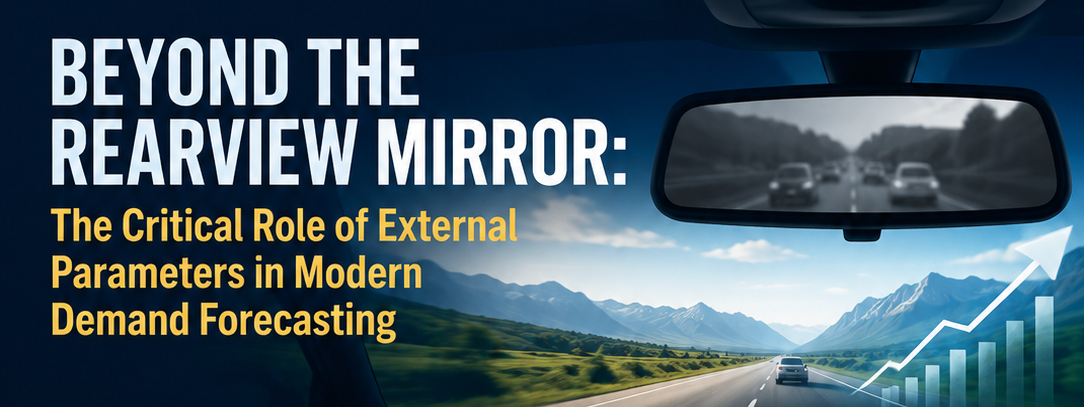
Imagine driving a vehicle down a winding mountain highway while staring exclusively out of your rearview mirror. If the road is perfectly straight, you might survive for a mile or two. But the moment a sharp turn, an unexpected pothole, or a sudden storm hits, a crash is inevitable.
This is exactly what businesses do when they rely solely on historical data to forecast future demand.
Looking at past sales to predict future performance is called univariate time-series forecasting. While it is a foundational starting point, treating the past as a perfect blueprint for the future is a dangerous gamble. In the real world, demand does not happen in a vacuum. It is constantly shoved, pulled, and shaped by external forces.
To build an accurate, resilient forecasting model, you must look out the front windshield. That means integrating External Parameters — also known as causal variables — into your data pipeline.
Why Historical Data Alone Fails (The Blind Spots)
Historical data is excellent at capturing two structural patterns: Seasonality (e.g., selling more coats in November) and Baseline Trends (e.g., a business growing at 5% year-over-year).
However, pure history falls short because it cannot anticipate changes in environment, economics, or consumer behavior. If a competitor launches a massive discount, if a global shipping route gets blocked, or if an unseasonable heatwave strikes, historical models are completely blindsided. Shifting to a multivariate forecasting model allows you to feed these external drivers directly into your algorithms, drastically reducing tracking errors, preventing stockouts, and eliminating inventory bloat.
The External Parameter Framework: 4 Core Pillars
To build a robust forecasting engine, you need to look beyond your internal sales database. External parameters generally fall into four critical quadrants:

Forecast Engine
1. Macro-Economical Indicators
Economy-wide shifts dictate your customers’ buying power long before they visit your storefront or website.
- GDP (Gross Domestic Product): A rising GDP signals a healthy, expanding economy where businesses and consumers are willing to spend. A dropping GDP warns of a contraction, signaling you to tighten inventory.
- Inflation & CPI (Consumer Price Index): When CPI spikes, consumer purchasing power erodes. Customers start trading down to cheaper alternatives or slashing discretionary spending entirely.
- Interest Rates & Employment Figures: High interest rates cool down expensive B2B procurement and luxury consumer markets, while low unemployment pumps liquidity back into retail.
2. Political & Regulatory Shifts
Government policy can alter supply chains, compliance requirements, and purchasing incentives overnight.
- Geo-Political Stability & Trade Restrictions: Tariffs, trade wars, or regional conflicts disrupt supply routes and create sudden spikes or drops in domestic product availability.
- Regulatory Changes: New environmental laws, safety mandates, or tax incentives can spark artificial demand surges (e.g., a sudden tax rebate on electric vehicles or solar panel installations).
3. Social, Demographic & Environmental Metrics
These track who your buyers are and the physical environment they live in.
- Population Indices & Demographics: Tracking shifting population densities, urban migration, or an aging demographic gives long-term demand planning a realistic baseline.
- Weather and Temperature Anomalies: A blistering hot summer drastically pulls forward demand for beverages, air conditioners, and summer apparel, while leaving winter inventories stranded if cold weather arrives late.
4. Operational, Calendar & Market Triggers
These are localized, highly specific factors that create sharp, short-term demand spikes or valleys.
- Calendar Holidays: Knowing when Easter, Thanksgiving, or Lunar New Year falls is vital. Because many holidays float to different dates each year, they throw off strict month-to-month historical comparisons.
- Promotions and Discounts: Your own marketing campaigns — and just as importantly, your competitors’ promotional calendars — completely warp standard demand. A 50% off flash sale creates a massive demand spike that historical baselines cannot explain without a promotional flag.
Real-World Use Cases
Use Case 1: HVAC and Energy Utilities
- External Parameters: NOAA Weather Data, Temperature Anomalies, Housing Starts.
- Impact: An energy provider tracking an upcoming winter anomaly can accurately forecast peak grid load. Similarly, an HVAC manufacturer uses housing starts and regional temperature trends to position inventory where AC units will be needed most before the heatwave hits.
Use Case 2: Consumer Packaged Goods (CPG) & Retail
- External Parameters: CPI, Competitor Markdowns, Floating Holidays.
- Impact: If inflation (CPI) jumps by 6%, a premium grocery brand can predict a drop in demand for luxury items and a surge in baseline, store-brand staples. Factoring in a floating holiday like Easter ensures they don’t misallocate spring inventory.
Free & Open-Source Resources for External Parameters
To build these parameters into your forecasting models without breaking the budget, use these excellent free, open-source data registries:
1. Macroeconomic & Social Data
- DBnomics (
dbnomics.world): A massive aggregator that provides free API access to millions of economic series from providers like the IMF, World Bank, Eurostat, and the OECD. It features an open-source Python library (pip install dbnomics) to stream data straight into data frames. - FRED (Federal Reserve Economic Data): Operated by the Federal Reserve Bank of St. Louis, FRED hosts hundreds of thousands of economic time series (inflation, interest rates, employment) available via a free API.
2. Environmental & Weather Data
- Open-Meteo (
open-meteo.com): A free, open-source weather API that provides historical weather data and climate reanalysis spanning decades. Ideal for training machine learning models on temperature anomalies without commercial licensing fees. - NOAA / National Centers for Environmental Information: Excellent for extracting free, public-domain global climate and historical weather datasets.
3. Public Calendars
- Python
holidaysLibrary: A fast, open-source Python package (pip install holidays) that generates country-specific, state-specific, and religious holiday calendars on the fly to help flag your time-series matrices.
Conclusion
Is historical data useless? Absolutely not. Historical sales data provides the essential foundation — the “skeleton” of your forecast. But external parameters provide the “muscle” and the “nervous system,” allowing your model to adapt to a changing environment.
If you want to stop reacting to supply chain surprises and start anticipating them, look past your internal spreadsheets. Build external parameters into your data models and focus on the road ahead.

Bye!
메타데이터
- post_id
- 8adfc201c893
- slug
- beyond-the-rearview-mirror-the-critical-role-of-external-parameters-in-modern-demand-forecasting-8adfc201c893
- url
- https://medium.com/@rkirankumarreddy599/beyond-the-rearview-mirror-the-critical-role-of-external-parameters-in-modern-demand-forecasting-8adfc201c893
- canonical_url
- https://medium.com/@rkirankumarreddy599/beyond-the-rearview-mirror-the-critical-role-of-external-parameters-in-modern-demand-forecasting-8adfc201c893
- author_url
- https://medium.com/@rkirankumarreddy599
- status
- ok
- fetched_at
- 2026-06-16 20:05:23