From Copper Pots to Lead Poisoning: Why Cookware Materials Changed (And Why It’s Harming Families)
The Materials Diary #001
From Copper Pots to Lead Poisoning: Why Cookware Materials Changed (And Why It’s Harming Families)
The Materials Diary #001
A series that examines a variety of engineering choices that lie inside the materials that make up our world. Your grandmother cooked in copper cookware; you cook in aluminum. Your kids could be poisoning themselves at every meal! That’s the most extreme statement you can make, but it’s true. The study, which appeared in Nature Journal, recently tested the same aluminum cookware from the South Asia, and just 15 minutes of simmering in acidic tomato sauces was enough to result in one disturbingly high level of lead: 1,400 times the childhood safety limit! There’s a good explanation of this here, what safe cookware to use in Pakistan now, and how to test yours.
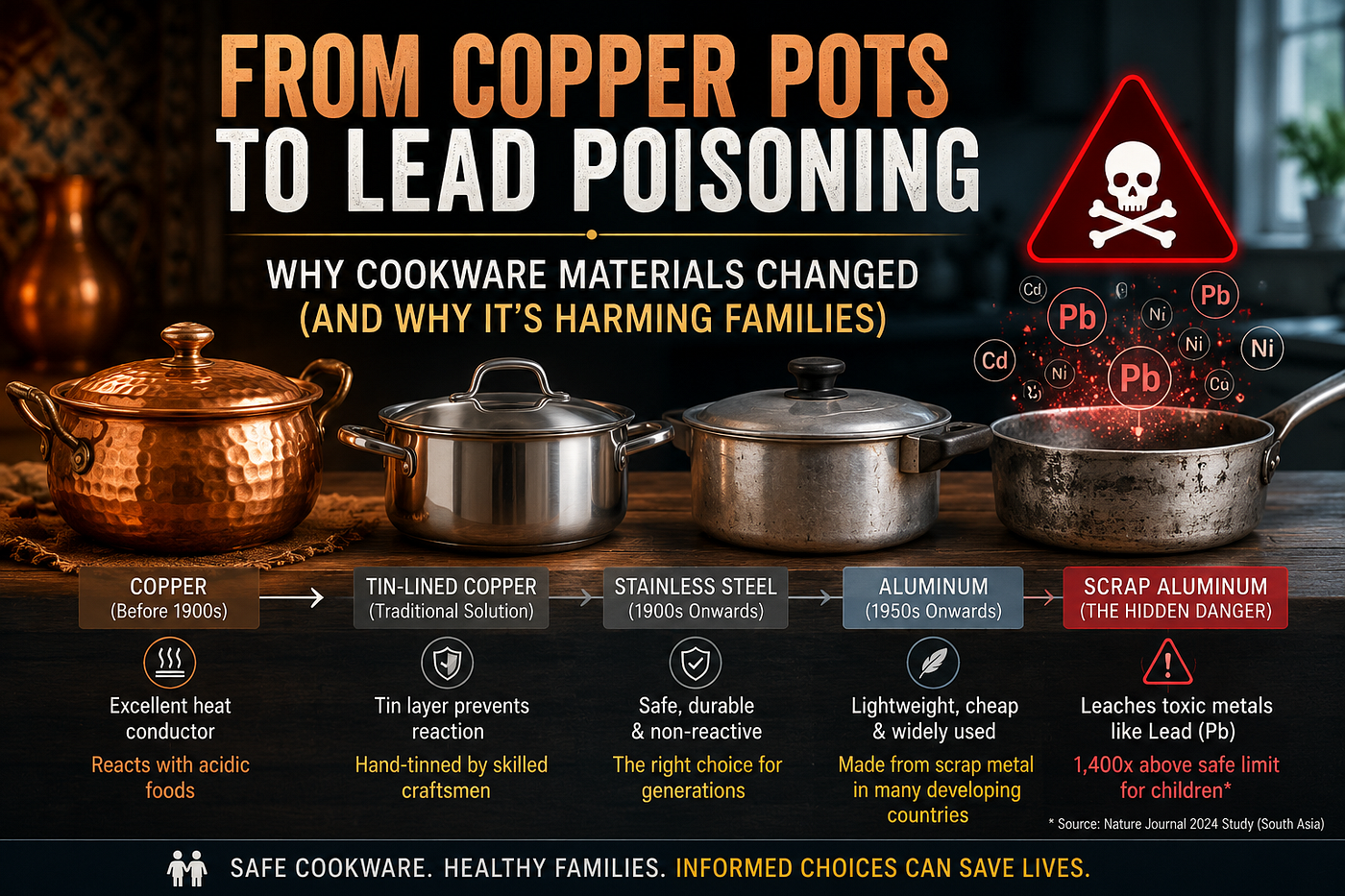
The evolution of cookware materials reflects centuries of engineering trade-offs between performance, affordability, durability, and safety.
Why did Grandma use it — It’s the Copper Era.
Copper has been the traditional choice for cookware since the ancient times. When you were wealthy you would cook with copper. There were good reasons. Copper is excellent at conducting heat — evenly and efficiently! A fast non-stick heating pan could be used as a heat source that would not have so many hot spots. It was durable enough: it lasted a long time, for decades. They were indeed a status symbol. Coppers pots were displayed as jewelry by wealthier families. Although this subject is not commonly reported, here was one problem that was encountered: copper reacts to acidic foods. If you were making tomato dishes, chutneys with vinegar or tamarind chutney in copper, the metal would leach into the dish. This accounted for the copper poisoning, which manifested itself in nausea, weakness, organ damage. There really was a problem, but they were not aware of the chemistry. Elegant was the answer — tin-plating. The craftsmen would slide a thin lining of tin around the inside lining of the copper for a barrier. The food was shielded by the tin and the copper was below. This practice was now a tradition. Thathera community of metal craft, who have been practicing hand tinning technique for century, protecting copper vessels exists in the province of Punjab in South Asia which was recognized by UNESCO as Intangible Cultural Heritage in 2014. The irony? Ancient artisans were working on a chemistry problem for which they did not know all the answers. They simply knew that re-plated copper vessels were safer for the food.
Why we changed –The Steel Revolution.
The Steel Revolution has led to the reasons we changed — steel was made cheaper. The Industrial Revolution brought about the relatively cheap production of steel which made it competitive with copper. The period of the early 1900’s saw more stainless steel cookware appearing. Steel was slightly less efficient heat conductor than copper, but it did NOT react with the food products that were acidic. It was cheaper. It was durable. Which was most important: it was safe. This is materials engineering thinking — focus on the key elements. Heat conductivity is a good property. However, safety is more important than nice. Affordability beats luxury. An example of this change from copper to steel highlights the making of engineer trade-offs. Best doesn’t always happen on all things. We select the most appropriate material for the problem that we are solving. Nickel = non-toxic, does not react with food, but also is an expensive metal.
Stainless steel = very hard to work on, is non-toxic and did not react with food. Steel = excellent heat conductor, safe and affordable. Steel won. Which was the correct answer — and for much of the 20th century, it was.
The Aluminum Blunder: What went wrong?
Aluminum seemed perfect. It was light weight — more convenient for families to carry. It had a reasonably high thermal conductivity of nearly as good as copper. And more importantly- it was cheap. It was relevant in Pakistan and other developing countries. A vast population would be able to purchase an aluminum cookware set for 2,000–5,000. A set of stainless steel is sold for Rs. 6,000–80,000. If you need to choose between helping your family feed and purchasing healthier cookware, it’s the cost that is the better choice. There was one little problem with aluminum no one was considering. In developing countries such as Pakistan, cookware is not produced from pure aluminium ingots obtained from bauxite. It is constructed of recycled metal. Until today, used aluminum pots from streets. Shards of broken spirits from trash at the rubbish collection centres. Vehicle radiators. Motorcycle parts. And arguably most important old car or truck lead batteries! Artisanal ALCO manufacturers in developing countries use ‘broken spoons, plates, old aluminium pots, cans collected from streets, gutters, dustbins,’ according to a 2020 study conducted at the Federal University of Technology (FUT) in Nigeria. Results of the study indicated that the source materials are “waste engine parts, vehicle radiators and vehicle lead batteries”. That’s the source of lead. Not intentionally added. It’s there because the raw material is contaminated. The result? A comprehensive study by Nature Journal was undertaken to test cookware in 2024 from several south Asian nations. The results were shocking: After a comparative examination of almost 60 types of Pakistani and Indian Hindalium pan, researchers found that the lead leaking rate exceeded 1,400–1,500 times the children safe limit. After 15 minutes of simmering, one pan released more than 14 times the amount of lead a kid is allowed to have per day. All Afghan pressure cookers tested were unsafe for use, no matter their brand. Indian Brass Cooking Utensils? Tenfold it’s childhood limit. The study carried out in the 2023 Toxics Journal specifically focused on cookware used in Pakistan and stated that “most cookware used in Pakistan is made of metal wastes and is not well anodized, making the risk of lead and other metal contamination to poses as a serious health concerns in public interest”.
Understanding the Damage: which are the most dangerous metals?
Lead is the worst. It becomes lodged in the brain and leads to permanent damage to children’s cognitive function. It is toxic to kidneys, reproductive organs and the nervous system. There is no safe dose of lead. Cadmium is extremely toxic: it can lead to kidney failure and bone disease on a long-term basis. Nickel sensitivity (approximately 12–15% of women and 1–2% of men) is a condition that can be affected by nickel. It produces skin reactions and actually triggers systemic reactions in susceptible persons. What grandmother’s generation knew: Copper, when out of control, can make you feel sick, tired, and cause damage to organs. These are all prevalent in the cooking utensils used with artisanal aluminum pots and pans in Pakistan, as they are part of the scrap metal in the pan and they leach into food especially in the acidic food that is cooking.
Which Cookware Is Actually Safe?
Safe Options: Stainless Steel (Rs. 6,000–80,000) Does not leach lead in normal cooking conditions. Nature Journal states that stainless steel was the only product to come out from all the testing results with a safe rating. The brands of Pakistan are Kitchen King (low cost and FDA approved), Prestige (mid-range) and Magno (high end and has been established for 40+ years and has FDA approval). They are more costly, but are probably the best resource for a set that will serve for decades. Cast Iron (Rs. 2,000–8,000) Clean iron — no “toxic” metals. The traditional karahis are made of cast iron. Enriches food with beneficial iron. Needs “salt and pepper” and is for a lifetime usage! The price of a single shot is self-returning. Anodized Aluminum (Rs. 4,000–12,000) Corrosion-resistant alloy of aluminium that does not dissolve. The study, published in the 2020 Annals of Science & Technology suggests anodized aluminum as a safer alternative in developing countries. Less expensive than stainless steel and safer than standard aluminum. Clay/Earthenware (Rs. 500–3,000) Traditionally used for cooking in rural areas of Pakistan. Acidic foods are balanced with alkaline nature. A 2025 Archaeometry study validated that clay provides added minerals which are beneficial to the plant: calcium, phosphorus, iron, magnesium. Do have to be lead-free (inquire about older glazes). Ceramic-Coated Cookware (Rs. 8,000–20,000) The ceramic coating may be found on brands such as Klassic Kitchenware as opposed to the PTIFE (non-stick chemicals). Coatings must be complete: chips should show no underlying colored material.
Unsafe Options to Avoid:
Non-stick Cookware (PTFE/Teflon) At normal cooking temperatures, it gives off 15 toxic gases. The coating is prone to degradation, and the microplastics get released when it is scratched. Avoid!!! Unregulated Aluminum In particular in Pakistan, wider the artisanal production. Assume contamination unless it is identified as being anodized and tested. Old Brass Cookware Brass: Copper + Zinc (sometimes with some lead as an alloy strengthener). Some brass pieces tested showed lead levels as high as 47,000 ppm. Unsafe.
The First and foremost step: Inventory your existing cookware.
Inspect for: signs of wear, color changes, blistering or peeling glaze, broken glaze. Oxidation and leaching has started when there is green / blue tint to aluminum. If so, Test If Concerned (Free to affordable) Vinegar test (free): Mix 50% vinegar + 50% water and allow to sit for 24 hours. If there’s any residue or metallic taste, the glaze is damaged. Lead test kit (Rs. 1,000–2,000): Available online with a limited range sensitivity usually around the safety limit. Professional leach testing (Rs. 15,000–25,000): Most realistic — simulates actual cooking. Contact PSQCA-certified labs. Replace Gradually If you have used aluminum pans don’t worry. Accumulated damage is caused by time. First of all, change out cookware for foods that are high in acid; such as tomato curries, tamarind chutneys, pressure cookers for tart food. These are causing greatest leaching. Don’t use unsafe alternatives If funds are available, try using stainless steel, cast iron or anodized aluminum. If you are short on funds, then anodized aluminum is the medium price — sovieter as stainless, on the safer side than regular aluminum.
Where Traditional Wisdom Meets Modern Science
Interesting to me as a materials engineer is that traditional culture was right, without knowing all the science. Cooking in clay pots is recommended by the Ayurvedic tradition due to its properties of being alkaline and beneficial to the body. This has been proved by modern archaeometry: Clay neutralizes acidic foods while adding accessories of minerals. The practice of copper-tinning was adopted in South Asia when people noticed that copper without the tinning would make them ill. They developed solutions. Tin-plating worked. They had no idea that it was protecting against Copper sulphate poisoning, only that it worked! Its a record of 2500 years of trying things by humans. Current chemistry is just confirming cultural traditions. Innovation comes in many forms, and it is not always about inventing new things. It may be learning from the past to reconnect old practices with new knowledge.
Pakistan’s Specific Situation
This problems are not unique to Pakistan, it is a problem throughout the world, but it is especially severe in Pakistan since the public makes use of cookware here in a very different way. The 2020 Annals of Science & Technology study on the production of artisanal aluminum cookware says: Raw Material Sources in Pakistan (and similar developing countries): All scrap aluminum from city streets and gutters. Aluminum utensils and containers from before 1991. Aluminum utensils and pots from before 1991. Refrigeration Equipment: Vehicles Parts/Radiators/Engine Blocks Motorcycle scrap Car battery lead (most contaminated source) Industrial waste aluminum
Why This Happens:
The margins for artisanal cookware manufacturers are low. They are unable to import virgin Aluminium Ingots at Rs. The cost of scrap aluminum is Rs.200 or more per kg. 30–50 per kg. The gap becomes evident in its capability of household affordability for pots, if they can be had of course.
Pakistan’s Regulatory Framework:
There is a PSQCA (Pakistan Standards and Quality Control Authority) but it is not having any resources for enforcement. The agency is not updated to EU standard (EN 12983–2023) given in February 2023. This can result in a gap in regulation that allows manufacturers to go about their business without the need for material testing.
The Materials Diary exists to explain how the materials you use actually work — and why it matters. From cookware to cars, the same engineering principles apply. Understanding them makes you a smarter consumer and a better decision-maker.
Sources & Research Papers
Nature Journal (2024): “Evaluating metal cookware as a source of lead exposure” — Fellows, KM et al., Vol. 35, Pages 342–350, DOI: 10.1038/s41370–024–00686–7
Lead leaching data, comparison of materials, Pakistan/India/Afghanistan context
Toxics Journal (2023): “Assessing Leaching of Potentially Hazardous Elements from Cookware during Cooking: A Serious Public Health Concern” — Pakistan-specific findings on aluminum and brass cookware
Documented that Pakistan cookware is made from scrap metals and poorly anodized
Annals of Science & Technology (2020): “Production, Usage and Potential Public Health Effects of Aluminum Cookware: A Review” — Alabi & Adeoluwa, Federal University of Technology, Akure
Details on artisanal production in developing countries, scrap metal sourcing
AYUSHDHARA Journal (2020): “Review on Health Impact of Hazardous and Safest Traditional Cookware with Ayurvedic Approach” — Bansal, Zaina, & Parihar
Traditional cookware benefits, health impacts of various metals
Home Science Journal (2025): “Impact of cookware on nutritional security and sustainability: A scoping review” — Bawa et al.
Comprehensive comparison of all cookware types
UNESCO (2014): Recognition of Thathera Metal-craft as Intangible Cultural Heritage
Historical context on copper vessel tinning tradition.
EN 12983–2023: European standards for domestic cookware safety — Updated February 2023
Current international standards Pakistan should adopt
PSQCA Standards: Pakistan Standards and Quality Control Authority food safety guidelines
메타데이터
- post_id
- 8aefca41de38
- slug
- from-copper-pots-to-lead-poisoning-why-cookware-materials-changed-and-why-its-harming-families-8aefca41de38
- url
- https://medium.com/@maham267.aziz/from-copper-pots-to-lead-poisoning-why-cookware-materials-changed-and-why-its-harming-families-8aefca41de38
- canonical_url
- https://medium.com/@maham267.aziz/from-copper-pots-to-lead-poisoning-why-cookware-materials-changed-and-why-its-harming-families-8aefca41de38
- author_url
- https://medium.com/@maham267.aziz
- status
- ok
- fetched_at
- 2026-06-26 03:39:16