The History of Psychic Art in the USA — From Séance Rooms to Digital Portraits
There is a house in Hydesville, New York, that changed American spiritual history.
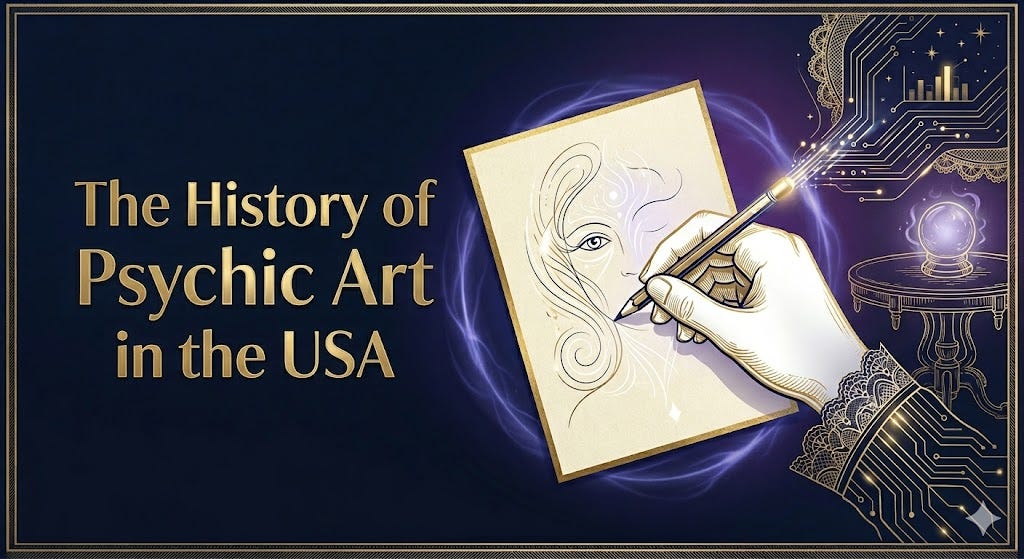
The History of Psychic Art in the USA — From Séance Rooms to Digital Portraits
There is a house in Hydesville, New York, that changed American spiritual history.
In 1848, two young sisters — Kate and Margaret Fox — began communicating with what they believed was the spirit of a murdered peddler through a series of knocking sounds inside the walls of their home. Word spread. Within months, thousands of Americans were holding their breath in darkened parlors, attempting to make contact with something beyond the visible world.
What followed was one of the strangest and most enduring chapters in American cultural history — a 175-year arc that began with knocked walls and table rappings, passed through séance parlors and criminal investigations, touched the foundations of modern abstract art, and arrived at something nobody in that Hydesville farmhouse could have predicted: millions of people ordering personalized psychic portraits of their soulmates from their phones.
This is the history of psychic art in America. It is stranger, richer, and more artistically significant than most people realize.
**The Birth of American Spiritualism — 1848 and the Fox Sisters**
Understanding psychic art in America requires understanding Spiritualism — the 19th-century movement that made it possible.
The Fox Sisters did not invent the idea of communicating with spirits. That impulse is as old as human consciousness. But they did something historically specific: they gave it a performance format that could spread through American culture like fire.
By 1850, the Fox Sisters were conducting public demonstrations across New York State. By 1852, their fame had reached the White House — President Franklin Pierce invited them to hold a private séance following the death of his son. Their influence on American culture was enormous.
What matters for the history of psychic art is what Spiritualism demanded from its practitioners: evidence. Spirits needed to prove themselves. And increasingly, that proof came in visual form.
Written messages from beyond, produced by a medium's hand moving without conscious direction. Portraits appearing on blank canvases during séances. Drawings materializing, allegedly, without any physical intervention at all.
America had discovered psychic art — though it would take decades before anyone called it that.

**The First American Psychic Artists — Spirit Drawing in the Séance Room (1850s–1880s)**
The earliest documented psychic art in America emerged directly from the Spiritualist séance tradition of the 1850s.
Mediums began producing what were called *automatic drawings* — images created while in a trance state, with the practitioner claiming no conscious control over the moving hand. The underlying belief was straightforward: the spirit world was using the human body as an instrument to communicate visually. The medium's hand moved, but the intelligence behind the movement was not the medium's own.
These drawings ranged from simple geometric patterns to detailed portraits of deceased individuals recognized by their living relatives. The emotional power of a portrait — the specific, personal nature of a recognizable face — made psychic portraiture one of the most compelling forms of spiritual evidence the 19th century produced.
By the 1870s, **the Campbell Brothers** had become the most famous psychic artists in America.
Allen and Charles Campbell operated from **Lily Dale**, New York — the Spiritualist community in western New York that still exists today as the largest active Spiritualist camp in the world. Their specialty was something even more dramatic than automatic drawing: **precipitated portraits**. These were images that allegedly appeared on blank canvases during séances, without the brothers' hands ever touching the surface.
Their most celebrated work was a precipitated portrait of Abraham Lincoln — produced in public, with witnesses attesting that no conventional painting process had taken place. Whether one accepts the supernatural explanation or not, the cultural impact was real. Psychic portraiture had become a serious American phenomenon.
**The Lily Dale Community — America's Psychic Art Capital (1879–Present)**
Lily Dale Assembly, founded in 1879 in Chautauqua County, New York, became the institutional center of American psychic art.
This small community, accessible for much of the year only to registered visitors, became a destination for Americans seeking psychic readings, spiritual healing, and — crucially — psychic portraits. Certified mediums at Lily Dale offered sittings in which they would draw or paint the faces of departed loved ones, spirit guides, or occasionally future connections.
The tradition that developed at Lily Dale was specific: a psychic artist would enter a meditative state in front of a client, take up a pencil or brush, and begin drawing without looking at what was appearing on the paper. The portrait would be revealed at the end of the session. The sitter would recognize — or not recognize — the face that had appeared.
This practice established the core format that psychic portraiture would follow for the next 150 years: intuition, trance, portrait, recognition. That format, refined across generations of American practitioners, forms the direct ancestral line of every psychic portrait service operating in the USA today.
**Psychic Art and the American Art World — The Hidden Influence (1890s–1940s)**
Here is something most American art history courses omit entirely: the profound influence of psychic and spiritualist practice on the development of modern American art.
The connection runs deeper than most people realize.
**Abstract Expressionism** the radical art movement that made New York the center of the global art world in the 1940s and 50s — drew heavily on automatic techniques developed in the Spiritualist tradition. Jackson Pollock's drip paintings, for example, employed a technique of surrendering conscious control over the brush that was functionally identical to the automatic drawing practiced by séance-room mediums fifty years earlier. Pollock himself was deeply interested in Jungian psychology and what he called "direct" expression from the unconscious — language that echoed the Spiritualist framework almost exactly.
**Mark Rothko**, Agnes Pelton, and Joseph Cornell all engaged with spiritual traditions that overlapped with the psychic art lineage.
The Surrealist movement, which deeply influenced American art after European Surrealists fled to New York during World War II, made *psychic automatism* — automatic drawing and writing as a route to unconscious truth — a central artistic technique. André Breton's 1924 Surrealist Manifesto defined the movement's core technique as "pure psychic automatism... thought dictated in the absence of all control exerted by reason."
Psychic art had gone from the séance room to the most prestigious galleries in New York — without most viewers understanding the connection.
**The New Age Revival — Psychic Art Goes Mainstream (1960s–1980s)**
American Spiritualism had entered a long decline after the 1920s, partly due to high-profile exposure of fraudulent mediums and partly due to the rising authority of scientific materialism in American culture. Psychic art retreated from public view but never disappeared entirely from Lily Dale and the network of Spiritualist churches that persisted quietly across the country.
The 1960s and 70s changed everything.
The counterculture's rejection of materialism, the explosion of interest in Eastern spirituality, and the emergence of the New Age movement created a new and enormous American audience for psychic and intuitive services. Tarot, astrology, past-life regression, aura reading, and psychic portraiture all experienced dramatic revivals.
**By the 1980s, psychic art had entered mainstream American culture in a new form**: celebrity psychic advisors. Names like Sylvia Browne, who appeared regularly on television, and Edgar Cayce's continuing legacy through the Association for Research and Enlightenment in Virginia Beach, gave psychic practices mainstream American visibility they hadn't enjoyed since the Spiritualist peak of the 1870s.
Psychic portrait artists began appearing at New Age fairs, holistic health expos, and spiritual retreats across the USA. The format evolved: sitters would receive portraits not of deceased relatives but of spirit guides, guardian angels, or — increasingly — future romantic partners.
That last category — the psychic portrait of a future soulmate — would prove to be the most enduring popular form psychic art has ever taken in America.
**Psychic Art in American Law Enforcement** — The Unexpected Chapter
One of the most striking and least discussed chapters in American psychic art history involves its use in criminal investigations.
Throughout the 1970s and 80s, several American law enforcement agencies quietly consulted psychic artists — individuals who claimed to produce portraits of unknown suspects through intuitive impressions rather than eyewitness descriptions.
The most documented American case involved the **Hillside Strangler** **investigation **in Los Angeles in the late 1970s. A psychic artist worked with investigators to produce a rendering of the suspect based on claimed psychic impressions of the crime scenes. The resulting sketch was later compared to the eventual arrested suspects.
Whether these cases represent genuine psychic ability or the psychology of pattern-matching in collaborative investigation remains genuinely contested. But the fact that American law enforcement agencies — under the intense practical pressure of active murder investigations — took psychic art seriously enough to use it officially is a significant data point in the cultural history of the practice.
It demonstrates something important: in the American tradition, psychic art has never been only a spiritual curiosity. It has been taken seriously as a practical tool for producing visual representations of what cannot be directly observed.
**The Digital Revolution — Psychic Art Finds the Internet (1990s–2010s)**

The arrival of the internet transformed every aspect of American psychic culture — and psychic art was no exception.
In the 1990s and early 2000s, psychic portrait services moved online for the first time. What had previously required a trip to Lily Dale, attendance at a New Age fair, or access to a local Spiritualist church became available to any American with an internet connection.
The first online psychic portrait services were basic by current standards: an email inquiry, a waiting period of days or weeks, and a scanned image delivered by attachment. But the fundamental format — submit your details, receive a portrait — was established.
The 2000s brought digital payment systems that made the process seamless. The 2010s brought social media, which allowed psychic portrait services to reach audiences they had never previously accessed. A woman in rural Kansas who had never attended a spiritual fair and had no local psychic resources could now order a portrait from an artist operating on the other side of the country — or the world.
The audience for psychic portraiture in America expanded dramatically. And with that expansion came a specific, highly popular focus: the soulmate portrait.
**The Soulmate Sketch Phenomenon — Psychic Art's Modern American Form (2015–Present)**
The soulmate sketch represents the current peak of a very long American tradition.
The idea that a psychic artist could draw the face of your future romantic partner — someone you haven't met yet, whose appearance exists only in the energetic impression of your future — is not new. American Spiritualists of the 1870s believed mediums could do exactly this. The practitioners at Lily Dale who drew future connections for their sitters were doing a version of this work 140 years ago.
What changed in the 2010s was scale, accessibility, and the specific emotional moment American culture was experiencing.
Dating apps had created an entire generation of Americans who had turned the search for love into an algorithm — swipe, match, chat, repeat. Many people found the process dehumanizing. The psychic soulmate sketch offered a completely different relationship with the unknown: instead of an algorithm choosing your matches from a database, an intuitive human artist channeled a portrait of the person already meant for you.
The contrast was culturally powerful. And it drove enormous demand.
Services like the one offered by **Tina Aldea** became some of the most searched psychic products in the USA. Tens of thousands of American buyers ordered portraits based on a model that would have been completely recognizable to the mediums at Lily Dale in 1890 — and completely alien in its digital execution to anyone from that era.
Today, the practice sits at the intersection of a 175-year American tradition and a 21st-century digital marketplace. If you want to see what modern American psychic art looks like — the current form of a tradition that began in a farmhouse in upstate New York — you can explore it at [[tinapsychicsoulmate.com](https://tinapsychicsoulmate.com)].
**What the History of Psychic Art Tells Us**
Standing back from 175 years of American psychic art history, several things become clear.
**First: **This practice has never been fringe in the way popular culture assumes. It has touched the White House, influenced the development of modern abstract art, been consulted by law enforcement, and attracted tens of millions of American participants across a century and a half. It is woven into the fabric of American spiritual and cultural life in ways that are easy to overlook if you only look at it from the outside.
**Second: **The core need that psychic art addresses has not changed. Americans in 1850 and Americans in 2026 are both trying to do the same thing — make the invisible visible. To see, in some concrete form, what they cannot yet see with their ordinary eyes. Whether that is the face of a departed loved one or the face of a future romantic partner, the impulse is identical.
**Third:**The forms change while the need persists. Séance rooms gave way to Spiritualist churches. Churches gave way to New Age fairs. New Age fairs gave way to online services. Online services gave way to instant digital delivery. At every transition, people who dismissed the new form as a diminishment of the original failed to understand that the original was never really about the form at all.
**Fourth: **The debate about whether psychic art "works" in a scientific sense has been going on for 175 years and shows no sign of resolution — because it is not primarily a scientific question. It is a question about meaning, about what we need from our inner lives, and about the role of visual experience in shaping how we understand our own futures.
That question does not resolve. It persists. And as long as it persists, so will psychic art.
**A Note on What Comes Next**
American psychic art is currently in its most accessible form in history. The same practice that once required a journey to Lily Dale, New York, now requires nothing more than a smartphone and $37.
Whether that accessibility deepens the tradition or dilutes it is genuinely contested among practitioners and scholars of American spiritual culture. Some argue that digital delivery strips the experience of the relational depth that made séance-room portraits meaningful. Others argue that wider access democratizes something that was previously available only to those with the means to travel and the cultural knowledge to seek it out.
**What is not contested is this:** the need that has driven 175 years of American psychic art is not going anywhere.
If anything, in an era of algorithmic matching, social media performance, and the persistent loneliness that runs beneath the surface of hyper-connected American life, the pull toward something more intuitive, more personal, and more visually concrete than a profile photo may be stronger than it has ever been.
The farmhouse in Hydesville is a historical landmark now. The knocking sounds are long since silent.
But the human desire to see what is not yet visible — to hold, in one's hands, a portrait of what is coming — is as alive in 2026 as it was in 1848.
Disclosure: This article contains an affiliate link to tinapsychicsoulmate.com. If you make a purchase through that link, I may receive a small commission. This does not affect the research, historical content, or conclusions of this article. All historical claims are drawn from documented sources.
메타데이터
- post_id
- 8afcb7512c24
- slug
- the-history-of-psychic-art-in-the-usa-from-séance-rooms-to-digital-portraits-8afcb7512c24
- url
- https://medium.com/@wavebillion387/the-history-of-psychic-art-in-the-usa-from-s%C3%A9ance-rooms-to-digital-portraits-8afcb7512c24
- canonical_url
- https://medium.com/@wavebillion387/the-history-of-psychic-art-in-the-usa-from-s%C3%A9ance-rooms-to-digital-portraits-8afcb7512c24
- author_url
- https://medium.com/@wavebillion387
- status
- ok
- fetched_at
- 2026-06-09 14:34:10