‘Masculine’ and ‘Feminine’ Don’t Actually Mean Anything
Other than what we as a culture decide they mean today
‘Masculine’ and ‘Feminine’ Don’t Actually Mean Anything
Other than what we as a culture decide they mean today
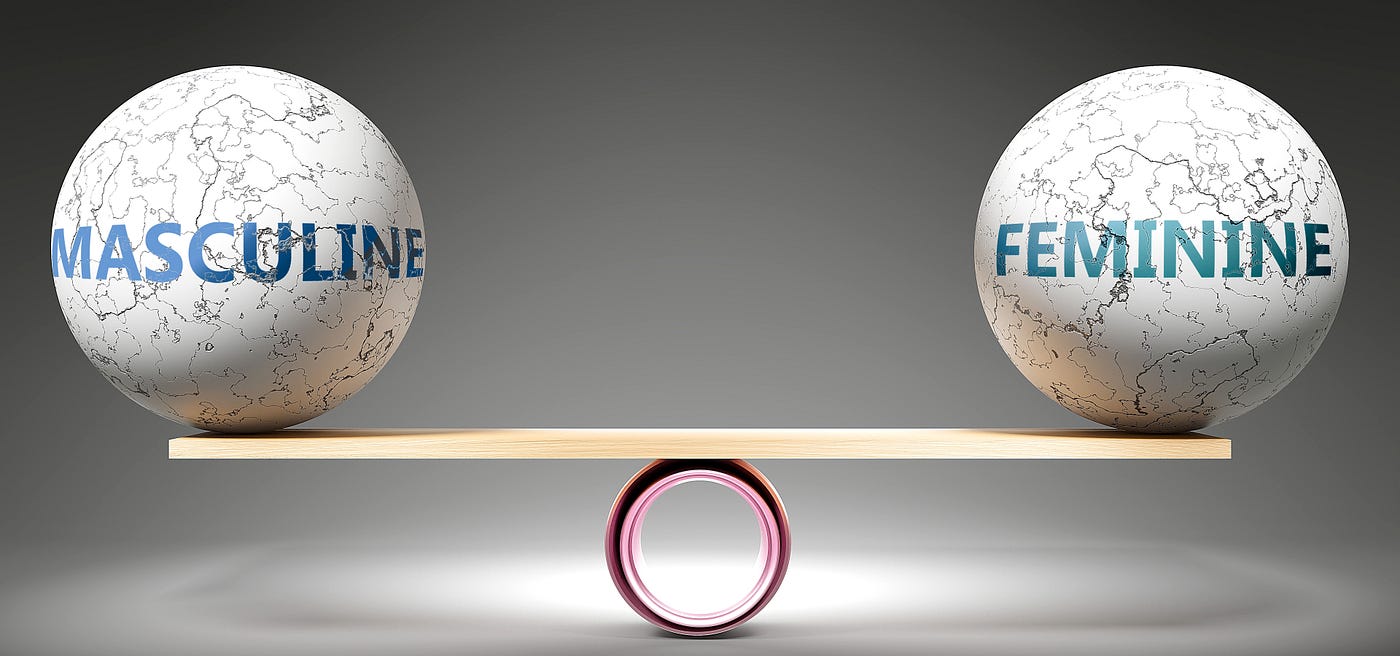
Licensed from Adobe Stock
“She needs to get more into her feminine if she’s ever going to be happy and find a good man.”
“He doesn’t seem masculine enough to represent a state like Texas in the Senate.”
Phrases like these are ubiquitous today, alongside the larger suggestion that polarity (one person very feminine and one person very masculine) is necessary for romantic attraction. I know what those sentences above are intended to convey, but what do they actually mean in a world where feminine and masculine have no agreed upon universal or scientific meaning?
[embed]‘Relationship Polarity’ is BroScience It’s a myth that opposites attractmedium.com
As I’ve noted before, this stuff is all bro-science, intended to reinforce the gender binary that is central to the maintenance of a patriarchal system. It has no actual scientific basis. In fact, the idea that opposites attract has been so thoroughly debunked, that the attraction between those who are similar is one of the most recognized dynamics in social psychology.
For decades, psychologists and sociologists have pointed out that the idea that opposites attract is a myth. In fact, almost all the evidence suggests that opposites very rarely attract.”
In fact, the idea that we are more attracted to similar others is incredibly robust. One review of 313 studies with over 35,000 participants found that similarity was a strong predictor of attraction in the early stages of a relationship — finding no evidence that opposites attract. So strong is the relationship that some psychologists have even proclaimed the similarity effect as “one of the best generalisations in social psychology.
In the US these days, masculine tends to indicate toughness, logic, assertiveness, confidence, being in control, and suppression of all difficult emotions that aren’t anger.
Feminine tends to indicate nurturance, intuition, creativity, receptivity, softness, and warmth.
The problem with this kind of generalization though is that it’s not in the least bit uniform, and there is a lot of overlap, both within our own culture as well as those around the world.
The “Big Five” personality traits of psychology — openness, conscientiousness, extraversion, agreeableness and neuroticism — do not categorically vary between men and women. Contrary to stereotypes, women were not found to be significantly more intimate in their relationships, and science inclination did not overwhelmingly favor men. And masculinity and femininity, the study found, “are not all-or-nothing traits…they are truly a continuum.”
For 122 different characteristics, from empathy to sexuality to science inclination to extroversion, a statistical analysis of 13,301 individuals did not reveal any distinct differences between men and women.
While there are average differences between the sexes, they aren’t consistent enough to accurately characterize the entire group. Just because a man or woman fits into one stereotype for their gender doesn’t mean they will fit into another. *~Popsci.com*
In other words, these terms describe stereotypes, but not actual people, and the blend of interests or traits these terms convey vary more between individuals than they do between men and women as a group.
And that’s just within modern Western industrialized cultures today.
In subsistence cultures around the world, women often engage in physically demanding, high risk, or public facing tasks. Does that make them not very feminine? I doubt they believe so. Here are a few examples:
The Himba, are an ethnic group living in northern Namibia.
Women and girls tend to perform more labor-intensive work than men and boys do, such as carrying water to the village, earthen plastering the mopane wood homes with a traditional mixture of red clay soil and cow manure binding agent, collecting firewood, attending to the calabash vines used for producing and ensuring a secure supply of soured milk, cooking and serving meals, as well as artisans making handicrafts, clothing and jewelry.
The responsibility for milking the cows and goats also lies with the women and girls. Women and girls take care of the children, and one woman or girl will take care of another woman’s children. The men’s main tasks are tending to the livestock farming, herding where the men will often be away from the family home for extended periods, animal slaughtering, construction, and holding council with village tribal chiefs. ~Himba People
The Mosuo, who live near Lugo Lake in southwest China, are a matrilineal culture where everyone lives in the home of their mother or grandmother and relationships between men and women are rarely formalized. Fatherhood is not a recognized social category.
Women own and inherit property, sow crops in this agrarian society, and run the households — cooking, cleaning and child-rearing. The men provide strength, ploughing, building, repairing homes, slaughtering animals and helping with big familial decisions, although the final say is always with Grandmother.
Although men have no paternal responsibilities — it is common for women not to know who the father of their children is, and there is no stigma attached to this — they have considerable responsibility as uncles to their sisters’ children. In fact, along with elderly maternal great-uncles, who are often the households’ second-in-charge, younger uncles are the pivotal male influence on children. ~The Kingdom of Women
The Minangkabau of West Sumatra are another matrilineal culture. Although they converted to Islam in the 16th century, women still retain a central role and the culture is built around balance between the sexes. That being said, women maintain both property and familial lineage, as well as being primary decision makers in the family. They are often active as breadwinners and entrepreneurs. Upon marriage, men move into the houses their wives own.
This is not a subsistence society, and in fact, they are quite developed, driving things like literature, commerce, and the politics of Indonesia.
Minangkabau matriarchaat is an established social system that appears to be drawn largely from the customary practice (adat) that involves tracing inheritance through the matrilineal line and giving prominent roles to women in public ceremonies.
Minang women uphold these pre-Islamic adat customs, which not only trace ancestry through the female line but also involve a complex social system in which women and men share power and control based on the principle of interdependence and mutual responsibility. ~The Conversation
So, as you can see, what we consider to be masculine or feminine in modern Western industrialized patriarchies has little bearing on many other cultures ideas of what is appropriate for men and for women.
Are Himba women not really feminine because they do most of the heavy labor? Are Minang men not masculine because inheritance runs through the female line and women make a lot of the household decisions? When you zoom out from modern Western industrialized patriarchies (who don’t even all have the same definitions), you begin to see how arbitrary these terms are.
They mean what we have decided they mean right now, in the specific places that these norms exist. They mean absolutely nothing in the abstract or as part of any sort of scientific definition. So sure, you could say, “He doesn’t seem very masculine by the norms of our culture right now,” — that at least means something — but it still means something artificial and non-standardized.
As I noted in the story about relationship polarity, my husband and I are a lot alike and that’s why I think our relationship has lasted close to 40 years. He’s tall, strong, and confident — but so am I. He loves animals and nurturing our son — but so do I. Neither one of us wants to be with someone who isn’t showing up as a whole human being, with a blend of Yin and Yang characteristics.
We’re not exactly alike, and I’m not saying that nobody who is somewhat different than their partner can make it long term. I’m just saying that artificial ideas of a gender binary are a function of patriarchy, and not of science, or actual relationship successes.
You don’t need a leader and a follower, or an assertive person and a passive one. All the best, long-standing relationships I see around me are partnerships where nobody is too slotted into societal ideas of who they are supposed to be based on their gender. And the reason that’s so impactful is that ideas about gender in our culture are entirely artificial.
Men can be warm, nurturing and intuitive. I know a lot of guys like that. Women can be assertive and confident, making things happen. At 62, I’d say most of the women I know are like that. We’re all a blend of Yin and Yang traits, in a very organic way. The differences between individuals is way more important than the differences between genders.
This doesn’t mean that everyone is or should become some sort of uni-gender. In fact, it would be impossible for that to take place, because each person is fairly unique. And that’s the way that it should be. Forcing men to disavow large parts of their humanity in order to appear masculine is harmful to men and society. Pretending that women aren’t also quite capable of all the same manly traits is frankly turning a blind eye to reality.
I really wish this culture would stop obsessing about inherent binary differences that really just aren’t there, even though we’ve been socialized to support that. I’ve spent the last 20 years challenging and investigating my gender indoctrination trying to get a better handle on who I actually am.
I’ve made good progress, but there is no way to fully separate out nature from nurture, particularly not 40 years into your indoctrination. The best we can do is to back off from telling people who we think they should be based on what’s in their pants and just let them be as much their authentic self as possible in this environment.
I actually see this played out in the autistic young adults that are in my son’s social circle. They don’t care about gender norms, so they just are themselves. They are each just people, with individual traits and interests. It’s quite inspiring, actually.
Remember, there is no ideal masculine man or feminine woman. Even the Erika Kirks of the world, who are pushing this stuff don’t themselves embody it. Those are just stereotypes that describe archetypes we’ve created, largely to justify a patriarchal system that systemically disempowered women and that some people would like to get back to more overtly.
Those terms only mean what this society says they mean, today, in our little neck of the woods. They have no universal or scientific meaning and people in other cultures may have archetypes that are vastly different than ours. I think the only sane thing is to stop worrying so much about historic metrics about supposed binaries and just try to figure out what you’re authentic self is.
I’m still going to paint my nails and wear makeup, but I think men who do that are just fine as well. I’m still going to be assertive and a linear thinker, but it’s fine for guys to do that too. People are people, and that’s what I think is the most important thing. Why can’t we just let everyone be? I think we’d all be a lot happier if we stopped trying to shove people into boxes that they may or may not fit into. I know I’m a lot happier just being who I want to be, rather than who some external force says I ought to be. It seems like a no brainer, actually. 🤷♀️
© Copyright Elle Beau 2026
메타데이터
- post_id
- 8afecee48717
- slug
- masculine-and-feminine-don-t-actually-mean-anything-8afecee48717
- url
- https://medium.com/sensual-enchantment/masculine-and-feminine-don-t-actually-mean-anything-8afecee48717
- canonical_url
- https://medium.com/sensual-enchantment/masculine-and-feminine-don-t-actually-mean-anything-8afecee48717
- author_url
- https://medium.com/@ellebeauworld
- status
- ok
- fetched_at
- 2026-06-21 12:17:11