The Real AI Divide is not Access, but AI Literacy
A student uses ChatGPT to draft an essay and gets penalized for taking a shortcut. A consultant uses ChatGPT to draft a report and is…
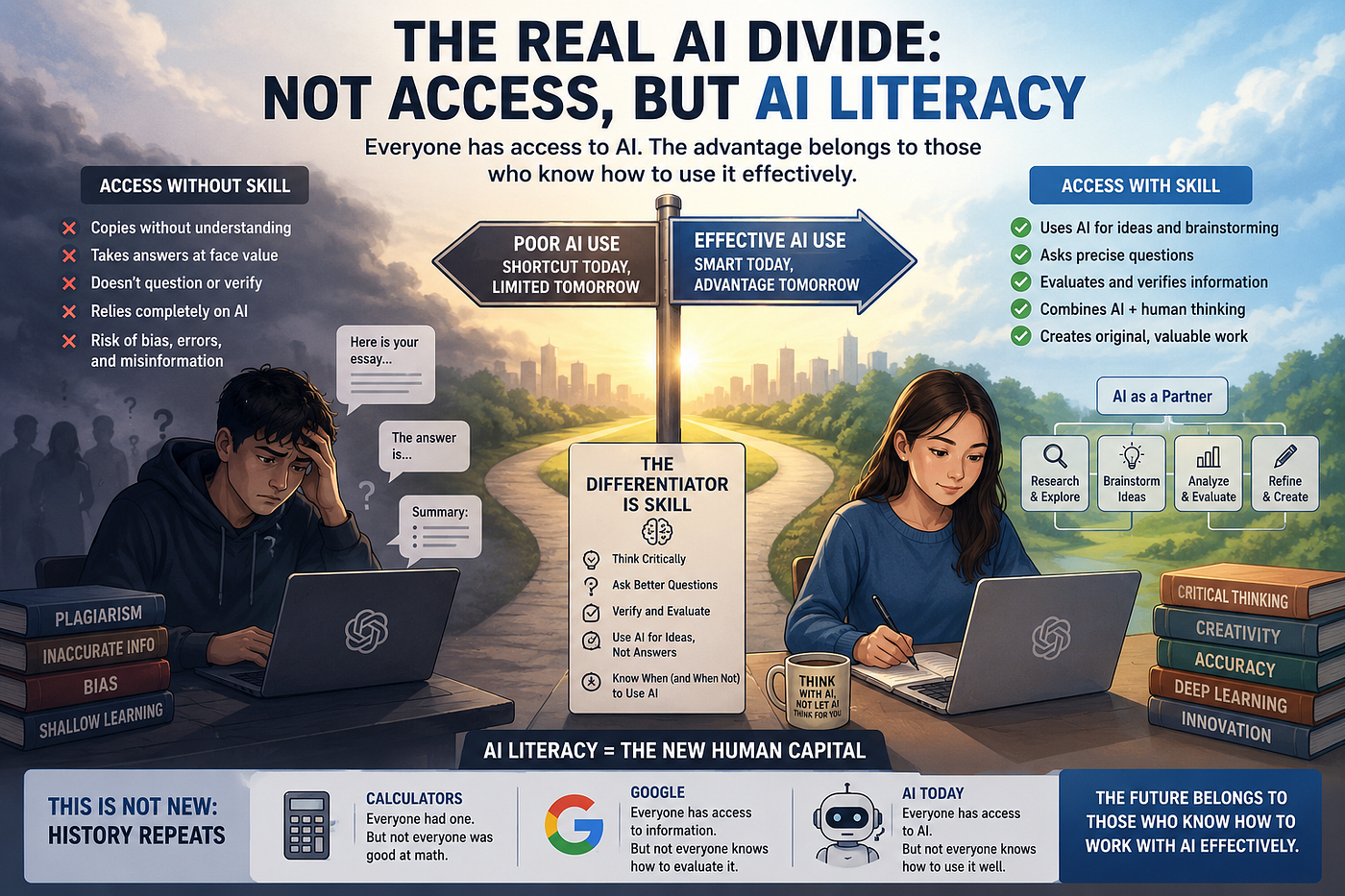
Image generated by AI
The Real AI Divide is not Access, but AI Literacy
A student uses ChatGPT to draft an essay and gets penalized for taking a shortcut. A consultant uses ChatGPT to draft a report and is praised for being efficient.
So the same thing is being used in two different settings, yet one setting welcomes it while the other discourages it. AI is becoming a norm in many workplaces. Every worker uses AI in some form, and it is often encouraged by companies. However, we also see students using AI for different kinds of work like college essays and brainstorming ideas.
So the debate has shifted from “Should we use AI” to “How should we use AI?”
What I believe is that the future divide will not be between people who use AI and people who don’t. It will be between people who know how to work with AI effectively and those who use it poorly.
During the past few years, AI was something that could only be accessed by a limited number of people. It was not that popular. However, right now it is more popular than ever. Tools like ChatGPT, Gemini and Claude are widely accessible and mostly free for users. So it is no longer a competitive advantage.
And it is important to understand that this is not new. This has happened before.
Take calculators. Everybody got a calculator, but not everybody is good at maths.
A better example is Google. Everybody has access to Google. It basically democratized access to information. At first, people thought information is now free. But this created a new problem: how do you evaluate sources? Are they credible? Are they accurate? Are they spreading misinformation/disinformation?
Some people fell into this trap, but some people actually became really good researchers. AI is doing the same thing.
So when everybody has access to the same tool, how can someone create a competitive advantage?
Well, the differentiator is skill. How effectively can you use AI? Can you use it for ideas and brainstorming instead of letting it do everything for you? Can you still think on your own instead of giving away all decision making power to it? And most importantly, can you recognize bias and wrong information being generated by AI, or are you just taking it all in blindly? Are you asking precise questions? And are you able to understand when AI should and should not be used?
If you can do that, then you are already using AI productively.
For students and universities, I strongly believe that AI should be used in universities, but students also need to be taught AI literacy. It can be seen as a form of human capital. Universities exist to build human capital, and if AI is becoming a tool that increases productivity, then knowing how to use it well is also part of that human capital.
In today’s time, AI skills are highly demanded. Companies expect you to know how to use AI. But a lot of students are learning this informally. Universities don’t really teach it properly, and in many cases they discourage it or penalize it. Instead, students should be trained properly in how to use AI, its advantages and disadvantages, and in what context it should and should not be used.
I think my university professors are already trying to do that. In my first semester, I had an assignment where I had to use ChatGPT’s Deep Research tool to develop a research question for my final essay. I also had to go through the sources ChatGPT found, skim them, pick the useful ones, and then build my thesis and write the essay myself. That actually taught me to use AI more responsibly. It didn’t replace my thinking, it just helped the research process.
Now coming to the risk of not teaching AI to students. Students will use AI anyway, regardless of what you tell them. It is already part of everyday life in very subtle ways. If we don’t teach it properly, students will still use it, but in a very messy way. And that becomes normalized. Another reason, as I mentioned before, is the mismatch between skills demanded and skills taught to students.
Some counterarguments are that AI reduces creativity and critical thinking and that AI encourages plagiarism. I agree with that. That is exactly why I believe universities should teach AI properly. The solution is education, not avoidance. Similar concerns existed with calculators and the internet.
So, in conclusion, I believe AI literacy has become as important as digital literacy. Future success depends on how well AI is used, not just who has access to it. Universities should focus on teaching students how to think with AI, not let AI do all the thinking, or avoid AI completely.
메타데이터
- post_id
- 8b132af4dca4
- slug
- the-real-ai-divide-is-not-access-but-ai-literacy-8b132af4dca4
- url
- https://medium.com/@alankrita.sah1206/the-real-ai-divide-is-not-access-but-ai-literacy-8b132af4dca4
- canonical_url
- https://medium.com/@alankrita.sah1206/the-real-ai-divide-is-not-access-but-ai-literacy-8b132af4dca4
- author_url
- https://medium.com/@alankrita.sah1206
- status
- ok
- fetched_at
- 2026-07-10 10:46:47




