The ones who love our ugly
My best friend is a chubby barney with a filthy mouth.
The ones who love our ugly
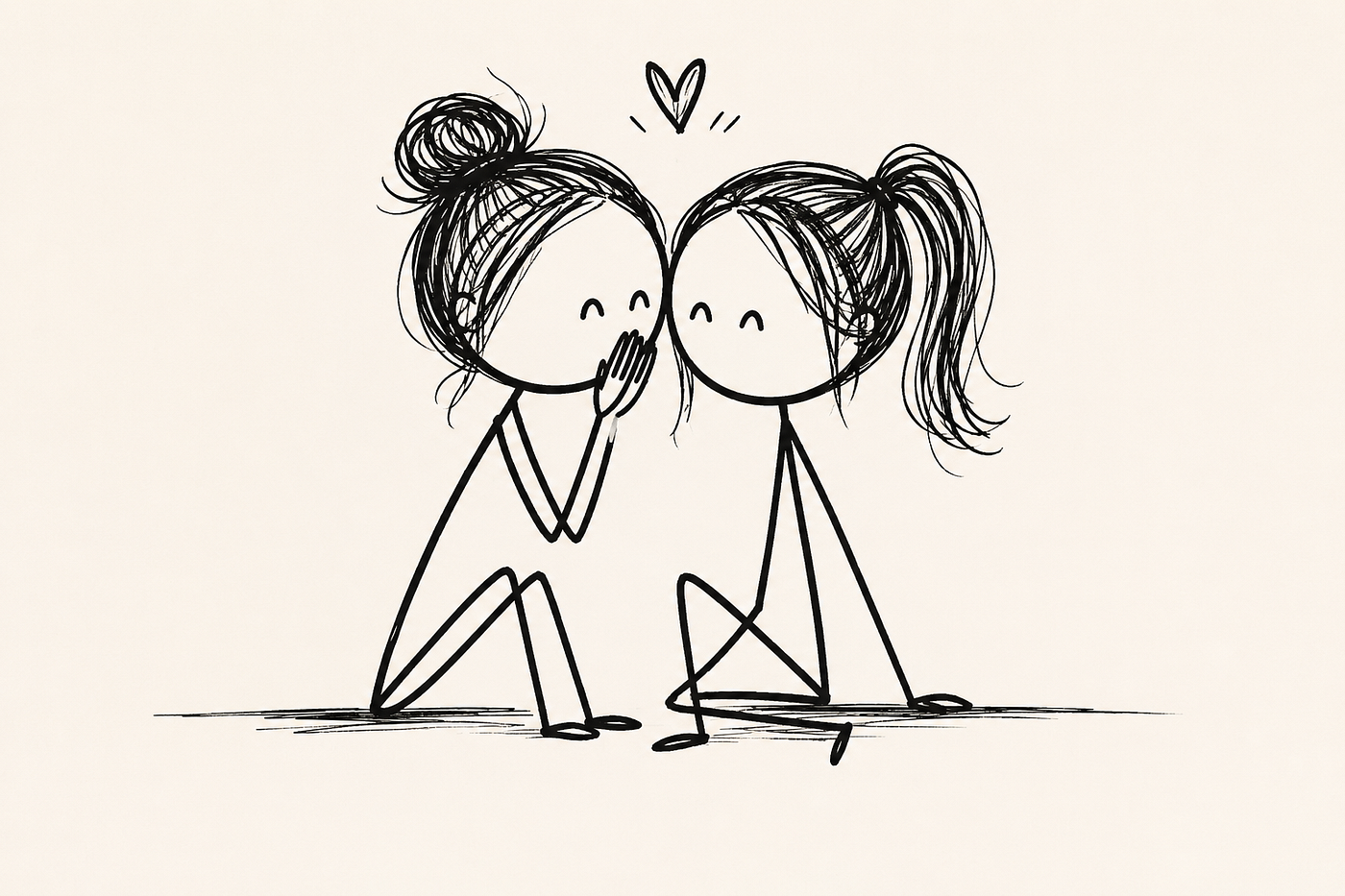
My best friend is a chubby barney with a filthy mouth.
We’ve lived in different cities for years now.
Sometimes weeks pass without a conversation.
And then one random Tuesday one of us calls.
We skip the awkwardness.
There is no catching up.
No warming up to get back into familiarity.
The conversation just jumpstarts like we paused it an hour ago.
I’ve always wondered why.
We’ve changed.
We’ve grown.
We’ve become entirely different women.
Yet nothing about us ever feels unfamiliar.
No parts of her ever feel unsafe despite the secrets we keep from each other.
One day, it finally clicked when I remembered university.
Not the lectures, exams, scary girls nights out or splitting every pie 3 ways so we could all have a taste of everything.
It was the gossip.
The knowing looks when our eyes meet as a certain person walks by.
The dissections in-between hisses and cackles after group meetings.
The professors we psychoanalyzed.
The church members whose entire lives we diagnosed and declared judgement on.
The dramatic recounts and exaggerations.
It goes on and on.
None of it was fair even though most of it was purely for entertainment and not malicious.
You may sprinkle in a dash of shared humor and laughter till we fell off the bed.
You could add the naivity of teenage girls bonding over boys, fashion, and duty to humanity.
But at the very center of our bond, was us sharing the most unhinged takes about the it-girl’s newest sugar daddy.
Human intimacy increases in proportion to the amount of morally costly information exchanged.
The Moral Architecture of Friendship
The most dominant philosophies of human social bonding have leaned towards positive forces. Aristotle argued that friendship is sustained by shared virtue and mutual goodness. Contemporary psychology circles around reciprocity, emotional support, similarity, proximity, and shared experience as the principal mechanisms through which relationships are formed. Evolutionary theorists add cooperation and reciprocal altruism to the list, suggesting that friendships endure because they increase the survival prospects of both parties.
All these accounts are very persuasive. They explain why individuals continue relationships. They explain trust reasonably well. Yet they fail to account for a peculiar observation found across virtually every culture: some of the strongest interpersonal bonds are forged not through the exchange of virtues but through the exchange of moral imperfections. Philosophies must get off the high-horse of a God’s-eye view, and acquiesce that shared values may also be shared vices, and mutual badness is a much stronger binding force than mutual goodness.
I want to very lightly examine this.
My proposition is not that vices create friendship.
But, that the disclosure of moral imperfection functions as a means of social bonding because it reduces interpersonal uncertainty and ends moral performance.
As human beings, we are constantly under normative observation.
Every culture has expectations concerning what emotions ought to be expressed, what opinions ought to be voiced, and which desires ought to remain concealed. The sociologist Erving Goffman described social interaction as theatrical performance. So we construct a “front stage” self for public use while reserving a “back stage” where our seemingly unacceptable impulses can safely exist.
Goffman’s work, says quite little about intimacy.
If everyone performs, who gains access to the backstage? Or are we meant to live alone behind those castle walls.
The conventional answer is trust, but I would like to reverse the relationship.
Trust is not just the prerequisite for backstage access. Backstage access is one of the primary precursors to trust.
Everyone has a concealed moral interior. To err is human. This interior contains our thoughts that are unspoken, the judgments that are socially inappropriate, envies that are publicly denied, and pleasures that all we respectable humans will rarely admit to wanting.
These thoughts are not exceptional and are not necessarily pathological, unless of course they are relished with delight. To err is human. Intrusive thoughts, envy, prejudice, and aggressive impulses happen in psychologically healthy people. What separates morally upright individuals from immoral ones is not the absence of these thoughts but their regulation. This is one distinguising feature we have from lower class animals.
Your hidden self is therefore just ordinary and nothing too obscene. I hope.
So why conceal it?
Concealment is a social necessity as long as we stand on this performance stage called social life.
The exchange of morally compromising information then, will alter the structure of a relationship because it changes how each participant approaches the other.
Now let me borrow from information theory.
Every friendship contains some level of uncertainty. Will this person reject me? Will they leave if they discover something unpleasant about me? What aspects of myself must I hide for this relationship to continue?
Each disclosure between friends answers these questions incrementally with the passing of time. But information is not unequal.
Revealing a favourite colour has almost no relational cost, revealing fear carries greater cost, revealing shame has an even heavier weight.
Revealing one’s capacity for evil, pettiness, resentment, or contempt may be one of the highest-cost disclosures because it directly threatens one’s moral identity.
This is like what social psychologists describe as the “risk-regulation” function of self-disclosure, but goes beyond emotional vulnerability into moral vulnerability.
It is not surprising that gossip has persistent across centuries in human societies.
Anthropologist Robin Dunbar argued that gossip functions as the evolutionary replacement for grooming among primates. As language replaced physical grooming, information exchange became the principal mechanism through which coalitions were maintained.
The topic of discussion is often irrelevant. The real transaction occurs between the speakers.
One person says:
“I am willing to reveal a version of myself that polite society discourages.”
The response is:
“Your disclosure does not diminish your standing with me.”
This reciprocal suspension of moral judgment creates intimacy.
The content of the gossip is secondary.
Psychologist Brené Brown has said that vulnerability leads to connection. While her work focuses primarily on emotional exposure, I dare say that moral exposure may constitute an even stronger category of vulnerability because it threatens not merely one’s emotional safety but one’s ethical identity.
This explains why relationships founded on shared hatred often become extraordinarily resilient.
Political movements, workplace factions, religious schisms, and even adolescent friendships frequently emerge through the identification of common enemies.
René Girard argued that communities stabilize themselves through shared opposition and scapegoating. Although Girard emphasized violence and mimetic desire, his work suggests a broader principle: collective moral condemnation strengthens internal cohesion.
Shared contempt functions as social glue.
Its effectiveness should not be mistaken for its goodness.
Some of history’s most destructive communities have been held together precisely because mutual hostility produced extraordinary internal intimacy.
The mechanism is psychologically efficient while being ethically catastrophic.
The implication of this theory is not that gossip should be celebrated.
Nor is it that moral failure should be encouraged.
But to expose that human beings all have an unmet need for environments where moral performance can be safely called off.
The popularity of anonymous internet forums, private group chats, confession, therapy, satire, and irreverent humour, all represent attempts to satisfy this need through different forms.
We are not just looking for acceptance.
We want acceptance after disclosing the aspects of ourselves least deserving of it.
Being loved for your virtues is gratifying.
Being loved after revealing the thoughts that run unchained behind the veil is transformative.
Friendship is therefore the mutual custodianship of each other’s concealed humanity.

메타데이터
- post_id
- 8b2eea14688b
- slug
- the-ones-who-love-our-ugly-8b2eea14688b
- url
- https://medium.com/@faithiabenson/the-ones-who-love-our-ugly-8b2eea14688b
- canonical_url
- https://medium.com/@faithiabenson/the-ones-who-love-our-ugly-8b2eea14688b
- author_url
- https://medium.com/@faithiabenson
- status
- ok
- fetched_at
- 2026-07-09 20:10:33