The ‘second liberation’ of Bangladesh?
A repost, after talking to Tahmima Anam, whose new novel has a remarkable uprising
The ‘second liberation’ of Bangladesh?
A repost, after talking to Tahmima Anam, whose new novel has a remarkable uprising
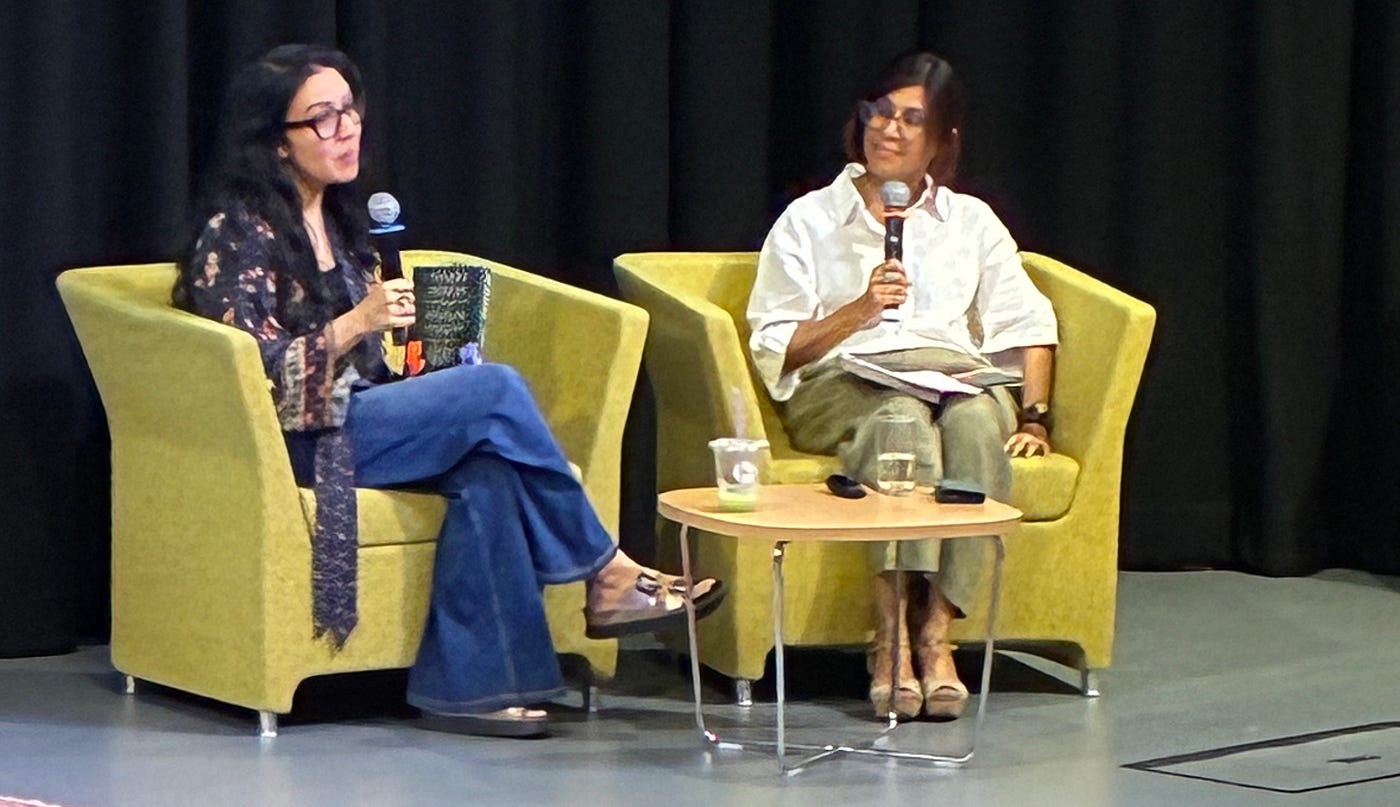
TWTB in conversation with Tahmima Anam at the Khushwant Singh Literary Festival in London
This Week, Those Books links the big international story to the world of books. We’ve been going nearly three years on Substack and have a few thousand followers on every continent except Antarctica. Our aim is to provide, **in roughly five minutes, crucial context — from fiction and non-fiction — to the shouty, doomscroll news cycle. It’s a small operation here at TWTB, and we’re sustained by reader support, so if you find This Week, Those Books useful, thoughtful, and…a conversation starter, please read, respond, refer a friend.**
We live at a time the world needs more context and fewer walls! This Week, Those Books has no paywalls, but please support us by signing up and sharing.
Sign up here
Housekeeping note: I’m away on holiday until June 7. This is an updated version of a post that originally appeared in August 2024
The Big Story:
Bangladesh is in the news in the creative and finance worlds, nearly two years after an uprising that ousted its autocratic prime minister Sheikh Hasina.
- Bangladesh-born prizewinning author Tahmima Anam just published her fifth novel Uprising, about woman power, and TWTB spoke to her at length at a literary festival in London.¹ (More to come on that.)
- The International Monetary Fund chief for Bangladesh has said the country has requested a new financial aid package, a sign that its economic situation remains doleful.
This Week’s Books:
- An anthropologist assesses crowds as a political actor in Bangladesh.
- Fact disguised as fiction from the life of a child during the first liberation of Bangladesh.

Paradoxes of the Popular: Crowd Politics in Bangladesh
By: Nusrat Sabina Chowdhury
Year: 2019
Publisher: Stanford University Press
This anthropological analysis of the size, shape and sound of crowds in Bangladesh is apt. Nusrat Sabina Chowdhury² starts her assessment by reminding us how crowded Bangladesh is, its roads constantly clogged with traffic jams. But “protesting crowds have been the media of meaningful change in the democratic culture of Bangladesh,” she says, and popular politics has long relied on the power of the crowd.
The country’s literature has taken note. In some significant novels, written within a few years of Bangladesh’s 1971 independence, the marching crowds are depicted as “a force of nature”, “a political actor”, an entity with undeniable power, the very “motor of history”.
Interestingly, the first chapter is about Muhammed Yunus’s failed attempt to create a new and accountable politics in Bangladesh soon after his 2006 Nobel Prize win. Chowdhury says he was too inclined to liberal individualism and did not sufficiently appreciate the importance of the crowds, both in and to, Bangladesh.
Choice quotes:
…the crowd is both a solution and a scapegoat…Indeed, in Bangladesh, michhil [procession] and meetings have played formative roles in the origin story of the nation. The crowd at Sheikh Mujibur Rahman’s speech…in 1971 is a significant part of national folklore. Nearly a million people had assembled on the afternoon of March 7 to hear the leader. They chanted ‘Joy Bangla’ (Victory to Bengal)…The event that was led by the future first president of Bangladesh was a grand moment of declaration…
They [crowds] have been formally akin to the spontaneous assemblies that dotted parts of the world…Whether against corporate capital, land grabs, military rule, or war crimes trials, they have defied easy labeling, their form and content veering between progressive, patriotic, secular, religious, reformist, violent, radical and reactionary.
Scenes from Early Life: A Novel
By: Philip Hensher
Year: 2012
Publisher: Fourth Estate
British writer Philip Hensher has been nominated for a Booker Prize but not for this novel, a semi-fictional account of his husband Zaved Mahmood’s childhood. But people who know the Bangladeshi capital Dhaka, not least writer Amitav Ghosh, have said that this book “deserves to be garlanded with many prizes”.
The novel is narrated by Saadi, the fictional name given to Dhaka-born Zaved. It is set in a tumultuous period³ for the South Asian region when the Bengali-speaking eastern half of Pakistan fought the 1971 war to liberate itself from the western part and create Bangladesh. Saadi tells us what he remembers of those days including “those yellow calligraphic sweets that look like a circular signature in Arabic”, the large family home bustling with servants, a life that is comfortably upper middle class and seemingly destined to stay that way. But politics intervenes.
Choice quotes:
My grandfather would boast about how many books I had read, and…mention that he thought in the end I would be the Churchill of Bangla Desh.
My grandfather had a gardener called Atish…a poor Hindu who was left behind in 1947. Grandfather and Grandmother had had to leave Calcutta in a great hurry and come to Dacca. Nana had bought a house in Rankin Street from a rich Hindu, who had had to leave Dacca in a great hurry and go to Calcutta. I wondered why they had not simply swapped their houses, but they had not. Atish had not gone like the rich Hindus to Calcutta: he had stayed where he was, and Grandfather had taken pity on him and employed him…
The Back Story:
- August 5, 2024, the day Prime Minister Sheikh Hasina fled Bangladesh, was described as the country’s “second liberation”.⁴
- That dramatic display of people power in a country of 170 million was remarkable for the hope and forcefulness with which the young protesters demanded systemic change.
- Hasina, daughter of Bangladesh’s independence leader Sheikh Mujibur Rahman, was the world’s longest serving female leader. On her watch, Bangladesh went from being one of the world’s poorest countries to high growth, though the government also trampled on civil rights and political freedoms.
If you enjoyed this post please forward to a friend to sign up
Connect with me on: LinkedIn | X | Bluesky | Facebook | Threads | YouTube

¹ https://kslitfestlondon.com/

² Nusrat S. Chowdhury, Associate Professor of Anthropology at Amherst College in Massachusetts, is on the editorial board of Journal of Bangladesh Studies.
³ Philip Hensher lamented the 2024 destruction “by a mob” of the house of Mujib, founder of Bangladesh.
⁴ The words of Nobel Prize-winning pioneer of micro loans Muhammad Yunus, who agreed to head the interim government after Sheikh Hasina was ousted. Yunus is known as “banker to the poor”, the title of the eponymous book he co-authored on the concept of micro finance. He is credited with helping lift millions out of poverty by providing tiny loans to people too poor to put up the collateral usually required by banks.
메타데이터
- post_id
- 8b495ef4fc01
- slug
- the-second-liberation-of-bangladesh-8b495ef4fc01
- url
- https://medium.com/this-week-those-books/the-second-liberation-of-bangladesh-8b495ef4fc01
- canonical_url
- https://medium.com/this-week-those-books/the-second-liberation-of-bangladesh-8b495ef4fc01
- author_url
- https://medium.com/@thisweekthosebooks
- status
- ok
- fetched_at
- 2026-07-19 02:17:21