Figma Alternatives: Deep Analysis of Motiff, Visily and Uizard
A deeper look into Motiff, Visily, and Uizard and how each one tackles a different challenge that designers really have.
Figma Alternatives: Deep Analysis of Motiff, Visily and Uizard
A deeper look into Motiff, Visily, and Uizard and how each one tackles a different challenge that designers really have.
Visualise this: You are a member of a design team that has been utilising Figma for an extended period of time. You are fond of it for its collaborative nature. Your entire workflow is located there.
Then, Figma reveals AI capabilities. Everyone becomes enthusiastic. However, months pass, and access is restricted. Upon its arrival, an additional $16 per person per month will be added to your bill. Also, what are the features? They are satisfactory. It was not quite what you were looking for.
This is the point at which the narrative becomes captivating. Amidst the anticipation that Figma would fulfil its AI promises, three other tools were discreetly developing an alternative. I am not attempting to emulate Figma. I aim to resolve specific issues expertly.
Motiff prioritised the amelioration of the undesirable qualities of design systems. Visily facilitated the production of professional-looking items by individuals who were not designers. Uizard has incorporated flexibility into all aspects of its software, enabling you to operate in a manner that suits your preferences.
This article is not intended to identify victors or take a stance. It is crucial to comprehend the distinct functions of each instrument to identify the source of a particular issue.
Understanding the problem space
This is what really happened. Figma became the industry standard since it was known for working well with others. When AI became popular, everyone thought Figma would be the leader there as well.
But it takes time to build AI features.
- When they did get there, they arrived with restrictions that made things difficult for some clubs. Because of the extra cost, smaller teams had to choose between AI features and other things that were more important to their budget. Because the deployment was so sluggish, a lot of teams couldn’t even use the features when they needed them.
- Because it was a general-purpose technique, the AI didn’t dive deep enough into certain workflows.
- None of these makes Figma awful. It only made room for other tools to better meet certain demands. Think of it this way: You can do a lot of things with a Swiss Army knife, but occasionally you actually need a genuine screwdriver or saw. There is a time and place for each of these tools.
- Market leaders can’t always fix every problem since they can’t always move quickly or specialise enough. That’s not a bad thing. It’s just how markets function. The fun thing is seeing how specialised tools fill in those gaps.
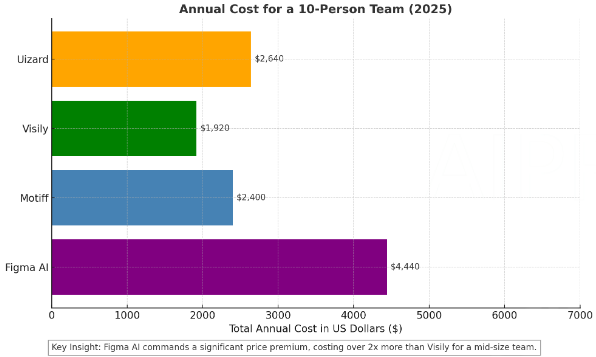
Annual cost for a 10-person team (2025)
Motiff: When your design system is the bottleneck
Let’s take a moment to discuss about design systems. You know how hard it is to build one from the start or keep one up to date as your product expands.
Parts grow in number. Changes keep happening.
- Someone makes a button style that is a little different because they couldn’t find the perfect one. Three months later, you have twelve copies of the same part, and no one knows which one to use. Your design system has turned into a design chaos.
- Motiff saw all this confusion and thought, “What if AI could really help you stay consistent instead of just making new things?”
- Their method is based on figuring out how the parts work together. When you make something new, the AI tells you how it fits into your current system. It warns you of inconsistencies before they become problems when parts start to move apart.
- It’s like having a very organised friend who sees you ready to put the cereal in the fridge instead of the pantry. They gently steer you away from the mistake before it becomes a habit.
- What does this mean in real life? Teams say they can construct design systems roughly 75% faster. Not because the AI performs everything, but because it takes care of the boring task of verifying for consistency that usually takes hours. One designer said it was like finally having an assistant who remembers where everything goes.
- The AI also cuts down on the time it takes to maintain parts by about 90%. This is more important than it seems. Design system upkeep might take up to a week of a designer’s effort per quarter for big goods. Designers can spend that time tackling real user problems instead of playing component detective.
- Who gets the most out of it? Larger teams and businesses where keep up with the design system is a big continuing expenditure. This can be too much if you’re a solitary designer or part of a small team that doesn’t have a lot of components. When you only have twenty parts, you don’t need a method for organising them that is as strong as a factory.
The main point here is simple yet crucial. Motiff sees keeping a design system up to date as the fundamental problem to address, not simply a nice extra. If that’s your primary problem, this particular concentration is more important than having the most features overall.
Visily: Speed over perfection
Now let’s move on to a very different problem.
- Picture yourself as a product manager who has to test a concept. Or a business owner who needs to demonstrate to investors a new idea. Or a designer who wants to quickly make five different mockups before really getting into one.
- You don’t need designs that are perfect down to the pixel yet. You need something excellent enough to see if the idea will work.
- Visily made an interesting bet here. They didn’t aim to compete with Figma on professional design capabilities. Instead, they made it ridiculously easy to move from an idea to a prototype. They weren’t going after designers who already know how to do their jobs well. It was everyone else who needed to communicate visually but hadn’t had years of design instruction.
- The main event is their screenshot-to-design feature. Visily can turn any interface into editable parts in around two minutes. This includes a competitor’s app, a doodle on paper, or a wireframe from a whiteboard.
- The accuracy is quite high. About 95% of the design features are correctly identified. Buttons turn into real button parts. Text fields turn into editable text. The different sections of navigation bars are shown separately.
- It takes about ten minutes to repair the last 5% by hand. It’s possible that the AI saw a complicated emblem as a basic form or that it missed a thin line that separated two things. But it’s still a lot faster than starting from scratch and rebuilding everything.
- Something is a real-life example of how something works. A product manager wants to find out if consumers would rather have a hamburger menu or tabs for navigation. With the past, they would have had to either explain this to a designer and wait for mockups or try to make it themselves with a design tool they didn’t really know how to use.
- They took screenshots of two existing apps that use distinct navigation patterns using Visily. They have editable prototypes of both ways with their own content, two minutes later. They can try out the idea that afternoon instead of next week.
- But you need to know what you’re giving up. You won’t be able to control and customise things as much as you can in Figma. Visily is designed to be fast and easy to use. Thus, certain complicated functions are made simpler or left out altogether.
- You can’t get into every pixel or make complicated component versions with dozens of characteristics. That’s on purpose. Those features would make the product slower and tougher for people who aren’t designers to use.
- Who should be concerned about this? Product managers who need to show concepts in pictures. Founders who wish to make a prototype before employing designers. Small groups where not everyone knows how to design. Anyone who has ever been annoyed by the time it takes to go from having an idea to showing it to someone else.
Sometimes it’s more important to test a concept fast than to make it flawless. Visily sees fast prototyping as a real way to work, not merely a way to save time or make do. That impacts who can be part of the design process, which is a big deal.
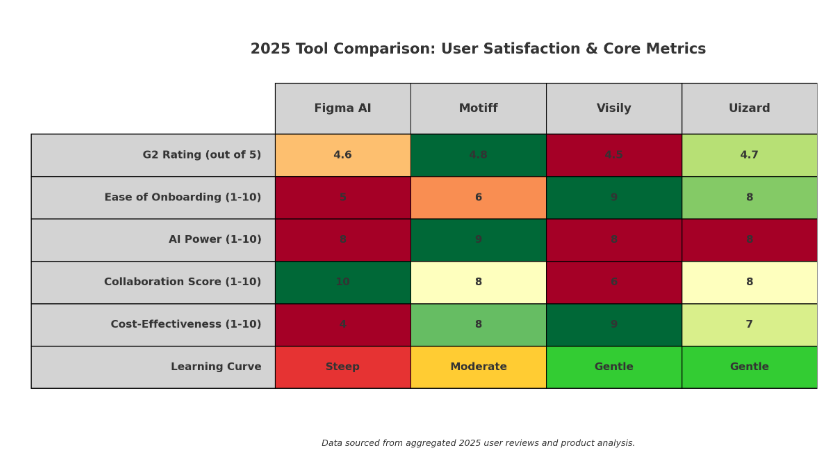
2025 Tool comparison: User Satisfaction & Core metrics
Uizard: Betting on flexibility
This is where things start to get fascinating in a new way.
- Motiff was an expert in design systems. Visily was all about speed. Uizard looked at the overall picture and raised a different question: Why make people work in a certain way?
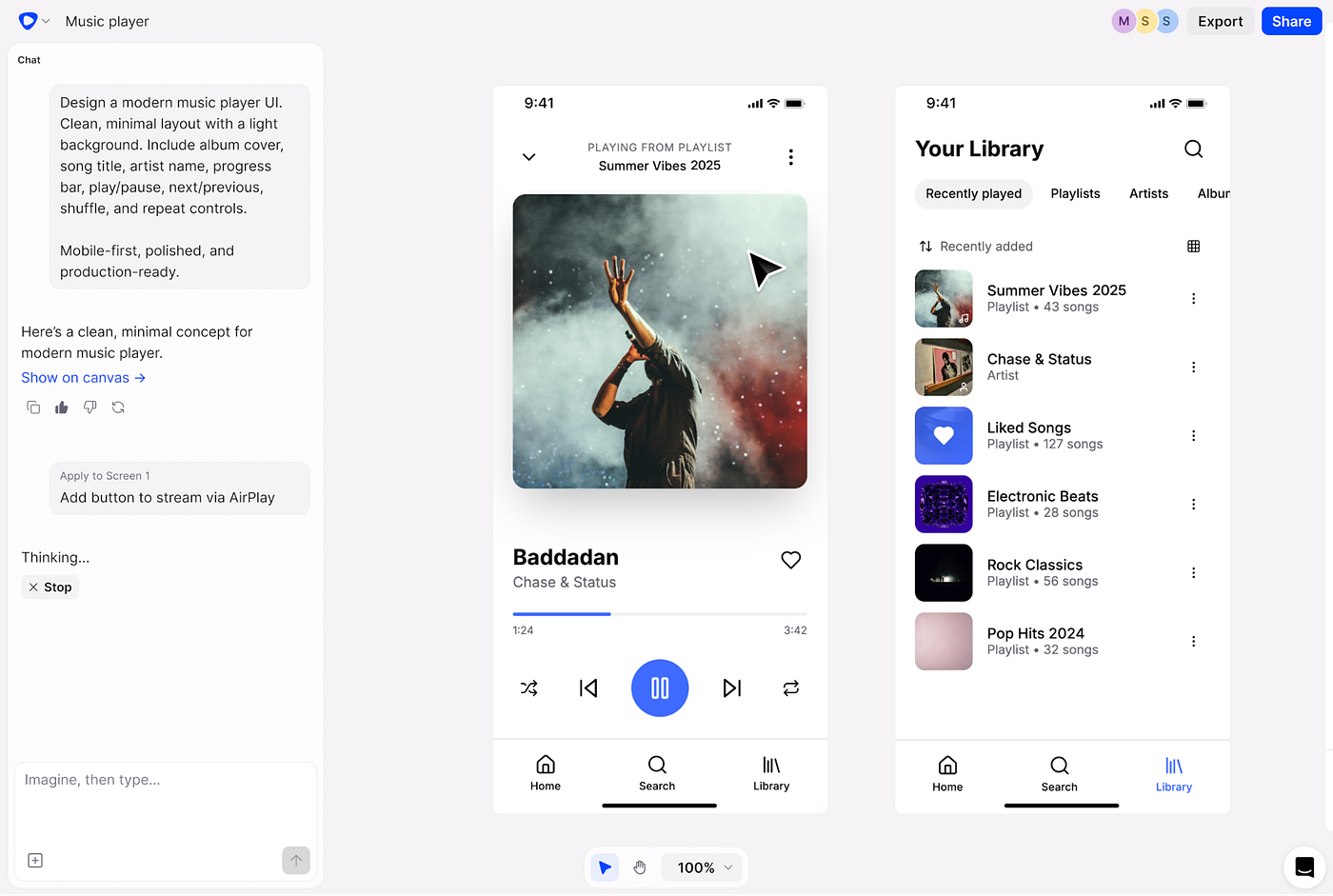
- They devised five alternative ways to input data. You can start with text prompts that tell you what you want in clear English. You can draw by yourself and let the AI figure out what your rough sketches mean. You can upload screenshots like Visily does. You can choose from their library of templates. You may drag and drop normal design parts.
- All five paths lead to the same place: a working model. But the trip appears very different depending on how you choose to imagine it.
- Some people think in terms of words and pictures. They want to type “make a dashboard with three charts and a sidebar” and have it show up. Some folks think in pictures and wish to draw rough shapes that get better over time. Some people wish to change something that already exists.
- Uizard argues that all of these are good places to start. Instead of making you adapt to it, the tool adapts to you.
- This flexibility gets much more intriguing with the Miro integration. There are more than 50 million Miro users, and a lot of teams are already using it for brainstorming and coming up with ideas. Sticky notes, rudimentary schematics, and sketches of user flows all live on Miro boards.
- You can pull that work right into design prototypes using Uizard without having to switch contexts or start from scratch. You may turn the sticky note that says “user dashboard” into a real dashboard design. The preliminary user flow diagram can make prototypes of the screens that go with it.
- This is important since switching contexts costs a lot. You lose a little bit of your mental state and momentum every time you switch tools. Anything that cuts down on wasteful tool-hopping saves mental energy for real creative work.
- Their library of templates is also very amazing. More than 1,000 pre-made screens for a variety of industries and uses. Not only general landing pages, but also things like healthcare dashboards, onboarding flows for fintech, product pages for e-commerce, and admin panels for SaaS.
- These templates are more than simply nice pictures. They are starting points that know how things usually work in certain areas. A healthcare dashboard template realises that keeping track of patients’ information, making appointments, and keeping track of medications are all important. You aren’t beginning from scratch.
- Who gets something good out of this? Groups that collaborate on different kinds of projects. Agencies that work with a variety of clientele who have diverse needs. Consultants who can’t say for sure what each job will need. People who become angry when tools presume that everyone works the same way.
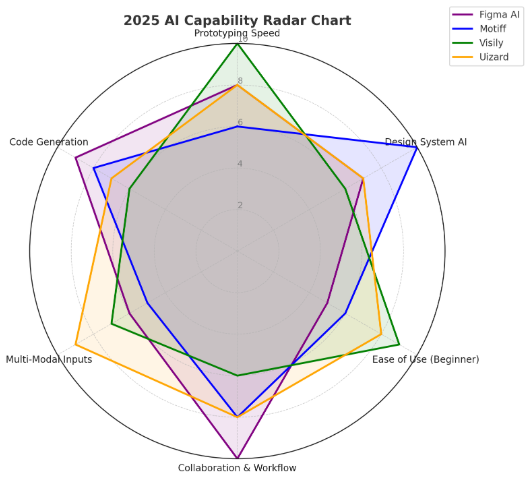
2025 AI Capability radar chart
It’s not about depth or speed in this case. It’s about the learning curve. More options to understand come with more flexibility. Some people find this freeing. They like having more than one option to handle an issue. Some people find it too much and would rather have tools that tell them exactly what to do.
Uizard thinks that being able to operate in diverse ways is more important than giving everyone the same workflow. That could be useful. However, it depends on how much variety your task really has.
Actually choosing between them.
So how do you really choose between these choices?
- The honest answer is that it depends on what issue you’re trying to fix.
- Start by thinking about some things. What is the most difficult part of your present workflow? Is it keeping things the same as the product grows? Is it moving quickly enough from idea to prototype that can be tested? Is it able to collaborate with team members who think and operate in various ways?
- The budget is important, but not simply the monthly expense. Also, think about how much time you can save. If Motiff saves your team ten hours a week on maintaining the design system, that extra expense might pay for itself rapidly. That’s a different kind of value if Visily helps your product manager make prototypes of concepts without taking a designer away from their other job.
- This is a basic way to think about price. It costs roughly $37 per person every month to get a Figma subscription with AI features. Visily costs about $15, Uizard about $20, and Motiff about $18. When you multiply those numbers by the size of your team and by twelve months, they look smaller.
- But the true math is more interesting. How much does it cost to clean up a chaotic design system? How much does it cost to put off testing an idea because it takes too long to make mockups? What happens when team members can’t join design talks because they don’t know how to use the tools?
- Be honest about how long it will take you to learn. Any new tool will take your staff some time to get used to. Most people can make their prototype in 15 minutes or less with Visily, which is arguably the easiest to learn. Uizard is in the middle, taking around 30 minutes to get the hang of it. Motiff has the hardest learning curve, taking one to two hours to understand all of its features, but it’s worth the time if design systems are a big part of your job.
And here’s something that people don’t talk about enough: you don’t have to choose just one.
- Many teams utilise multiple tools for different projects or parts of a project. Visily for quick prototyping in the early stages when ideas are still raw. Motiff for running the real production design system after you know what you’re making. Figma is great for thorough work with other individuals when they all need to be in the same file at the same time. Uizard for client projects that need to start in different ways.
- The tools aren’t truly competing with each other in the sense we generally think of competition. They are meeting various needs that happen to be in the same area.
- The best tool isn’t the one that has the most features or costs the least. It’s the one that fixes your specific problem without causing new ones. That’s different for everyone, which is why it’s important to have specialised choices.
The bigger picture
Let’s take a step back and see what’s really going on here.
- It’s not about one tool beating another. That’s not the true narrative. It’s about how the market for AI design tools is moving away from generic features and toward more specialised solutions. We’re seeing the market change from “AI can make designs” to “AI can fix this design problem in this way.”
- Figma’s AI features will likely get better over time. The company has more resources and input from users than smaller competitors. They made an amazing platform that altered the way designers work. But that doesn’t mean these other options aren’t still useful.
- What’s really remarkable is that design teams now have real options. You can choose tools depending on what you need to do, not just what everyone else is using or what works best with what you already have.
- That makes the market healthier. Innovation is driven by competition. When people specialise, they can come up with better answers to certain situations. When one company can’t meet all of your wants flawlessly, it leaves room for others to meet some of your needs very well. When there are real choices that challenge each other to get better, everyone wins.
- In a year, the landscape for AI design tools will be different. Some of these tools will provide you with new features. Some people could put features together in ways that are surprising. Figma could fill up the holes that gave competitors a chance to get ahead. That’s how markets that are in good shape work.
So, before you add Figma AI to your membership without thinking about it or wait forever to get access, stop and think about what problem you’re really attempting to solve.
Motiff might be better for you if you need to keep your design system up to date and consistent on a large scale. Visily might be the answer if you want to quickly make prototypes and make the design available to people who don’t design. Uizard is worth a look if you want a flexible workflow that can handle varied ways of working.
Start with the issue. After that, it becomes much easier to choose a tool.
This article’s goal is to give an unbiased comparison based on information that is available to the public and experiences that many users have had. Tools change quickly, so it’s always a good idea to examine their current features and prices before making a choice.
메타데이터
- post_id
- 8b64ec4a9305
- slug
- figma-alternatives-deep-analysis-of-motiff-visily-and-uizard-8b64ec4a9305
- url
- https://medium.com/@hashbyt/figma-alternatives-deep-analysis-of-motiff-visily-and-uizard-8b64ec4a9305
- canonical_url
- https://medium.com/@hashbyt/figma-alternatives-deep-analysis-of-motiff-visily-and-uizard-8b64ec4a9305
- author_url
- https://medium.com/@hashbyt
- status
- ok
- fetched_at
- 2026-06-15 20:49:13