Physical AI Has Hit a Wall. World Models Are the Way Through It.
Part of my current mandate is to scout the robotic workforce market: which platforms are real, which are demo videos, and which could…
Physical AI Has Hit a Wall. World Models Are the Way Through It.
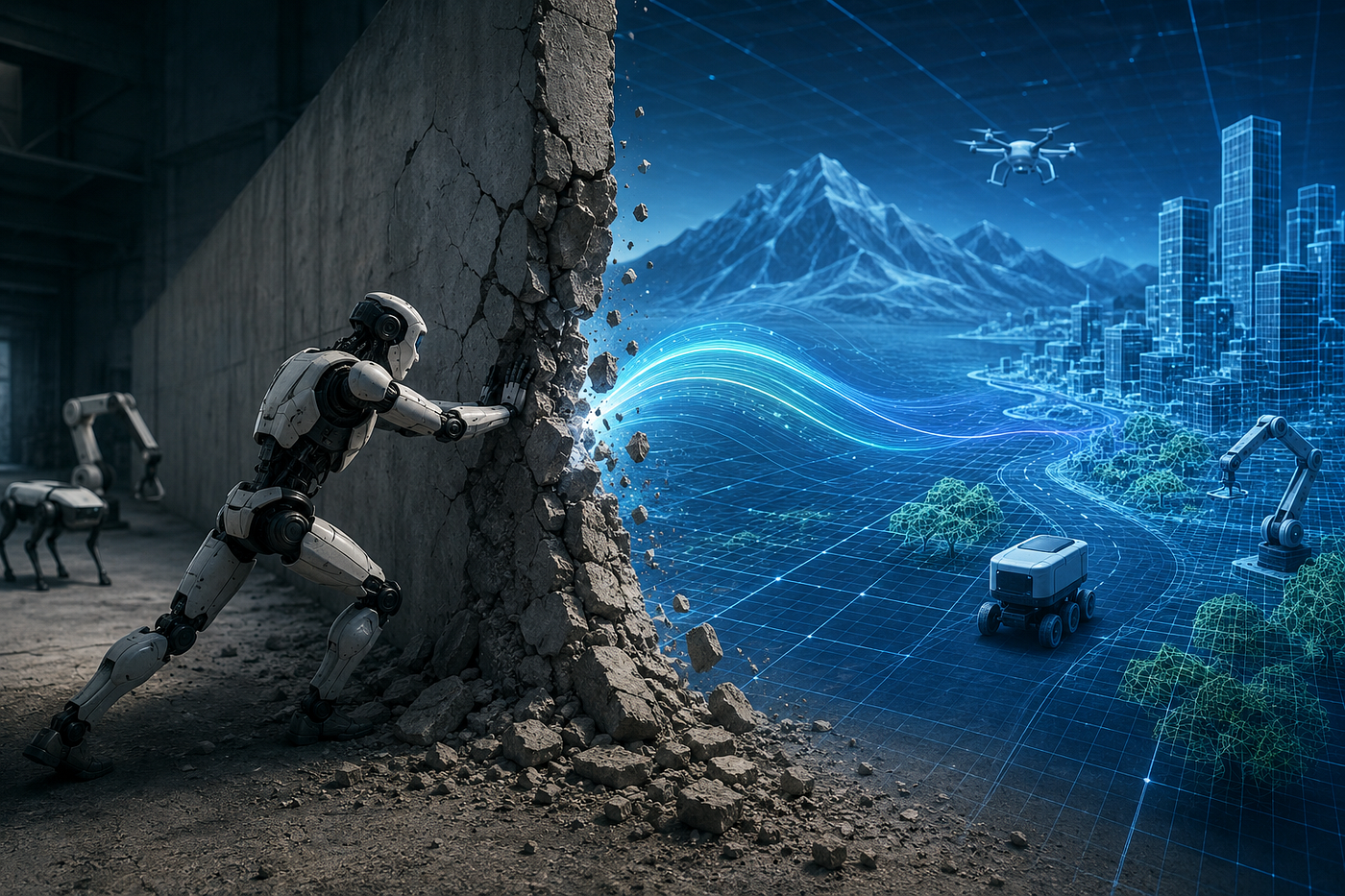
Part of my current mandate is to scout the robotic workforce market: which platforms are real, which are demo videos, and which could plausibly operate inside a live commercial or industrial environment in the next few years. That has meant sitting through a fair number of vendor pitches, but more usefully, it has meant visiting the factories and labs where these systems are actually built and tested, watching them fail in person rather than in a highlight reel.
A pattern shows up quickly once you’re standing on the factory floor rather than watching a curated demo. The robots are articulate. They follow spoken instructions, recognise objects they’ve never seen labelled before, and execute a plausible grasp on the first try. Then you ask for something slightly outside the script, a box in an unexpected orientation, a task with a longer sequence of dependent steps, and the confidence drops off a cliff. That gap between the polished demo and the messy edge case is not a training data problem that will quietly resolve with the next model release. It’s architectural.
I say this as someone who was genuinely won over by VLA models the first time I dug into them properly. I wrote at length (read it here) about how they replace the old disconnected pipeline of separate vision, language and action modules with a single unified network, and how models like OpenVLA and π0 made robots feel intelligent rather than merely programmed for the first time. That enthusiasm wasn’t misplaced. But the more time I’ve spent watching these systems operate outside a scripted demo, the clearer it has become that unifying perception, language and action in one network solves the coordination problem, not the foresight problem. A model can integrate everything it sees and hears beautifully and still have no way of knowing what its next move will actually cause.
For the past two years, the story of “physical AI” has followed a comfortable script: take the transformer architecture that worked for language, bolt on vision and action outputs, and let scale do the rest. Vision-Language-Action (VLA) models such as RT-2, OpenVLA and π0 have been genuinely impressive, and they’re the backbone of most of what I’ve seen on these visits. It looked, for a while, like robotics was about to have its own GPT moment.
It hasn’t happened, and it’s worth being precise about why. The limitation isn’t compute, and it isn’t ambition. It’s architectural. VLA models are, at their core, sophisticated pattern-matchers over demonstration data. They map what a robot sees and hears directly to what it should do next. That is a powerful trick, but it is still imitation, not understanding. Researchers surveying the field this year have been blunt about it: purely reactive VLA policies keep struggling with long-horizon reasoning, tracking which past action caused a current problem, and staying robust as small errors compound over a task.Purely reactive VLA policies remain limited in complex physical environments, where they often struggle with long-horizon reasoning, temporal credit assignment, and robustness under compounding errors.
Why the current generation runs out of road
A VLA model doesn’t ask “what happens if I do this?” before it acts. It has no internal rehearsal step. It reacts to the current frame, produces a motor command, and finds out the consequences the same way the robot’s actuators do: by living through them. Analysts covering the embodied AI space this year describe the same underlying problem in market terms. VLA systems have made real progress in closing the perceive-decide-act loop, but they remain closer to pattern imitation than to genuine physical reasoning, and they lack foresight about the consequences of their own actions.Robot large models represented by Vision-Language-Action models have made significant progress in the perception-decision-execution closed loop, but such models still face bottlenecks in coping with the high diversity and uncertainty of the physical world, and in essence are more like imitating patterns in training data, lacking the foresight of action consequences and the understanding of physical logic.
That single sentence explains most of the practical failures anyone who has spent time around real robot deployments will recognise:
- Data hunger. Generalising a VLA policy across tasks and environments takes hundreds of thousands of teleoperated demonstrations, and collecting that data on real hardware is slow, expensive and dangerous to scale.
- Latency. Real-time control loops typically need 50 to 100Hz. Even the fastest current VLAs strain to hit 10 to 20Hz on capable edge GPUs, which is a hard ceiling for anything requiring fine motor coordination.
- No safety guarantee. A classical control algorithm can be formally verified. A seven-billion-parameter neural network producing raw motor commands cannot, at least not with any rigour a safety engineer would sign off on.
- Brittleness under clutter and distraction. Small perturbations to lighting, layout or an unexpected object in frame degrade performance in ways that pure imitation learning has no principled way to recover from.
None of this means VLA models were a wrong turn. It means they were the first turn, not the last one.
What a world model actually adds
A world model is not a bigger VLA. It’s a different kind of component entirely: a learned simulator that predicts what the world will look like a few seconds after an action, before the action is taken. Give it the current state and a candidate move, and it returns a plausible next state. That is the missing piece that lets a system evaluate several possible actions internally, discard the ones that lead somewhere bad, and only then commit to the one it executes on real hardware.
This is exactly the direction NVIDIA has taken with its newer humanoid model. Rather than treating action generation as the only output, the architecture predicts the expected next observation alongside the action, effectively letting the robot imagine the outcome before it happens and catch likely failures in simulation rather than on the shop floor.This world model component lets the robot imagine the outcome of an action before executing it, catching likely failures in simulation before they happen on hardware. The world model is trained in a physics simulator and doubles as both a synthetic data generator and an online safety check, which directly attacks the two weakest points of pure VLA systems: data scarcity and unverifiable safety.
The research community is converging on the same conclusion from a different angle. A recent robustness study comparing “world action models” against classic VLAs found the world-model-backed systems held up far better under noise, lighting changes and layout perturbations, a difference attributed to the physical priors baked into the world model backbone rather than learned purely from demonstration.WAMs generally demonstrate strong robustness to noise, lighting and layout perturbations in both single-arm and bimanual settings, a robustness believed to be at least partially attributable to the spatiotemporal priors inherited from their world model backbones.
The field is already placing its bets
What makes this shift credible rather than speculative is who is funding it and how much. Google DeepMind’s Genie 3 generates persistent, explorable 3D environments in real time from a text prompt, and Waymo has already adopted it to build synthetic edge cases for autonomous driving that real robotaxis would rarely encounter on their own. Meta’s V-JEPA 2 learns physical intuition from roughly a million hours of ordinary video and then transfers that intuition to robot control with a comparatively tiny amount of real robot data, which is precisely the kind of leverage the data-hunger problem needs. Fei-Fei Li’s World Labs shipped Marble as a commercial 3D world-generation product. NVIDIA’s Cosmos platform builds synthetic training worlds from a reported twenty million hours of footage. And Yann LeCun left Meta specifically to pursue this thesis full-time, raising roughly a billion euros for a new lab built around the argument that language-model-style prediction will never get machines to genuine physical understanding, and that world models are the only credible path there.
That last point deserves more weight than it usually gets in boardroom AI conversations. This isn’t a case of researchers chasing an incremental benchmark improvement. It’s one of the field’s most senior architects making a public, well-funded bet that the current path (bigger transformers, more demonstration data, more parameters) has a ceiling, and that the ceiling is close.
The part of this story that gets underweighted: China
Most of the coverage of this shift, and most of my own reading before I started doing factory visits, centres on Silicon Valley and DeepMind. That’s a distorted picture. China is not a fast follower here. On hardware volume it’s already the market: Chinese manufacturers, led by AgiBot and Unitree, accounted for roughly 85 to 90 percent of global humanoid robot shipments in 2025, with Tesla, Figure AI and Agility Robotics each shipping only a few hundred units by comparison.In 2025, Chinese manufacturers, led by AgiBot at approximately 5,168 units and Unitree Robotics at approximately 5,500 units, accounted for roughly 85 to 90 percent of global humanoid robot shipments, according to multiple analyst estimates including Omdia and IDC, while American companies including Tesla, Figure AI, and Agility Robotics each shipped approximately 150 units. AgiBot rolled its 10,000th general-purpose humanoid off a Shanghai line within three years of founding, and Unitree cleared listing-committee review for a Shanghai STAR Market IPO in June, the first embodied AI company approved for China’s A-share market.On June 1, 2026, China’s humanoid robotics sector crossed two thresholds that had little to do with backflips: Unitree Robotics cleared the Shanghai Stock Exchange’s listing-committee review for a STAR Market IPO, the first embodied AI company approved for China’s A-share market, while two months earlier rival AGIBOT had rolled its 10,000th humanoid robot off its Shanghai assembly line. These aren’t lab prototypes; Walker S2 and equivalent platforms are already on the assembly floors of BYD, Foxconn, Audi FAW and, since January, Airbus.In early 2026, Ubtech signed a service agreement with Airbus, marking what the company describes as the first humanoid robot deployment in aviation manufacturing, with further partnerships in place with Siemens, Texas Instruments, Audi FAW, BYD, and Foxconn.
What’s easy to miss on the volume numbers alone is that the software stack underneath these robots is moving through the same architectural shift as everyone else, and in some cases moving first. Unitree open-sourced its own world-model-action framework rather than keeping the technique proprietary, a meaningfully different posture from most Western labs still guarding their world model architectures closely. Ubtech has built its industrial humanoids on a three-part stack that explicitly separates a language-and-reasoning layer from a dedicated world model component, branded internally as Thinker WM, sitting alongside its VLA layer rather than being treated as an optional add-on.The company has built a technology stack around large embodied intelligence models, including its Thinker embodied large model, a Vision Language Action model known as Thinker VLA, and a world model referred to as Thinker WM. Alibaba, meanwhile, has been investing directly in the world model layer rather than just the robots sitting on top of it, leading funding rounds in video-and-physics generation startups and framing the move explicitly as a bet that language models trained on text have hit their ceiling and that the next foundation has to be built on video and physical simulation instead.Alibaba Cloud is investing in a new type of artificial intelligence designed to better replicate the real world using a different approach from chatbots such as ChatGPT, recognising the limits of large language models trained primarily on text, as developers increasingly focus on world models built on videos and real-life physical scenarios.
This matters for anyone doing vendor evaluation, not just for the geopolitics. China’s advantage isn’t only cheaper manufacturing and a denser supply chain, though both of those are real. It’s that the volume of real-world deployment, tens of thousands of units now generating operational data across factories, logistics hubs and now aviation lines, feeds directly back into the world model training loop these companies are racing to build. Scale in hardware and scale in the physical data needed to train a good world model are the same flywheel. Anyone benchmarking robotic workforce vendors against a Boston Dynamics or Figure demo alone, without putting a Unitree, AgiBot or UBTech platform through the same evaluation, is working from an incomplete map of where the capability actually sits today.
What “beyond automation” actually looks like
It’s worth being clear-eyed about what problem this solves and what it doesn’t. A VLA model automates a task: it takes an instruction and produces a plausible action sequence for a scenario resembling its training data. That’s automation, and it’s valuable, but it’s fundamentally reactive. A world model adds the one capability automation has never had: foresight. The system can roll forward several possible futures, compare them, and choose the one that avoids the outcome nobody wants, before a single motor command is sent to real hardware.
That distinction is the difference between a warehouse robot that has memorised ten thousand box-picking demonstrations and one that can reason “if I grip here, this box is likely to slip, so I’ll adjust before I commit.” It’s the difference between a home-lab robotics hobbyist’s party trick and a system an insurer, a regulator or a board would actually be willing to certify for autonomous operation in a space with people in it.
For anyone advising boards on AI investment, that reframing matters more than the underlying architecture debate. The question worth asking a robotics vendor in 2026 isn’t “how large is your VLA and how much demonstration data did you train it on.” It’s “what does your system do internally before it commits to an action, and can you show me the simulated futures it rejected.” If the answer is nothing, you are buying automation with a language interface bolted on. If the answer involves a world model, you are looking at something closer to a system that can actually be trusted to operate in the physical world without a human standing by to catch its mistakes.
The VLA era proved robots could understand us. The world model era is the one that has to prove robots can understand consequences. That’s a much higher bar, and it’s the one that actually matters.
메타데이터
- post_id
- 8b68cd24ab0b
- slug
- physical-ai-has-hit-a-wall-world-models-are-the-way-through-it-8b68cd24ab0b
- url
- https://medium.com/@ianloe/physical-ai-has-hit-a-wall-world-models-are-the-way-through-it-8b68cd24ab0b
- canonical_url
- https://medium.com/@ianloe/physical-ai-has-hit-a-wall-world-models-are-the-way-through-it-8b68cd24ab0b
- author_url
- https://medium.com/@ianloe
- status
- ok
- fetched_at
- 2026-07-23 13:37:26