SRE and the Agentic Future of Production Systems
When AI agents become both the operators and the subjects of reliability engineering, what does it mean to run systems at scale?
SRE and the Agentic Future of Production Systems
When AI agents become both the operators and the subjects of reliability engineering, what does it mean to run systems at scale?
The Pager That Never Sleeps Is Getting Smarter
For the last two decades, Site Reliability Engineering has operated on a simple premise: humans write the rules, systems break them, and on-call engineers pay the price. A service degrades at 2 AM. PagerDuty fires. A bleary-eyed SRE opens a laptop, reads runbooks, runs kubectl commands, and either fixes it or escalates.
That model is under pressure — not from burnout alone, but from something more fundamental: the systems we now operate are too fast, too distributed, and too opaque for reactive human intervention to be the primary reliability mechanism.
The shift isn’t just automation. It’s agentic infrastructure — systems that observe, reason, act, and learn continuously without waiting for a human to pull the trigger.
“The next decade of reliability engineering won’t be about responding faster. It’ll be about building systems that make most responses unnecessary.”
What “Agentic” Actually Means for Production
The term “agentic AI” gets thrown around loosely. In the context of production systems, it has a specific, grounded meaning: an AI agent is a process that observes system state, selects actions from a policy, executes those actions, and updates its beliefs based on outcomes — in a continuous loop, without requiring synchronous human approval for each step.
This is categorically different from:
- Dashboards — passive visualisation requiring a human to interpret and act
- Automated scripts — fixed-rule execution with no reasoning layer
- Alert correlation tools — still producing a ticket for a human
A true agentic reliability system has four capabilities working together:
1. Situational awareness Real-time ingestion of metrics, traces, logs, deployment events, and dependency topology — with enough context to understand why an anomaly matters, not just that it exists.
2. Causal reasoning The ability to trace a symptom (elevated p99 latency) to a root cause (a misbehaving upstream dependency after a specific config change) without a human walking the graph.
3. Safe, bounded action Execution of remediations — traffic shifting, replica scaling, circuit breaker trips, cache invalidations — within pre-defined safety envelopes, with full audit trails.
4. Learning and calibration Updating remediation policies based on outcomes. Did the rollback actually fix it? Did auto-scaling cause a thundering herd? The system should know.
The New Stack: Observability for Agentic Systems
Here’s the uncomfortable irony: AI agents are among the hardest systems to make observable. Traditional metrics tell you a service is slow. But when the “service” is an LLM reasoning over incident context and choosing remediation actions, you need an entirely different telemetry layer.
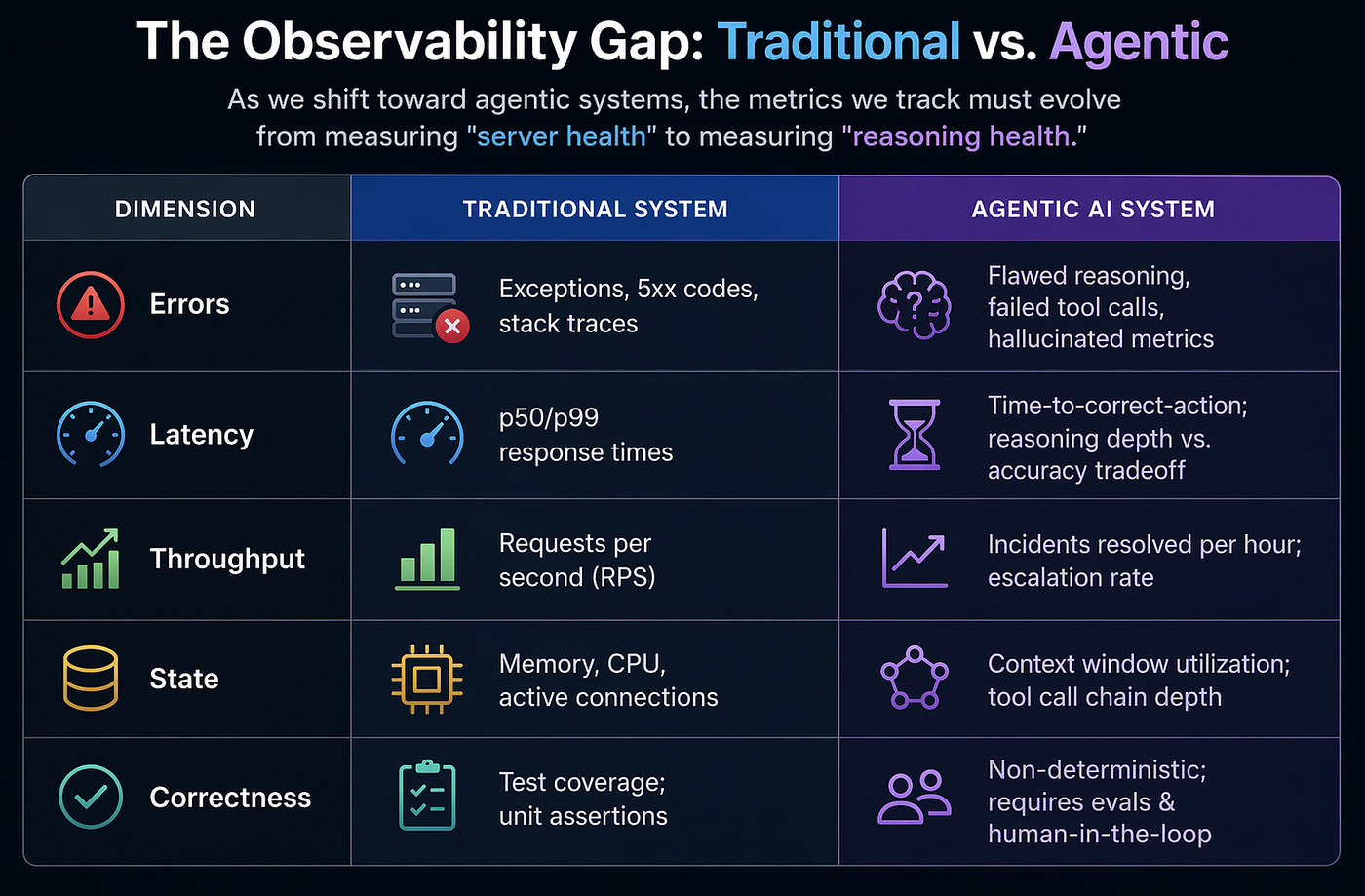
This means the SRE of the agentic era needs to build two observability planes simultaneously: one for the underlying infrastructure the agents manage, and one for the agents themselves. The agents are both the operators and the subjects.
The SRE Role Doesn’t Disappear — It Evolves
There’s a common anxiety among SREs when this topic comes up: “Are agents replacing us?” The honest answer is: agents are replacing the worst parts of the job — the 3 AM pages for things that could have been automated, the repetitive runbook execution, the alert fatigue from noise that dwarfs signal.
What expands is the work that humans are actually good at:
- Reliability policy design — defining what “safe action” means for each system, what an agent is and isn’t allowed to do, and at what confidence threshold it should escalate.
- Agent evaluation and red-teaming — injecting synthetic failure scenarios to test whether the agent reasons correctly under novel conditions. This is chaos engineering for AI.
- Runbook-to-policy translation — converting tacit human knowledge embedded in runbooks into structured decision policies that agents can reason over.
- Incident archaeology — reviewing agent actions post-incident to understand where its reasoning went wrong and how to improve the policy.
- Trust calibration — deciding progressively how much autonomy to extend as agents demonstrate reliable behaviour in production.
The SRE who thrives in the agentic future is part systems engineer, part ML ops practitioner, and part reliability policy author. The toil decreases; the cognitive leverage increases dramatically.
Real-World Patterns Emerging Today
This isn’t speculative. The following patterns are already being deployed in production at companies operating at scale:
Pattern 1 — Autonomous Incident Triage
When an alert fires, an agent automatically correlates it against recent deployments, dependency health, and historical incident patterns. It produces a structured triage document — likely root cause, blast radius, recommended next action — before a human even looks at the alert. MTTD (mean time to diagnose) drops from minutes to seconds.
Pattern 2 — Confidence-Gated Autonomous Remediation
The agent proposes a remediation action (e.g. “roll back the checkout service to the previous image”). If its confidence score exceeds a threshold and the action falls within its approved action set, it executes automatically and notifies the team. Below the threshold, it pages and presents the proposed action for human approval. This creates a graduated autonomy model rather than binary human/machine control.
Pattern 3 — Synthetic Load and Failure Injection
Agents continuously run low-level chaos experiments in non-production environments, automatically generating and evaluating system responses. SREs review the results and update reliability policies. The agent learns which failure modes are novel vs. understood; novel ones trigger human review automatically.
Pattern 4 — LLM-Native Observability
For companies running LLM inference in production, agents monitor not just latency and error rates but semantic quality signals: output coherence, context window utilisation, prompt injection attempts, and model drift. This is an entirely new class of telemetry that didn’t exist in the pre-LLM stack.
The Hard Problems We Haven’t Solved
Intellectual honesty requires acknowledging what remains genuinely difficult:
Compound action safety. An individual action might be safe; a sequence of individually-safe actions might not be. Ensuring agents reason about compound effects remains hard.
Explainability under pressure. When an agent takes an action that makes things worse, SREs need to understand the reasoning chain fast. Current LLM reasoning traces are verbose and inconsistent.
Trust calibration in novel failure modes. Agents trained on historical incidents may be overconfident about failure modes that look superficially similar to past incidents but are actually novel.
Multi-agent coordination. As organisations deploy multiple specialised agents (one for databases, one for networking, one for the application layer), coordinating their actions safely without conflicts is an open problem.
Regulatory and audit requirements. In regulated industries, autonomous system changes require audit trails that current agentic frameworks don’t produce consistently.
Starting Points for the Next 12 Months
If you’re an SRE or engineering leader thinking about where to start, here’s a pragmatic sequence:
1. Instrument your incidents. Before building agents, build the training data. Structure your incident reports with consistent fields: timeline, root cause, remediation steps, and outcome. This becomes the corpus your agents reason over.
2. Automate triage before remediation. Start with read-only agents that produce triage summaries. This builds trust and surfaces gaps in your observability without the risk of automated action going wrong.
3. Define your action taxonomy. Write down every action an agent could take, classify them by blast radius and reversibility, and define the conditions under which each is pre-approved for autonomous execution.
4. Build evals before you build agents. Define what “correct” looks like for your reliability agents — specific scenarios with known right answers. Without evals, you have no way to know if a model change improved or regressed agent behaviour.
5. Extend autonomy incrementally. Gate autonomous action behind confidence thresholds. Log every agent decision, whether executed autonomously or surfaced to a human. Review the logs weekly and expand the action set as trust accumulates.
“The measure of a great SRE organisation won’t be how quickly engineers respond to incidents. It’ll be how rarely incidents require a human response at all — and how gracefully they handle the ones that do.”
The agentic future of production systems is not a threat to SRE as a discipline. It’s an upgrade to what the discipline can accomplish. The engineers who will shape it aren’t just on-call heroes — they’re architects of the systems that remove the need for heroics in the first place.
The question isn’t whether agents will operate your production systems. It’s whether you’re designing the policies, guardrails, and feedback loops that make them trustworthy when they do.
메타데이터
- post_id
- 8b7207eab1e1
- slug
- sre-and-the-agentic-future-of-production-systems-8b7207eab1e1
- url
- https://medium.com/@tripathy-sibaprasad/sre-and-the-agentic-future-of-production-systems-8b7207eab1e1
- canonical_url
- https://medium.com/@tripathy-sibaprasad/sre-and-the-agentic-future-of-production-systems-8b7207eab1e1
- author_url
- https://medium.com/@tripathy-sibaprasad
- status
- ok
- fetched_at
- 2026-07-17 06:11:15




