Two Years Later, the Butler Shooting Still Won’t Stay Closed
Trump’s Near-Assassination Still Has No Clean Answer
A Pattern, Not an Aberration
Two Years Later, the Butler Shooting Still Won’t Stay Closed
Trump’s Near-Assassination Still Has No Clean Answer
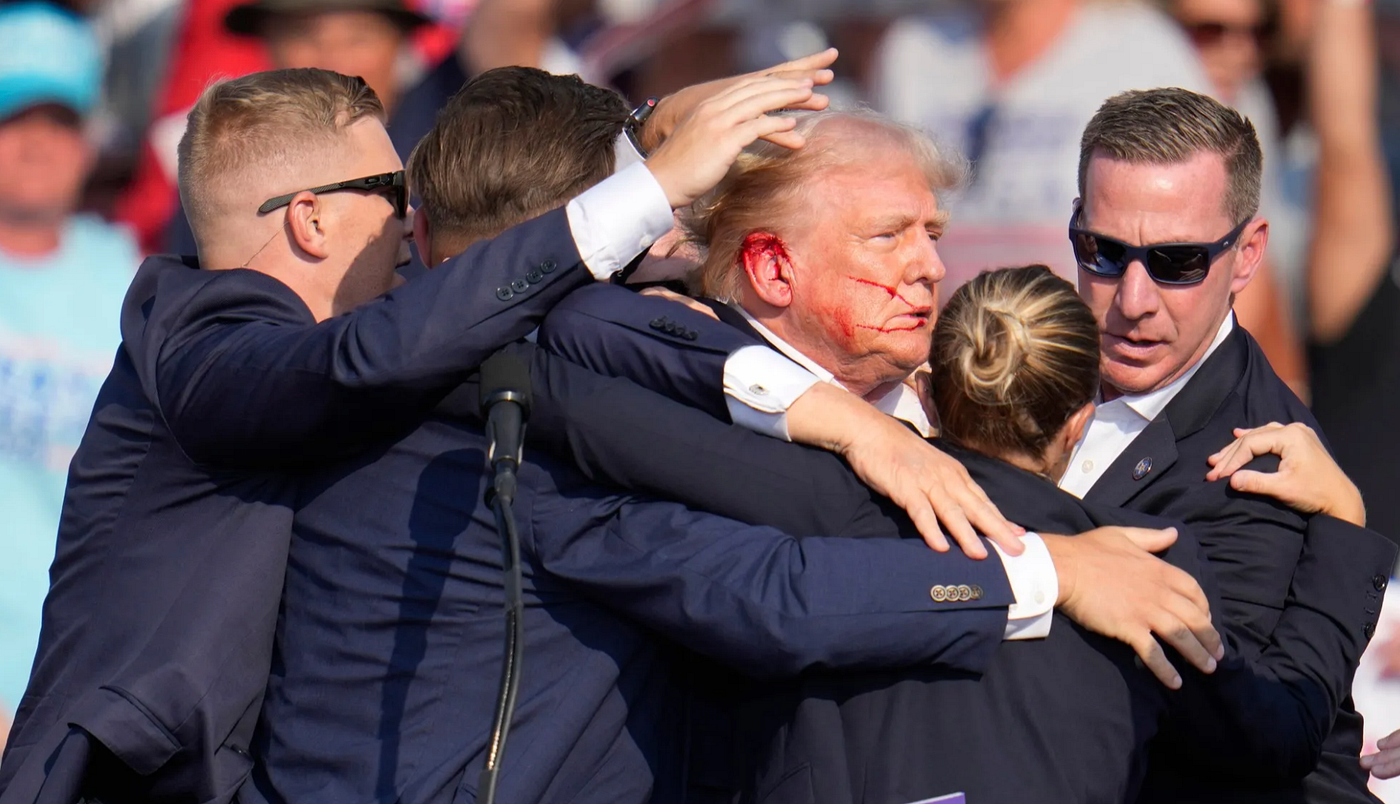
Secret Service director, grilled by lawmakers on the Trump assassination attempt, says ‘we failed’ — Sun
This never sat right with me.
How does an entire crowd see a man on a roof with a rifle before the Secret Service does? That question has bothered me since July 2024, and nearly two years later, it still has not been answered in a way that makes sense.
I kept thinking about Muhammad Abdul-Raheem’s memoir, The N-Word Is No Secret In The Service: Memoirs Of A Black Man In The U.S. Secret Service.

Photo taken by Author (2026)
Abdul-Raheem spent over a decade as a Secret Service officer under Presidents Bush and Obama, and his book lays out, from the inside, the dysfunction and institutional rot he says he witnessed throughout the agency.
He never wrote about Butler. He could not have; the shooting happened years after his book was published. But the culture he describes, an agency he says was more invested in protecting its own hierarchy than in doing its actual job, makes Butler easier, in a grim way, to understand.
An agency like that is exactly the kind of agency that could let a credible, twenty-five-minute warning die somewhere between a state trooper’s radio and a former president’s own security detail.
Because that is what actually happened.
Not a theory or a transcript read aloud by people guessing on a podcast. A bipartisan United States Senate investigation found it, named it, and put it in writing.

Trump rally shooting: “One in a million shot” killed Thomas Crooks, USSS claims | LiveNOW from FOX
Nearly two years after a twenty year old named Thomas Matthew Crooks climbed onto the roof of a glass manufacturing building in Butler, Pennsylvania, and opened fire on a presidential campaign rally, the public record around that day is still being fought over in real time, in public, on social media, between people who are supposed to be on the same side.
Crooks fired eight rounds. One grazed Donald Trump’s ear. Two rallygoers were wounded. A third, a retired volunteer fire chief named Corey Comperatore, was killed while shielding his family from the gunfire.
A Secret Service countersniper shot and killed Crooks within seconds of the first shots. That much has never been in dispute.
What has remained in dispute, for almost two years, is how a twenty year old with a rangefinder and a rifle was able to get within roughly 150 yards of a former president with an unobstructed line of sight, and what, if anything, law enforcement knew about him beforehand.
That question has produced a year-long bipartisan Senate investigation, six suspended Secret Service agents, multiple federal lawsuits from rally victims, and, as of this month, a public brawl between a conservative watchdog group and the FBI’s own press office that ended with one side deleting its claims and apologizing to a sheriff’s office it had nothing to do with.
This piece lays out what is actually documented, what was claimed and retracted, and what remains genuinely, officially unresolved.
It does not start from the premise that the shooting was staged. It starts from the premise that institutions tasked with protecting a presidential candidate failed in ways that are now a matter of bipartisan congressional record, and that the public’s difficulty getting straight answers since then has made room for every theory imaginable to fill the gap.
What the Senate actually found
In July 2025, exactly one year after the shooting, the Senate Homeland Security and Governmental Affairs Committee released a final report that did not equivocate.
Committee chairman Rand Paul’s investigators had spent a year conducting seventeen transcribed interviews with Secret Service personnel and reviewing more than 75,000 pages of documents from federal, state, and local agencies.
Their conclusion was that the agency’s failures amounted to a
“cascade of preventable failures”
that nearly cost President Trump his life, building on a preliminary report issued in September 2024.
The specifics are damning on their own terms, without any need for embellishment. A Pennsylvania State Police officer flagged Crooks as suspicious, carrying a rangefinder, at least twenty-five minutes before he opened fire.
That warning reached a Secret Service agent in the command post but never made it out over the radio to Trump’s actual security detail in time to act on it.
The rooftop Crooks eventually climbed was left unguarded entirely, despite having a clear, unobstructed sightline to the stage from about 135 meters away, and one of the agency’s own countersniper teams had an obstructed view of that same roof.
Perhaps most damaging to institutional credibility:
the committee found that Secret Service headquarters had denied multiple requests from Trump’s protective detail for additional staffing and equipment in the run-up to the rally, including specific requests tied to Butler itself, and that then-Director Kimberly Cheatle had told Congress under oath that no such requests had been denied.
The Senate report concluded that was false.
In the end, the agency that allowed a sitting former president to be shot at a campaign event did not fire a single person. Six employees were suspended without pay, several of them as late as July 2025, and in at least two cases the final discipline was softer than what investigators had originally recommended.
Two of the men wounded that day have since sued the federal government, citing the Senate’s own findings of gross negligence as the basis for their claims.
None of that requires a staged-event theory to be alarming. It is alarming as stated, in the bipartisan, on-the-record conclusion of a Republican-led Senate committee.
The FOIA fight nobody expected
The most recent chapter in this story has nothing to do with the Secret Service, and almost nothing to do with Trump’s security detail.
It involves Judicial Watch, the conservative legal watchdog group long associated with pursuing records requests against Democratic administrations, and a Freedom of Information Act lawsuit it filed against the Department of Justice in July 2025, a full year after Crooks tried to kill Trump, after the FBI failed to respond to its original 2024 records request.
That lawsuit forced the release of 48 pages of FBI material, almost all of it redacted.
Among the documents was a July 2024 FBI summary of interviews conducted with five deputies from a Butler County Sheriff’s Office, in which one deputy described having exchanged two emails with Crooks before the shooting, with the substance of those emails redacted.
The same records described a SWAT officer recovering a gray remote device with an antenna, along with a cellphone, from Crooks’s pocket after he was killed.
Judicial Watch’s president, Tom Fitton, announced the email detail publicly, framing it as evidence the FBI was sitting on a major story, and accused the bureau of “slow rolling” the release.
The FBI’s newly created Rapid Response account on X did not respond with a quiet correction. It went after Fitton directly, calling the claim a clickbait lie, and stating that the unredacted underlying documents actually showed the deputy was contacted by college instructors about coursework, not law enforcement officers communicating with Crooks before the attack.
This is where the story gets genuinely strange, and where independent verification matters most, because both halves of that exchange turned out to be wrong in different ways.
Judicial Watch’s original framing fell apart fastest. Within days, the organization quietly deleted its initial release and published an update acknowledging the records had been misread:
the deputy who exchanged emails with Crooks was not in Butler County, Pennsylvania, at all. The deputy worked for the Butler County Sheriff’s Office in Ohio, an entirely different agency in an entirely different state, and the office had nothing to do with the Pennsylvania shooting.
The Ohio sheriff, whose name and that of his deputy were spread across social media before the correction, told a local paper he was glad Judicial Watch had updated its release but was frustrated by the damage already done to his office and to
“that young female deputy whose name and face was irresponsibly placed all over social media.”
So a real person, with no connection to the Trump shooting whatsoever, had her name and image circulated nationally because of a sourcing error in a FOIA release. That is a serious failure of verification, and it happened on the watchdog side, not the government side.
But the FBI’s counterattack does not come out clean either.
Independent fact-checks of the underlying redacted documents found that the bureau’s own framing, that the records showed nothing but a college instructor discussing coursework, was itself an oversimplification of records so heavily blacked out that even close readers reached different conclusions about what they showed.
A community note attached to the FBI’s own social media post pushed back on the bureau’s characterization, noting that the released summaries did include an interview with a Butler County, Pennsylvania deputy who confirmed exchanging two emails with Crooks, separate from the Ohio mix-up.
What is left, once the partisan framing on both sides is stripped away, is this:
heavily redacted federal records exist describing pre-shooting contact between Crooks and at least one law enforcement-adjacent figure, the exact nature of that contact has not been made public, a federal agency and a federally focused watchdog group spent a week publicly accusing each other of lying about what their own documents say, and an uninvolved sheriff’s deputy in another state had her name dragged through it because nobody slowed down to check jurisdiction before hitting publish.
The device in Crooks’s pocket
One detail in the FOIA release has drawn far less attention than the email dispute, and arguably deserves more:
the gray remote device with an antenna, found alongside a cellphone in Crooks’s pocket after he was killed.
Multiple outlets reporting independently on the same FBI records confirm this detail consistently. A SWAT officer recovered the device and the phone from Crooks’s body following the shooting.
The FBI has not, in any public statement reviewed for this piece, offered an explanation of what that remote device was for, whether it was tested, or whether it factored into the bureau’s eventual conclusion, delivered by Director Kash Patel, that Crooks acted alone, a finding reached after an investigation that involved 485 agents and more than 1,000 interviews.
A remote device with an antenna, found on a shooter’s body, is the kind of detail that in any other context would generate its own news cycle. Here it has largely been overshadowed by the louder fight over the emails.
Is this evidence of a cover-up? Or is it is evidence that when government agencies and partisan watchdogs spend their public bandwidth attacking each other’s credibility, the actual unanswered technical questions tend to get buried under the noise?
A pattern, not an aberration
Abdul-Raheem’s central argument, that the Secret Service’s failures are cultural and structural rather than the product of one bad day, holds up against the agency’s own documented record going back well over a decade.
None of what follows is in dispute. It comes from inspector general reports, congressional hearings, and the agency’s own admissions.

Couple slips though security to crash state dinner — San Diego Union-Tribune
In 2009, an uninvited couple, Tareq and Michaele Salahi, walked through two Secret Service security checkpoints and into a White House state dinner without being on the guest list, mingling with the vice president and the sitting administration’s chief of staff before anyone realized they did not belong there.
In November 2011, a man parked outside the White House and fired a semiautomatic rifle at the building while Sasha Obama was inside and Malia Obama was on her way home. A Secret Service supervisor mistook the gunfire for a car backfiring and ordered officers to stand down. The agency did not determine that the White House had actually been struck by bullets for four days, and only then because a housekeeper noticed broken glass.
In April 2012, ahead of a presidential trip to Colombia, a dozen or more Secret Service agents and officers were implicated in a prostitution scandal in Cartagena, partying with sex workers the night before President Obama’s arrival. A Justice Department investigation followed. Several agents lost their jobs, resigned, or had their security clearances revoked.
In September 2014, a man named Omar Gonzalez climbed over the White House fence carrying a knife and made it all the way to the East Room of the executive residence before being stopped, exposing what a Department of Homeland Security inspector general later attributed to communication breakdowns, faulty radios, and notification failures among Secret Service personnel that night. The agency’s director resigned over the incident.
In July 2024, after the Butler shooting, then-Director Kimberly Cheatle told a bipartisan House committee under oath that the attempt on Trump’s life was the most significant operational failure at the Secret Service in decades, comparing it to the failed 1981 attempt on President Reagan. She resigned the next day under pressure from members of both parties.

CLICK BAIT LIE!’ FBI Attacks Right-Wing Group Claiming Bureau is ‘Slow Rolling’ Release of Records Connected to Assassination Attempt On Trump
The FBI’s newly created Rapid Response account on X did not respond with a quiet correction. It went after Fitton directly, calling the claim a clickbait lie, and stating that the unredacted underlying documents actually Service indexed several hundred people who could have accessed the area, found no usable fingerprints or DNA on the packaging, and stated it had no surveillance footage that offered any investigative leads. The case was closed without anyone ever being identified, in a building protected around the clock by the same agency responsible for the president’s life.
In July 2022, the Department of Homeland Security’s inspector general told Congress that the Secret Service had erased text messages from agents covering January 5 and 6, 2021, the day of and day before the Capitol attack, after the inspector general’s office had already requested those records.
The Secret Service disputed the timeline and denied any deletion was deliberate, saying the data loss happened during a pre-planned phone migration that began before the formal request arrived. The inspector general’s office did not accept that account at face value, and the dispute over what happened to those specific records, covering one of the most scrutinized two-day periods in recent American history, was never fully resolved.
In the years around the 2014 fence-jumping scandal, the inspector general also found that top Secret Service officials had diverted agents assigned to presidential protective intelligence at the White House for five straight days to instead monitor a colleague’s personal neighborhood dispute, fifty minutes away, because, in the agency’s own internal reasoning,
“you look after your people.”
Journalist Carol Leonnig, who won a Pulitzer Prize for her Washington Post reporting on the Cartagena scandal, later expanded her reporting into a book, Zero Fail:
The Rise and Fall of the Secret Service, which traces these failures to chronic underfunding and what she and others inside the agency described as a bro culture that prioritized loyalty and image over discipline and protective competence.
That is the institutional backdrop Abdul-Raheem’s memoir adds a missing piece to, the lived account of a Black officer who served inside that same agency under two presidents and says the dysfunction he witnessed was inseparable from how the agency treated its own people.
An organization that, by its own watchdogs’ repeated findings, has stood down during actual gunfire, lost track of bullet holes in the White House for four days, and pulled protective intelligence agents off the president’s detail to settle a coworker’s personal dispute, is not an organization where a single missed radio call in Butler should surprise anyone.
It is the same pattern, with much higher stakes.
Why the suspicion took root in the first place
It is worth being honest about why so many people, across the political spectrum, found the original event difficult to accept at face value, separate from anything in the new FOIA documents.
The Senate’s own findings are the best explanation available, and they do not require speculation.
A young man was able to access a rooftop with a direct sightline to a presidential candidate after having already been flagged as suspicious by state police twenty-five minutes earlier.
The Secret Service’s own internal communications about that threat did not reach the people who needed them in time. The agency’s director told Congress, under oath, that no protective resources had been denied to Trump’s detail, and the Senate later determined that was not true.
Nobody was fired. The investigation that established all of this was not run by Trump’s opponents. It was run by a Republican-controlled Senate committee, chaired by a senator from Trump’s own party, who said publicly that the consequences imposed so far do not reflect the severity of what happened.
When official accountability lands that softly after a failure that nearly cost a presidential candidate his life, public skepticism is not irrational. It is a predictable response to watching an institution mark its own homework.
The error is not in asking hard questions about Butler. The error is in assuming that because the official response was inadequate, the underlying event must therefore have been theater. Those are two different claims, and the evidence supports only the first one.
Where things stand now
As of this month, the email dispute between Judicial Watch and the FBI remains publicly unresolved in its particulars, even after the Ohio correction. The Pennsylvania deputy’s confirmed two-email exchange with Crooks, separate from the Ohio case, has not had its contents disclosed.
The remote device found in Crooks’s pocket has not been publicly explained. Two Secret Service civil lawsuits from wounded rallygoers are proceeding through the federal court system, built directly on the Senate’s own findings of negligence.
And the FBI, an agency that traditionally avoided public spats with outside groups over redacted FOIA productions, now runs a combative rapid-response social media account that picks fights with the people requesting its records, in language that reads more like a campaign account than a law enforcement agency.
None of that adds up to a staged assassination attempt. It adds up to something almost more troubling in its ordinariness:
a federal government that, two years on, still cannot manage a transparent, consistent account of one of the most significant security failures in modern Secret Service history, and watchdog institutions, on every side of the political spectrum, that are increasingly willing to publish first and verify second.
A real person in Ohio paid the price for that this month. The next person who pays it might not get a correction.
If you’re tired of choosing between “it was staged” and “nothing to see here,” and you wanted someone to actually show their work, give this piece some claps. The Secret Service has failed publicly, repeatedly, for over a decade, and somehow that’s still less talked about than a conspiracy theory. Give this piece some more claps if you’d rather know the real pattern than settle for the comfortable lie.
Further Reading
Mediaite’s coverage of the FBI/Judicial Watch public dispute over the Butler FOIA records
Muhammad Abdul-Raheem, The N-Word Is No Secret In The Service: Memoirs Of A Black Man In The U.S. Secret Service
Carol Leonnig, Zero Fail: The Rise and Fall of the Secret Service
NPR coverage of the Senate committee’s findings on Secret Service communication failures
Butler Eagle reporting on the Ohio sheriff’s office correction request
PBS News, one-year retrospective on unresolved questions at the Secret Service
메타데이터
- post_id
- 8b827eccbbbf
- slug
- two-years-later-the-butler-shooting-still-wont-stay-closed-8b827eccbbbf
- url
- https://medium.com/illumination/two-years-later-the-butler-shooting-still-wont-stay-closed-8b827eccbbbf
- canonical_url
- https://medium.com/illumination/two-years-later-the-butler-shooting-still-wont-stay-closed-8b827eccbbbf
- author_url
- https://medium.com/@jusbouey
- status
- ok
- fetched_at
- 2026-06-22 05:41:33