Between Order and Control: Policing San Francisco Chinatown, 1849–1957
In the half-century before the 1906 earthquake, San Francisco’s Chinatown was not simply a neighborhood under police jurisdiction. It was a…
Between Order and Control: Policing San Francisco Chinatown, 1849–1957

Police department oficers from Company A, Division 2, pose for a group photo in 1894. Photographer unknown (from the collection of the San Francisco Police Department).
In the half-century before the 1906 earthquake, San Francisco’s Chinatown was not simply a neighborhood under police jurisdiction. It was a space through which the limits of municipal authority were tested across racial, legal, and institutional lines. For Chinese residents, excluded from meaningful participation in civic life, the San Francisco Police Department became both the most immediate representative of the state and, at times, its most unpredictable instrument. For the police, Chinatown was at once a site of perceived disorder, a field of specialized enforcement, and a community whose internal structures resisted easy translation into American law. The relationship was neither static nor reducible to a single narrative, but evolved through recurring patterns of distance, misrecognition, and negotiated dependence.
Policing the Gold Rush Port
The earliest encounters between police and Chinese residents unfolded within the volatile conditions of a Gold Rush port. The Chinese population, small at first but growing rapidly after 1850, organized itself through district associations and kinship networks that mediated labor, housing, and dispute resolution. These institutions were legible within a South China context; they were far less so within an American legal framework.
Police contact in these years was episodic and often reactive. Chinese residents appeared in early records primarily as victims of assault and theft, frequently at the hands of non-Chinese actors. At the same time, figures such as Norman Assing — merchant, community leader, and political intermediary — served as visible points of contact with municipal authorities, including the police.
Yet even at this early stage, the police encountered forms of organization they did not understand.
The January 1854 raid on a Jackson Street gathering — led by City Marshal Brandt Seguine — remains instructive. Acting on a tip, officers forced entry into a crowded ceremonial space, arrested 159 men, and brought them before the Recorder’s Court. Contemporary newspaper accounts recorded testimony describing elaborate oaths, symbolic language, and a fraternal structure in which initiates were bound “as though they were of the same bone and flesh,” and required to adopt the surname “Hung.” The testimony of the merchants, “Tong R. Achick” in particular, also pointed to the exaction of money from prostitutes and Chinese merchants on Sacramento Street, suggesting that coercive economic practices were already intertwined with these associations at an early stage. The proceedings yielded little admissible evidence, and most of the detainees were released.

“The Chinese Case,” from the Daily Alta California, January 5, 1854. This report probably represents the first recitation of a portion of the bylaws of a secret society dedicated to the restoration of the Ming dynasty, some of the provisions of which were reported as follows: “ — Ist. After entering into this gate to learn the regulations of the society and keep the secrets, father may not inform the son, nor the son the father. Nothing shall leak out. — 2d. All are to have the same father and the same mother, after entering this gate, and the son of one is to be the nephew of another, and the wife of one the sister-in-law of another. — 3d. Not to molest the chief, nor injure the brethren. If any one shall do this, he shall be killed by ten thousand knives. — 4th. Not to transfer the secrets to another. If he does he is to be killed by ten thousand knives. — 5th. To help any brother who gets into difficulty, and to take him away. — 6th. Any person so covetous of wealth as to give up a brother for whom a reward has been offered, is to be drowned, and his corpse swallowed by the animals of the sea.”
What the officers had in fact disrupted was almost certainly an early manifestation of the Hungmen Hui (洪門會, canto: “hung4 mun4 wui4”) tradition — the transnational secret society network from which organizations such as the Chee Kung Tong (致公堂, canto: “zi3 gung1 tong4”) would later emerge in the Chinese diaspora. Nineteenth-century observers lacked the conceptual framework to identify these associations, variously describing them as “conspiracies” or “mysterious societies,” but the features recorded in the Daily Alta account — the oath-taking, fictive kinship, and ritualized entry — closely track known Hungmen practices.
The episode thus represents more than a failed prosecution. It may also mark one of the earliest documented encounters between American law enforcement and the institutional forms of Chinese secret society organization in San Francisco. In that encounter, authority was immediate, but understanding was not. Police intervention preceded comprehension and even rudimentary intelligence operations; legal institutions struggled to translate Chinese social structures into categories that could sustain prosecution.

“Bullying the Chinese,” San Francisco, c. 1855, signed “Chapman.” Artist unidentified (from the collection of the Bancroft Library). This mid-1850s cartoon depicts the assault of Chinese residents by figures in plainclothes wearing star-shaped badges, suggesting police or deputized authority. Produced at a moment when San Francisco’s municipal police institutions were still taking shape, it is likely the earliest surviving visual representation of official authority confronting the Chinese community. Set before a “Police Office” and “Recorder,” the scene suggests not the absence of law, but its uneven application. Violence appears here as an extension of authority rather than a breakdown of it, reflecting the ambiguous and often precarious position of Chinese residents in early San Francisco. At the same time, the image points to an emerging duality in policing: law enforcement operating not only as a guarantor of public safety, but also as an instrument for managing and controlling segments of the city’s population.
By the mid-1850s, two overlapping systems of violence had become visible. Chinese residents in San Francisco and throughout California remained vulnerable to assault by white offenders, often with limited effective protection.
At the same time, evidence accumulated — through police observation, press accounts, and court testimony — of internal coercive practices within Chinatown. These included extortion schemes directed at Chinese women and merchants, enforcement of obligations by secret societies, and the emergence of organized protection networks (Mullen, Chinatown Squad, 22–25).
The difficulty, then as now, lay in disentangling perception from structure. Contemporary observers often collapsed all Chinese associations into a single category of criminal conspiracy. Yet the record suggests something more complex: legitimate district associations, mutual aid societies, and criminal organizations existed in overlapping networks, with individuals moving between them. Mullen himself acknowledges the likelihood of “cross-membership” between ostensibly lawful and unlawful bodies, even in this early period (Ibid., 23).
For the police, this produced an enduring ambiguity. Chinatown was at once a community requiring protection and a space requiring surveillance and, increasingly, the enforcement of laws that disproportionately targeted the Chinese population. In practice, it was treated as both, though not always in equal measure.

“The Guardian of the Peace,” The Illustrated Wasp, January 8, 1881. Illustration by Frederick Keller (from the collection of the Bancroft Library). In this composite satire, Keller contrasts the uneven application of law enforcement across San Francisco society. Police are shown deferential toward white respectability and largely passive in the face of disorder, yet forceful and routine in their arrest of Chinese residents under measures such as the city’s Cubic Air Ordinance. The title is deliberately ironic. The “guardian of the peace” appears less as a neutral enforcer of law than as an agent whose authority is selectively applied — maintaining public order while simultaneously regulating and controlling targeted populations.
Patrol Specials
If the first recorded raid on a Chinatown secret society in 1854 revealed the limits of early enforcement, the decades that followed saw the emergence of a more continuous — and more localized — police presence in Chinatown. By the 1870s, this role was often carried out not only by regular officers but by so-called “patrol specials,” privately compensated policemen assigned to fixed beats and frequently aligned with particular commercial interests. Their position was not merely informal. What began as a Gold Rush–era practice of privately compensated “special police” received municipal recognition in the city’s mid-1850s reorganization and was later codified in language that made explicit its hybrid character: “special police officers may be appointed… subject to the orders of the Chief of Police, but their compensation shall be paid by the persons at whose request they are appointed.” The office, in this sense, institutionalized a form of policing that was at once public in authority and private in function — a structure that has persisted in San Francisco law into the modern Charter.
Among the most prominent figures on this beat was Delos Woodruff, whose activities illustrate the evolving character of enforcement in this period. The 1871 Langley directory shows a “Delos Woodruff, special policeman” living at 642 Jackson Street.
Although Woodruff may have served as an officer for the San Francisco Police Department, the directory’s listing him as a “special policeman” indicates that he worked in the early 1870’s as a city-authorized “rent-a-cop.” Woodruff’s apparently aggressive pursuit of criminal suspects in Chinatown gained him notoriety to such an extent that his resignation as a special in 1874 was reported in the Daily Alta California (of December 7, 1874) under the headline “Resignation of Local Officer Woodruff.”
“His specialty,” the paper noted, “was looking after Chinese thieves, in which he was most successful, and indeed he was looked upon as the head and front of the Chinese specials whenever any important duty was to be performed in that branch of the police service.“
As an early adopter of early photograph technology for law enforcement purposes, Woodruff remains an interesting figure in the history of old Chinatown and a sort of pioneer of the police intelligence function. he maintained a “mug-book” of Chinese suspects — an early exercise in photographic surveillance that, as Allan Sekula would later describe, reflected the “repressive” logic of the camera as an instrument of classification and control.


“A Few Chinamen,” no date. Photographer unknown (from a private collection). These mounted album pages appear to derive from an early San Francisco police “mug book” or detective reference album used to identify Chinese suspects, repeat offenders, or persons of interest connected with Chinatown investigations. Several images include paired frontal and profile views — an increasingly standardized format in late nineteenth-century criminal photography intended to facilitate visual identification before the widespread adoption of fingerprinting. The photographs belong to an important transitional period in the history of policing and surveillance. The San Francisco Police Department began experimenting with photographic identification remarkably early. By the early 1870s, detectives attached to the Chinatown detail — especially Delos Woodruff — were reportedly maintaining albums of Chinese suspects and known offenders. Historian and curator Ekalan Hou has described Woodruff’s surviving “mug-book” as a portable rogues’ gallery containing photographs annotated with names, criminal histories, and occasional notations such as “dead.” The practice predated the formal Bertillon identification system later adopted in Europe and the United States during the 1880s and 1890s. These images therefore represent some of the earliest surviving examples of systematic police photography directed at a Chinese American population in the United States. Their significance extends beyond criminal identification. The photographs reveal the emergence of a bureaucratic visual regime in which Chinatown residents — particularly working-class men — became subjects of organized state surveillance long before modern identification systems were fully institutionalized. At the same time, the albums reflected the practical difficulties faced by police officers unfamiliar with Chinese names, dialects, kinship networks, and systems of association; photography became a substitute for linguistic and cultural comprehension. The surviving pages also reveal the uneven nature of nineteenth-century police recordkeeping. Some sitters appear without names, some in Western clothing and hats, others with queues or partially shaved foreheads associated with Qing-era custom. Whether all of the individuals depicted were convicted offenders remains unclear; nineteenth-century police “rogues’ galleries” often included suspects, detainees, informants, and persons merely regarded by officers as criminal associates.

Untitled print of photo “B3751. Bartlett Alley, Chinese Quarter. S.F.” c.1870, by Carleton Watkins (from the collection of the Bancroft Library. This photo shows the view north on the alleyway (now named Beckett) from Jackson Street. This wider angle photograph shows Chinese men on northwest corner of the T-intersection, or left side of the street, and Caucasian men occupying the northeastern corner of the intersection. A white-owned saloon occupied the ground floor of this corner building, with a Chinese restaurant— identified by signage as 會芳樓 (canto: “Wui6 Fong1 Lau4”) — operating above. At the northeast corner of the T-intersection a figure stands watch near the entrance and streetlamp. While not definitively identified, the figure may be Patrol Special officer Delos Woodruff, who lived and worked at this location at 642 Jackson Street. The image captures an early form of fixed, localized policing in Chinatown, in which officers — often privately compensated — maintained a visible presence at key commercial thresholds, protecting certain interests while monitoring others.
Woodruff is also often credited with introducing the term “highbinder” into the local lexicon when he reportedly used it in court testimony to describe tong-affiliated “hoodlums” or enforcers. By the 1890s, the label had become a staple of local journalism, functioning as both an ethnic stereotype and a shorthand for Chinatown criminality.

“Typical Highbinder” no date. Photograph by Oscar Maurer for The Wave magazine, published between 1886–1901 (from the collection of the Bancroft Library). Published as an illustration accompanying press coverage of Chinatown crime and tong violence. The image depicts a Chinese man walking along a Chinatown street, presented to readers not as an identified individual but as a racialized criminal type. The caption’s use of the term “highbinder” reflected the sensational vocabulary commonly employed by San Francisco newspapers to describe alleged tong enforcers or “hatchet men,” often without distinction between actual criminal actors and ordinary residents.

“Highbinders & Tong Wars” from The Wave magazine, published between 1886–1901.
Crisis and Consolidation
The Burlingame Treaty of 1868 accelerated immigration from China, expanding San Francisco’s Chinese population at precisely the moment when economic contraction sharpened labor competition. By the early 1870s, anti-Chinese agitation had become organized and increasingly violent. White hoodlum gangs targeted Chinese residents, while internal conflicts within Chinatown intensified.

Composite of political cartoons produced in the 1870s and 1880s, widely circulated in illustrated newspapers such as Frank Leslie’s Illustrated Newspaper and Harper’s Weekly, as well as labor and regional presses, depicting — and often sanctioning — violence against Chinese laborers amid the rise of organized anti-Chinese movements, including the Workingmen’s Party of California following the unrest of 1877. Through recurring motifs of exclusion (“No Chinese Need Apply”), mob action, and the framing of Chinese immigrants as moral and economic threats, such imagery both reflected and amplified the climate that culminated in the Chinese Exclusion Act of 1882. Set against this backdrop, the cartoons underscore the dual burden placed upon San Francisco police: to enforce public order while simultaneously confronting — and at times restraining — the private violence directed against the Chinese community. In this charged environment, officers were compelled not only to police Chinatown, but also to protect its residents from assault, intimidation, and mob action arising beyond its boundaries, revealing the inherent tension between law enforcement duties and the racialized pressures of the era.
The crisis reached its most visible form in the riots of July 1877. Over the course of several days, mobs attacked Chinese neighborhoods and businesses across the city. The police, limited in number and already strained, were unable to contain the violence fully. Order was restored only after the mobilization of a large civilian force — the so-called “Pick Handle Brigade” — which supplemented — and in practice temporarily displaced — the authority of the state (Mullen, Chinatown Squad, 12–13).
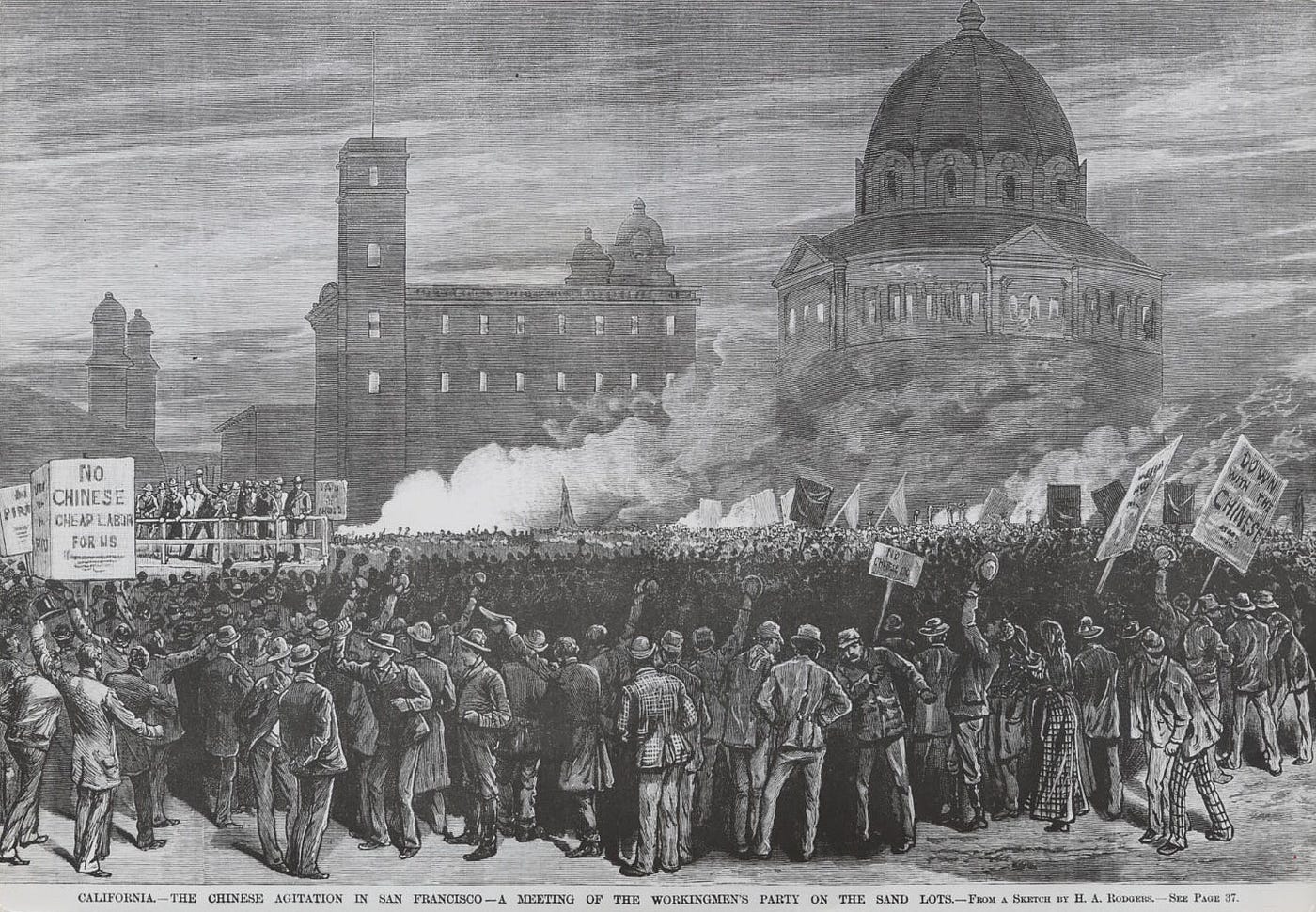
“California — The Chinese Agitation in San Francisco — A Meeting of the Workingmen’s Party on the Sand Lots — From a sketch by H. A. Rodgers, 1877.” Published in Frank Leslie’s Illustrated Newspaper, this image records the mass meetings on the sand lots south of Market Street where Denis Kearney and the Workingmen’s Party galvanized anti-Chinese sentiment during the economic crisis of the 1870s. Within days of such rallies, agitation spilled into organized violence: from July 23 to July 24, 1877, mobs swept into Chinatown, killing at least four Chinese residents and inflicting more than $100,000 in property damage. Rioters destroyed roughly twenty laundries, stoned the Chinese Methodist Mission, and attacked the Pacific Mail Steamship Company’s wharves — targeting both the physical presence of the Chinese community and the infrastructure that sustained continued immigration. The scene thus marks not merely political assembly but the ignition point of collective violence, presenting law enforcement with the immediate challenge of containing mass unrest while attempting to protect a besieged Chinese population.
The lesson drawn by city leaders was not subtle. The existing police structure was inadequate — both to control anti-Chinese violence and to manage the internal conflicts that had become associated, fairly or not, with Chinatown.
The legislative response came in 1878 with the McCoppin Act. It did more than expand the force; it marked a transition toward a more professionalized and specialized police department. In that sense, while the San Francisco Police Department predated Chinatown as an institution, its modern form was forged in response to the crises of the 1870s. The demands of policing anti-Chinese violence on the one hand, and Chinese internal disorder on the other, drove the expansion, centralization, and specialization of the force. Chinatown thus functioned less as a marginal district than as a testing ground in which the practices of modern urban policing in San Francisco were first worked out.

A colorized detail from photo “B. 58. Chinese Quarter, S.F. Cal.” c. 1885. Image enhancement by Wong Yuen-ming of a photograph by Isaiah West Taber (from the Marilyn Blaisdell Collection). In this view of the east side of Dupont St., a police officer can be seen at right, standing watch near the curb in front of 800 Dupont St. at the northeastern corner of its intersection with Clay Street.
The Chinatown Squad and Specialized Policing
Among its provisions, the 1878 Act created a unit dedicated to Chinatown. This unit, later known as the Chinatown Squad, has often been described as the first ethnically targeted policing unit in the United States (Mullen, Chinatown Squad, 5–7). Its structure reflected both practical adaptation and cultural assumption. As Mullen wrote, “the officers worked in plain clothes. One rationale for that practice was that the officers could thus better blend in with the general public and thus be less noticeable to criminal malefactors. Such reasoning had less utility in Chinatown where a group of large young white men would have stood out, no matter what they wore. Departmental thinking was — and still is — that the Chinese considered uniformed officers as soldiers and thus low-ranking officials. But men wearing civilian dress were viewed as more important representatives of officialdom and thus worthy of greater deference.” Whether or not this belief accurately captured Chinese perceptions, it shaped operational practice.
The Squad’s early focus was on vice enforcement — gambling houses, prostitution, and opium dens — but its remit quickly expanded to include the suppression of gunplay and other forms of violence associated with the criminal tongs. In both respects, its work took place largely within spaces that were socially and linguistically opaque to outsiders. By the mid-1880s, however, this work had assumed a more formalized and measurable character, as the Department tracked arrests, fines, and the performance of specialized details assigned to Chinatown. Contemporary reporting makes clear that such policing was not only intensive, but increasingly bureaucratized and closely tied to the city’s administrative and fiscal interests.
The Department’s involvement in Chinatown extended beyond the suppression of gambling and tong violence. By the turn of the century, police officers increasingly operated alongside Protestant rescue missions whose campaigns against prostitution and trafficking drew law enforcement into a parallel regime of moral and social intervention.
The relationship between the San Francisco Police Department and the Protestant rescue missions of Chinatown developed gradually during the late nineteenth century and became increasingly institutionalized by the early twentieth century. Mission workers associated with organizations such as the Presbyterian Mission Home — later known as Cameron House under Donaldina Cameron — depended upon police officers, court officials, and occasionally the Chinatown Squad to recover Chinese girls and women alleged to have been held in conditions of forced prostitution, indenture, or unlawful confinement. Police assistance ranged from accompanying missionaries during extractions and serving warrants to providing protection after rescues triggered retaliation threats from brothel operators or tong affiliates. The collaboration reflected overlapping, though not identical, interests: reformers framed the rescues in evangelical and humanitarian terms, while police authorities approached the same activities through the lenses of public order, vice suppression, and anti-tong enforcement. At times, these rescue operations also reinforced prevailing racialized assumptions about Chinatown as a district requiring exceptional surveillance and intervention. Nevertheless, contemporary court records, mission reports, and newspaper accounts leave little doubt that at least some women and girls were in fact being trafficked, sold, or coercively confined, and that police intervention occasionally proved decisive in securing their removal.

Donaldina Cameron and unidentified Chinese girls in staged “rescue” photographs in a Chinatown alleyway, c.1908–1912. Photographer unknown (from a private collection). Produced shortly after the rebuilding of Chinatown and the Presbyterian Mission Home following the earthquake and fire of 1906, these images likely served both documentary and fundraising purposes, dramatizing the Mission’s efforts to remove Chinese girls and women from prostitution, indenture, or coerced confinement. The ladder, balconies, and interconnected rear passages visible in the photographs reflected the dense architectural environment that had long complicated policing and surveillance in Chinatown itself. The photographs also document the continuation — rather than the disappearance — of anti-vice and rescue operations after the reconstruction of Chinatown. Mission workers associated with Cameron frequently relied upon police officers, court orders, and at times members of the Chinatown Squad during extractions and protective operations involving women alleged to have been unlawfully confined in brothels or association-controlled buildings. Although the scenes were almost certainly posed or reenacted for public presentation, they drew upon real patterns of cooperation between Protestant reform organizations and law enforcement authorities in campaigns directed against trafficking and prostitution in Chinatown. The imagery reveals how rescue, policing, and public representation became intertwined. Chinatown’s alleys and rooftops were presented to outside audiences not merely as urban spaces but as theatrical settings of danger, concealment, and intervention, reinforcing contemporary perceptions of the district as a place requiring exceptional forms of surveillance and control.
Meanwhile, even as rescue missions and reform campaigns expanded their presence in Chinatown, the Department’s own policing apparatus was becoming increasingly formalized and measurable, as officials tracked arrests, fines, and the performance of specialized details assigned to the district.

“Chinatown Changes: Sergeant Birdsall and Posse Replaced by a New Squad,” Daily Alta California, July 23, 1885. Reporting on the reassignment of a Chinatown detail under Chief Patrick Crowley, the article records 4,281 arrests and more than $63,000 in fines collected over twenty-nine months. The account illustrates the scale and routinization of Chinatown policing by the mid-1880s, as well as its integration into the administrative and fiscal operations of the Department.
The methods developed by the Chinatown Squad were distinctive and, by modern standards, deeply problematic. Mullen is unusually direct on this point, noting that the Squad’s “tools of the trade… were sledgehammers and firemen’s axes,” and that officers often “ignored writs and warrants” in conducting raids (Mullen, Chinatown Squad, 5-7). Forced entry into secured premises — particularly gambling houses fortified against intrusion — became routine. Raids were executed with speed and theatrical force, producing a visual record in which officers posed with the implements of entry and the paraphernalia of vice.

Sergeant George Wittman’s Chinatown Squad, 1889. Photographer unknown (from the collection of Kevin Mullen, enhancement by Jeff Stewart). Sledgehammers and axes comprised the standard breaching equipment on the old Chinatown Squad, used to break in the doors of gambling dens. Officers operated in plain clothes rather than uniform — a decision grounded in the belief that Chinese residents would respond more readily to men who appeared to hold higher administrative authority than to uniformed patrolmen.
These practices must be situated within their historical context. Tong conflicts did produce real violence, including targeted killings carried out by hired enforcers. Vice economies were embedded in the physical fabric of Chinatown, often shielded by architectural and social barriers. Cooperation with police was uneven, filtered through interpreters, informants, and community leaders whose own positions were not always neutral.
Yet the effect of these methods was cumulative. Policing in Chinatown came to operate according to a different practical standard — one in which procedural constraints were relaxed in the name of necessity. The law, in other words, was not suspended, but it was applied unevenly.
Mediation and Force
By the late nineteenth century, the phenomenon later termed the “tong wars” had become central to both policing and public imagination. Mullen’s description of tong enforcers as “salaried soldiers… paid assassins” reflects the reality of organized violence, but also the language through which that violence was framed for a broader audience (Mullen, Chinatown Squad, 6–7).

“Raiding a House on Clay Street,” c.1891. Illustrator unknown (from the collection of Kevin Mullen).
The photographic and illustrative record from this period reinforces that framing. Images of raids, seized implements, and posed officers present Chinatown as a space defined by criminality and intervention. What they do not show — except obliquely — is the ordinary life of the neighborhood, or the extent to which most residents were not participants in these activities.
Mullen himself acknowledges that “the vast majority” of Chinese residents were law-abiding (Mullen, Chinatown Squad, 10). That recognition, however, sits uneasily alongside the narrative weight assigned to vice and violence. The imbalance is not accidental. It reflects both the priorities of policing and the expectations of the audience to whom such accounts were directed.
The form of the Chinatown Squad as a unit took was not predetermined. It was forged in practice by officers such as William “Bill” Price, whose tours in Chinatown in the 1890s established the enforcement patterns that would come to define the Squad.
Price emerged as one of the most consequential — and controversial — figures in the early history of the San Francisco Police Department’s Chinatown Squad. First assigned to the district as a patrolman in 1888, Price rose quickly through the ranks, becoming a sergeant and assuming command of the Squad in January 1890. His tenure followed the rotational pattern typical of the period, but it was during these repeated assignments between 1890 and 1891 that he established the enforcement model that would define the unit for years to come.

From the Daily Alta California of January 31, 1891: RAIDING HIGHBINDERS. Headquarters of the Outlaws Demolished by Police. Chief Crowley Determined to Put a Stop to Shooting- Affrays and Murders in Chinatown. “The highbinders must go!” This is the edict issued by Chief of Police Crowley, in consequence of the pitched battle among the Mongolians on Jackson street on Thursday noon, which resulted in the wounding of Wong Ah Dick, and the numerous Chinese murders that have taken place in the last few years. His officers have already begun to carry out his orders by raiding the highbinders’ headquarters, where they hold meetings and plot devilment. Last evening Sergeant Price and Officers Coleman, Dawes and Starbird and Detective Cox. raided half a dozen places with axes, and Chinatown labored under great excitement for a couple of hours. The first place visited was the Ping Kong Tong (tong means society in the Chinese language), on the southwest coiner of Waverly place and Washington street. The three rooms were turned upside down in short order. Society rules and regulations and pictures were stripped from the walls, furniture smashed and even the joss and idols fell with a crash to the floor amid the general wreck. The dozen Chinese highbinders who were in the rooms jabbered angrily but offered no resistance. The next place was the headquarters of the Jog Lum Sim Tong at 831 Clay street, where the performance was repeated. Across the way, at 826 Clay street, the Ep Yeng Tong establishment fell a victim to the raiders. By this time word was passed around Chinatown, and the Chinese began to more their effects from their tong headquarters. The other places raided and despoiled were the Quong Dow Tong at 824 Washington street, Ong Yeck Tone at 7261/2 Pacific street, and places at Waverly place and Clay, Waverly and Washington, Jackson and Dupont. and Dupont and Bartlett alley. In several of these places boxes of cartridges were found, bat the weapons had been removed. At each place the Sergeant warned the Mongolian outlaws not to repair to the places for society purposes again under the penalty of the outfits being smashed up again. This work of raiding and breaking up these gangs is sanctioned by the better class of Chinese, who are forced by fear to give the rascals blood-money The real cause of Thursday’s shooting was learned last evening by an Alta reporter. Dick, the wounded man, owed a member of a rival society $4, besides jewelry he had stolen. When told that he must pay the debt and return the jewelry he replied in substance that he would not pay until he was whipped, and that the question of his strength and that of his society could be tested by the lighting men of both societies meeting on Jackson street at the noon hour and having it out with pistols. Half a dozen fighting men of the Suey Ong Tong and the Hop Sing Tong met according to appointment and fired nearly thirty shots at each other, as published in yesterday’s Alta.
Price’s approach was marked by an aggressive and often extralegal campaign against tong-affiliated violence, particularly the activities of so-called “highbinders.” Contemporary accounts credited him with restoring a measure of order during periods when tong violence appeared unchecked, and his reputation — “the mere mention of whose name chills the blood in highbinders’ veins” — reflected both his effectiveness and the fear he inspired. Central to his methods was a willingness to act with broad discretion, frequently pushing beyond the limits of formal legal process. These practices, while celebrated in some quarters, would not withstand constitutional scrutiny by today’s standards. Moreover, the destructiveness of police operations exposed the city to damages claims. For example, a raid on the Chee Kung Tong in February 1891 resulted in the destruction of its shrine hall on Spofford Alley and a damages claim as recounted here.

“Highbinders’ Retreat” undated photo taken in San Francisco. Photographer unknown (from the Cooper Chow collection at the Chinese Historical Society of America).
A defining feature of Price’s operations was his collaboration with Chinese authorities, particularly the Chinese Consul General, Fung Yung Heng. With the consul’s backing, Price undertook coordinated campaigns against tong organizations, including raids on headquarters such as the Bo On Tong on Stockton Street. This cooperation extended to public declarations by the consul discouraging resistance to police actions, effectively aligning official Chinese representation with the Department’s enforcement efforts. For Qing officials, such cooperation likely served multiple purposes. Beyond suppressing criminal violence and disorder, the disruption of secret societies also aligned with the dynasty’s longstanding hostility toward associations connected to the broader Hung Mun (洪門) tradition, which Qing authorities had historically viewed as potentially subversive or anti-dynastic, even when local branches functioned primarily as fraternal or criminal organizations rather than overt revolutionary movements.

Chinese Consul General Ho Yow and his San Francisco consular staff, as they posed for Colliers Weekly in 1902. Photographer unknown (from a private collection). The Chinese consulate building was located on Stockton Street
Price’s most dramatic intervention came in 1899, when, supported by Chief Patrick Crowley and bolstered by the consul’s assurances, he led a large-scale campaign against suspected highbinder societies. Armed with axes and accompanied by uniformed officers and even a surgeon, Price and his men forcibly entered tong premises and systematically destroyed interiors, reportedly causing extensive property damage. These raids, intended to cripple the organizational infrastructure of tong violence, exemplified the Squad’s readiness to employ overwhelming force as both a practical and symbolic measure.
Despite — or because of — his severity, Price’s career in Chinatown was cyclical. He was repeatedly reassigned, sometimes amid criticism, then returned at the request of merchants or amid renewed outbreaks of violence. By the late 1890s, now a lieutenant, he operated alongside other officers such as Sergeant Bernard McManus, dividing responsibilities between vice enforcement and the suppression of organized violence. Press coverage of Price oscillated between praise for his toughness and concern over his methods, reflecting broader tensions in public attitudes toward policing Chinatown.


At left, Sgt. William (“Bill”) Price and his Chinatown Squad 1891 pose in front of the August Pistolesi grocery and liquor store at 752 Washington Street (from the collection of the San Francisco Public Library). The Chinese at second from the right may have been an interpreter for the squad. According to the last police historian and deputy chief Kevin Mullen, “Chinatown was much less exclusively Chinese in those days than it is now.” The year of this photo is also variously dated to 1895. One of the plainclothes officers stands in the entryway to the Chinese basement eatery, probably named “Ka Hong Kue,” located at 752–1/2 Washington. The location was not incidental. At right, the same address appears in contemporary advertisements for guided tours of Chinatown operated by former police officers Captain T. J. O’Neil and T. H. Douglass, who offered escorted day and night visits to the district and prominently cited endorsements from Mayor L. R. Ellert and Chief of Police Patrick Crowley. The juxtaposition underscores the extent to which policing, tourism, and the public representation of Chinatown were intertwined. Officers tasked with enforcing order in the neighborhood also occupied a central role in mediating its visibility to outsiders, as Chinatown was alternately policed, interpreted, and displayed.
The policing of Chinatown was not insulated from the broader political economy of San Francisco. As Kevin Mullen wrote about the Squad’s unique position in city politics:
“Over the next 40 years, the unit would be at the center of departmental and city political affairs, as news headlines chronicled successive waves of scandal and reform while the Squad struggled with seemingly intractable crime conditions in the Chinese Quarter. City administrations would fall, and political hay would be made, against a backdrop of thrilling slave girl rescues, murderous “tong wars” and rampant extort ion — official and otherwise.
“They are little remembered now but many past Department leaders, including several chiefs of police, received their first trial in the fiery crucible of duty in the Chinatown Squad. Chiefs George Wittman and John Martin both served tours of duty with Nineteenth-Century squads, and both of them, when later appointed as chief, suffered career-ending blows — in part from Chinatown scandals. Others, like Jesse Cook [in 1908], Daniel O’Brien, and William Quinn also served on the Squad, but then went on to successful careers as chiefs.” (Mullen, supra at 55)
Corruption and Scandal of 1894
In 1894, a widely reported graft scandal implicated members of the Chinatown Squad in accepting payments from operators of gambling houses and other vice establishments in exchange for advance warning of raids or selective enforcement. The episode underscored the extent to which discretionary policing in a vice economy could blur the line between enforcement and participation, particularly in a district where access depended on informants, intermediaries, and negotiated entry.
The controversy centered on Captain William E. Hall and Officer W. A. Dawes, both of whom were removed by Chief Patrick Crowley amid allegations that officers assigned to Chinatown had tolerated — and in some cases profited from — the very lottery and gambling operations they were charged with suppressing. Contemporary newspaper coverage (such reported at length in the San Francisco Call on April 19, 1894), portrayed the dismissals not as isolated misconduct but as evidence of a broader system in which enforcement could be tightened or relaxed according to political influence, personal relationships, or financial inducement.

Excerpt from the San Francisco Call of April 19, 1894, reporting on Police Chief Crowley’s dismissals of officers from the Chinatown Squad.
The reporting surrounding Dawes was especially revealing. Dawes defended himself publicly, claiming that during sixteen months on the Chinatown detail he had made between 400 and 500 arrests, seized approximately 375,000 lottery tickets, and generated more than $6,000 in fines. He insisted that his removal stemmed not from corruption but from his aggressive campaign against counterfeit lottery operators and from rival factions within the Department. Former Detective H. H. Handley, however, stated that he had refused to continue working with Dawes because he was “color blind,” a contemporary euphemism implying compromised or selective enforcement. Ex-Sergeant Donnellan went further, asserting that police reports themselves demonstrated that officers knew precisely where gambling and opium operations were located while allowing them to continue largely undisturbed. Hall, for his part, denied accepting bribes and openly challenged Chief Crowley to substantiate the accusations before the Police Commission.
Whether the allegations were fully true, partially true, or politically manipulated is now difficult to determine with certainty. What the episode demonstrates clearly, however, is that Chinatown policing had already become recognized within both the Department and the broader public as an assignment unusually susceptible to corruption. The combination of concentrated vice activity, discretionary enforcement, linguistic isolation, and substantial illicit revenue created conditions in which the suppression of gambling and opium could itself become a form of negotiated management rather than straightforward law enforcement.
The opportunities for informal remuneration that accompanied vice enforcement did not disappear with the close of the nineteenth century. Rather, they persisted as a structural risk within policing regimes that relied on plainclothes work, discretionary authority, and negotiated access to tightly knit communities. Contemporary accounts and periodic investigations in the early twentieth century continued to allege the exchange of payments for advance warning of raids or selective enforcement — practices not unique to Chinatown but made especially visible there. While the historical record for this later period is less specific than for the scandals of the 1890s, it indicates that the same conditions that had earlier enabled corruption — language barriers, reliance on intermediaries, and the concentration of vice economies — remained in place. Efforts at professionalization and reform sought to constrain these dynamics, but did not eliminate them entirely. In this respect, informal remuneration was not an aberration confined to a single episode, but a recurring feature of a system in which enforcement and discretion were closely intertwined.
Early Community Policing Demands
At the same time, Chinatown itself became a recurring object of political discourse. Its conditions were invoked alternately as evidence of municipal failure and as justification for expanded control. Yet beyond these moments of attention, the city largely neglected the neighborhood, allowing the underlying dynamics — of selective enforcement, mediated authority, and periodic exploitation — to persist. Within this uneven landscape, Chinese community leaders did not remain passive. They articulated their own demands for order and protection, seeking a more consistent and accountable police presence in the district. This dynamic was not merely implicit. It was, at times, explicitly articulated by Chinese community leadership.

“Crime in Chinatown,” Daily Alta California, Jan. 24, 1890. Reporting on a meeting of the Chinese Six Companies, the article describes a formal request to Chief of Police Patrick Crowley for increased protection and the assignment of a Chinese-speaking officer to Chinatown. The appeal underscores a recurrent but often overlooked dynamic: Chinese community leaders did not simply resist policing, but actively sought more effective and culturally competent enforcement. Their request for an officer “formerly a detective in Chinatown” reflects both the limits of existing police practice and the degree to which mediation through language and familiarity was understood, on both sides, as essential to maintaining order.
[embed]
“Arrest in Chinatown, San Francisco” (1897), produced by the Edison Manufacturing Company and directed by James H. White, captures a Chinese man being escorted by police along Washington Street near Ross Alley. A circular sign bearing the Chinese character 押 (canto: “aat”), marking the presence of one of the neighborhood’s pawnshops, this one located at the northwest corner of the T-intersection of Washington and Ross Alley. The scene situates police officers within the dense commercial core of Chinatown, where immigration control, vice enforcement, and public order policing converged. Whether staged or observational, the footage records policing as both routine practice and public spectacle, with a largely white crowd gathering to witness the arrest and transport in a department wagon.
It is in this context that Mullen’s observation takes on particular force: for many years, the Chinatown Squad constituted “the main connection between the city and its isolated Cantonese quarter” (Mullen, Chinatown Squad, 7). The relationship was therefore not simply coercive. It was also mediating, transactional, and, at times, dependent. Police relied on Chinese intermediaries, including interpreters, as evident from the Squad’s photos of 1895 and 1898, to navigate the community; Chinese residents, in turn, relied on the police — however imperfectly — for protection and access to authority.

Sergeant John (a.k.a. James) Donovan’s Chinatown Squad of 1899. Photographer unknown (from the collection of the San Francisco Public Library). In this photo, squad members brandish axes and sledgehammers for breaching unlawful Chinatown establishments. “In the forefront,” criminal justice historian Mullen observes, “is shown an opium layout and ropes used to rappel down from skylights to get around barricaded doors. The Chinese man standing next to Donovan is Dong Tying, the Squad interpreter. Not surprisingly, he was not too popular in some Chinatown quarters and he had a bounty placed on his head.” (Mullen, Chinatown Squad, 96). Donovan took command of the squad that year after the Police Commission had removed Bill Price for “not maintaining the efficiency of the Police Department in Chinatown” in the wake of allegations that graft occured in Chinatown under Price’s watch.
Quarantine and Containment: Plague and Police Power, 1900–1904 and 1907–1908
The turn of the twentieth century brought a different kind of crisis to San Francisco’s Chinatown — one that would place the Police Department at the intersection of public health and racialized control. In March 1900, following the death of a Chinese laborer at the Globe Hotel on Dupont Street, bacteriological tests confirmed the presence of bubonic plague. The diagnosis triggered an immediate and sweeping response from municipal and federal authorities. Chinatown was cordoned off, its boundaries marked by ropes and guarded by police officers and, at times, federal troops, restricting movement in and out of the district. What followed was one of the earliest large-scale attempts at urban quarantine in the United States — and one of the most controversial.

“Work for the Force” c.1900. Photographer unknown (from a private collection). A police officer stands beside a rope barrier across a cobblestoned Clay street (?) at what appears to be the southeast corner of Portsmouth Square. The San Francisco Police Department were deployed to enforce a quarantine of Chinatown in the wake of diagnosed bubonic plague cases.
The quarantine was unevenly conceived and unevenly enforced. While nominally a public health measure, it was directed almost exclusively at Chinese residents. White residents and business interests were often permitted to pass through the cordon, while Chinese inhabitants were detained within it. The San Francisco Police Department played a central role in maintaining this boundary — patrolling entry points, enforcing restrictions, and, in effect, transforming Chinatown into a controlled space within the city.

“On the Edge of the Quarantine, San Francisco” from the The Wave magazine, June 16, 1900. Photograph by Isaiah West Taber (from a private collection). The police-enforced rope barrier appears strung across the east side of Dupont Street at old St. Mary’s church and probably across the street to bar entry or exit from the southern end of Dupont at California Street.
The use of rope barriers rather than walls did not diminish the force of the restriction; it instead rendered visible a line that was at once physical, legal, and racial. In practice, the quarantine functioned less as a neutral health measure than as a form of collective containment, imposed on a neighborhood already subject to segregation, surveillance, and regulation.

“A Conversation Across the Ropes” c.1900. Photographer unknown (from the collection of the Bancroft Library). A group of men, including two Chinese, converse at the southeast corner of Portsmouth Square with a civilian at the rope line barring westerly travel up Clay Street.

“No Admittance” c.1900. Photographer unknown (from a private collection), colorization by Jim Cunningham. A uniformed patrol officer in a helmet confers with perhaps one or a pair of public health officials beside a rope line at the the southeast corner entrance to Portsmouth Square park. Another officer can be seen in the background, walking within the park enclosure. Although the year of this photo is established, the dates of photos taken in old Chinatown can often be determined by examing police department gear, as the late crime historian Kevin Mullen observed for other images. “The helmet remained as standard uniform until November 1914. . . Patrol officers wore the helmets and sergeants on up wore the caps from 1896 to 1914. Even after 1914, some officers resisted changing to the caps because of the expense of acquiring the new ones. So the helmet conceivably could have been worn into 1915.”

Long (possibly Stockton) street view with extended barbed wire barriers lining Chinatown blocks, c.1900. Photographer unknown (from a private collection). The quarantine of Chinatown ostensibly to avoid the spread of bubonic plague represented a district-wide containment.
The measures adopted during the 1900 outbreak were quickly challenged. Chinese community leaders, supported by diplomatic intervention from the Qing government, contested both the legality and the discriminatory application of the quarantine. Federal courts ultimately intervened, most notably in Wong Wai v. Williamson (1900), where the court enjoined the enforcement of an inoculation order that had targeted Chinese residents alone.


headlines from the San Francisco Call newspaper of June 1 and 20, 1900, announcing the end of the quarantine of San Franciso Chinatown
Although the immediate quarantine was lifted, the episode established a template: public health authority — backed by law enforcement staff — could be mobilized in ways that mapped directly onto existing racial boundaries.
A second outbreak of bubonic plague between 1907 and 1908 prompted renewed efforts at containment, this time more systematic and citywide in scope under the direction of federal health authorities. By then, lessons had been drawn — at least in part — from the earlier controversy. Measures included rat eradication campaigns and broader sanitary reforms that extended beyond Chinatown. Yet even in this more coordinated response, Chinatown remained a focal point of surveillance and intervention, and the Police Department continued to play a supporting role in enforcing access restrictions and facilitating inspections.
After the Quarantine: Continuity and Adaptation
For the San Francisco Police Department, the plague years marked a critical moment in the evolution of its role. The Department was no longer acting solely in response to crime or disorder; it was enlisted in the enforcement of public health policy, blurring the line between protection and control.
In Chinatown, that distinction was especially thin. The same structures that enabled rapid quarantine — bounded space, concentrated population, and an established pattern of targeted policing — also made it possible to impose restrictions along racial lines. In the years that followed, these practices extended beyond emergency response into more visible and demonstrative forms of enforcement. The result was a further consolidation of the dual function that had been developing since the mid-nineteenth century: policing as both a mechanism of public safety and an instrument for managing a defined population.

Lieutenant William (“Bill”) Price and his Chinatown Squad of 1901–1902. Photographer unknown (from the San Francisco Chronicle archive). Price is seated second from the right. From left to right standing: officers T.B. Murphy, David Murphy, Michael Brady, Robert Connor, G.P. Chase, and (seated) William M. Ross, Charles H. Taylor, Robert A. Coulter.

“Chinatown Squad 1901–2” Photographer unknown (colorization by Wong Yuen-ming from a private collection). Lt. Bill Price’s legacy lies less in any single campaign than in the institutional pattern he helped establish: a model of Chinatown policing characterized by controversial and aggressive intervention, reliance on extralegal authority, collaboration with Chinese intermediaries, and a willingness to use force to dismantle perceived sources of disorder. In this sense, his tenure marked an early and formative phase in the evolution of the Chinatown Squad as a specialized arm of urban policing in San Francisco.
In 1901, former Chief Crowley advised the City’s “Fisk Committee” that it would take 100 officers to control vice in Chinatown. Chief Sullivan opined that it would take 300. Chief Biggy, who was regarded as an inept amateur, estimated 30 officers were needed. The calls for additional staffing did not go unheeded, and the Chinatown Squad’s photos from 1905 indicate a peak staffing complement.

Sergeant Jesse B. Cook (later Chief of Police) and members of the Chinatown Squad, San Francisco, 1905. Photographer unknown (from the collection of the Bancroft Library). This image captures Cook during his final tour commanding the Chinatown Squad and reflects the City’s acceptance of Chief William J. Biggy’s assessment that effective policing of Chinatown required a substantially enlarged detail — approximately thirty officers. Cook is seated at center; to his right stands Corporal William Ross, who would assume command of the Squad later in 1905. Cook’s repeated assignments to command the Chinatown Squad illustrate both the importance and the instability of the post. He first took command on April 11, 1895, but was reassigned on June 13 of that year, reportedly in response to complaints from Chinatown interests, likely stemming from his disruption of gambling operations. He returned in February 1897 following the assassination of tong leader “Little Pete,” and again in November 1902 to counter the establishment of a gambling house associated with Lem Yee. His tenure ended abruptly on March 1, 1903, when he was removed for political reasons by Chief George Wittman, himself a former Chinatown Squad commander. Under new leadership, Cook returned once more to head the Squad in November 1904, remaining in the post into early 1905. As Kevin Mullen notes, the demands of the assignment were considerable: “Cook worked from 9 a.m. to midnight every day of the week, including Sundays and holidays, from December 1, 1904 to March 1905 when he asked to be relieved.” The photograph thus records not only personnel but the intensity and continuity of a policing regime that relied on sustained, near-constant presence in Chinatown.
By the early twentieth century, this system had reached a point of uneasy equilibrium. The Chinatown Squad had become an established institution, and its methods were, in Mullen’s history, “normalized within the department, if not universally accepted.” However, the Chinese community both resented its presence and, in certain respects, relied upon it for public safety.
At the same time, gradual changes were underway within the Chinese community itself: increasing adaptation to American social forms, the beginnings of linguistic accommodation, shifts in associational life, and a larger number of families that would become more visible in the decades to follow (Mullen, 7–8).

Sergeant William Ross and his Chinatown Squad, c.1905. Photographer unknown (from the collection of Kevin Mullen). In this photo, the Squad gathered in front and on the steps to the Tin How Temple on Waverly Place. Notably, children joined the police officers for the photo, several of them brandishing the Squad’s axes.

“China Town Squad, San Francisco from July to Dec. 1905.” Photograph by Louis J. Stellman (from the Jesse B. Cook collection at the Bancroft Library and published in Dillon, Richard, Images of San Francisco Chinatown, 1976). The Bancroft Library states the following about this image: Back Row, left to right: 1. T. O’Connell, Police Officer, 2. Fred. Krack, Police Officer, 3. H. Bolton, Police Officer, 4. Ed. Casey, Police Officer. 2nd Row, left to right: 1. Collins, now a Lieut. of Police, 2. Ed. Foley, Police Officer, 3. O. Burg, Police Officer, 4. R. Curtin, Police Officer, 5. T. Hanley, Police Officer. 3rd Row, left to right: 1., 2. T. Curtis, Police Officer, 3. T. Conley, Police Officer, 4. Cliff Fields, now a Lieut. of Police, 5. Dan Cronin, now a Lieut. of Police. 6. Front row, left to right: Sergt. Wm Ross, Corpl. Wm Ferguson.
Rupture and Reconstruction
The earthquake and fire of April 1906 abruptly dismantled the physical and institutional framework within which Chinatown had been policed. With the destruction of the district and the displacement of its residents, routine police operations gave way to emergency measures: patrol priorities shifted to guarding property, preventing looting, and maintaining order in a city placed largely under military control. In practice, authority during the crisis was shared — often uneasily — between the San Francisco Police Department and the U.S. Army, whose officers imposed sweeping restrictions across the burned district and surrounding areas.

The temporary “police camp” in Portsmouth Square, April 1906. Photograph by W.J. Street (from the Marilyn Blaisdell Collection). In this slightly cropped photo of the refugee camp for police officers and deputies, some of whom can be seen wearing badges, the ruined facade of the building at the northwest corner of Clay Street and Brenham Place can be seen in the background to the right of the trees.
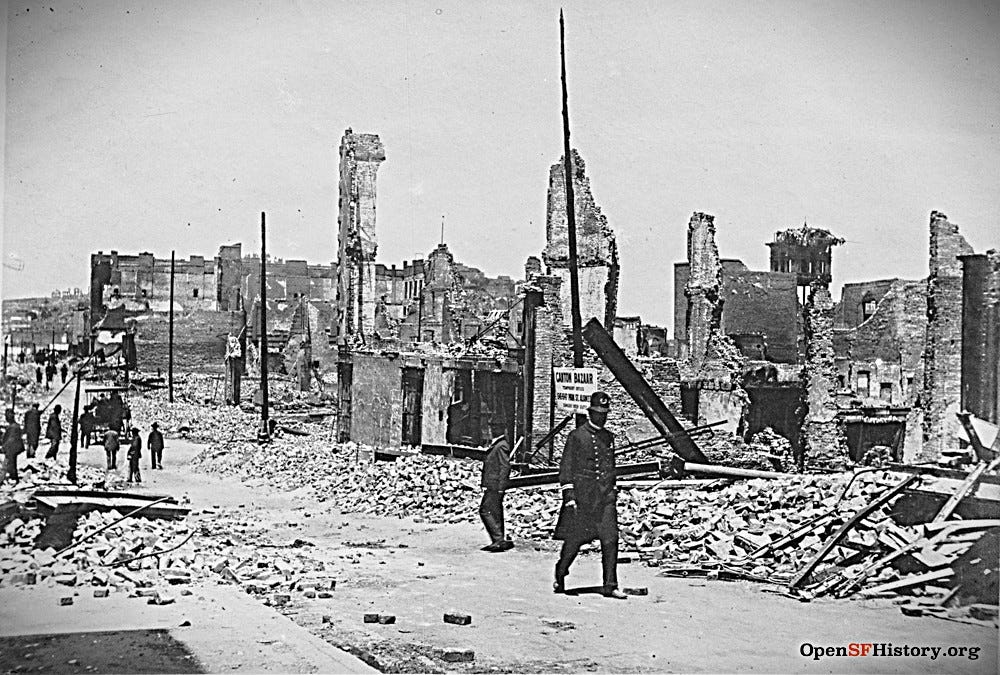
Dupont Street at Clay Street, looking north, San Francisco, 1906. Photographer unknown (from the Marilyn Blaisdell collection). Taken in the aftermath of the 1906 earthquake and fire, this view shows the destruction of Chinatown, where shattered masonry walls and cleared debris mark the former streetscape. In the foreground, a uniformed police officer walks south on Dupont past a sign advising the temporary relocation of the Canton Bazaar, reflecting the San Francisco Police Department’s role in guarding property, preventing additional looting, and controlling access to the burned district in the weeks following the disaster. Police presence remained continuous even as the neighborhood lay in ruins and civic leaders debated whether Chinatown would be rebuilt on its original site. The charred and twisted tower of the Hall of Justice on Kearny and Washington Streets can be seen in the right quarter of the frame.
Chinatown itself became both a site of absence and a subject of contest, as civic leaders advanced plans to relocate the Chinese community away from the downtown core even as residents regrouped in refugee camps and began the process of return. In this moment of rupture, the established routines of the Chinatown Squad were suspended, but not extinguished.

“All that was saved from the Chinese Bureau,” c. 1906. Photographer unknown (from the collection of the Bancroft Library). In the aftermath of the 1906 earthquake and fire, officials stand amid rubble and salvaged materials identified as records relating to the policing of San Francisco’s Chinese community. Such materials — whether formally designated as part of a “Chinese Bureau” or maintained by officers assigned to Chinatown — reflect an early system of surveillance and record-keeping that operated alongside the Chinatown Squad. Preserved even in partial form, these records point to the administrative dimension of Chinatown policing: not only the enforcement of law on the street, but the systematic documentation and monitoring of a targeted population.
As for the northeast corner of the T-intersection of Bartlett Alley and Jackson Street, the site reappears in the post-1906 record as a locus of continued police presence, suggesting not permanent rupture but continuity in the policing of Chinatown. The built environment had been remade, and Bartlett Alley would soon be renamed Beckett Street, but the underlying pattern persisted: the reestablishment of a white-owned saloon at this location — recorded before the fire and visible again here — underscored the durability of the district’s mixed and contested character, even as Chinatown was being recast in new architectural and administrative forms.

Northeast corner of Bartlett (later Beckett) Alley and Jackson Street, San Francisco Chinatown, post-1906. Photographer unknown, from Quake News (private collection). This view shows the same corner previously associated with Patrol Special Delos Woodruff in the 1870s. Notably, the white-owned saloon — identified at this location on the city’s July 1885 “vice” map — had reestablished itself after the earthquake and fire, underscoring the persistence of non-Chinese commercial interests within Chinatown well into the twentieth century. Historian Kevin Mullen identified several police personages in the image, including George Duffield (#4), noted for his role in the 1876 legislative hearings on Chinatown; William Quinn (#5), later Chief of Police; and Daniel O’Brien (#7), who led the Chinatown Squad in the 1910s and, as Chief, appointed Jack Manion to command the unit. The intersection would continue to serve as an informal police waypoint long after the white-owned saloon on the northeast corner disappeared. Across Bartlett (later Beckett) Alley, the northwest corner became home to Red’s Place, a favored gathering spot for members of the Chinatown Squad. According to Mullen, Squad officers used the bar as a message drop and rendezvous point in the era before portable radios and mobile communications. City records indicate that the former saloon site on the northeast corner had instead become associated by 1930 with the locally-celebrated Lun Ting restaurant, one of Chinatown’s best-known “pork chop houses,” illustrating how the corner evolved from a locus of white-owned commercial activity into a distinctly Chinese institution while retaining its long-standing association with the policing of the district.
The habits of surveillance, mediation, and selective enforcement that had defined police interactions with the Chinese community reemerged in the management of displacement and in the politics of reconstruction. It would not, however, erase the underlying dynamics. The patterns of police-community relations which had been established in the half-century before 1906 — distance, mediation, selective enforcement, and mutual dependency — would persist, reshaped but not fundamentally altered.

Members of Lieutenant Dan Sylvester’s Chinatown Squad of 1911 pose with neighborhood children. Photographer unknown (from the collection of the Bancroft Library). From L. to R.: Chas. E. Munn, Lieut. H. Sylvester, Arthur McPhee, J.J. Cummings, Ed Plume, and L.P.H. Meyer
To read the history of policing in pre-1906 Chinatown only through the lens of repression is to miss its structural complexity. To read it only as a story of crime control is to accept, uncritically, the categories imposed by those doing the policing. The record instead reveals a relationship formed at the intersection of exclusion and necessity: a community pushed to the margins, and a police force tasked — unevenly, and often inadequately — with governing what lay beyond its full comprehension. The resulting system was neither stable nor just. But it was, for decades, the framework through which Chinatown and the city encountered one another.

A pair of San Francisco police officers engage in conversation with a young Chinese boy on a Chinatown sidewalk, as a couple of adult male bystanders look on, c.1896–1911. Photographer unknown (from the collection of the Bancroft Library). The officers’ expressions — appearing to smile — suggest an informal, amicable street encounter, offering a glimpse of day-to-day “community policing” interactions within the neighborhood. The officers wear the domed “helmet” style headgear that, according to SFPD historian Kevin Mullen, remained standard uniform for patrolmen until November 1914, while caps were reserved for higher ranks (sergeants and above) from 1896 onward. Although some officers continued to wear helmets as late as 1915, the queues worn by the Chinese figures in the scene indicate a date prior to 1911 and the fall of the Qing dynasty. The photograph therefore most plausibly dates to circa 1896–1911. Beyond its documentary value, the image captures a moment of everyday contact between police and residents in pre-1906 Chinatown, complicating the historical record by preserving an instance of interaction that appears, at least on its surface, to be non-confrontational.
The reconstruction of the Hall of Justice following the 1906 earthquake and fire ensured that the San Francisco Police Department’s institutional relationship with Chinatown remained geographically intact. Although Chinatown continued to fall within the jurisdiction of Central Station, the rebuilt Hall of Justice at Kearny and Washington Streets placed the Department’s command staff, detectives, courts, and jail facilities immediately adjacent to the Chinese quarter. Overlooking Portsmouth Square, the Hall stood beside what had become Chinatown’s principal public gathering place. By the interwar period, the Square functioned as the community’s civic commons — a daily meeting ground for laborers, merchants, community leaders, and the growing ranks of elderly pioneers whose lives had been shaped by decades of exclusion and the barriers to normal family formation imposed by federal law. The Hall of Justice housed not only police headquarters but also courtrooms, detention facilities, and administrative offices, concentrating in a single complex many of the municipal institutions with which Chinatown residents most frequently interacted. Its proximity to Portsmouth Square reflected a continuity stretching back to the nineteenth century, when Chinatown occupied a distinctive place within the Department’s policing priorities. Even as the rebuilt neighborhood adopted its celebrated post-1906 architectural identity and increasingly marketed itself as a tourist destination, Portsmouth Square remained a focal point where community life and municipal authority met on a daily basis.
In the decade following the plague quarantine, law enforcement increasingly took on a public and demonstrative character, as authorities sought not only to suppress vice but to display that suppression before the community. A striking example may be found in the 1912 public burning of confiscated opium in Chinatown — a staged “object lesson” in enforcement involving police, state officials, and spectators, which I examine in detail here.

The California Board of Pharmacy, assisted by members of the San Francisco Police Department, prepare to set fire to opium and drug paraphernalia on Washington Street, near the southern outlet of Ross Alley, in San Francisco Chinatown, May 9, 1912. Photographer unknown (from the collections of the San Francisco Police Department and the Bancroft Library). At top, further evidence of the year in which this photo was taken — a partial view of an automobile. According to the late deputy police chief and historian Kevin Mullen, “they had motorized patrol wagons in 1912. By 1915 they had a few Ford runabouts which were assiged to the statios. They didn’t real patrol with them though but positioned them in the stations as a reserve to respond to callls from other officers or the public.”
The destruction of Chinatown in the earthquake and fire of 1906 has often been treated — implicitly or explicitly — as a rupture that brought an end to the tong violence of the nineteenth century. The historical record suggests otherwise. In the years that followed, the rebuilding of Chinatown produced not a pacification but a reconfiguration of violence within a denser and more intensively policed district.
Drawing on police records, SFPD historian Kevin Mullen has shown that homicide rates in Chinatown rose after 1906 and remained elevated into the 1910s, a pattern consistent with the destabilizing effects of displacement, the reconstitution of tong rivalries, and the increased visibility of violence under more systematic surveillance.

Chinese and white homicide rates compared (1860–1930). Chart by historian and Deputy Chief Kevin Mullen (ret.).
The events of 1908 provide a concrete illustration. Early in that year, Police Chief William J. Biggy intervened directly, convening tong leaders and brokering a written peace agreement — one of several attempts to formalize order within an ongoing cycle of violence — preserved in Chinese-language form, in which multiple associations pledged to cease hostilities and submit future disputes to mediation. Yet such efforts proved fragile.

Chinese-language peace agreement among San Francisco tongs, counter-signed by Police Chief William J. Biggy on Jan. 27, 1908 (from the collection of Kevin Mullen). Brokered with the involvement of Chief Biggy, this written agreement recorded a negotiated cessation of hostilities among multiple tongs (belligerents and peace guarantors), including provisions prohibiting retaliation and requiring disputes to be resolved through mediation. The document reflected a parallel system of order in which violence was managed through formalized agreements and community enforcement, even as police authorities sought, often unsuccessfully, to assert control.
By September, highly publicized accounts in the national press described renewed cycles of retaliatory killings and organized “gunplay” in Chinatown, framing the conflict in sensational and often racialized terms for a national audience. Even this sequence — formalized truce followed by renewed violence — underscored the persistence, rather than the resolution, of the underlying conflict: violence had not disappeared but had instead required new forms of negotiation, documentation, and police intervention — evidence that the structures of violence and control had adapted rather than disappeared. (A detailed account of the 1908 tong war and the terms of the peace agreement is set out in the Appendix below.)

“War of the Chinese Tongs…” The Sun (Baltimore), September 6, 1908. A nationally circulated account of tong violence in San Francisco Chinatown, illustrating how conflicts were framed for distant audiences through sensational narratives of organized assassination and exoticized motives. Such reporting amplified the visibility of “tong wars” while often simplifying their underlying social and institutional context, contributing to a public image of Chinatown as a site of perpetual and inscrutable violence.
Ongoing efforts to impose order also emerged from within the Chinese community itself. San Francisco police officials worked with the Chinese Consul General and merchant associations to repeatedly broker “peace treaties” between rival tongs. However, the ceasefires rarely proved durable. The agreements were often negotiated in response to immediate outbreaks of violence, but the underlying conditions that sustained tong warfare remained unresolved. Contemporary newspaper accounts and later historical research suggest that these conflicts were driven not merely by local disputes, but by overlapping systems of rivalry extending throughout Chinese communities on the Pacific Coast. Retaliatory killings in San Francisco were frequently tied to events in Sacramento, Stockton, Fresno, Marysville, San Jose, Los Angeles, and other cities where affiliated tong members operated.

“San Francisco Police Department, Chinatown squad number 72” c.1910s. Photographer unknown (from the collection of the San Francisco Public Library).
Economic competition over gambling, prostitution, labor contracting, and extortion rackets further destabilized truces, while the decentralized nature of tong organization made enforcement of agreements difficult even when senior leaders formally consented to peace.

The San Francisco Call, March 13, 1913, reports on gunplay as part of a statewide conflict between the Suey Sing (萃勝堂) and Bing Kung tongs. The Suey Sing Tong traced its establishment to San Francisco in 1867 when merchants formed a fighting arm to protect their property interests.
Younger tong gunmen often acted autonomously in pursuit of revenge, personal status, or factional loyalty, undermining negotiated settlements. The result was a recurring cycle in which police efforts focused on immediate violence suppression and public order, while the broader interstate and transnational dynamics driving tong conflict remained beyond the effective reach of local law enforcement.

“Corporal Peter McGee, head of Chinatown squad,” c.1913. Photographer unknown (from the collection of the San Francisco Public Library.


The Chinatown Squad, June 10, 1918. Photographer unknown (from a private collection). Names of the officers pictured as listed at the bottom of glass plate: 1.Walter E. Harrington, 2. Dennis B. Devine, 3. John J. Donegan, 4. John J. O’Donnell, 5. Robert J. McDermott, 6. Thomas F. Flood, 7. George R. Vevoda 8. Michael V. Burke (Sergeant), 9. Edward J. Glover, 10. J. Griffith Kennedy (Second Sergeant), 11. George M. Healy, 12. Herman C. Hextrum. At right, the same officers wearing hats. This photo has probably been mis-labled as taken in 1938.

“San Francisco Police Department, Chinatown squad,” c.1918. Photographer unknown (from the collection of the San Francisco Public Library).
A photograph of tong peace treaty negotiators from 1921 depict representatives of rival associations assembled by police commanders, presumably for the purpose of entering into a binding agreement, signaling attempts by police and Chinatown merchants to regulate conflict and restore commercial stability.

“Peace Meeting in Chinatown, San Francisco, Feb. 1921, bet. the Hip Sings and Ping Koongs[sic].” Photographer unknown (from the Jesse B. Cook collection of the Bancroft Library). The photo shows police officials mediating treaty talks between the warring Hip Sing (協勝堂) and Bing Kung (秉公堂) tongs.
Such negotiated settlements did not immediately reverse the upward trend in homicides identified by Mullen, but they formed part of a broader process through which violence became more contained and, over time, less publicly visible.
Manion and the Professionalization of the Squad
By the early 1920s, however, homicide rates began to decline as extensions of the Chinese Exclusion Act and the roots of wider conflict between criminal tongs created conditions for change. Crime historian Paul Drexler attrributes violence reduction to several factors as follows:
“The overthrow of the Manchu dynasty reduced the flow of tong members from China. As a result, Chinatown was becoming a more middle-class area. Community leaders realized they could make more money from legitimate commerce than from vice and became more supportive of The City’s government. Additionally, the Chinatown Squad, under the leadership of Sgt. Jack Manion, changed tactics and used community policing to win the trust of the Chinatown population.”
Whether that reduction should be attributed to the policing strategies associated with figures such as Jack Manion, or instead to longer-term demographic and structural changes — most notably the aging out of tong-affiliated gunmen and the cumulative effects of nearly four decades of Chinese exclusion in constricting the replenishment of that cohort — remains an open question. It is within this shifting landscape, where enforcement and demographic transformation intersect, that Manion’s role must be situated.

“Det. Sergt. [Harry] Walsh and his China Town Squad, January 1921.” Photographer unknown (from the collection of the Bancroft Library). The location of the group photo appears to be in front of the “Dead Wall” at the northwest corner of Washington Street and Grant Avenue. The wall was reputed to be the place where criminal tong death threats were posted in addition to community news.

Member of the 1920–1921 Chinatown Squad commanded by Sgt. Harry Walsh (standing at left with axe) break into the headquarters of the Bing Kung Tong at 722 Jackson Street. Photographer unknown (from the collection of Kevin Mullen). Officers Tommy Hyland (kneeling) and George Ripley (at right) assist with the breaching operation.

“Officers McDowell & Mahoney of the China Town detail. 1922” Photographer unknown (from the collection of the Bancroft Library).
Against this backdrop, John J. (“Jack”) Manion emerged as a central figure in Chinatown policing. In 1921, Chief Daniel O’Brien selected Manion to lead the then sixteen-member Chinatown Squad, placing him at the forefront of enforcement at precisely the moment when homicide rates began to decline. Under Manion’s leadership, the Squad entered a more aggressive and self-conscious phase of operation, consolidating practices that had developed in earlier decades into a more systematic regime of surveillance and control. Whether this intensification of policing was the decisive factor in the reduction of violence, or coincided with deeper demographic changes already underway, is a question that frames any assessment of Manion’s tenure.

“Det. Sergt. John J. Manion’s, China Town Squad, March 1924.” Photographer unknown (from the collection of the Bancroft Library) From L. to R.: Sitting — John Connolly, Geo. W. O’Leary, Detective Sergt. J.J. Manion, Thos. F. Cronin, J.P. O’Connor. Next Row: J.J. O’Donnell, Carl R. Mareus, Horace M. McGowan, L.P. Delmas, David

“Sergeant John Manion seated at his desk and examining a pair of shoes,” January 27, 1930. Photographer unknown (from the collection of the San Francisco Public Library).

Inspector John J. (“Jack”) Manion receiving a string of firecrackers from a Chinese girl in San Francisco Chinatown, September 1, 1933. Photographer unknown. By the early 1930s, Manion was a senior plainclothes officer and a central figure in the San Francisco Police Department’s long-running Chinatown detail. Having risen through the ranks from patrolman to inspector, he was associated with the maturation of the Chinatown Squad into a specialized unit focused on violence, gambling, and vice enforcement. During this period, the Squad continued to rely on informants and community intermediaries while conducting periodic raids and interventions in disputes among Chinese associations. Images such as this — showing Manion in a moment of informal interaction — stand in contrast to the more forceful methods for which the unit was known, and reflect the dual character of policing in Chinatown: at once coercive and mediated, distant yet dependent on ongoing contact with the community it policed.

A mixed crowd of non-Asians, Chinese, and Filipinos view a S.F. Police “Educational Car” at Portsmouth Square, San Francisco, 1934. Photographer unknown (San Francisco Police Department collection). An SFPD “Educational Car” equipped with a public-address loudspeaker is shown parked at Portsmouth Square during a traffic-safety demonstration in 1934. Developed during the early automobile era, these vehicles were used to promote pedestrian and traffic safety through public announcements and educational campaigns. The location is significant. By the 1930s, Portsmouth Square had become even more the principal gathering place of San Francisco Chinatown, serving as a daily “living room” for workers, merchants, and retired pioneers of the nineteenth-century immigrant generation. The appearance of the Educational Car in the Square illustrated a broader evolution in police activity: alongside criminal enforcement, the Department increasingly embraced public education, accident prevention, and community outreach. Yet the image also underscores a longer continuity. The western facade of the Hall of Justice overlooked the square, a reminder that after the rebuilding of 1906 the city’s police headquarters remained immediately adjacent to Chinatown, preserving a physical and institutional proximity that had characterized relations between the Department and the Chinese community since the nineteenth century.

“San Francisco’s famous Chinatown, the largest outside of China itself,” c.1938. Photograph by Zan Stark (from a private collection). In this northerly view of Grant Avenue from Pine Street, a uniformed police officer walks south along the east side of Grant, his presence a quiet but visible reminder of the San Francisco Police Department’s continued role in Chinatown’s daily life. The street reflects the district as reconstructed after the 1906 earthquake and fire. Visible along Grant Avenue are the Shanghai Low restaurant at right, the New Grant Hotel, the Hotel Yamato, Sing Chong Co., and, further in the distance, the Far East Café and the Hang Far Low restaurant. The Hotel Yamato would close within a few years with the onset of World War II.
By this period, the community itself was also changing, though within the continuing constraints of exclusion, which would not be repealed until 1943. The bachelor society that had defined Chinatown in the late nineteenth century was beginning, slowly and unevenly, to give way as family formation — still limited — started to reshape the district’s social composition.
Manion, who rose from the ranks and developed a reputation as a capable plainclothes officer, helped solidify the Squad’s identity as a specialized unit tasked not merely with routine patrol but with the suppression of vice and tong-related violence. As Kevin Mullen recounts, the Squad under Manion relied heavily on informants and interpreters drawn from within the Chinese community, even as it cultivated a readiness to act independently of formal process. Raids on gambling houses and association premises were frequent, and the use of force — particularly the now-familiar axes and sledgehammers employed to breach reinforced doors — remained emblematic of the unit’s methods (Mullen, Chinatown Squad, 6–7).

The Chinatown Squad under John J. (“Jack”) Manion was featured in a police officers’ union newsletter in February 1941, on the occasion of Manion’s 20th anniversary as its commander. Manion commanded the Squad for a record 25 years before retiring in 1946.
At the same time, Manion’s tenure illustrated the paradox that defined Chinatown policing: the Squad depended on relationships with Chinese intermediaries to function at all, yet its tactics often deepened mistrust among the broader community. In this respect, Manion’s leadership did not so much resolve the tensions inherent in policing Chinatown as institutionalize them.

Inspector Jack Manion chats with some of Chinatown’s aging bachelor society sometime during the 1940s.
Wartime Opening and Its Limits
On September 30, 1943, press photographers captured a sequence of events along Grant Avenue near Pacific Street: a group of teenage boys detained after a reported fight, a youth placed into a paddy wagon, and several detainees shielding their faces as they were transported for processing at the Hall of Justice. The images — taken in the heart of Chinatown during the middle years of World War II — record a routine but revealing episode of urban policing.

“Teenage gang fight, Chinatown, San Francisco, September 30, 1943.” A sequence of press photographs by S.W. Snow (Examiner Negative Collection) records the police response along Grant Avenue near Pacific Street. Plainclothes officers assemble outside Wing Wo hardware (1110 Grant Street) before taking a youth into custody and placing him into a paddy wagon, with several other teenagers shielding their faces from the camera. The sequence concludes at the Hall of Justice, where detainees await processing, likely within the juvenile system. Contemporary accounts identified the youths seen in the lower right image as Ted Morales and Joseph Bravo, who claimed they had been beaten in the incident.
By the late 1930s and into the war years, San Francisco police were encountering an increasingly visible cohort of American-born Chinese youth in Chinatown — part of a second generation that had emerged in the decades following 1906. By the late 1930s, San Francisco’s Chinese population included several thousand American-born children and adolescents — likely on the order of 2,500 to 3,500 individuals under the age of twenty — constituting a visible second generation within a still predominantly immigrant community. Yet this cohort remained comparatively contained in both scale and social reach: the long constraints of the exclusion era — imbalanced family formation, restricted immigration, and tight community oversight — had the effect of limiting the size and diffusion of youth populations, and with it, the scope of juvenile delinquency. Police contact with Chinese American youth was therefore episodic rather than systemic, typically confined to street-level disturbances, curfew enforcement, or isolated altercations of the kind captured in the 1943 sequence. In that respect, the year 1943 itself carries a certain irony: Congress repealed the Chinese Exclusion Act that year, but did so within the continuing framework of the national origins quota system, permitting only a token annual immigration from China and leaving the underlying demographic constraints largely intact. Contemporary press coverage, however, often treated such incidents as novel or emblematic, amplifying their visibility while obscuring the structural limits that had, in practice, kept juvenile disorder within manageable bounds.
Against this backdrop of continuity in everyday policing, the onset of World War II placed immediate strain on the San Francisco Police Department as large numbers of officers entered military service. In response, the Department expanded its use of auxiliary personnel, drawing on civilians to fill gaps in patrol and support functions. These auxiliary ranks included women and, notably, individuals from communities that had previously been excluded from any meaningful participation in policing. Departmental photographs from 1942 document this moment of constrained but consequential change: among the trainees is B. Chung, a Chinese American auxiliary officer, seated alongside white recruits in classroom instruction and firearms training. His presence — along with that of an African American auxiliary officer noted in the same cohort — reflected a wartime departure from the Department’s longstanding exclusionary practices, even if those departures were limited in scope and framed as temporary expedients.

Officer Fred Franke gives a lecture on firearms to a class of SFPD Auxiliary personnel in 1942. Among the participants is B. Chung (in the front row). Photographer unknown (from the collection of the San Francisco Public Library).

SFPD Auxiliary officers William O’Brien (left) and B. Chung (right) aim police shotguns at the camera in March 1942. Photographer unknown (from the collection of the San Francisco Public Library).
That opening did not immediately translate into permanent institutional change, and the historical record remains unclear whether Auxiliary Officer Chung was ever deployed to the Chinese community.
Slow Integration and Institutional Change
With the end of the war and the return of a predominantly white male police force, the auxiliary experiment receded, and the Department reverted largely to its prior patterns of recruitment and appointment. Although at least one Chinese American had, as wartime photos show, already served in an auxiliary capacity, the appointment of a Chinese American as a full-duty sworn officer would not occur until 1957, with the hiring of Herbert P. Lee.

This newspaper clipping documents the appointment of Herbert P. Lee, widely recognized as the first Chinese American sworn officer in the San Francisco Police Department. Lee was sworn in in 1957 under Chief Frank Ahern, marking a formal break from the Department’s longstanding exclusion of Chinese Americans from full-duty police service.
Lee’s appointment carried a broader historical resonance within Chinatown itself. Sixty-seven years earlier, in 1890, the Chinese Six Companies had appealed to Chief Patrick Crowley for increased protection in Chinatown and specifically requested the assignment of a former Chinatown detective believed capable of navigating the district’s language and customs. In modern terms, the Six Companies were effectively asking for what would today be described as a culturally competent officer. Lee’s appointment thus represented more than a personnel milestone. It reflected a delayed institutional recognition that effective policing in Chinatown required not merely force or surveillance, but linguistic ability, cultural familiarity, and some measure of community trust.
Even then, progress was incremental. Meaningful integration of the Department — across race and gender — did not occur until the late 1970s, when federal litigation filed by minority police officers organized as the “Officers for Justice” compelled reforms under a court-supervised consent decree. The lawsuit challenged longstanding discriminatory hiring and promotion practices and resulted in mandated changes to recruitment, testing, and advancement procedures. In that longer arc, the wartime service of auxiliary officers such as B. Chung stands less as a turning point than as an early, provisional breach in a structure that would take decades more to change.
The Chinatown Squad was the most visible expression of a broader system of policing that had taken shape over the preceding half-century. Its practices — selective enforcement, reliance on intermediaries rather than bilingual Chinese officers, and operation at the margins of formal constraint — were embedded more broadly within the Department and, over time, adapted to new conditions, from the rupture of 1906 to the exigencies of wartime mobilization and the slow, contested opening of the force to those it had long policed.
The dramatic demographic changes following the Immigration and Nationality Act of 1965 opened another chapter in the history of Chinatown policing — one marked by the rise of youth gangs and episodes of violence that reshaped both community life and law enforcement strategies. In response, the Department developed specialized units and task forces focused on gang activity, in some respects echoing earlier patterns of concentrated policing in Chinatown associated with the Manion era, though under different institutional forms. That later, and often more sanguinary, period, however, lies beyond the scope of this article.
By the early twenty-first century, however, the San Francisco Police Department had become one of the most ethnically diverse major police agencies in the United States, with Asian American officers comprising a significant portion of the sworn ranks and many officers speaking Cantonese, Mandarin, Vietnamese, Tagalog, Korean, and other Asian languages. The transformation was substantial, though incomplete: from a force that once relied almost entirely on white intermediaries and interpreters to police Chinatown, to one in which Asian American officers themselves had become integral participants in the policing of San Francisco.
Even so, the patterns established in the earlier period remain instructive. The result was neither a linear progression toward reform nor a static regime of repression, but a durable structure of negotiated authority shaped as much by the management of difference as by the maintenance of order. In that history, Chinatown was never simply a place policed — it was a place through which San Francisco policing itself was defined.
— — — — — — — — — — — —
Appendix: The 1908 Tong War and Peace Agreement
The following account expands upon the events referenced in the main text. Readers primarily interested in the narrative may skip this section.
Background and Origins of the Conflict: The outbreak of the 1908 tong war had its roots in a dispute over Chen How Kee, the 10-year-old daughter of Chen Louis, a fish merchant from Fourth Street, Oakland. Two men, Low Toy and Hong Di, both affiliated with rival tongs, sought her hand in marriage. What began as a personal rivalry quickly escalated, drawing their respective tong organizations into a broader and more violent feud.
Escalation of Violence: The first act of bloodshed came when a tong member was slain in broad daylight in San Francisco’s Chinatown. This killing initiated a cycle of retaliatory assassinations, as each faction sought vengeance for its dead. The violence did not remain confined to San Francisco, but spread to other cities in which the tongs maintained influence, reflecting the interlinked nature of these organizations across the region.
Police Intervention and Its Limits: Despite repeated efforts by San Francisco Police Chief William J. Biggy to mediate the conflict, the killings continued. Biggy convened meetings with tong representatives in an attempt to broker peace, but neither side initially demonstrated a willingness to abandon retaliation. The inability of authorities to suppress the violence through conventional enforcement contributed to heightened public anxiety and further scrutiny of Chinatown.
The legal system also intervened. Wong Gil, a member of one of the tongs, was convicted and sentenced to death for the murder of Chis Han, a rival tong member. His execution was intended as a deterrent, but it failed to halt the cycle of violence. Additional killings followed, including the murder of Lee Dong, an influential tong figure, as reprisals continued.
The 1908 Peace Agreement: Recognizing the need for a more durable resolution, Chief Biggy ultimately succeeded in brokering a formal peace agreement among the warring factions. Representatives from multiple tongs — including the Suey Sing Tong, Hop Sing Tong, and Kwong Tak Tong — agreed to its terms.
The agreement, preserved in Chinese-language form, set forth a structured framework for ending hostilities and preventing future conflict.
Terms of the Agreement
-
Ceasefire. Both parties agreed to immediately cease hostilities. From that point forward, no member of either tong was to engage in acts of violence, retribution, or conflict.
-
Prohibition of Retaliation. No individual was to seek revenge for past grievances. Any act of retaliation would constitute a violation of the agreement and subject the offender to expulsion.
-
Mutual Recognition of Authority: Leaders of each tong were responsible for ensuring compliance. Violations were to be reported and addressed internally.
-
Non-Interference with Members. Members of both organizations were to conduct their affairs without harassment, detention, or attack arising from prior disputes.
-
Resolution of Future Disputes. Any future disagreements were to be resolved through negotiation and mediation rather than violence.
-
Enforcement and Consequences. Violators would be expelled from their tong and could be turned over to authorities. Leaders bore responsibility for maintaining discipline.
-
Binding Nature of the Agreement. The agreement was intended to be permanent. Violations were to be treated as acts of dishonor subject to sanction by both tong leadership and community authorities.
Signatory Organizations (Romanized): The following organizations can be discerned from the surviving document, with names romanized in Jyutping:
竹林公所 — Zuk6 Lam4 Gung1 So2 (Jok Lum Gung Saw) 廣德堂 — Gwong2 Dak1 Tong4 (Kwong Tak Tong) 華勝堂 — Waa4 Sing6 Tong4 (Hop Sing Tong) 華英堂 — Waa4 Jing1 Tong4 (Wah Ying Tong / Chinese Hero Hall) 合勝堂 — Hap6 Sing6 Tong4 (Hop Sing Tong, variant or affiliated group) 萃勝堂 — Seoi6 Sing6 Tong4 (Suey Sing Tong)
Other associated organizations referenced in related materials include:
秉公堂 — Bing Kung Tong Seui Yeuhn Tong 保良公所 — Bou2 Loeng4 Gung1 So2 萃英堂 — Seoi6 Ying4 Tong4 協勝堂 — Hip3 Sing3 Tong4 (Hip Sing Tong) 協英堂 — Hip3 Jing1 Tong4 (Hip Ying Tong)
Aftermath and Historical Significance: Despite the formal agreement, the legacy of the 1908 tong war persisted. The violence disrupted commercial activity, instilled fear among residents, and drew intensified law enforcement attention to Chinatown, particularly toward gambling, prostitution, and extortion networks. While the treaty appears to have reduced open hostilities in the immediate term, tensions remained unresolved beneath the surface.
The events of 1908 illustrated the limits of both enforcement and mediation. Violence was neither fully suppressed nor entirely uncontrolled; rather, it was managed through a hybrid system combining police intervention, community governance, and negotiated settlement. In this respect, the 1908 tong war and its resolution reflect the broader patterns described in this article — of policing as a process shaped not only by force, but by mediation, accommodation, and the persistent negotiation of order.
— — — — — — — — —
**Afterword:** This essay draws in part on conversations with the late Kevin J. Mullen, Deputy Chief (ret.), San Francisco Police Department, whose work remains the most comprehensive account of the Chinatown Squad and its role in policing San Francisco’s Chinese community. During and after my service as a police commissioner, Mullen generously shared his research, archival findings, and interpretive conclusions. While the narrative and analysis presented here are my own, they are informed by those exchanges as well as by his published scholarship. I also wish to express my appreciation to the late Sgt. Bob Fitzer whose response to my questions about a photo on a wall of the 5th floor in the Hall of Justice helped start this personal journey.
Further Reading: Mullen, Kevin J., Chinatown Squad: Policing the Dragon from the Gold Rush to the 21st Century. Novato, CA: Noir Publications, 2008.
메타데이터
- post_id
- 8bb509fdd03f
- slug
- between-order-and-control-policing-san-francisco-chinatown-1849-1957-8bb509fdd03f
- url
- https://medium.com/@dougchan/between-order-and-control-policing-san-francisco-chinatown-1849-1957-8bb509fdd03f
- canonical_url
- https://medium.com/@dougchan/between-order-and-control-policing-san-francisco-chinatown-1849-1957-8bb509fdd03f
- author_url
- https://medium.com/@dougchan
- status
- ok
- fetched_at
- 2026-06-20 20:29:01