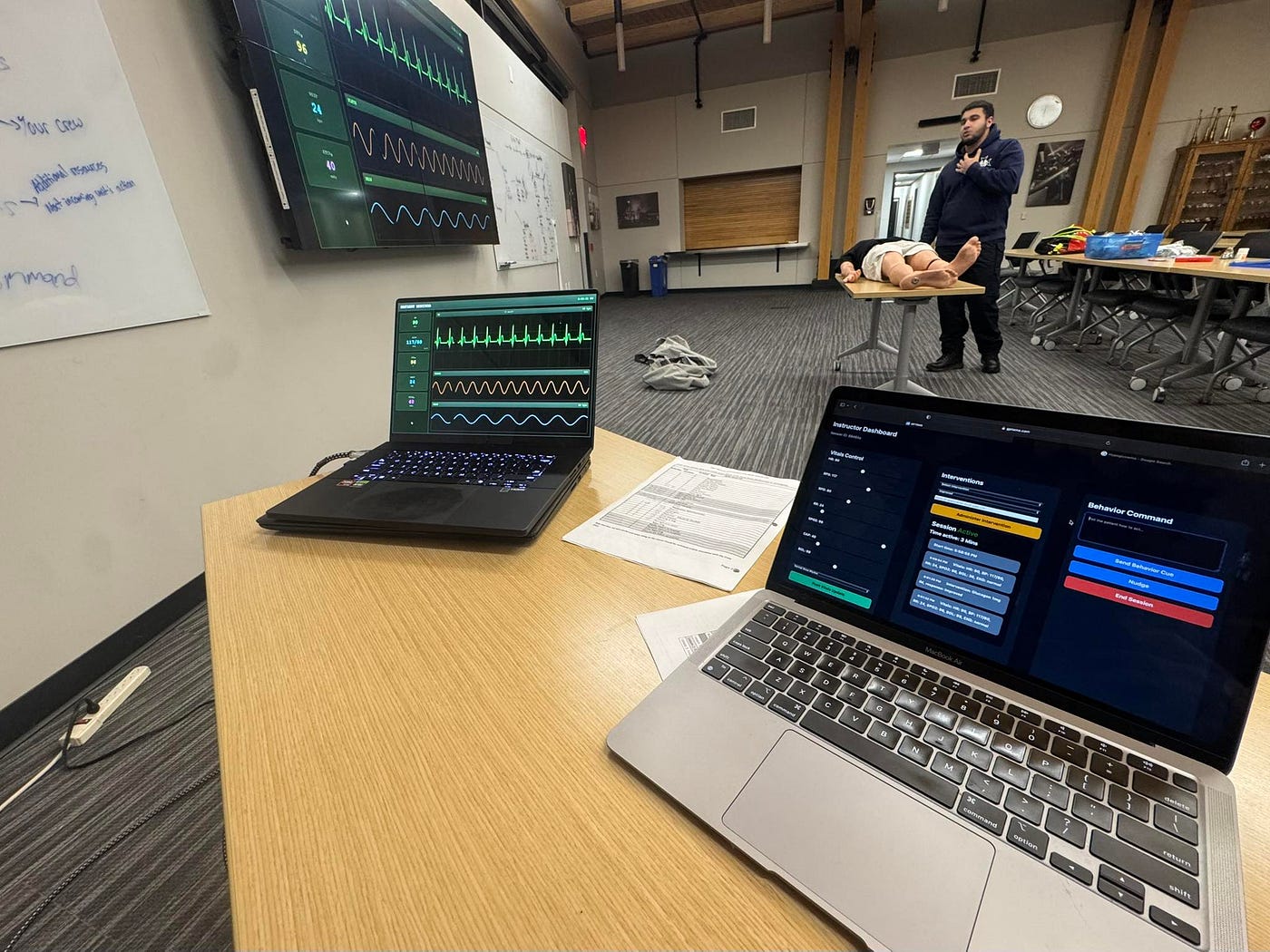
The $20,000+ Manikin vs. The Browser-Based AI Patient
Why EMS Training is Finally Getting a 21st Century Upgrade
The $10,000 Manikin vs. The Browser-Based AI Patient: Why EMS Training is Finally Getting a 21st Century Upgrade
The Scene: A Typical Tuesday Training Night
It’s 7 PM at a suburban fire department. Six EMS providers gather around a $20,000+ high-fidelity manikin that can breathe, has a pulse, and theoretically “talks” via an instructor with a walkie-talkie hidden in another room.
The scenario: 55-year-old male, chest pain.
The trainee asks: “Sir, can you tell me where the pain is?”
The instructor, trying to manage three other scenarios simultaneously, fumbles with the walkie-talkie: “Uhh… he says… it’s in his chest.”
“Is it radiating anywhere?”
“He says… to his arm.”
“On a scale of 1–10, how bad is it?”
“He says… eight.”
This isn’t training realism. This is theater. And it’s costing departments thousands while delivering questionable educational value.
The Broken Economics of EMS Training
Let’s break down the real costs:
Traditional Simulation:
- High-fidelity manikin: $8,000 — $15,000
- Annual maintenance: $1,500 — $3,000
- Instructor time: 4 hours @ $40/hour = $160
- Facility costs: $200
- Crew downtime: 6 people @ $30/hour = $720
- Total for one scenario: ~$1,080+
The Hidden Costs:
- Scheduling Nightmares: Getting crews together outside regular shifts
- Geographic Limitations: Rural departments traveling hours for training
- Limited Repetition: Each provider gets maybe 2–3 scenarios per year
- Inconsistency: Different instructors, different quality
Worst of all? The manikins don’t talk back. They don’t panic. They don’t give inconsistent histories. They don’t scream in pain or become combative. They’re dolls with LED lights.
Enter the AI Patient: What Happens When Simulation Actually Simulates
Imagine this same scenario with GPTEMS:
The trainee opens their laptop anywhere, anytime. They’re presented with:
- 55-year-old Michael, who speaks in real-time through voice AI
- Dynamic vitals that change with interventions
- Emotional responses that match the clinical picture
The conversation goes differently:
Trainee: “Michael, can you tell me where the pain is?” AI Patient: [voice strained] “It’s… right here in my chest. Feels like an elephant sitting on me.” Trainee: “Does it go anywhere else?” AI Patient: “Yeah… down my left arm. My jaw hurts too.” Trainee: “On a scale of 1–10?” AI Patient: [breathing heavily] “Nine. Maybe ten. I’m scared.”
Suddenly, we’re not checking boxes on an evaluation sheet. We’re building clinical intuition — the ability to read subtle cues, manage patient emotions while treating, and think dynamically.
The Four Revolutions Happening Right Now
1. Accessibility Revolution
- Then: Training only for departments with $15,000 budgets
- Now: Any provider with a laptop and internet
- Impact: Rural EMS and volunteer departments
2. Frequency Revolution
- Then: 2–3 scenarios per year
- Now: 2–3 scenarios per week
- Impact: Skill retention improves from 70% to 95% (based on spaced repetition research)
3. Realism Revolution
- Then: Scripted responses from an overworked instructor
- Now: Dynamic AI that remembers, reacts, and responds
- Impact: Trainees develop actual patient communication skills, not just clinical algorithms
4. Data Revolution
- Then: Subjective evaluation sheets
- Now: Objective metrics: response times, communication effectiveness, clinical accuracy
- Impact: Identify skill gaps before they become real-world errors
Case Study: Cutting Costs While Improving Outcomes
A mid-sized EMS agency with 50 providers was spending:
- Annual training budget: $54,000
- Scenarios per provider: 3/year
After implementing AI simulation theoretical:
- Annual training cost: $3,500 (15000% reduction)
- Scenarios per provider: 12/year (400% increase)
The Human Element: Why AI Doesn’t Replace Instructors — It Empowers Them
I hear the concern: “But we need human instructors!”
Absolutely. The magic happens when you combine AI scalability with human expertise.
Instructor Role Evolution:
- Before: Actor, technician, evaluator
- After: Coach, strategist, mentor
The AI handles the repetitive simulation work. The instructor focuses on:
- Debriefing and reflection
- Advanced clinical thinking
- Individualized coaching
- Curriculum development
Addressing the Elephant in the Ambulance
“But AI makes mistakes!”
So do human instructors. So do textbooks. So do real patients giving unreliable histories.
The difference? Transparent limitations.
Every GPTEMS scenario begins with: “This is a training tool. Verify all information with approved protocols and medical direction.”
We’re not replacing medical judgment. We’re creating a safe sandbox to develop it.
The Future Is Already Here (And It’s in Your Browser)
The technology exists. The need is proven. The economics are undeniable.
What’s holding us back? Mostly inertia. The “we’ve always done it this way” mentality that keeps EMS training stuck in the 1990s while every other industry evolves.
But the early adopters are seeing results:
- Departments cutting training budgets while improving outcomes
- Providers actually enjoying training again
- Measurable improvements in real-world performance
Your Department’s Choice
You have three options:
- Status Quo: Keep spending thousands on manikins that don’t talk back
- Partial Adoption: Blend traditional and AI simulation
- Full Transformation: Reimagine your entire training program around accessible, frequent, realistic simulation
Option 1 is bankruptcy by a thousand cuts. Option 3 is the future.
Option 2? That’s where most smart departments start.
The GPTEMS Waitlist: Be Part of the Change
We’re not selling a product yet. We’re building a movement.
Join our waitlist and you’ll get:
- First to get access to GPTEMS
- Influence on feature development
- Access to our community of forward-thinking EMS educators
More importantly, you’ll be part of fixing a broken system. You’ll help shape the future of how 1.2 million EMS providers in the US alone train for the moments that matter most.
The 20,000+ manikins had their day. The AI patients are here to stay.
Join the waitlist today: https://gptems.com
메타데이터
- post_id
- 8bc9aa3f60a2
- slug
- the-20-000-manikin-vs-the-browser-based-ai-patient-8bc9aa3f60a2
- url
- https://medium.com/@GPTEMS/the-20-000-manikin-vs-the-browser-based-ai-patient-8bc9aa3f60a2
- canonical_url
- https://medium.com/@GPTEMS/the-20-000-manikin-vs-the-browser-based-ai-patient-8bc9aa3f60a2
- author_url
- https://medium.com/@GPTEMS
- status
- ok
- fetched_at
- 2026-06-10 12:26:30